

You’re a PGY‑1 or early PGY‑2. It’s 10:30 p.m. You just finished sign‑out, you’re half‑listening to a cross‑cover question, and your upper casually says, “So… what are you thinking for fellowship?”
You mumble something vague about “maybe cards or GI, not sure yet.” They nod. “You need to figure that out this year. Timelines creep up.”
They’re right. They do.
Here’s the truth: by the time you click “Certify” on ERAS for fellowship, the decision to subspecialize is already months—sometimes years—in the making. If you treat fellowship like a last‑minute PGY‑3 project, you will be behind. Sometimes fatally behind.
Let’s walk through this from first interest to signed contract, step‑by‑step, month‑by‑month.
Big Picture: The Multi‑Year Fellowship Timeline
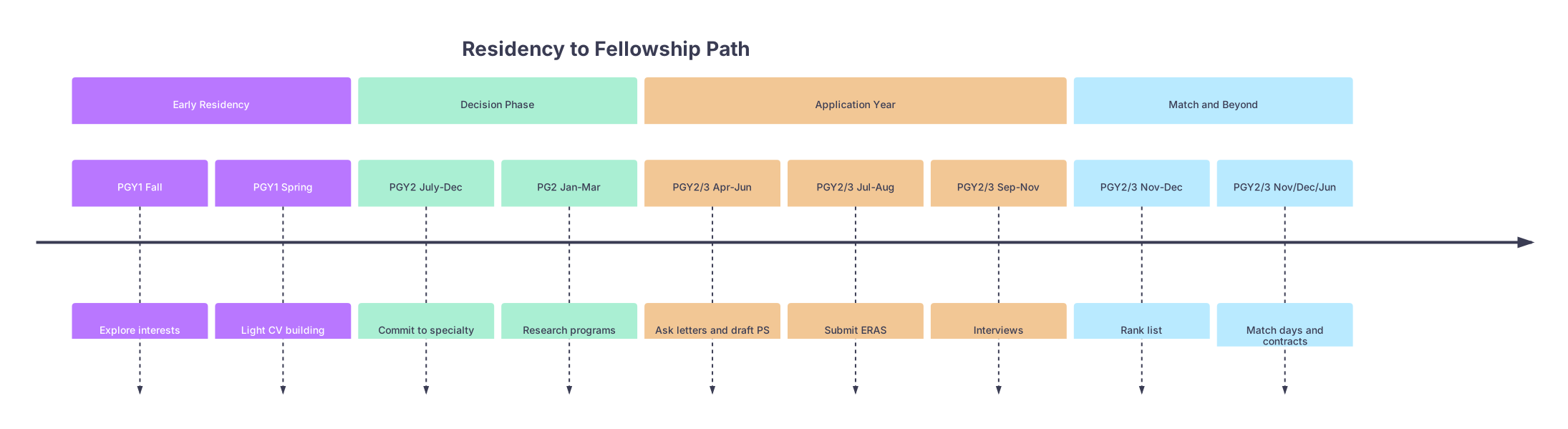
| Period | Event |
|---|---|
| Early Residency - PGY1 Fall | Explore interests |
| Early Residency - PGY1 Spring | Light CV building |
| Decision Phase - PGY2 July-Dec | Commit to specialty |
| Decision Phase - PG2 Jan-Mar | Research programs |
| Application Year - PGY2/3 Apr-Jun | Ask letters and draft PS |
| Application Year - PGY2/3 Jul-Aug | Submit ERAS |
| Application Year - PGY2/3 Sep-Nov | Interviews |
| Match and Beyond - PGY2/3 Nov-Dec | Rank list |
| Match and Beyond - PGY2/3 Nov/Dec/Jun | Match days and contracts |
Different specialties have different match cycles:
| Fellowship Type | Match System | Application Opens* | Match Month** |
|---|---|---|---|
| Cardiology (IM) | NRMP | Late Nov–Dec | Nov (prior yr) |
| GI (IM) | NRMP | Late Nov–Dec | Nov |
| Pulm/CC, Heme/Onc | NRMP | Late Nov–Dec | Nov |
| Nephrology, Endo | NRMP | Late Nov–Dec | Nov |
| Surgical fellowships | Mixed (SF/NRMP/independent) | Varies | Varies |
| EM fellowships | Many use ERAS/NRMP | Varies | Varies |
* “Application Opens” = first ERAS token/program side
** Match month for many IM subspecialties is November of PGY‑3 for categorical residents (so you’re applying ~18–21 months before fellowship start).
Do not obsess over the exact dates right now. They shift slightly each year. What matters is the relative timeline: what you should be doing when.
PGY‑1: From Curiosity to Direction
July–December PGY‑1: Pure Exploration, Zero Panic
At this point you should:
- Stop pretending you “have no idea” forever.
- Start noticing what actually energizes you.
On service:
- Pay attention on rotations:
- On cards: Do you find yourself staying late to watch caths or TEE?
- On heme/onc: Do family meetings drain you or fulfill you?
- On MICU: Do you like managing vents or dread it?
- Note your own behavior:
- What notes do you write fastest?
- Which consults do you secretly enjoy?
Very minimal “career tasks” now:
- Ask seniors what they’re doing for fellowship—just to map the terrain.
- Attend 1–2 divisional conferences per area you might like:
- Cardiology grand rounds
- Tumor board
- Pulm case conference
No, you do not need a project yet. No, you do not need to email the program director. If someone tells you “you’re already behind” as an intern in October, they’re either misinformed or flexing.
January–June PGY‑1: Gentle Positioning
By now, you probably have 1–3 realistic interests. At this point you should narrow, not finalize.
Do the following:
Identify likely top 1–2 fields
- “Probably cards vs pulm.”
- “Maybe GI vs heme/onc.”
-
- Ask fellows: “Is there a case report, QI, or retrospective project I can help with?”
- Your goal is one thing that can eventually produce:
- A poster, OR
- A talk, OR
- A line on your CV that is not embarrassing.
Find one informal mentor in each maybe‑field
- Fellow, junior faculty, or senior resident is fine.
- 20‑minute coffee chat. Ask:
- How competitive is this fellowship right now?
- What do strong applicants from our program look like?
- When should I get serious?
By the end of PGY‑1, you should not be fully decided—but you should have:
- 1–2 likely directions.
- One tiny research or QI effort started.
- Names of a couple of people you can email without anxiety.
PGY‑2: Decision and Positioning Year
This is where people either set themselves up well or scramble late.
July–December PGY‑2: Commit and Build
By early PGY‑2, you should commit to a primary field.
Not 3. Not “we’ll see.” One.
If you are truly torn between two very different fields (e.g., cardiology vs palliative), then:
- Pick the more competitive one as your “official” track.
- Keep the other warm by attending occasional conferences and staying in touch with one mentor there.
At this point you should:
Secure a main mentor in your chosen field
- Preferably faculty with a track record of successful fellows.
- Email with clarity:
- Brief intro.
- Clear interest in that subspecialty.
- Ask for 20–30 minute meeting.
Clarify your competitiveness Ask your mentor directly:
- Are my evaluations, exam scores, and letters on track for this field?
- What do I need in:
- Research?
- Leadership/teaching?
- Networking?
Grow your portfolio strategically
- Finish or advance at least one project in your chosen specialty.
- Try to present something by late PGY‑2/early PGY‑3:
- Local poster
- Regional meeting
- Journal club with real prep
This is also a good time to aim for:
- Chief resident interest (if that fits your goals).
- Teaching roles: morning report, med student small groups.
January–March PGY‑2: Look Outward – Programs and Paths
Now your focus widens from “What do I want?” to “Where can I get it?”
At this point you should:
Learn the training structures
- 2‑ vs 3‑year cards tracks, research‑heavy onc vs clinically heavy, combined Pulm/CC vs separate Pulm only.
- Ask recent fellows where they matched and what they liked.
Rough‑draft your target tiers Create a raw list (not final) of:
- Dream programs (e.g., MGH cards, MD Anderson heme/onc).
- Realistic matches.
- Safety options that still fit your life goals (geography, lifestyle).
Assess your gaps Brutally:
- Research weak?
- No leadership or teaching?
- Awkward evaluations from PGY‑1?
Fix what you can now, not in July when LORs are due.
The Application Year: Month‑by‑Month
For most IM‑based fellowships, the core application year straddles late PGY‑2 and early PGY‑3. For surgical and EM subspecialties, shift this logic one year earlier or later as your specialty demands, but the sequencing holds.
April–June (Spring before Applications Open)
Application season is coming. This is where people either prepare or deny reality.
At this point you should:
Choose your letter writers You usually need:
- Program director
- One or two subspecialty faculty in your chosen field
- Possibly one additional general IM or research letter
Approach them now, even if ERAS is not open yet.
Lock down clinical rotations that help
- Try to schedule:
- An away elective or in‑house subspecialty block with big‑name faculty.
- ICU time if relevant.
- If your schedule is fixed, talk to the chief or scheduling office about strategic swaps—early, not two weeks before block start.
- Try to schedule:
Start your personal statement skeleton Not polished. Just:
- Why this field?
- What experiences define your interest?
- What do you want from fellowship?
You should have a rough, ugly draft by the end of this window.
Clean your CV
- Standardize dates and formatting.
- Make sure every project has:
- Clear role (first author, co‑author).
- Status (submitted, accepted, presented).
July–August: ERAS Season and Submission
Most IM subspecialty ERAS applications go live early summer, with programs downloading and reviewing in late summer.
At this point you should:
Finalize and send your personal statement Timeline:
- Early July: Full draft done.
- Mid‑July: Feedback from mentor or PD.
- Late July: Final version locked.
Do not be revising this in September.
Confirm all letters of recommendation
- Check ERAS weekly.
- If a letter is missing by the agreed date, send a short, respectful reminder.
- Have one backup letter ready if someone falls through.
Submit your application on the early side I recommend: submit within the first 1–2 weeks after programs can start viewing applications.
Late September submissions are a bad idea in competitive fields.
Draft your program list sanity‑checked by a mentor Have someone experienced look at your distribution of programs. If you are an average applicant applying to only three top‑tier fellowships “because I like the cities,” that is application malpractice.
Interview Season: September–November
Once interviews start dropping, the game shifts to time management, performance, and reading subtext.
September: Invitation Wave 1
At this point you should:
Open every fellowship‑related email immediately
- Many invites are first‑come, first‑served.
- Some programs send invites at predictable times (e.g., 8 a.m. local); ask seniors from your program what they saw.
Book dates strategically Prioritize:
- Top‑choice programs first (allows rescheduling if needed).
- Avoid stacking 4–5 interviews in one week if you are also on wards or ICU. You will be incoherent.
Start basic interview prep At minimum:
- 3–5 solid patient stories in your chosen field.
- 1–2 examples of:
- Handling conflict.
- Teaching a learner.
- A time you failed and what changed.
Do a mock interview with a senior or mentor if you can. They will catch your bad habits faster than any guide.
October: The Grind
In October, you are juggling full‑time residency plus interviews. This is where people start to show cracks.
At this point you should:
Refine your narrative After 2–3 interviews you will notice which answers feel clumsy. Fix them. Do not give the same awkward ramble 15 times.
Track your impressions immediately after each interview Make a simple table or doc for each program:
- Gut feeling (1–10).
- Strengths (training, research, vibe).
- Red flags (fellow burnout, vague curriculum).
- Geography/family logistics.
You will not remember these accurately later.
Stay functional on service Program leadership will often informally ask attendings, “How is she doing during interviews?” This is not the month to let your floor work collapse.
November: Final Interviews and Ranking Thoughts
Interviews start slowing down. You move into synthesis mode.
At this point you should:
Stop chasing phantom late invites Yes, a few late invites appear. But if you spend all November obsessively refreshing email instead of reflecting on what you saw, you miss the point.
Start rough ranking Not the formal rank list yet. But:
- Top 3–5 you would be genuinely excited about.
- Middling but acceptable programs.
- Programs you would attend only if absolutely necessary.
Ranking and Match: November–December (and Beyond)
Exact NRMP deadlines change yearly, but generally:
- Rank order lists due late November / early December.
- Match day early December (for many IM subspecialties).
Pre‑Rank Deadline: Clarify and Commit
At this point you should:
Revisit your priorities Ask yourself, in order:
- Training quality (procedures, autonomy, case mix).
- Research/academic support if you care about academics.
- Geography and support system.
- Vibe and culture (how fellows talk when faculty are not around).
If you are ranking a program higher only because of its name while everything else felt off, be honest about that gamble.
Email your top program (maybe) The “love letter” to your true #1 is often overdone and frequently ignored. My stance:
- If you truly have a clear #1:
- One concise, honest note to the PD indicating strong interest is fine.
- Do not tell multiple programs they are your “top choice.” That behavior circulates and makes you look unserious.
- If you truly have a clear #1:
Match Day and After: Contracts and Reality
Match hits. You either:
- Matched where you wanted.
- Matched somewhere acceptable.
- Did not match.
Each path has its own timeline.
If You Matched
At this point you should:
Review the contract carefully Pay attention to:
- Salary and benefits.
- Moonlighting rules.
- Non‑compete or restrictive covenants (yes, some fellowships include them).
- Call schedule structure.
Clarify any pre‑fellowship expectations
- Do they expect you to do pre‑fellowship research blocks?
- Visa issues if you are an IMG.
Tell your own program leadership early They may need your match outcome for scheduling, letters, and institutional bragging rights.
If You Did Not Match
Brutal, but survivable. I have watched good residents land well the second time.
At this point you should:
Meet with your PD and subspecialty mentor within 1–2 weeks Get a frank read on:
- What was weak in your application.
- Whether a re‑application is realistic and under what conditions.
Decide: re‑apply vs pivot Re‑applying makes sense when:
- You were close (some interviews, but no match).
- There is a clear fix (better letters, more concrete research).
Pivoting (hospitalist, different field, non‑clinical path) is not failure. It is strategy.
Map the corrective year
- Extra research year?
- Chief resident role?
- Stronger ICU or subspecialty rotations with new letter writers?
Managing the Emotional Load Along the Way
Quick reality check. This entire process unfolds:
- While you are doing 70‑hour weeks.
- While your friends outside medicine are posting about vacations.
- While you are thinking about loans, burnout, maybe starting a family.
The timeline is not just logistical. It is psychological.
To survive it:
- Build one small peer group also applying to fellowship—shared information and venting matters.
- Set hard boundaries about when you will not touch fellowship tasks (e.g., post‑call, or one afternoon a week).
- Accept that you will not optimize every detail. Good enough, on time, beats perfect and late.
What You Can Do Today
You’re somewhere on this path right now.
Do one concrete thing before you scroll away:
Add three bullets:
- Your current PGY level and likely fellowship interest.
- The month and year you will likely submit your fellowship application.
- The next three actions you need to take (e.g., “email Dr. X about a project,” “schedule meeting with PD,” “draft personal statement outline”).
That document becomes your anchor. You update it as you move from “first interest” to “signed contract.”


