
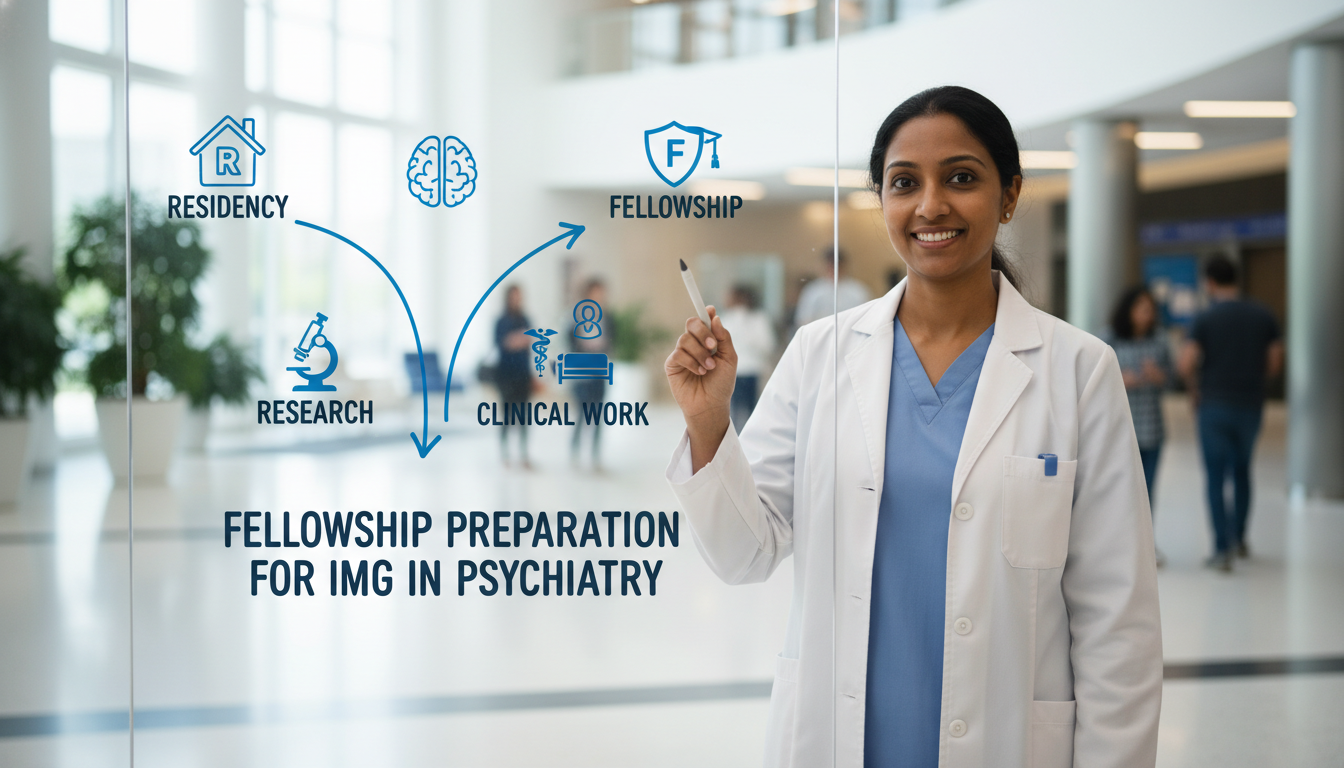
International medical graduates (IMGs) in psychiatry often think seriously about subspecialty training early in residency. Yet the pathway from intern to fellow can feel confusing, especially in a new country, new system, and often a new language and culture. This IMG residency guide focuses on fellowship preparation—how to position yourself from day one of psychiatry residency so that competitive U.S. fellowships are realistic, not just aspirational.
Understanding the Fellowship Landscape in Psychiatry for IMGs
Before planning how to get fellowship, you need a clear overview of what’s available, how competitive it is, and what matters most for the psych match at the fellowship level.
Common Psychiatry Fellowships in the U.S.
Most psychiatry fellowships are 1-year ACGME-accredited programs (some have 2+ year tracks or research components). Major categories include:
- Child and Adolescent Psychiatry (CAP)
- Addiction Psychiatry
- Geriatric Psychiatry
- Consultation-Liaison (C-L) Psychiatry
- Forensic Psychiatry
- Sleep Medicine (shared with multiple specialties)
- Pain Medicine (multidisciplinary)
- Neuropsychiatry / Behavioral Neurology (various structures)
- Psychosomatic / integrated care programs
- Research fellowships (T32 or institutional research tracks)
- Non-ACGME fellowships (e.g., women’s mental health, reproductive psychiatry, public psychiatry, early psychosis)
For IMGs, the “IMG-friendliness” and visa policies of a program can be as important as prestige or location.
How Competitive Are Psychiatry Fellowships?
Compared with some surgical or procedural subspecialties, many psychiatry fellowships are relatively accessible—but this varies:
More competitive for IMGs:
- Child and Adolescent Psychiatry (at top-tier academic centers)
- Forensic Psychiatry (at marquee institutions)
- Research-heavy or T32-funded tracks
- High-prestige programs in major cities (Boston, NYC, San Francisco)
Moderately competitive:
- Addiction Psychiatry
- Consultation-Liaison Psychiatry
- Geriatric Psychiatry (academic centers)
Often more accessible options:
- Community-based CAP or Addiction/Geriatric programs
- Regional or state programs with strong clinical focus
- Some non-ACGME fellowships
Competitiveness is not only about exam scores; it’s about fit and evidence of sustained interest in the subspecialty.
Key Factors Fellowship Programs Consider
For an international medical graduate, selection criteria are similar to U.S. grads but with added scrutiny on training background and visa status:
Residency performance
- Clinical evaluations, rotation feedback
- In-service exam scores (PRITE)
- Professionalism and reliability
Evidence of subspecialty interest
- Electives in that subspecialty
- Research projects, QI work, scholarly presentations
- Longitudinal clinical experiences (e.g., CAP continuity clinic)
Letters of recommendation
- From subspecialty faculty
- Ideally including the fellowship program director if applying internally
Academic / scholarly output
- Posters, oral presentations, publications
- Case reports or clinical vignettes in the relevant subspecialty
Interpersonal skills & cultural fit
- Interview performance
- Teamwork, communication, insight into one’s limitations
Visa and licensing
- J-1 vs H-1B implications for future jobs
- ECFMG certification and state licensing progress
Understanding these levers early will shape how you spend your time during residency.
Year-by-Year Roadmap: From PGY-1 to Fellowship Application
The fellowship application timeline is shorter than many IMGs expect. For some psychiatry fellowships—especially Child and Adolescent Psychiatry—you may apply as early as PGY-2 for a “fast-track” entry. Planning ahead is essential.

PGY-1: Laying the Foundation
Primary goals:
- Prove you are a dependable, teachable resident.
- Learn the U.S. health system and psychiatric practice patterns.
- Begin light exploration of subspecialty interests.
Action steps:
Master fundamentals of clinical care
- Prioritize being organized, on time, and prepared.
- Develop strong documentation, risk assessment, and communication skills.
- Ask for feedback early and act on it.
Observe and sample subspecialties
- During inpatient and outpatient rotations, pay attention to:
- Complex consults (C-L exposure)
- Pediatric and geriatric patients
- Legal/forensic issues
- Patients with addiction and co-occurring disorders
- Keep a simple “interest journal” where you note:
- What types of cases you find energizing
- Which mentors you connect with
- During inpatient and outpatient rotations, pay attention to:
Start building relationships
- Introduce yourself to fellowship directors and subspecialty faculty:
- “I’m new and just exploring different areas; I’d love to sit in on a clinic or ask you about your career path.”
- Attend subspecialty conferences or journal clubs when possible.
- Introduce yourself to fellowship directors and subspecialty faculty:
Light scholarly engagement
- Volunteer for simple projects:
- Case reports
- Retrospective chart reviews
- Assistance with a faculty’s ongoing QI project
- Focus on learning the process rather than producing immediate publications.
- Volunteer for simple projects:
Common PGY-1 mistake for IMGs:
Trying to over-focus on research or fellowship branding while neglecting basic clinical performance. Poor early evaluations are difficult to overcome, even with strong later achievements.
PGY-2: Clarifying Direction and Building a Track Record
By mid-PGY-2, you should have a clearer idea of core interests and potential fellowship paths.
Primary goals:
- Narrow to 1–2 likely fellowship interests.
- Start dedicated work in that area (clinical + academic).
- Identify 2–3 mentors who can eventually write strong letters.
Action steps:
Select a working subspecialty interest
- You can still adjust later, but choose a provisional focus:
- Example: Addiction, CAP, C-L, Forensic, Geriatric.
- Discuss with your program director to align rotations and electives.
- You can still adjust later, but choose a provisional focus:
Strategic elective planning
- Request at least one elective directly related to your target fellowship.
- Use this elective to:
- Demonstrate reliability and advanced curiosity.
- Ask for concrete responsibilities (e.g., leading a case conference, helping with a small study).
- Keep a portfolio of experiences: notable cases, presentations, teaching sessions.
Deepen scholarly activity
- Aim for at least one of the following:
- Poster at a national or regional meeting (APA, AACAP, AAPL, AAAP, AGS, ACLP).
- Small original project or QI initiative with presentable outcome.
- Co-author a case report or brief review article.
- For IMGs, these activities show not only interest but also ability to work within U.S. academic culture.
- Aim for at least one of the following:
Strengthen relationships with potential letter writers
- Regularly ask for formative feedback:
- “What could I do differently to function at a fellow level?”
- Offer to help them with tasks that matter (lectures, protocols, teaching sessions).
- Let them see your growth over time.
- Regularly ask for formative feedback:
Prepare for in-service exams (PRITE)
- Strong PRITE scores can reassure fellowship committees about your knowledge base.
- Study systematically, not just before the exam; use question banks and reading plans.
For fast-track CAP candidates
You may be applying to child and adolescent psychiatry during PGY-2. That means:
- Start CAP exposure in PGY-1 (if possible).
- Secure at least one strong CAP faculty mentor by early PGY-2.
- Have a polished CV and draft personal statement by mid-PGY-2.
PGY-3: Positioning Yourself as a Future Fellow
In many programs, PGY-3 is the time of heaviest outpatient and subspecialty exposure—ideal for proving you’re ready for advanced training.
Primary goals:
- Demonstrate sustained commitment and growing expertise.
- Finalize your target fellowship area.
- Prepare a strong fellowship application package.
Action steps:
Maximize subspecialty visibility
- Do at least one advanced or “sub-sub-specialty” elective in your chosen field:
- For example, C-L psychiatry in oncology, reproductive psychiatry in women’s mental health, or geriatric psychiatry in memory disorders clinic.
- If your program lacks your niche interest, arrange an away elective (visiting rotation) if feasible.
- Do at least one advanced or “sub-sub-specialty” elective in your chosen field:
Lead small projects and teaching
- Lead case conferences or journal clubs related to your area.
- Teach interns or medical students; ask for formal teaching evaluations.
- Take ownership of a scholarly project:
- Lead author on a poster
- First draft of a manuscript
- Development of an educational curriculum
Refine your academic profile
- Curate your CV to highlight:
- Subspecialty-specific activities (research, presentations, electives).
- Leadership roles (chief roles, committees, interest groups).
- Update your ERAS profile (if using ERAS for fellowship) with accurate dates, responsibilities, and outcomes.
- Curate your CV to highlight:
Prepare application materials early
- Personal Statement:
- Tell a coherent story linking your background as an international medical graduate, your clinical experiences, and your passion for the subspecialty.
- Avoid generic language like “I have always wanted to help people”; use specific clinical moments, mentors, and projects.
- Letters of Recommendation:
- Ask 2–3 subspecialty faculty by late spring/summer of PGY-3.
- Provide them with:
- Updated CV
- Draft personal statement
- Summary of your work with them (cases, projects, strengths)
- Program List:
- Create a spreadsheet of potential programs with:
- Visa policies (J-1/H-1B/US citizen/green card)
- Number of IMG fellows historically
- Research opportunities vs clinical focus
- Geographic and lifestyle factors
- Create a spreadsheet of potential programs with:
- Personal Statement:
Understand the fellowship application timeline
- Some psychiatry fellowships use ERAS and NRMP; others use non-ERAS systems with independent timelines.
- Typical sequence (may vary by subspecialty):
- Application opens: late PGY-3
- Interviews: late PGY-3 to early PGY-4
- Rank lists / offers: PGY-4
- Check each subspecialty’s professional organization (e.g., AACAP, AAAP, ACLP) for the current recommended timeline.
PGY-4: Executing the Plan and Transitioning to Fellow
PGY-4 should be a year of consolidation and leadership while you finalize your fellowship path.
Primary goals:
- Perform strongly in interviews.
- Explore backup plans and career flexibility.
- Prepare for the transition from resident to fellow.
Action steps:
Interview preparation
- Common fellowship interview questions for IMGs:
- “How has your international background shaped your approach to psychiatry?”
- “Why this subspecialty, and why now?”
- “Tell us about a challenging case and what you learned.”
- “What are your long-term career goals after fellowship?”
- Practice with:
- Program leadership or trusted faculty
- Fellow residents who have matched into fellowships
- Prepare thoughtful questions to ask programs:
- Visa support and institutional experience with IMGs
- Balance of clinical vs research time
- Formal mentorship structures
- Graduates’ job placements
- Common fellowship interview questions for IMGs:
Parallel planning
- Even if you are highly competitive, always plan alternatives:
- General psychiatry attending position (with optional later fellowship)
- Non-ACGME or research fellowships
- Additional clinical training or academic roles in your area of interest
- For J-1 IMGs:
- Consider how fellowship timing will affect the 2-year home requirement and waiver options.
- For H-1B-eligible IMGs:
- Confirm whether your desired fellowship sponsors H-1B; many only sponsor J-1.
- Even if you are highly competitive, always plan alternatives:
Leadership and mentorship
- Use PGY-4 to step into leadership positions:
- Chief resident roles
- Committee membership (e.g., graduate medical education, DEI, wellness)
- Mentor junior residents and medical students, especially other IMGs. This reflects well in letters and in interviews.
- Use PGY-4 to step into leadership positions:
Licensing and exams
- Ensure all USMLE steps are done (or COMLEX, if applicable).
- Begin state licensure process if needed prior to fellowship, depending on state and program requirements.
- Take board preparation seriously; strong psychiatry board performance is reassuring to fellowship programs and future employers.
Strategic Considerations Specific to IMGs
Being an international medical graduate adds layers of complexity to fellowship planning—but also unique strengths.

Visa and Immigration Realities
Visa status shapes the “how to get fellowship” question in very practical ways.
J-1 visa
- Most common route for IMGs in residency.
- Many fellowships readily accept J-1 candidates.
- After fellowship, you face the 2-year home residence requirement unless you secure a J-1 waiver (e.g., Conrad 30, VA, academic waiver).
- Planning:
- Consider fellowships located in states where J-1 waiver jobs are more available.
- Use fellowship years to network with potential post-fellowship employers in underserved areas.
H-1B visa
- Less common but sometimes available for residency and fellowship.
- Some fellowships do not sponsor H-1B due to cost/complexity.
- Planning:
- Verify H-1B sponsorship early in your program list building.
- Be prepared for additional documentation and timing challenges.
Permanent residency/other statuses
- If you have or expect to get a green card, fellowship options widen considerably.
- You can prioritize fit, quality, and long-term academic positioning more freely.
Leveraging Your International Background
Your background is not just a hurdle; it’s a strength—if you learn to present it effectively.
Cultural competence:
Experience understanding different health beliefs, stigma, and family dynamics is invaluable in psychiatry.Language skills:
Being bilingual or multilingual is a major asset, especially in public psychiatry, CAP, addiction, and C-L settings.Resilience narrative:
Navigating a new system, licensing exams, and immigration complexities speaks to perseverance and adaptability.
In your personal statement and interviews, frame your IMG identity as a value-add for patient care, teaching, and systems-level thinking.
Common Pitfalls for IMGs—and How to Avoid Them
Waiting too long to plan
- Starting fellowship preparation in late PGY-3 is often too late, especially for competitive subspecialties.
Underestimating networking
- Many IMGs assume merit alone will speak. In reality, faculty advocacy and informal reputation are critical.
Limited scholarly footprint
- You don’t need multiple first-author papers, but a complete absence of scholarly activity can hurt you, especially for academic fellowships.
Ignoring visa realities until late
- You may fall in love with a program that cannot sponsor your visa—avoid heartbreak by checking early.
Poor communication skills or lack of self-awareness
- Fellowship directors need fellows who function almost like junior faculty. Show insight into your strengths and growth areas, and demonstrate openness to supervision.
Choosing the Right Fellowship for Your Long-Term Goals
Fellowship is just one bridge in your career, not the destination. Think beyond the title of “fellow” toward your 10-year plan.
Clarify Your Long-Term Vision
Ask yourself:
- Do I want an academic career (teaching, research, leadership)?
- Am I more drawn to clinical excellence and high-volume patient care?
- Do I see myself in a specific population (children, older adults, people with addictions, legal settings)?
- How important are:
- Work-life balance
- Geographic location
- Financial considerations
- Opportunities for advocacy or policy work
Your answers will shape which fellowships and which types of programs are best.
Academic vs. Community vs. Hybrid Programs
Academic centers:
- Stronger for research and teaching.
- Often more competitive.
- Better for those preparing for fellowship and possibly later subspecialty leadership.
Community or regional programs:
- High clinical volume and practical skills.
- Can be more welcoming to IMGs.
- Great if your main goal is robust clinical training and a specific practice niche.
Hybrid or university-affiliated community programs:
- Blend of clinical exposure and academic opportunities.
- Often good choices for IMGs seeking balance.
Internal vs External Fellowships
Internal fellowship (same institution as residency):
- Familiar faculty, easier letters, known performance record.
- Sometimes less competitive for well-regarded internal candidates.
External fellowship (different institution):
- Expands network and diversity of training.
- Useful if your residency has limited exposure in your desired subspecialty.
- May offer higher prestige or particular niche expertise.
For many IMGs, a strategy of applying both internally and externally maximizes chances and flexibility.
Practical Checklist: Fellowship Preparation for IMG Psychiatry Residents
Use this as a quick IMG residency guide for fellowship-focused planning:
PGY-1
- Learn U.S. clinical and communication norms.
- Informally explore multiple subspecialties.
- Meet at least 2–3 potential mentors.
- Participate in a small scholarly or QI project if possible.
PGY-2
- Choose 1–2 target fellowship areas.
- Schedule at least one elective in your top area.
- Start subspecialty-specific scholarly work (poster, case report, etc.).
- Improve PRITE performance with structured study.
- Begin tracking fellowship programs and visa policies.
PGY-3
- Confirm primary fellowship target.
- Take advanced electives or away rotations if needed.
- Lead at least one project, presentation, or teaching activity.
- Finalize CV and begin drafting personal statement.
- Request letters from subspecialty faculty with enough lead time.
- Understand and follow the fellowship application timeline for your subspecialty.
PGY-4
- Practice interview skills with a focus on your IMG story and subspecialty passion.
- Maintain strong clinical performance and leadership roles.
- Consider backup plans and geographic/visa constraints.
- Begin planning post-fellowship employment and immigration steps.
FAQ: Fellowship Preparation for IMGs in Psychiatry
1. Do I really need a fellowship to have a good career in psychiatry as an IMG?
No. Many international medical graduates have excellent, satisfying careers as general psychiatrists. Fellowship is most valuable if:
- You want specialized clinical expertise (e.g., CAP, addiction, forensic).
- You aim for an academic or research-focused career.
- You want to stand out in a competitive job market or region.
However, fellowship can open doors—especially in academic centers and certain subspecialty-focused jobs.
2. How much research do I need to match into a psychiatry fellowship?
There is no fixed requirement. For most clinically focused fellowships, you do not need multiple first-author publications. What matters is evidence of:
- Sustained interest in the subspecialty.
- Ability to complete scholarly work (e.g., at least one poster, case report, or small study).
- Engagement in QI or educational projects.
Highly academic or research track fellowships expect more: ongoing research involvement, presentations, and ideally at least one publication.
3. As an IMG, should I prioritize prestige or visa-friendliness when choosing fellowships?
You need both feasibility and alignment with your goals. In practice:
- First filter: Programs that reliably support your visa type and have trained IMGs before.
- Next filter: Within that group, prioritize:
- Training quality
- Fit with your long-term career vision (academic vs clinical)
- Mentorship and support culture
A moderately prestigious but highly supportive, IMG-friendly program is often better than a top-name institution that cannot sponsor your visa or where IMGs rarely succeed.
4. Can I decide on fellowship late in residency, or do I have to know from PGY-1?
You don’t need to know your subspecialty from day one, but earlier clarity helps. Many IMGs successfully decide in PGY-2 and still build a competitive profile. Deciding very late (end of PGY-3 or PGY-4) limits your options, especially for competitive fields and research-heavy fellowships.
If you’re unsure, focus early on:
- Exploring diverse clinical settings.
- Building general academic capital (posters, teaching, QI).
- Maintaining strong relationships with faculty who can advocate for you once you decide.
Fellowship preparation as an international medical graduate in psychiatry is not about perfectly following a rigid path—it’s about strategically using each year of residency to build a coherent narrative of who you are, what you care about, and how additional subspecialty training will help you serve patients and the profession. With early planning, honest mentorship, and realistic attention to visa and system realities, fellowship can be an achievable and powerful next step in your psychiatric career.


