

The hidden weight of your residency program’s reputation is bigger than anyone admits to you as an intern.
Not just “does your program have a name.” I mean: how your residents are perceived in the wild. At national meetings. In fellowship group chats. In late‑night ranking meetings when the chair says, “Remind me… how have we done with people from that place?”
Let me walk you through what really happens on the other side of the fellowship application—and how your residency’s reputation quietly rewrites your odds before anyone even reads your personal statement.
What “Reputation” Actually Means to Fellowship Programs
Everyone throws around “program reputation” like it’s this vague mystical thing. It’s not. On the selection side, it breaks down into a handful of brutally practical questions.
When faculty sit in the conference room with a pile of ERAS applications, they’re not asking, “Is this a top‑10 residency?” They’re asking:
- If we take this person, will they survive and thrive in our fellowship?
- Have residents from their program done well for us in the past—or burned us?
- Do we trust their letters? Do we know what “strong” means from that program?
- Is this program known for over‑inflated grades? Easy rotations? Or serious training?
- Does the PD there send us people who match how they’re described?
That’s “reputation.”
And there are layers to it.
At some programs, faculty will literally say during ranking:
“I’m a little nervous about taking another one from [X residency]. The last two we had were overwhelmed. Let’s drop them a few spots.”
Or the opposite:
“She’s from [Y residency]? Their people crush it here. Bump her up.”
You never see that. But it happens every year.
The Three Levels of Residency Reputation That Matter
People think “big name versus community.” That’s only the top layer. The reality is more nuanced. On selection committees we end up talking about:
1. Macro‑Reputation: National Name Recognition
This is the obvious one: big university names, top‑tier academic hospitals, the “brand names” of each specialty.
Put bluntly: yes, it matters. A cardiology fellowship knows that a strong resident from MGH, Duke, Brigham, UCSF, Michigan, Baylor, etc. has already been battle‑tested in a high‑volume, high‑acuity environment with research infrastructure. There’s a baseline assumption: “If they didn’t drown there, they won’t drown here.”
But here’s the part nobody tells you: the macro‑reputation mostly sets the floor of what they’re willing to believe about you, not the ceiling of how high you can go.
From a top‑tier residency, a good but not spectacular application may still get the interview because the program’s name buys you trust. From an unknown or mid‑tier place, you often need a spikier application—publications, strong Step 2, killer letters—to get to the same pile.
Is that fair? No. Is it real? Absolutely.
2. Meso‑Reputation: Specialty‑Specific Standing
This is where a lot of residents get blindsided.
Your internal medicine residency might be unknown nationally, but inside cardiology, GI, or heme/onc circles, it can have a very clear reputation. Same for surgery with surg‑onc, vascular, CT. Same for EM with critical care or tox. And sometimes that specialty‑specific reputation is better than the overall brand.
I’ve watched selection committees say, “I’ve never heard of that IM program,” and then the cardiology PD chimes in:
“Oh, actually, they do a great job with cardiac pathology. We’ve had two fellows from there; both were excellent. That program trains their people hard.”
That one comment changes how the entire group reads every future application from that residency.
Conversely, there are prestigious flagships where the subspecialty exposure is thin, the call is cushy, or the residents are very protected. In certain fellowships, those residents are seen as less “hungry” or under‑seasoned procedurally, even though the logo is shiny.
3. Micro‑Reputation: Your Program’s Track Record with That Fellowship
This is the most underrated piece—and the one you feel most directly.
Fellowship programs absolutely keep a mental ledger of individual residencies:
- How did their last fellow from your program perform?
- Did they show up prepared? Needed hand‑holding? Stir drama? Burn out?
- Did they finish projects? Did they match into competitive jobs afterward?
- Did the LORs match reality?
If a residency sends them a fellow who arrives as advertised, gets along with the team, and graduates strong, that residency’s next applicant gets an invisible boost.
If your predecessor was a diva, chronically late, or flagrantly underprepared? You’re starting the race 10 yards behind before your file is even opened.
No one writes this in emails. It’s body language in the ranking meeting. It’s “We should be careful with [that program]” mumbled over coffee.
How This Plays Out in Real Fellowship Selection Rooms
Let me walk you through a real dynamic from a GI fellowship selection meeting I sat in on.
We had ~400 applications for 4 GI spots. The coordinator had done an initial screen for minimum Step 2, visa status, etc. We were down to ~120 for discussion.
The group starts flipping through applications projected on the screen.
Candidate A:
- Residency: Mid‑tier university IM program, not a “top 20” name.
- Research: 2 GI abstracts, 1 middle‑author paper.
- Letters: One from a GI division chief that multiple faculty in the room know personally.
- Comments: “Their last fellow here was excellent. Quiet, hardworking, no drama.”
We interviewed them.
Candidate B:
- Residency: Highly prestigious East Coast IM program.
- Research: One case report, no GI work.
- Letters: Good but generic from people nobody in our group knew.
- Comments: “We had one from there a few years back who really struggled with call and procedures. I’m not convinced they’re as procedurally strong.”
We also interviewed them—but the tone was very different. People were more skeptical than you’d expect given the program name.
Here’s the uncomfortable truth: the mid‑tier residency candidate was talked about more favorably than the prestigious‑program candidate because of the program’s micro‑reputation with that fellowship. The “brand name” wasn’t enough to erase the committee’s memory of a weak prior fellow.
You can’t Google this stuff. It lives in the heads of faculty who’ve been doing this for 10–20 years.
The Quiet “Tiering” of Applicants by Residency Background
By the time you’re applying for fellowship, most programs are doing some version of mental tiering. They won’t admit it to you, but you can see it in how they structure the interview list.
Roughly, for many competitive fellowships, it looks like this:
| Tier | Typical Residency Background | What It Buys You |
|---|---|---|
| 1 | Top academic programs with strong track record to that fellowship | Easier interview offer with solid application |
| 2 | Mid-tier but respected programs, or strong community with known faculty | Interview if application has a clear spike |
| 3 | Unknown or small programs without track record | Interview only with outstanding numbers and letters |
| 4 | Programs with a bad or questionable track record | Needs near-perfect application to overcome skepticism |
This isn’t written into any rubric. But when you watch the discussions, this is exactly how it functions.
What pushes you up within or across tiers?
- Known, trusted letter writers
- Evidence of success from your program’s prior fellows
- Clear exposure that matches the fellowship (cases, procedures, call structure)
- Your own scholarly work that signals seriousness in that subspecialty
And what drags you down?
- Prior fellows from your residency who underperformed
- Glaring mismatch between glowing letters and mediocre prior experience with your program
- Reputation for “easy” training, light call, or malignant culture that produces burned‑out fellows
The harsh part: you inherit the past behavior of residents you’ve never met.
How Residents Unintentionally Shape Their Program’s Future Reputation
You think it’s just about you and your application. It’s not. Every time a resident from your program goes to a fellowship, they’re teeing up what will happen to the next 5–10 applicants from your residency.
Here’s what faculty pay attention to once a fellow starts:
- Do they show up to conference prepared, or always scrambling?
- Can they handle the volume, or are they constantly “overwhelmed”?
- Do they own their patients, or disappear on hard cases?
- Are they teachable, or defensive when corrected?
- Do they poison the call room with complaining, or try to help?
You’d be surprised how long memories are. I heard a PD in heme/onc say in 2024, “We had someone from that program in 2014, and that was a rough experience.” That’s a 10‑year half‑life on reputation damage.
By contrast, when a fellow from a less famous residency comes in and absolutely crushes it—data driven, shows up early, closes notes, takes feedback, finishes projects on time—that program suddenly becomes “on the radar.” Within 2–3 years you’ll see: “Oh, look, another applicant from [that place]. Their last person was fantastic. Let’s bring them in.”
Where Residents Overestimate and Underestimate Reputation
You’re probably getting bad advice from both ends:
- Some people will tell you: “Only big‑name residencies can get top fellowships. Period.” That’s false.
- Others: “If you’re strong individually, where you trained doesn’t matter.” Also false.
Here’s the more accurate version.
You overestimate the power of reputation when you think:
- A fancy residency name can cover for mediocre performance, weak letters, or no actual interest in the subspecialty.
- Any “top 10” program opens doors everywhere equally. (Many are strong in one subspecialty and mediocre in another.)
- A single rotation at a big‑name place during residency erases three years of training at a smaller program.
You underestimate the power of reputation when you think:
- Your unknown community program completely dooms you. It doesn’t, if you play this right.
- Prior fellows from your program don’t affect you. They absolutely do.
- Internal politics at your own residency stay inside your hospital. They don’t—PD emails and side texts travel.
The trick is to stop thinking of “reputation” as one big yes/no and start thinking in specific levers you can pull.
What You Can Actually Control from a Non‑Name or Mid‑Tier Residency
You can’t go back and re‑match into a different residency. Fine. But you’re not powerless.
Let me be blunt: I’ve seen residents from small community programs beat out applicants from Ivy‑label residencies for top fellowships. It’s not luck. It’s strategy plus performance.
Here’s how they did it.
1. Manufacture a Micro‑Reputation Before You Apply
If your program has never sent people to, say, advanced heart failure or interventional pulm, you need to become the test case that wins them over.
That means, before you apply:
- Pick a subspecialty early enough that you can accumulate real experiences, not just one elective.
- Attach yourself to one or two subspecialty attendings who are respected beyond your hospital. Not the “nice” attending. The one who publishes, speaks at conferences, or trained at a big center.
- Ask them explicitly: “I want to be competitive for [subspecialty]. What would you need to see from me to write a letter that you would be proud to send to your friends at other institutions?”
When faculty sense you’re serious and self‑aware, they’re much more likely to go to bat for you later.
2. Use Away Rotations and Visiting Time Surgical‑Strike Style
Away rotations during residency aren’t always necessary. But if you’re coming from a low‑visibility program and chasing a hyper‑competitive fellowship, a well‑chosen month can be surgical.
The key mistake I see: residents doing an away at a big name just to say they were there. They show up, do okay work, and leave no trace.
What works:
- Pick one or two programs where your target fellowship is strong and that actually interview outside applicants (not closed shops).
- Aim to rotate on the actual subspecialty service or closely related service, not cushy consult electives.
- Act like a junior fellow, not a student: pre‑round thoroughly, know your patients cold, be predictably dependable.
- At the end, ask one attending (not three) who’s seen you work deeply for a letter later when you apply.
That attending’s credibility can partly offset the weaker macro‑reputation of your home program.
3. Build an Evidence Trail That You’re “Fellowship‑Ready”
Committees are trying to solve one problem: “Will this person function as a fellow on day one?”
From a lesser‑known residency, you need to give them undeniable proof in your file:
- Procedures and case logs that show you’ve done volume, not just shadowed.
- A couple of focused scholarly products in that subspecialty—an abstract, QI project, case series.
- A personal statement that isn’t fluffy but speaks concretely about the work you’ve already done and the problems you want to tackle.
Vague “lifelong dreams of cardiology” from someone with no cardiology work at all? That just reinforces the bias that your program hasn’t prepared you.
How to Read—and Fix—Your Program’s Existing Reputation
Here’s one of those “nobody tells you this but it matters” tricks: you can actually ask about your program’s reputation if you’re subtle.
On away rotations or at conferences, try:
- “Have you had fellows from my program before? How did they do here?”
- “Do people from my program match into your subspecialty often?”
You’ll see the reaction on their face before they answer. That tells you almost everything.
If the vibe is lukewarm or negative, your path is not to argue with reality. It’s to overcorrect.
That means:
- Get letters from outside your residency that can counterbalance skepticism.
- Make your dean’s letter and PD letter bulletproof: specific, concrete, no generic “hardworking and pleasant” nonsense.
- Lean into data—evaluations, leadership roles, tangible achievements.
Faculty are persuadable, but not by claims alone. By evidence.
When a Big‑Name Residency Is Not Enough
On the flip side, let’s talk about the residents who think the logo on their fleece jacket will do the work.
Selection committees are increasingly wary of assuming that “top‑tier residency” equals “top‑tier fellow.” Why? Because they’ve been burned.
Patterns I’ve watched sink big‑name residents:
- “Floating”: They rely on brand name but haven’t actually committed to the subspecialty—no longitudinal mentors, no projects.
- Coasting on call: They avoid heavy rotations, pick schedule‑friendly electives, then apply to brutal fellowships.
- Thin letters: From busy big‑name attendings who barely know them. The letter is two paragraphs of reused boilerplate.
The quiet commentary: “I know [that residency]. Their best residents are phenomenal, but the middle of the pack is soft. This one looks middle of the pack.”
That’s where your personal micro‑reputation within your own residency either leverages the brand—or gets exposed by it.
The Email and Text Network You Never See
You need to understand one more unspoken mechanism: the back‑channel.
Fellowship selection in many fields doesn’t just happen in ERAS. It happens in:
- PD‑to‑PD emails
- Quick calls between division chiefs
- Texts between attendings who trained together
You’re not copied, obviously. But I’ve watched this play out in real time.
Scenario:
- Candidate from a mid‑tier residency with an unusually glowing PD letter applies.
- In the meeting, someone says: “I don’t really know that program. Do we trust their letters?”
- PD sends a quick email: “Hey, you know [PD at that residency]. Are their letters calibrated? Is this person as strong as they sound?”
- Reply comes back 30 minutes later: “Yes, they’re a star. Top 5% of their class. We’d keep them if we could.” Or: “They’re good, not amazing. I’d say top third.”
Your fate shifts based on conversations you’ll never see.
This is where your day‑to‑day behavior during residency—how your PD honestly perceives you—becomes existential. If they can’t, in good conscience, sell you as a top‑tier resident, the brand of the program can’t rescue you.
So What Do You Do With All This?
You’re probably somewhere along this spectrum:
- Early in residency, still deciding on a fellowship.
- Mid‑PGY2, realizing your program’s name isn’t magic.
- PGY3 scrambling to build a file that fights through the noise.
Wherever you are, your move now is not despair. It’s alignment.
Here’s a simple mental model I use when advising residents: you’re playing on three interconnected boards at once.

| Step | Description |
|---|---|
| Step 1 | Your Daily Performance |
| Step 2 | PD and Faculty Perception |
| Step 3 | Letters and Back Channel |
| Step 4 | Fellowship Shortlist |
| Step 5 | Case Volume and Skills |
| Step 6 | Program Name and Track Record |
You only directly control two of those nodes: your daily performance and your skills. But through them, you exert pressure on how your PD talks about you, and over time, how your program is perceived.
You cannot change that your residency isn’t Mayo or Hopkins. But you can absolutely:
- Become the resident your PD thinks of first when asked, “Who are your top people?”
- Collect objective proof that you can function at a high‑volume fellowship.
- Leave such a strong impression during away rotations or conferences that your name comes with a story attached, not just a program name.
And if you’re at a place with a shaky reputation? Your mission is almost missionary: be the one that flips the narrative.
A Quick Reality Check: Data vs. Narrative
Let me anchor this in something a bit more concrete.
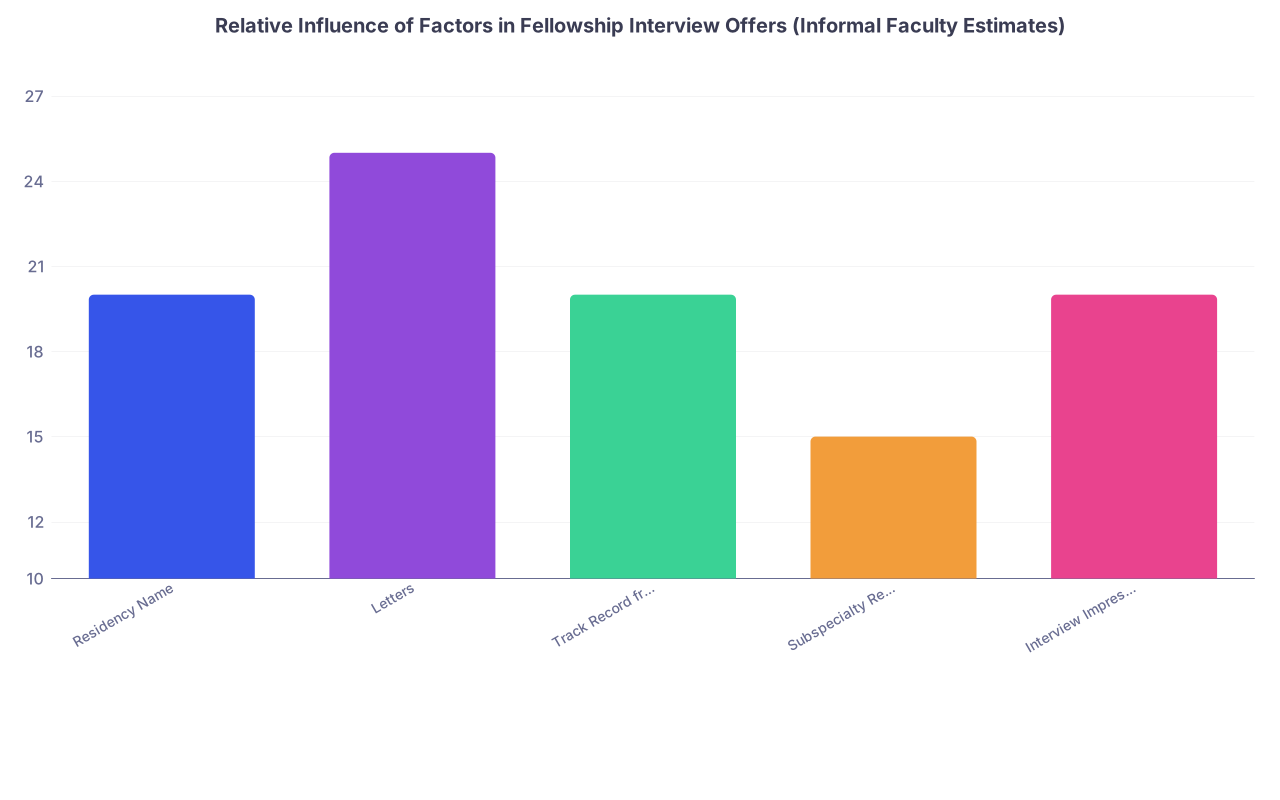
| Category | Value |
|---|---|
| Residency Name | 20 |
| Letters | 25 |
| Track Record from Program | 20 |
| Subspecialty Research | 15 |
| Interview Impression | 20 |
These numbers aren’t from a randomized trial; they’re from the informal “if you had to assign percentages” conversation I’ve had with multiple PDs. The point isn’t the precision. It’s the balance.
Residency name is one factor. Not 80%. Not 5%. Somewhere around 15–25% in the real world of competitive fellowships. You can’t ignore it—but you also don’t die by it alone.
Letters and your program’s track record together usually outweigh the macro‑reputation of the residency. That’s where your day‑to‑day life on the wards, the consults you don’t dodge, the notes you actually finish, and the feedback you take without getting defensive become long‑term capital.
What Comes Next For You
If you’re early in residency, your job now is to quietly start shaping your program’s micro‑reputation in your chosen subspecialty. That means being selectively excellent where it will matter later, and getting under the wing of people whose names carry weight beyond your hospital badge.
If you’re closer to applying, your focus shifts to exploiting every lever you still control: outside letters, strategic aways, tightening the story in your application so it aligns with what your program already whispers about you.
The hidden weight of your residency’s reputation is real. But it’s not fixed. With each graduating class, each fellow who performs—or crashes—it shifts a little.
Your fellowship application will ride on that tide, for better or worse. Your next move is to make sure that, when your name comes up in some conference room you’ll never see, there’s at least one person at the table who can say:
“From that program? We’ve had good experiences. And based on this file, this one looks like one of their best.”
How you engineer that outcome during residency is the real game. And once you land the fellowship? Then we can talk about how your fellowship’s name starts quietly dictating your attending job offers. But that’s a story for another day.


