

The attendings who will matter most for your fellowship match are often not the ones whose names end up on your letters.
Let me tell you what really happens.
The Hidden Power Structure Behind Your Application
Everyone obsesses over the “big name” fellowship director letter. The division chief. The NIH-funded PI. The program director who “always makes calls.” Those people matter. But there’s a whole layer underneath them that residents underestimate every single year: off-service attendings.
I’m talking about:
- The CT surgeon you’re on nights with for two weeks as a PGY-2.
- The MICU intensivist from anesthesia, not medicine.
- The cardiologist on consults while you “just” rotate through.
- The palliative care attending who sees you on your worst call month.
These people quietly feed information back into the system that decides if you’re “safe” to support for a competitive fellowship. They don’t formally vote at your rank meeting for cardiology or GI. What they do is simpler and more dangerous: they shift your narrative.
And fellowship selection is narrative-driven. Numbers get you through a screen. Stories get you ranked.
I’ve watched this play out in more PD meetings and fellowship selection discussions than I can count. The formal letters and CV come out first. Then someone says one sentence that changes the entire tone in the room:
“By the way, I heard from the CT service that he struggled when things got busy.”
or
“Palliative raved about her. Said she handled a family meeting better than most fellows.”
That’s it. One off-hand comment. Your “trajectory” just moved up or down a tier.
How Off-Service Opinions Actually Travel Back
Here’s the part no one writes in official handbooks: there’s an informal information pipeline in every academic hospital. Some places are more organized about it, some less. The pattern is the same.

| Step | Description |
|---|---|
| Step 1 | You on off service rotation |
| Step 2 | Off service attending impression |
| Step 3 | Comments to your PD or APD |
| Step 4 | Comments to core faculty in your specialty |
| Step 5 | Fellowship PD hears summary |
| Step 6 | Fellowship rank committee discussion |
Nobody’s logging into a portal titled “Destroy or Save Resident Careers.” It’s more mundane.
Coffee talk in the workroom. Quick hallway consults. A side comment at faculty meeting: “How are your residents this year? We just had your PGY-2 on nights, he looked a bit overwhelmed.”
Or the reverse: “Who is that PGY-3 on CT surgery? She’s phenomenal. If she wants cards, you should push her hard.”
Some programs formalize it. At one large IM program I know, off-service rotation directors submit a short “global impression” of each resident once a block. It doesn’t say “never let this person do cardiology.” It says things like:
- “Outstanding work ethic, took ownership of patients”
- “Knowledge good but needs improvement in prioritization”
- “Professional but distant with nursing staff”
- “Struggled with time management on busy days”
Those blurbs don’t die in an inbox. They get summarized in semi-annual reviews, which then get paraphrased in your Clinical Competency Committee (CCC) notes, which your PD has in the back of their mind when you ask for a cardiology or heme/onc letter.
Here’s the kicker: when fellowship PDs call your residency PD, they don’t just ask, “Are they good?” They ask, “How do they do in the ICU? How are they under pressure? Any concerns from surgery or other services?” Your PD is not going to lie outright for you. They’ll clean up the language, but the core message—shaped heavily by off-service impressions—comes through.
Why Off-Service Rotations “Count” More Than You Think
You think your home specialty attendings “know the real you.” They’ve seen your growth. They know your baseline. They watched you as an intern and now as a senior.
Off-service attendings? They get you in snapshots. Often at your worst:
- You’re on nights.
- You’re cross-covering.
- You’re in a foreign EMR order set.
- You don’t know the attending’s preferences.
- You’re exhausted from back-to-back wards.
And that’s exactly why their impressions matter so much to fellowship folks.
Strong fellowships want people who can function when everything is new and messy. Because that’s what first-year fellowship is. ICU months on a different service. Cath lab culture shock. Complex consults outside your comfort zone.
So how you show up on CT surgery as an IM resident or on MICU as a neurology resident becomes a proxy for: “How will this person function the first six months of our fellowship when they have no idea what they’re doing?”
I’ve been in a heme/onc selection meeting where the deciding factor between two otherwise identical applicants was this sentence from the residency PD:
“Look, they’re both smart. But Applicant A struggled every time they left general medicine. Applicant B excelled on MICU, ED, even on surgery. If you want someone you can throw into anything, B is your person.”
Applicant B got ranked substantially higher. The difference? Off-service performance.
What Off-Service Attendings Actually Judge You On
Here’s another secret: off-service attendings are not primarily judging you on whether you know the minutiae of their field. They know you’re “just the medicine resident” or “just the neurology resident.”
They’re watching something else.
They’re watching how you handle being out of your depth.
| Domain | What Helps You | What Hurts You |
|---|---|---|
| Attitude under stress | Calm, curious, proactive | Defensive, withdrawn, blaming |
| Communication | Clear updates, closed loops | Vague plans, disappearing |
| Ownership | Knows patients cold, anticipates | “Just covering,” minimal engagement |
| Team behavior | Respectful to nurses, RT, consults | Eye-rolling, dismissive, condescending |
| Adaptability | Asks for preferences, adjusts quickly | Insists on “how we do it on my service” |
The best residents I’ve seen on off-service rotations did something deceptively simple: they made the attending’s life easier without pretending to be something they weren’t.
A concrete example. PGY-2 IM resident on CT surgery:
Bad version: “I’m just the medicine resident, I don’t know what you want.”
Better version: “On medicine I’d manage this A-fib with metoprolol and maybe digoxin if hypotensive, but I know your post-op CT population has specific issues. Can you walk me through how you like it managed so I can carry that for the team?”
The attending instantly categorizes you as safe, humble, and high-ceiling. That will get mentioned later.
Another detail attendings notice but rarely say outright: how you talk about your own specialty colleagues when you’re “away from home.” I’ve heard residents trash their own program in front of off-service faculty.
“They never taught us that on medicine.” “Our ICU is a mess, nobody rounds on time.” “Our cards fellows are useless.”
That always, always gets back. And fellowship PDs do not want the person who tears down their own people the second they leave the room.
The Informal “Do Not Push Hard For This Person” List
Every residency program has one, even if it’s never written down.
It’s not a formal remediation list. Those people you already know about. I’m talking about the quieter category: residents who are “fine” on paper but about whom there’s just enough smoke that no one is going to stick their necks out for a hyper-competitive fellowship.
Smoke often comes from off-service.
- The resident who was rude to peri-op nurses.
- The one the ED labeled “slow and indecisive.”
- The one anesthesia said “panics with airways” about.
- The one palliative found emotionally disconnected from patients.
Individually, each comment is small. Put together, they form an unofficial consensus: this is not the person you call your friends in cardiology or GI to push.
I sat in a meeting where a PD said, “Look, if they apply to less competitive things, I’ll write a supportive letter. But I’m not calling my old co-fellow who runs that cards program for this one. Too many flags from outside services.”
That resident had solid scores, abstract posters, all of it. Their off-service trail killed any chance at big-name fellowships.
They eventually matched in a smaller, less competitive program. They’ll be fine. But it was not the match they thought their CV entitled them to.
How This Plays Out Specialty by Specialty
Different fellowships pull on different off-service signals. Here’s how the insiders think.
Cardiology
Cards PDs care a lot about:
- CT surgery impressions
- MICU performance
- ED consult behavior
If CT surgery says you were lazy or disappeared post-op, that’s death. Cards wants people who live in the gray zone between surgery, ICU, and medicine. If you fold there, no thanks.
I’ve seen PDs say, “He’s smart, but CT surgery said he never showed up before 7:30 and never knew the vent settings. We are not doing three years of fighting this.”
Pulm/CCM
Off-service signals: ED, surgery, anesthesia.
If anesthesia says you can’t handle airways or are terrified of procedures, that matters. If ED says you’re incapable of quick triage decisions, that matters.
I’ve sat with a pulm/CCM PD who literally filtered two otherwise-strong apps into a “risky” bucket because, “Anesthesia sent us feedback that they would not want them back in their ORs.”
GI
GI likes people who can manage chaos on wards and in consult-heavy environments. Off-service they listen very carefully to:
- Hospitalist/ward teams when you rotate as a senior on non-GI heavy months
- Surgery rotations where you co-manage post-op liver, IBD, etc.
- ED when you handle GI bleeds
If surgery says, “They punted everything back to us and avoided decision-making,” that carries a surprising amount of weight.
Heme/Onc
Heme/onc PDs quietly pay attention to:
- Palliative care feedback
- Complex medicine services (renal, transplant)
- ICU impressions on emotionally heavy cases
They want to know if you can sit in difficult spaces, not just recite chemo regimens. I’ve heard, “Palliative raved about her” used as a decisive positive more than once.
EM, Anesthesia, Others
Flip the direction and it’s the same story. EM PDs ask medicine, “Would you trust this person cross-covering 60 patients overnight?” Anesthesia PDs ask surgery, “Can this resident function in an OR environment or do they fall apart?”
You’re never just being evaluated by “your” people.
Specific Behaviors That Quietly Boost Your Fellowship Odds
Let’s get concrete. Here’s how you use off-service rotations to build—not sabotage—your fellowship narrative.
1. Day 1: Declare Yourself Intentionally
On the first day, don’t just say, “Hi, I’m the PGY-2.” Say:
“I’m a PGY-2 in internal medicine, very interested in [X field if you already know] but right now my main goal is to be as useful as possible on your service and learn your perspective.”
Short. Direct. It does two things.
First, it signals you’re not here to clock in and out; you’re here with intent. Second, if your fellowship interest overlaps at all, you’ve just told someone who might actually talk to people in that field about you.
2. Ask One Good Question Per Day
Not ten. Not a constant barrage.
One focused, thoughtful question that shows you’re thinking at the right level. For example, on MICU as a future cards hopeful:
“I know in cardiology clinic we obsess about long-term beta blocker titration post-MI. In the ICU, when someone’s on multiple pressors, how do you think about which chronic meds to keep versus hold?”
That’s the sort of question that later morphs into, “This resident thinks like a future [your specialty] doc.”
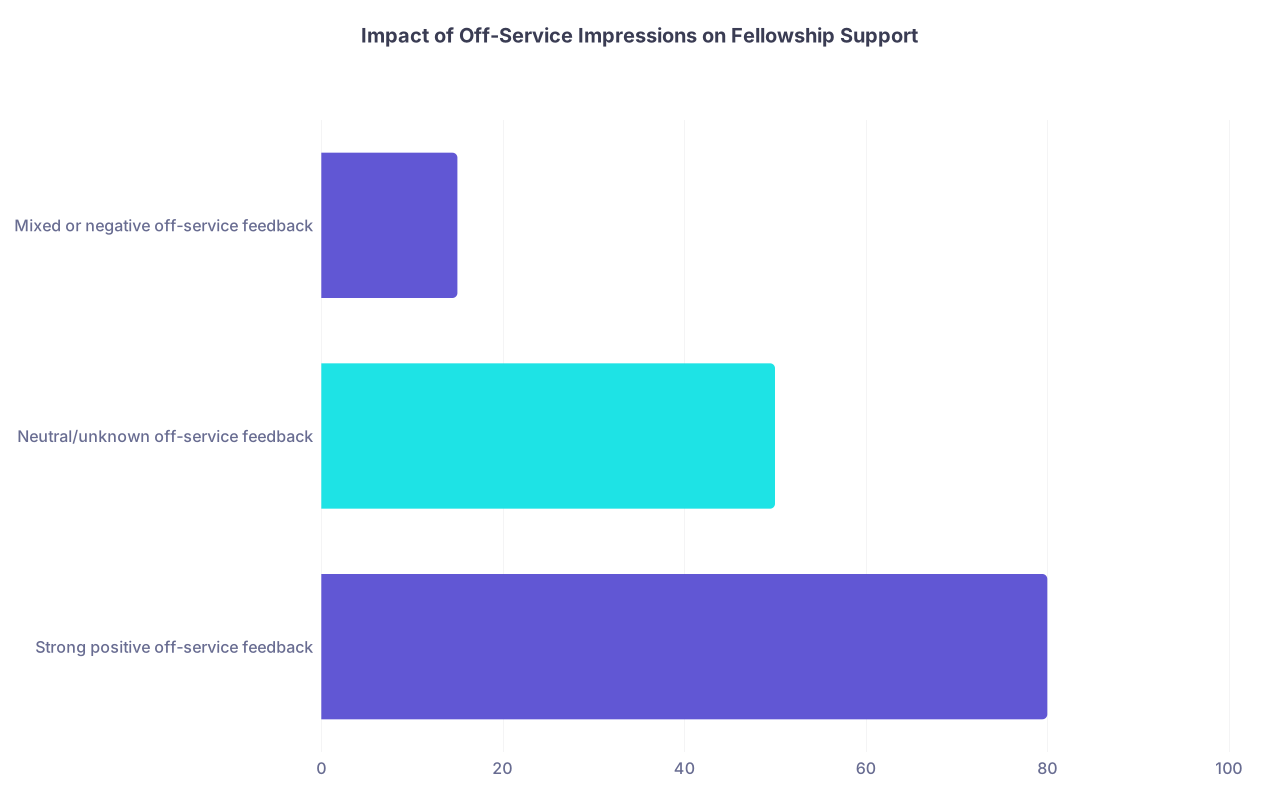
| Category | Value |
|---|---|
| Strong positive off-service feedback | 80 |
| Neutral/unknown off-service feedback | 50 |
| Mixed or negative off-service feedback | 15 |
3. Own a Domain That Matters to Them
You’re not going to out-surgery the surgeons. But you can own something they care about and are too busy to micromanage.
On CT surgery as an IM resident: you become the delirium and glycemic control hawk. You know every patient’s sugars, delirium risks, bowel regimens. You preemptively fix the stuff that makes their post-op course miserable.
On palliative: you own the data and chart prep. Every family meeting, you’ve already pulled prior notes, consultant opinions, goals-of-care documentation.
When an attending realizes, “If this resident is on, my service runs smoother,” that gets verbalized to someone later.
4. Treat Nursing Feedback As If It’s Going Straight To Your PD
Because it is.
I’ve seen more than one fellow applicant derailed because nursing on off-service rotations consistently labeled them “difficult.” That label gets repeated in subtle ways:
“Residents say she’s great, but nursing has had concerns.”
That’s code. Everyone at the table knows what it means.
Things that protect you: closing the loop when nurses escalate, not rolling your eyes when they call, giving clear timeframes (“I’ll be there in 10 minutes”) and meeting them, saying “Thank you for calling about that” when they catch something.
It sounds basic. Many residents fail at it when tired and off-service. Those are the ones who end up in the “we’re not pushing them for top-tier fellowships” category.
5. Don’t Oversell, Don’t Underplay
Two mistakes I see a lot.
Resident oversells: “I’m going into cards, I’ve done ten research projects, presented at AHA…” to an attending on day one.
You think that impresses them. It actually raises the bar and puts a target on your back. Now they’re watching to see if you live up to the hype, and anything less than stellar becomes “overconfident, not as good as they think.”
Resident underplays: “Oh, I’m just here to get through this month.”
That puts you in the forgettable bucket at best, and the “minimal effort” bucket at worst.
Find the middle. Transparent interest, grounded confidence, no bragging.
Salvaging a Bad Off-Service Rotation
You’re human. Sometimes you blow a month. You were sick, burnt out, fighting at home. It happens.
What residents almost never do—but should—is proactive damage control.
If you know a rotation went badly with an off-service attending who actually has influence, you don’t just hope everyone forgets. You go to your core faculty mentor or PD and say, directly:
“I had a rough CT surgery month. I was overwhelmed, and I don’t think I showed my best. I’ve made changes since then [concrete examples]. I wanted you to hear that context from me in case they share any concerns.”
That does two things.
First, it frames the narrative in your voice before someone else tells it more harshly. Second, it signals insight and growth. I’ve heard PDs defend residents in fellowship calls with lines like:
“They had a tough MICU rotation early on and got some critical feedback, but to their credit they sought coaching and made big improvements. Later ICU attendings had no concerns.”
That’s a very different story than, “Yeah, ICU was not great” with no context.
The “Invisible” Rotations That Matter Most
Residents often misjudge which off-service months matter most to fellowship folks.
You think: big-name services matter: CT surgery, MICU, advanced consults.
True, but some sleeper rotations have outsized influence because the attendings on them are deeply plugged into your program leadership.
- Palliative care in many hospitals is run by medicine faculty with close ties to your PD.
- Pre-op clinic sometimes has long-standing attendings who sit on your CCC.
- ED faculty often staff hospital quality committees with your chiefs and PD.
A generic “This resident was fantastic” from those people is like compound interest. It keeps your name in positive circulation.
One cards fellow I know had a game-changing comment from palliative: “If you have any influence over their future, do not let them go into a field where they never see patients longitudinally. They have an incredible bedside manner.”
The PD literally quoted that on the phone with fellowship PDs. Guess where that resident matched? Top-tier cards, despite Step scores that were merely “fine.”
Bottom Line: How To Think About Off-Service Rotations
Stop treating off-service as dead space on your schedule. Or “just surviving the month.” It’s your live audition in exactly the situations fellowship directors care about: unfamiliar, high-pressure, fragmented support.
If you want it in one sentence:
Off-service attendings are the ones who quietly answer the unspoken question every fellowship program has about you: “Can we trust this person when everything is new and the stakes are high?”
So, three things to keep front and center:
Every off-service rotation is a story generator. Those stories travel back to your PD and, eventually, to fellowship PDs. You don’t control the storytellers, but you absolutely control the raw material they’re working with.
Attitude under stress, how you treat non-physician staff, and your willingness to own patient care across service lines matter more than textbook knowledge on these months. That’s what off-service attendings actually remember and repeat.
One strong off-service champion is often worth more than another generic letter from your home specialty. When a CT surgeon, intensivist, or palliative attending tells your PD, “If this resident wants [X fellowship], push them hard,” that’s the kind of quiet endorsement that moves you from “good applicant” to “we’re making calls for this one.”


