

It’s 7:45 p.m. in a dim conference room off the fellows’ workroom. You’re on nights as a PGY-3, your future hanging on some spreadsheet you’ll never see. Down the hall, the fellowship selection committee is “just going through the initial screen.” You picture a bunch of gray-haired attendings carefully dissecting every line of your CV.
That’s not what’s happening.
What’s actually happening is that two attendings have already left for home, one is on silent mode scrolling email, and three tired fellows are driving the conversation. Someone says, “Wait, that’s the resident from County, the one who ran that insane septic shock case.” Another fellow marks you “interview.” Your fate just got decided in less than 15 seconds.
You need to understand this: at many programs, fellows are not background characters in the selection process. They’re gatekeepers. Sometimes kingmakers. Sometimes executioners.
Let me walk you through how that really works, because nobody on the outside ever explains this honestly.
How Much Power Do Fellows Actually Have?
I’ve watched this from both sides: as a resident applying, thinking the fellows were just friendly tour guides; and later as a fellow sitting in a dark room with a stack of 400+ applications, red-penning people I knew would never hear from us.
Fellows’ influence is program-dependent, but the patterns are predictable. Here’s the rough spectrum:
| Program Type | Typical Fellow Influence Level |
|---|---|
| Small community-based fellowship | High |
| Mid-size academic (non-elite) | Moderate to High |
| Large academic, top 5–10 | Moderate |
| Massive name-brand, 20+ fellows | Low to Moderate (biased to insiders) |
| Newer programs | High |
In small to mid-size programs, fellows absolutely shape the interview list. Not pretend influence—real votes. They’re the ones doing the first or second pass on applicants the PD does not recognize by name or institution.
Here’s the part you probably don’t know: faculty memory and attention are finite. Once you cross maybe 80–100 applications, they’re not carefully weighing each file. They’re pattern-matching. They lean hard on anyone they trust who has actually worked with residents recently—and that’s the fellows.
So practically:
- Fellows get lists or bins of applications to “flag” or “screen.”
- Their “yes” often guarantees an interview.
- Their “no” can bury you unless someone senior is already interested in you.
Nobody will ever put that in a policy document. But that’s exactly how it works in the room.
Where Fellows Show Up in the Process (That You Never See)
Let’s kill the fantasy that selection is some standardized ritual with rubrics and blind scoring. At most programs, it’s a messy hybrid of structure and gut feeling, and fellows are embedded in the messier parts.
1. The Early “Triage” Pass
Most fellowships get far more applications than they can possibly read deeply. So they triage. There’s usually a PD or APD who sets rough filters (Step scores, visa status, must-have letters, institutional preferences). Once those bins are created, the real decisions begin.
This is where fellows are pulled in.
You’ll see things like:
- “Ok, we have 300 apps. I want to interview 50. Give each fellow 50 to flag 10–15 for closer review.”
- Or: “Anyone from our feeder programs, our own residents, and that PD’s email referral gets auto-reviewed by me. The rest, fellows sort into ‘probably’ and ‘unlikely.’”
Fellows skim your application looking for:
- Have we worked with you?
- Does someone we trust know you?
- Do you look like someone who survives our workflow without imploding?
If your entire narrative is invisible to them—no shared rotations, no recognizable mentors, no connection points—you’re relying purely on numbers and brand name. That’s not always enough.
2. The “Do We Know This Person?” Cross-Check
Here’s a quiet move that matters more than any polished personal statement.
Picture this: they pull up an applicant from a residency two states away. Mid-tier program. Step scores fine. Research okay. One fellow squints and says: “Wait, isn’t that the guy who rotated here last year? The one who always disappeared before sign-out?”
Now you’re dead.
The attending will not override that. They do not care how pretty your ERAS looks when a fellow says, “They were unreliable” or “They were just… off.”
Flip side: if a fellow says, “That’s the resident who basically ran our MICU senior month, absolute workhorse, took feedback well, I’d trust them on nights” you jump up the list, even if your numbers are average.
Fellows are memory banks for visiting residents, away rotators, and even random night float interactions. Those memories get weaponized later, in both directions.
3. The “We Need People Who Fit Here” Conversation
No program will say this publicly, but every program has its culture. Some are purely research engines. Some are procedural cows. Some are service-heavy, borderline malignant, but proud of being “rigorous.” Fellows are the ones who know the truth.
So when they’re looking at you, it’s not just “are you good.” It’s “are you good for our reality.”
For example:
- A heme/onc program where fellows are drowning in notes and chemo consents:
They ask, “Is this someone who will do real work, or are they just a CV?” - A cush, research-heavy advanced GI program:
They care a lot more if you’ve done decent research and seem academically hungry than if you crushed 20 admits on call.
You see where this goes. Fellows run your application through the “can I imagine being on call with this person when it’s hitting the fan” filter. That filter is brutal. And shockingly accurate.
The Quiet Politics: Why Fellows Back Some Applicants And Tank Others
You want the unvarnished version? Fellows are not objective robots. They are tired, overwhelmed, underpaid, and juggling patient care with being conscripted into “educational leadership.” Their judgment is human. Which means biased, emotional, and influenced by things no one will list on a “selection criteria” slide.
1. Who Helped Them When They Were Residents
Fellows remember who made their lives easier when they themselves were residents applying.
If you were the med student who showed up on time, took feedback, didn’t vanish during scut, and then later emailed them a genuine update or asked for advice respectfully? Your name gets a quiet bump.
I’ve watched fellows say, “She rotated with us as a sub-I and never complained even when it was a train wreck. She’s on my list.”
That doesn’t show up in ERAS. But it shows up in that conference room.
2. Who Treated Juniors and Staff Like Human Beings
Here’s a scene I’ve personally seen play out:
A resident spends a month on a service. They’re polite to attendings and senior fellows. But they’re dismissive or condescending to interns and nurses. Maybe they snap at a unit clerk. Maybe they constantly pawn work off on others.
Months later, folders are open. Someone says, “Oh no. That’s the guy who made the intern cry. Hard no.”
Fellows talk to nurses. To pharmacists. To residents. They remember how you showed up in the hierarchy when you thought nobody important was watching. That memory can torpedo you faster than a mediocre publication list.
3. Local Politics and Turf
You will never hear this on a podcast, but internal and external politics absolutely influence which applicants fellows support.
Examples:
- The PD wants to improve relationships with a certain residency. Fellows know that pipeline has been weak. If a solid applicant from that program appears, fellows are nudged to “look favorably.”
- Conversely, if there’s a history of marginal performance from a particular residency, a fellow’s casual “We’ve had rough experiences from there” can bias the whole room against you before your file is read seriously.
Do I think that’s fair? No. Is it real? 100%.
How Fellows Actually “Read” Your Application
Let me be blunt. Fellows are not sitting there scoring each domain out of 5 with a careful rubric. On a good night, they might spend 90 seconds on you. More often, 20–30 seconds.
Here’s the unconscious order they scan, when they’re honest about it:
- Program and year
- Any personal familiarity (“Do I know them? Did they rotate here?”)
- Letters: Who wrote them, not what they say yet
- Red flags / weird gaps
- One-line impression of your “angle” (research heavy, grinder, late bloomer, etc.)
The reality is this: they’re not reading every word of your personal statement. Some will not read it at all, unless they’re on the fence about you.
They’re asking themselves:
- Do I trust this person clinically?
- Do I believe they will carry their share (or more) of the work?
- Does this person obviously want our type of career (academic vs private, procedure-heavy vs cognitive)?
If the answer to those three is yes, you’re in solid shape. If one is no, your file becomes a “maybe” that may never get revisited.
The Power of Name-Dropping (Done Right And Done Wrong)
You’ve heard “letters matter.” That’s not quite accurate. Who writes them matters more than what they say. And how fellows react to those names is different than how PDs do.
Attendings look at big names, national reputations, “Chair of X.” Fellows are more granular and more personal:
- “Oh, Dr. Kline wrote this letter? She never overstates. If she says this resident is outstanding, I believe it.”
- Or: “That’s Dr. Y from Big Name University. He writes everyone the same ‘best resident in years’ letter. I’ve seen three of those. Discount it.”
The unspoken truth: fellows have often just recently come out of the larger world of residency interviews and know exactly which letters are fluff and which are gold. PDs lean on that institutional memory.
What you need to internalize is this: a single, very well-placed letter from someone that fellows and faculty actually trust is more valuable than three generic “outstanding resident, pleasure to work with” letters from people with shiny titles.
When fellows see a letter from a clinician they respect who has a reputation for not sugarcoating, they read every line. And those lines get quoted out loud in the room.
The Insider Edge: How To Get Fellows On Your Side Before You Ever Apply
You can’t brute-force your way into fellow support at the last second. The real groundwork starts long before ERAS opens. Here’s where you actually have leverage.
1. Be Memorable on Rotations—for the Right Reasons
On any fellowship service, the fellows are taking quiet notes on everyone. Not in a notebook. In their heads.
You do not need to be perfect. You do need to be unmistakably:
- Reliable: show up, follow through, circle back.
- Coachable: if they give feedback once, you adjust.
- Humble but not passive: you say “I don’t know” when you don’t know, then go find out.
I remember one future applicant who was clinically average but relentlessly accountable. If he said he’d follow up something, it got done. Later, when his name came up, every fellow in that room said, “Oh yeah, he was solid.” Solid gets interviews.
2. Ask for Real Feedback, Not Just Letters
Here’s where most residents screw up. They treat fellows as letter vending machines instead of as future advocates.
Instead of: “Can you write me a letter for cardiology fellowship?” after a three-week rotation…
Try: “I’m thinking seriously about cardiology. I’d really value your honest take: what do you think I need to strengthen over the next year to be a competitive fellow and someone people want to work with?”
Why this works:
- You’ll get actual insight into what that field values.
- You signal maturity. Fellows remember that.
- When you later ask for a letter, they have a narrative ready in their heads, not just “hardworking and diligent.”
Those are the residents who get defended in the room when their application isn’t perfect.
3. Keep Them in the Loop Without Being Annoying
The best fellowship applicants maintain quiet, low-maintenance relationships with a handful of fellows and junior faculty. Not constant emails. Just periodic, purposeful contact.
Something like: “Just wanted to update you—I decided to apply in pulmonary/critical care, and I’m working on a project in ARDS outcomes with Dr. X. Hope fellowship is going well and you’re getting some sleep.”
That’s it. Now when your name comes across their screen, you’re not “random PGY-3 from Midwest” but “Oh, that’s the resident who emailed me about their ARDS project.”
Small difference. Big impact.
When Fellows Hurt You Without Ever Meeting You
There’s a darker side to all this: you can be tanked by fellow dynamics you never participated in.
Here’s how:
1. The “Our Own Residents First” Mindset
Some programs aggressively favor their own residents. They won’t say that on their website, but the fellows all know it. When they’re sorting applications, the question becomes: “Do we have enough spots for our own people first?”
If they’ve got three of their own applying for four slots, the bar for external candidates gets quietly pushed higher. Fellows, often proud (and sometimes protective) of their institution, will lean toward their “own,” especially if they trained with them.
You can’t change that reality. You can only target programs accordingly and avoid burning a ton of energy where you’re just interview filler.
2. “We Had a Disaster From That Program Before”
If a prior fellow from your residency crash-landed—poor performance, professionalism issues, patient complaints—that stink can linger years. Fellows remember that. They say, “We’ve had trouble with people from X program.”
Is that fair to you personally? No. Does that sentence get spoken? Absolutely yes.
What do you do if you know your residency has a weak reputation in a certain subspecialty? You overcompensate on two fronts:
- Secure letters from outside institutions with strong reputations in your target field.
- Cultivate relationships at audition or elective sites where your personal performance can override institutional bias.
You’re trying to create a counter-narrative strong enough that a fellow can say, “Yeah, but this one is different—and here’s why.”
What Actually Happens Once You Make the Interview List
Let’s say you dodge all the landmines and get the email: “We are pleased to invite you…” You think the fellow influence is over.
Not even close.
On interview days, fellows are often:
- Running the resident/fellow-only Q&A sessions.
- Giving informal tours.
- Eating lunch with you “off the record.”
- Reporting back afterward.
I’ve sat in multiple post-interview debriefs where the PD opens with, “Any concerns from the fellows?” Before faculty even weigh in on your research or case presentations, the fellows will say things like:
- “She seemed disinterested in our actual clinical volume.”
- “He talked over one of our junior fellows when she tried to answer.”
- “They complained a lot about their current program—might be a problem.”
Or, more positively:
- “She asked really sharp questions about our night float system, you can tell she cares about real work.”
- “He connected well with the team, felt like someone who would fit right in.”
Those impressions steer rank list discussions more than you think. Especially when candidates look similar on paper.
How To Behave Around Fellows On Interview Day (Since They’re Voting On You)
You’re not there to impress them with brilliance. You’re there to convince them you’re safe to work with at 2 a.m.
Practical ground rules that come directly from what fellows complain about afterward:
- Do not trash your current program. Ever. You can hint at wanting more procedural volume or academic exposure, but if you sound bitter, fellows will see you as a future problem.
- Ask at least a couple of questions that show you understand the day-to-day grind. They notice who only asks about research and vacation and who also asks, “What does your worst call night look like? What makes it tolerable?”
- Treat junior fellows—and even applicants—well. I’ve seen people ignore PGY-4 fellows and only talk to senior fellows or faculty. That arrogance gets reported.
The bar is not perfection. It’s “would I be okay seeing this person every day for three years, including when I’m exhausted and cross-covering with them?”
You’d be shocked how many applicants fail that test in the way they talk and carry themselves for a few hours.
The One Thing You Can Control Completely
You cannot control which fellows sit in that room, what baggage they carry, or what their program politics look like. You can’t fully control the institutional reputation of your residency.
You can control this: how every single fellow you encounter experiences you—during rotations, away electives, conferences, and interviews.
They remember:
- Who showed up prepared.
- Who took feedback with maturity instead of defensiveness.
- Who stayed to help when they clearly could have slipped away at 4:45 p.m.
Over time, those small interactions compound into something you desperately need on the other side of the wall: a fellow who looks at your name and says, “I know this person. We should interview them.”
That’s not luck. That’s the result of months and years of how you operate when you think no one important is watching.
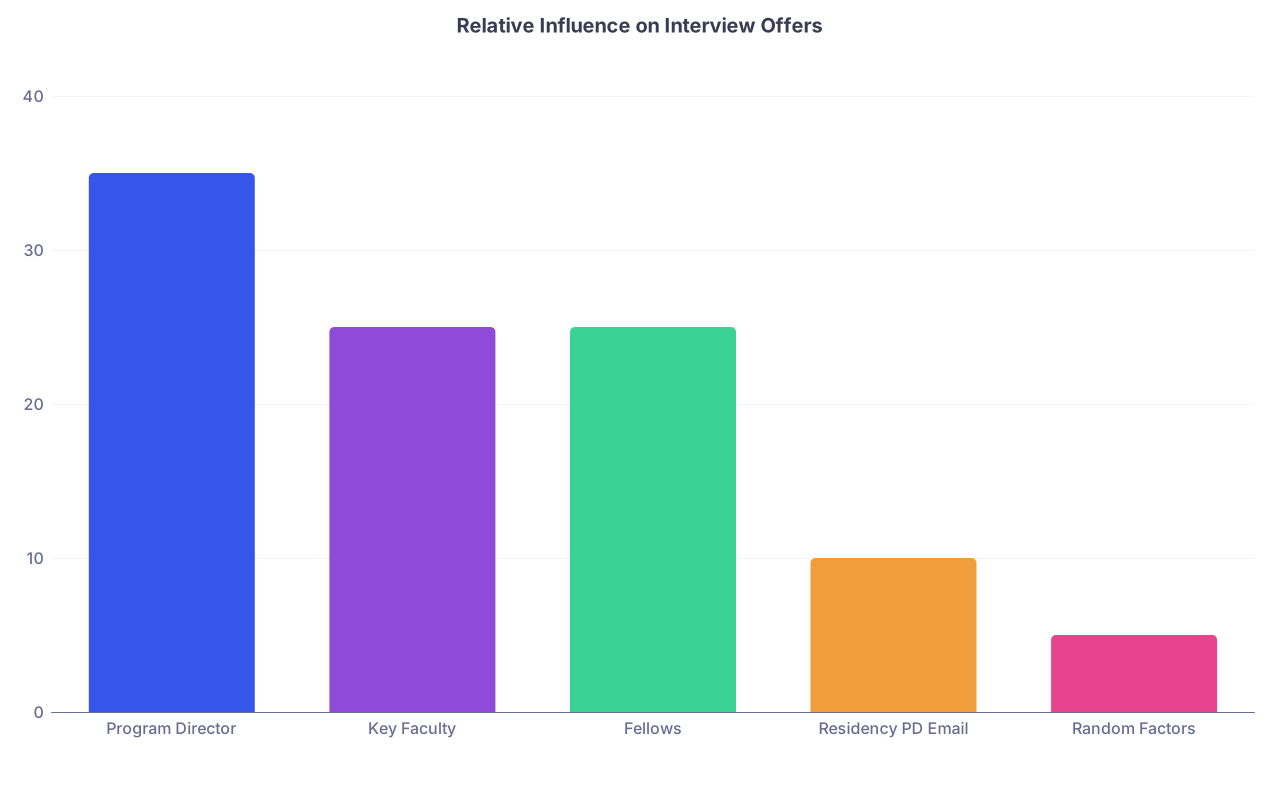
| Category | Value |
|---|---|
| Program Director | 35 |
| Key Faculty | 25 |
| Fellows | 25 |
| Residency PD Email | 10 |
| Random Factors | 5 |

| Step | Description |
|---|---|
| Step 1 | Resident Performance |
| Step 2 | Rotations with Fellows |
| Step 3 | Fellow Impression |
| Step 4 | Screening Committee |
| Step 5 | Interview Offer |
| Step 6 | Interview Day with Fellows |
| Step 7 | Rank List Discussion |
With all this in mind, where you are now shapes how much leverage you really have.
If you’re early in residency, you’re in the best possible spot. Every ICU month, consult rotation, and subspecialty elective is an audition not just for letters, but for advocates in a dark conference room two years from now. You can still build a reputation that walks into those meetings before you do.
If you’re closer to applying, you focus on the highest-yield relationships: fellows and junior faculty in your chosen field who actually know your work. Not just your name. You tighten up the way you show up on service. You cut out the casual complaining around people who might one day speak for—or against—you.
And once interview invitations start trickling in, you’ll walk into those programs with a clearer picture of what’s actually happening behind the smiles and “we’re so happy you’re here.” You’ll know that somewhere, down the hall, there’s a group of exhausted fellows whose impressions of you carry more weight than any glossy brochure suggests.
You’re not just applying to a name or a city. You’re applying to a microculture that those fellows live in every day. Learn how they think, how they talk about residents, what they value.
With that understanding, you’re not just another file on a spreadsheet. You’re someone they can already picture standing next to them during the worst night of the year.
And once you can do that, you’re not just ready to hit “submit” on ERAS. You’re ready for the quieter, more serious part of this whole process: becoming the kind of physician your future fellows will fight to bring onto their team. The rank list, the match email, the first day of fellowship—those are coming. But the groundwork for all of it starts right now, long before the door to that conference room ever closes.


