
Hidden Red Flags in Fellowship Applications Residents Overlook
What subtle detail in your fellowship application would make a program director quietly move you from “maybe” to “no” without ever telling you why?
If you think it’s just “low case numbers” or “not enough research,” you’re missing the real landmines. The things that get you silently screened out are usually much smaller and more avoidable—and residents walk straight into them every year.
Let’s walk through the red flags I’ve seen tank good candidates. You do not want to learn these from a rejection email.
1. Sloppy Signals That You Do Not Actually Want That Program
Here’s the mistake: residents honestly think programs believe “I’m very interested” just because they typed it.
Programs are not stupid. They see hundreds of applications. They can tell who wants them and who’s using them as a backup.
Generic, copy‑paste “interest” language
If your personal statement or supplemental blurb could be dropped into any program’s file without changing a word, it screams: “You are one of 30 places I applied because of geography and reputation.”
Red flags programs notice:
- “I am excited to apply to your esteemed program.” (You and 900 others.)
- No mention of:
- Specific tracks or pathways
- Faculty by name (accurately spelled, by the way)
- Unique clinical strengths
- Regional or population‑specific reasons that actually fit your story
- Same paragraph structure repeated across multiple submissions, with only the program name swapped.
The quiet consequence: no interview invite, even if your application is otherwise solid. They prioritize people who clearly cared enough to learn who they are.
Clumsy or wrong‑program references
Yes, this still happens:
- “I would be honored to train at [Another Institution].”
- Referencing a NICU track in a program that does not have one.
- Calling it a “community-based” program when it’s clearly tertiary/quaternary.
This isn’t “minor.” It reads as careless and disrespectful. Programs interpret this as: you’ll be equally careless with your patients, notes, and colleagues.
Fix this before you submit:
- For each program, write 3–4 program‑specific sentences that:
- Reference something verifiable from their website
- Connect directly to your concrete past experience
- Explain how you’d use that resource in your career path
If you can’t write those 3–4 sentences convincingly in under 10 minutes, you probably shouldn’t be applying there.
2. Recommendation Letters That Subtly Undercut You
Residents obsess over “Who is the most famous name I can get?” and ignore the far more dangerous question: “What does the letter actually sound like?”
Here’s the harsh truth: a lukewarm letter from a big name is worse than a strong one from someone less famous.
Coded language that programs recognize as negative
Fellowship PDs are experts at reading between the lines. They pay attention to what is not said.
Red flag phrases:
- “X is quiet but dependable.” → Where’s the initiative? Leadership? Curiosity?
- “X will do well in the right environment.” → Translation: not adaptable everywhere.
- “X met expectations.” → Death sentence for a fellowship applicant.
- “X is very nice.” (And nothing about clinical judgment, work ethic, or growth.)
- “I have limited direct clinical interaction with X, but…” → Why are they writing your letter?
Lack of specifics is also a red flag. Generic letters are interpreted as “this faculty member didn’t feel strongly enough to say anything concrete.”
Letters from the wrong people
Common mistakes:
- Letters from non-physician staff as core letters (NPs, PAs, nurses) when program clearly expects physician faculty sponsors.
- Letters from basic science PIs unrelated to the specialty you’re applying for, with no clinical context.
- Multiple letters from the same micro‑environment (all from your home ICU, none from wards, clinic, or consults).
What this signals:
- You didn’t develop strong clinical relationships.
- You couldn’t find people truly willing to advocate for you.
- You may be hiding weaker performance on core rotations.
How to avoid this trap:
- Choose letter writers who:
- Supervised you directly and closely.
- Can describe specific patient encounters or projects.
- Are known to write strong, detailed letters (ask senior residents; they know).
And yes, you need to ask them a direct question:
“Do you feel you can write me a strong letter for ___ fellowship?”
If they hesitate—walk away. That hesitation is the red flag you catch before programs do.

3. Personal Statements That Quietly Worry People
Most personal statements are not terrible. They’re just…forgettable. That’s not the problem.
The problem is the handful that plant doubt. Those are the ones that get you filtered out.
The “therapy on paper” mistake
Your personal statement is not your anecdotal psychiatry visit. Programs are not your therapist.
Red flags:
- Overly detailed descriptions of:
- Burnout
- Depression/anxiety
- Trauma without any:
- Evidence of treatment
- Stability
- Insight about how you now function safely as a clinician
- Long, emotional narratives with almost no discussion of:
- Clinical interests
- Skills
- Growth
- How you contribute to a team
Programs are cautious. If they walk away thinking, “Is this person ok to handle subspecialty call?”—you’ve already lost.
The “I hate my current specialty” confession
If you come off as trashing your residency specialty:
- “I realized I don’t enjoy general internal medicine.”
- “I knew I could never be content in primary care.”
- “I find general pediatrics unfulfilling.”
Programs see this as:
- Poor judgment in choosing residency.
- Risk for future dissatisfaction.
- Potential to bad‑mouth them later.
You’re applying to a subspecialty of what you already do. Don’t insult the foundation of their field.
Vague or inconsistent stories
More subtle but equally damaging:
- Timeline of your interest doesn’t match your CV (e.g., “Always wanted GI,” but no GI rotations, research, or involvement until PGY-3).
- Saying you love teaching with zero educational involvement listed.
- Claiming research passion with no real output.
Fellowship PDs will mentally cross‑check your statement against your CV. If your story doesn’t match your data, that’s a red flag.
Your personal statement should:
Show:
- A coherent, believable pathway into the specialty.
- Concrete examples (patients, projects) that clearly shaped you.
- Maturity, insight, and awareness of the field’s realities.
Avoid:
- Over-sharing mental health struggles without framing stability.
- Negativity about your current specialty or program.
- Overblown “calling” language with zero evidence.
4. CV Details That Quietly Scream “Disorganized” or “Inflated”
You’d be shocked how many residents sabotage themselves with their CV formatting and content.
Not because the content is weak. Because the signal is chaos or dishonesty.
Sloppy, inconsistent, or misleading formatting
Red flags PDs notice immediately:
- Random capitalization, spelling errors, inconsistent date formatting.
- Publications listed in “submitted” or “in preparation” that are:
- Never published.
- Clearly unlikely to ever be published.
- Overloaded “presentations” section where:
- Journal club = “oral presentation.”
- Required residency talks are blown up as “invited lectures.”
| Item Type | Red Flag Version | Safe Version |
|---|---|---|
| Publications | 6x “in preparation” papers | 1–2 realistic works in progress |
| Presentations | Journal club as “national presentation” | Journal club clearly labeled |
| Authorship | Implied first author with vague roles | Clear position and honest contribution |
| Dates | Missing years or overlapping gaps | Continuous, explained timeline |
Programs have seen inflation games for years. They’re very good at smelling it.
Research that doesn’t make sense for your story
If you’re applying for heme/onc and your entire “research experience” is a basic science project from M2 with nothing since, that’s not a deal breaker. But if you:
- Pitch yourself as “deeply committed to academic oncology”
- Have zero scholarly activity since med school
- List 10 “abstracts” all from one conference with your name buried as author #19
That combination raises suspicion. Not over research quantity—over honesty and self‑awareness.
Avoid these CV traps:
- Separate “invited talks,” “local presentations,” and “journal clubs” clearly.
- Label:
- Accepted
- Submitted
- In preparation
And keep “in preparation” to an absolute minimum. One or two max, and only if you’re truly wrapping them up.
- Never:
- Backdate activities.
- Exaggerate your role.
- List something as “published” when it’s not.
PDs are more forgiving of fewer, solid entries than many questionable ones.
5. Red Flags Hidden in Your Timeline and Gaps
Fellowship PDs look at your application as a story across time. When the timeline doesn’t make sense, they notice.
Unexplained gaps or sudden changes
Obvious red flags:
- 6–12 months with no clinical activity and no explanation.
- Sudden “leave of absence” during residency with zero context anywhere.
- Switching residency programs without mentioning why.
Here’s the mistake residents make: they think ignoring it will make it invisible. It doesn’t. It just means the program has to guess the reason. People rarely guess in your favor.
You don’t need to overshare, but you do need a professional, minimal explanation somewhere (personal statement, ERAS text box, or a brief note).
Reasonable examples:
- Family illness.
- Personal medical issue.
- Visa delays.
- Relocation for spouse/partner with clear continuity plan.
Unexplained = risky. Briefly explained = much safer.
Off-cycle graduation with no context
Programs know there are normal reasons for this:
- Chief year.
- Research year.
- Parental leave.
- Military deployment.
If you just list an odd graduation date with nothing else, that’s a yellow flag. They’ll worry about remediation, professionalism issues, or major problems.
Add a short, factual explanation in your application somewhere. Do not make them dig for it.
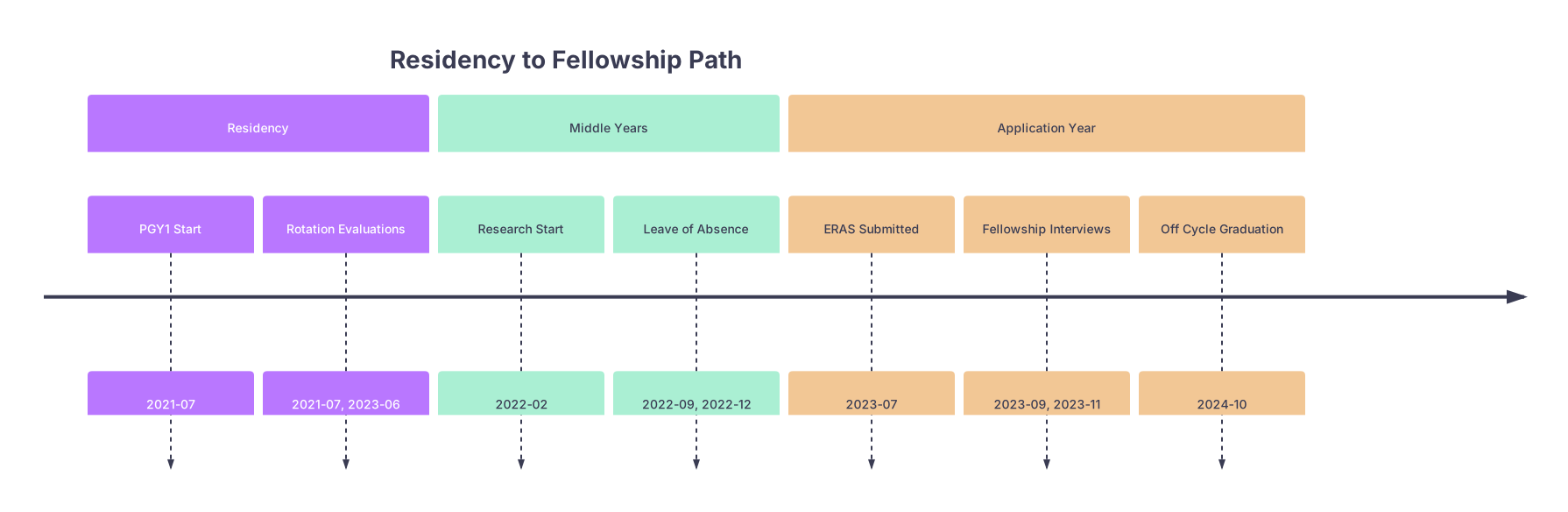
| Period | Event |
|---|---|
| Residency - PGY1 Start | 2021-07 |
| Residency - Rotation Evaluations | 2021-07, 2023-06 |
| Middle Years - Research Start | 2022-02 |
| Middle Years - Leave of Absence | 2022-09, 2022-12 |
| Application Year - ERAS Submitted | 2023-07 |
| Application Year - Fellowship Interviews | 2023-09, 2023-11 |
| Application Year - Off Cycle Graduation | 2024-10 |
6. Subtle Professionalism and Communication Red Flags
Programs watch your behavior before you ever show up on interview day.
You might think minor communication quirks don’t matter. They do.
Sloppy or entitled emails
Red flags in your emails to coordinators or PDs:
- No greeting. Just “Here is my CV.”
- Demanding language:
- “Please confirm you received my application.”
- “I would appreciate an expedited decision due to other offers.”
- Poor tone with coordinators that is very different from your tone with PDs.
Guess who coordinators tell PDs to be careful about? The person who treats staff poorly.
Strange or excessive “interest signals”
Another quiet red flag: inappropriate follow-up.
Things that make you look desperate or unprofessional:
- Multiple “just checking on my status” emails.
- Long emails trying to “explain” a weak Step score, bad rotation, or bad evals in detail before being asked.
- Sharing “other programs” you’re applying to or ranking as leverage.
If a program likes you, these behaviors can actually downgrade you. If they’re on the fence, it can tip you into the no pile.
Use email for:
- Sincere, concise thank-yous (fine, but not mandatory everywhere).
- Genuinely important updates (new publication, award, changed visa status).
- Clarifying logistics (interview date conflicts, accommodations, etc.).
Not for emotional reassurance.
7. Program–Applicant Mismatch That You Pretend Isn’t a Big Deal
You know the feeling: you’re applying to 30+ programs “just in case,” and some of them clearly don’t fit your profile.
Programs notice misalignment in:
- Career goals
- Setting (academic vs community vs hybrid)
- Research intensity
- Geography and long-term plans
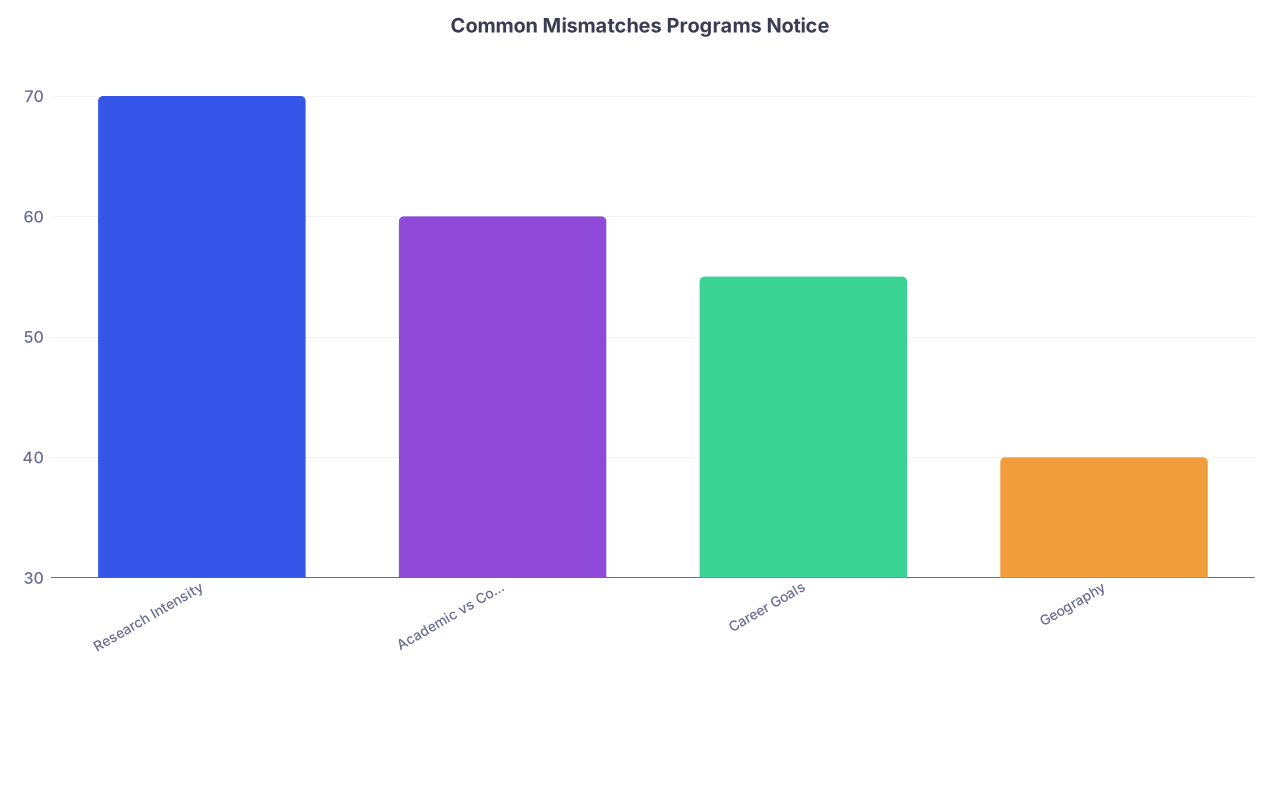
| Category | Value |
|---|---|
| Research Intensity | 70 |
| Academic vs Community | 60 |
| Career Goals | 55 |
| Geography | 40 |
Research vs non-research programs
If your CV shows:
- No research
- No ongoing projects
- No interest in scholarly work
and you’re applying to heavy, R01-funded, research-track programs, that’s not “shooting your shot.” That’s sending a confusing message.
They question:
- Do you understand what this fellowship actually is?
- Are you applying everywhere out of panic?
- Will you be miserable (and underperform) here?
Geography vs long-term plans
If you:
- Have deep, documented ties in one region
and - Apply to a program in a completely different part of the country
and - Never explain why anywhere
Programs may assume:
- You’re using them as a backup.
- You’ll leave immediately after fellowship.
- You’ll be unhappy far from your support system.
You don’t need a long paragraph. A single sentence in your statement can fix this:
“Although my family is based in the Midwest, my partner and I are planning a long-term move to the Pacific Northwest, which makes your program particularly appealing.”
Bottom line: if a reasonable person would look at your file and say “Why this program?”, answer that question somewhere. Or they will answer it for you—and not in your favor.

8. How Programs Silently Filter You Out (And You Never Know Why)
You will almost never get feedback on why you weren’t invited or ranked. That’s the brutal part.
But here’s what’s happening in the background:

| Step | Description |
|---|---|
| Step 1 | Application Received |
| Step 2 | Auto Screen Out |
| Step 3 | PD Quick Scan |
| Step 4 | Low Priority or Reject |
| Step 5 | Full Review by Committee |
| Step 6 | Interview Scheduled |
| Step 7 | Hold or Reject |
| Step 8 | Meets Basic Cutoffs |
| Step 9 | Red Flags Found |
| Step 10 | Interview Offer |
During the PD quick scan, they’re looking for:
- Obvious professionalism issues
- Major timeline red flags
- Completely generic / wrong-program statements
- Questionable letters or CV inflation
You never see this step. You only see silence.
Which is why noticing and removing these hidden red flags is the only rational move you have.
FAQ (Exactly 5 Questions)
1. My application has a leave of absence and a low Step score. Should I explain both, or will that draw negative attention?
You should briefly explain any major timeline disruption (leave of absence), because unexplained gaps force programs to guess. A low Step score, on the other hand, usually doesn’t need a long narrative unless:
- It’s dramatically out of proportion to the rest of your record, and
- You have a concrete, credible explanation (illness, documented testing accommodations, etc.) and demonstrated improvement (better in‑training exams, Step 3).
Keep any explanation short, factual, and non-emotional. Two to three sentences max. If you need a full paragraph to justify something, you’re probably overexplaining and making it worse.
2. Is it a red flag if none of my letters are from nationally known “big names”?
No. Programs care far more about content and specificity than reputation. A detailed, enthusiastic letter from a mid-level faculty member who knows you well will beat a vague, generic letter from a famous name every single time. The real red flag is a letter that sounds like the writer barely knows you, regardless of their title. Prioritize writers who can tell specific stories about your clinical performance, judgment, and growth.
3. How many “in preparation” manuscripts can I list without it becoming a problem?
One or two, maximum. Anything more looks like wishful thinking or padding. Programs have a strong radar for this. If something isn’t at least submitted, ask yourself if you’d be comfortable answering detailed questions about it and its realistic timeline. If not, don’t list it. Overpromising is a bigger red flag than publishing a bit less.
4. Can a mediocre personal statement actually hurt me, or does it just not help?
It can hurt you if it raises questions instead of answering them. Boring but coherent is fine. What hurts you:
- Overly emotional or unstable tone
- Contradictions with your CV
- Strong negativity about prior training or colleagues
- Long discussions of burnout/mental health without any clear evidence of current stability
If a PD finishes your statement thinking “Is this person safe? Are they going to be high-maintenance?” that’s damage you did to yourself.
5. Should I email programs to express interest if I haven’t heard anything?
Once, maybe. Politely. And only if:
- You have a genuine, program-specific reason for your interest
- Or you have a legitimate update (new publication, award, visa clearance, etc.)
What you should not do is send repeated “just checking” emails or vague “I remain very interested” notes with no real substance. Those look anxious and are quietly held against you. One short, respectful message is the ceiling. After that, let your application stand.
Key takeaways:
- Programs reject more people for quiet, preventable signals—sloppy letters, generic statements, unexplained gaps, inflated CVs—than for raw “stats.”
- Your job is not to be perfect; it’s to remove anything that makes a tired PD hesitate for even 10 seconds.