

It is 6:45 p.m. on a Friday. You finished a brutal ward week thirty minutes ago. You have not eaten a real meal since noon. Your co-intern just texted that the cross-cover list is a disaster. And you are jogging through an airport terminal, clutching a suit bag, about to board a 9 p.m. flight for a “can’t-miss” Saturday fellowship interview.
This is where people make quietly catastrophic decisions.
Not missing the flight. That is the obvious mistake. The subtle one is assuming every weekend interview is worth burning yourself out, shortchanging your team, and signaling to programs that your priorities are off. Fellowship interviews on weekends are a minefield. Your choices those days tell programs—and your own PD—exactly what you value.
Let me walk you through the weekend interview decisions that consistently backfire, damage reputations, or simply scream: “I do not understand what matters in fellowship selection.”
Because I have watched residents do this. And pay for it.
The Core Reality: Programs Are Judging Your Judgment
Before we get into specific mistakes, you need to internalize one thing: fellowship PDs are not just evaluating your CV. They are evaluating how you think.
On a weekend interview, you are not just “showing interest.” You are making a time, energy, and professionalism trade-off that they can usually see. If you consistently choose in ways that:
- Undercut your responsibility to your current patients and team
- Show desperation instead of discernment
- Treat your residency as disposable “until fellowship”
you are waving a big red flag. Not subtle. Not hidden.
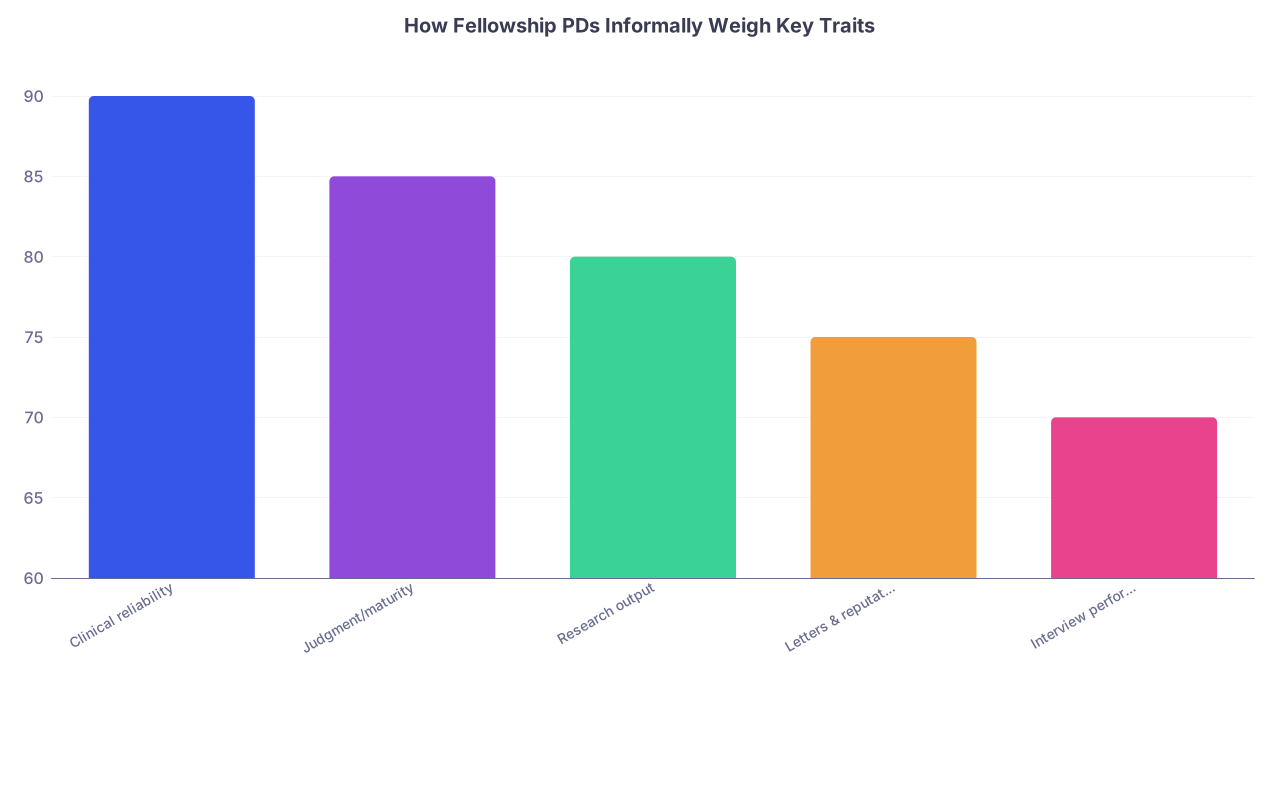
| Category | Value |
|---|---|
| Clinical reliability | 90 |
| Judgment/maturity | 85 |
| Research output | 80 |
| Letters & reputation | 75 |
| Interview performance | 70 |
Here is the mistake most applicants make: They think weekends are “free time,” so any interview that lands there is low-cost. It is not free. It pulls from three buckets that actually matter:
- Your physical and cognitive energy
- Your reliability on Monday morning
- Your credibility with your residency program
Let us talk about the weekend interview choices that scream wrong priorities.
Mistake #1: Saying Yes To Every Weekend Interview Offer
The classic insecurity move: accepting every single weekend interview because “I should keep all options open.”
No. You should not.
There is a ceiling on how many interviews you can do well while working 60–80 hours a week. Above that ceiling, the marginal interview hurts you more than it helps.
The residents I have seen crash and burn usually show the same pattern:
- 10–12 interviews total is reasonable for many specialties.
- They accept 18–20, especially with multiple weekend trips.
- By interview #11, they are flat, irritable, and recycling canned answers.
- By interview #14, they forget who they met where.
You may still match. But probably not at the programs that care about judgment and fit.
If you are applying to a moderately competitive fellowship, you do not need to accept every single weekend invite. You need to prioritize. Declining an early, low-priority invite to preserve your sanity and performance on higher-priority weekends is not risky. It is what grown-ups do.
The red flag for programs? Candidates who look wrecked and over-scheduled. They assume, correctly, that you will overcommit during fellowship too.
Mistake #2: Treating Every Weekend Like “Vacation Lite”
Here is a quiet career killer: using weekends as your “fellowship interview time” and not being honest with your residency program about it.
The pattern looks like this:
- You stack 3–4 out-of-state weekend interviews in October–November.
- You work full clinical weeks, then fly out Friday night, interview all day Saturday, fly back Saturday night or Sunday morning.
- You show up Monday looking like you were hit by a bus. You are slower. Less sharp. Forgetful.
You tell yourself: “I am not missing any clinical days, so this does not affect my PD’s view of me.”
Wrong. Your seniors and attendings see the difference. They see the attention lapses, the short temper, the mental fog. And your PD hears about it.
Do not forget: your residency PD and faculty write the letters that matter most. Not the fellowship program you visited for 8 hours on a Saturday.
Weekend interviews are not “free.” They trade off directly with:
- Your cognitive performance on the days before and after
- The quality of your interactions with your home program
- Your ability to be present with patients and co-residents
If you are stacking so many weekend interviews that your baseline work quality drops, you are making a bad investment. You might impress one extra external program while eroding the credibility of the people whose word carries the most weight.
Mistake #3: Skipping Program Fit Checks Just Because “It Is a Weekend”
Another common move: “It is on a Saturday, so why not? I am not that interested in the program, but it cannot hurt to see it.”
Yes, it can hurt. You just do not feel it immediately.
Here is what I mean: applicants treat weekend interviews like free sample days, especially for mid-tier or backup programs. They will fly across the country for a Saturday interview at a program that is:
- In a city they would never actually live in
- Weak in their desired niche (e.g., no transplant exposure for someone claiming transplant is their passion)
- Completely off their realistic rank list unless everything else implodes
Then they drag themselves through the day half-engaged, ask shallow questions, and fake enthusiasm badly. Faculty notice. They always do.
The backward logic is: “I do not really care about this one, so if it goes poorly, no big deal.”
Here is the actual problem: you are practicing bad interview habits. You are training yourself to fake, to be “on” when you are not authentically interested, and to ignore the clear mismatch between your goals and the program’s reality.
That leaks into your high-priority interviews. Your answers sound more generic. Your questions more rehearsed. A couple PDs might even talk, and your name will come up as the person who seemed checked out on Saturday.
Do not interview at places you would never rank. Weekend or not. Saying yes just because the calendar says “Saturday” is weak decision-making.
Mistake #4: Using Weekends To “Hide” From Your Residency Program
Some residents try to get clever. They stop asking for weekdays off because it is “politically easier” to just leave Friday evening or Saturday morning and come back unnoticed.
So they build this pattern:
- No explicit time off for interviews
- Several weekends away, sometimes back-to-back
- Slow erosion of performance and engagement at home
Your PD is not impressed by this. They see a resident trying to avoid uncomfortable conversations about priorities and scheduling. They see someone who would rather silently grind themselves into the ground than have a direct, adult-level negotiation about protected time.
You know what actually impresses a PD?
A resident who says early:
“I am applying to cardiology. Based on my competitiveness and prior match data, I expect around 8–10 interviews. I want to work with you now to figure out which ones justify time off versus weekend travel, and how to do this without compromising my rotations or my co-residents.”
That is professional. That shows foresight. It also lets them advocate for you, adjust the schedule, and avoid any appearance that you are sneaking around.
Trying to “hide” your fellowship efforts in weekends signals the wrong priorities twice:
- You are prioritizing short-term conflict avoidance over long-term trust.
- You are prioritizing external optics over your actual health and performance.
Stop trying to be invisible. That is a resident mindset. Fellowship applicants need to operate one level higher.
Mistake #5: Choosing Weekend Interviews That Clash With Brutal Rotations
There is a big difference between:
- A weekend interview during a lighter elective or research block, versus
- A weekend interview after a 6-day ICU stretch with three codes on Thursday and a late family meeting on Friday.
I have watched residents do both. The outcomes are not the same.
| Rotation Type | Weekend Interview Risk | Common Fallout |
|---|---|---|
| Outpatient clinic | Low | Mild fatigue |
| Research/elective | Low | Manageable with planning |
| Floor wards | Moderate | Monday performance drop |
| Night float | High | Cognitive impairment |
| ICU/CICU/NICU | Very High | Burnout, poor impressions |
The mistake: pretending that all weekends are created equal. They are not. Your baseline fatigue is rotation-dependent.
You should be brutal about declining or rescheduling weekend interviews that land directly after:
- ICU months
- Night float weeks
- Known heavy call stretches
You will show up to the interview with:
- Slower recall of your research and cases
- Less emotional bandwidth to connect
- Blunted enthusiasm that reads as disinterest
And then you will fly back and give your sickest patients the “leftover” version of you.
If a program insists on a specific weekend that collides with your worst rotation, and they will not budge? That itself is data. Programs that cannot be flexible at the recruitment stage rarely become more humane once you are a fellow.
Mistake #6: Treating Weekend Interviews as “Informal” and Letting Professionalism Slip
Too many residents treat Saturday interviews as somehow less formal. Dress a bit looser. Prepare a bit less. Stay partially in “weekend mode.”
I have seen people:
- Arrive Friday night too late to realistically rest, then yawn during the Saturday morning intro session.
- Skip deeper preparation (“It is a backup, and it is Saturday, how intense can they be?”).
- Act a little too casual at the social, because it feels like “their time.”
The message to the program: This applicant ranks their own convenience above the seriousness of the invitation.
Weekend interviews are not charity. Programs use weekends when:
- Faculty are clinically slammed during the week
- They want focused time to evaluate candidates
- They are filtering for people willing to prioritize the specialty
They are often watching more closely, not less, because they sacrificed their own weekend to be there.

If you treat weekday interviews as “serious” and weekends as “bonus,” you are telegraphing immaturity. That is not what they want in a future colleague who will be running codes, managing consults, and representing the program.
Mistake #7: Ignoring Travel Logistics That Will Sabotage You
This one sounds boring. Until you are the person sprinting through Atlanta Hartsfield at 10:30 p.m. Sunday night, realizing you are not going to make it back for Monday pre-rounds.
Sloppy logistics are not just “travel problems.” They are judgment problems.
The classic self-inflicted wounds:
- Booking the last possible return flight Sunday night with no buffer. One delay and you are texting your senior at 4 a.m. saying you will not make sign-out.
- Choosing connections instead of a more expensive direct flight, then calling out sick when weather hits.
- Not accounting for time zone shifts, so you show up to the interview either underslept or late.
Programs notice when you show up exhausted or frazzled. Your co-residents and chiefs notice when you stumble back in late or nonfunctional. People talk.
You are applying to be a subspecialist physician. If you cannot plan basic travel around your call schedule and clinical duties, they will question your ability to manage far more complex logistics—like sick patients, cross-coverage, and procedures.
Mistake #8: Using Weekend Interviews to Chase Prestige Instead of Fit
Here is the most subtle but probably the most damaging weekend mistake: spending your very limited weekend energy chasing famous names that make zero sense for your actual goals.
The storyline:
- You are a solid IM resident, strong clinically, light on research.
- The PD at a “big name” coastal academic powerhouse invites you to a Saturday interview. Their fellows all publish 3–5 papers a year. Many do T32s.
- Your actual career goal: clinically focused practice in a community setting.
You go anyway. Because “it is Harvard” or “it is UCSF” or “I cannot turn this down.”
So you burn a weekend flying there, get grilled on research you do not love, and spend the day trying to convince everyone (including yourself) that you care deeply about K awards. The PD sees the mismatch immediately. Then you drag home exhausted, less prepared for the interviews that actually align with your trajectory.
Instead, you should have protected that weekend for a place that:
- Matches your intended practice environment
- Aligns with your track record (clinic-focused vs heavy research)
- Has mentorship that actually fits your plans
Ambition is fine. But if your weekend choices show you care more about names on your CV than about realistic, coherent fit, sharp PDs will mark that down as immaturity. Or insecurity. Neither is appealing.
Mistake #9: Letting Guilt Or FOMO Drive Your Weekend Calendar
A lot of weekend interview decisions are not rational. They are driven by fear:
- Fear of missing out: “What if this is the one program that would have ranked me to match?”
- Fear of offending: “If I decline a Saturday invite, will they blacklist me?”
- Fear of being under-matched: “If I do not collect enough interviews, I will end up at a terrible program.”
Here is the actual data reality for most internal medicine–based fellowships: once you hit a reasonable interview count (often 8–12, depending on specialty and competitiveness), additional, lower-priority interviews add very little to your match probability, especially if they are at places you will rank low anyway.
Where they absolutely do add risk is:
- Your ability to be consistently “on” at your top choices
- Your performance and reputation at your home institution
- Your level of exhaustion midway through the season
Fear-driven scheduling is exactly how you end up overbooked on weekends, underperforming both at work and on interview days.
You need a clear line in your head before season starts:
“These are the types of programs and weekends I will say yes to. These are the ones I will decline, without guilt.”
That is what mature prioritization looks like.
What Weekend Choices Signal The Right Priorities?
You are applying for fellowship, not another year of school. You are supposed to be transitioning into a colleague. Your weekend interview behavior should reflect that.
The residents who send the right signals usually:
- Cap their total interviews to a sane number based on match data and their competitiveness.
- Are ruthless about saying no to programs that are geographic, academic, or practice-style mismatches. Weekend or not.
- Reserve the most demanding weekends (after ICU, nights) for recovery, not extra travel.
- Loop in their PD early, so their interview plans and weekend travel are not a surprise.
- Treat every attended interview—weekday or weekend—with the same level of professionalism, preparation, and respect.

| Step | Description |
|---|---|
| Step 1 | Interview Invite |
| Step 2 | Decline |
| Step 3 | Ask to reschedule |
| Step 4 | Accept |
| Step 5 | Plan travel with buffer |
| Step 6 | Inform PD if impact likely |
| Step 7 | Would I rank this program? |
| Step 8 | Conflicts with ICU or nights? |
| Step 9 | Already at safe interview count? |
They look like they have thought about their life as a whole, not just their application spreadsheet. PDs notice that. And respect it.
Final Takeaways
Keep it simple:
- Weekend interviews are not free. They cost you energy, performance, and reputation. Spend them where you would actually be happy to match.
- Saying yes to every weekend invite signals poor judgment, not dedication. Protect your clinical work, your health, and your high-priority interviews.
- If your weekend choices show you chasing prestige, avoiding honest conversations, or neglecting fit, programs will doubt your maturity. Choose like a future colleague, not a panicked applicant.


