
The biggest mistake residents make with fellowship support is asking for it months too late—and then trying to fix a timing problem with more effort. That never works.
You can be brilliant, hard‑working, and genuinely liked. Blow the timing, and your letters, advocacy, and “support” will be half‑baked at best and nonexistent at worst. I have watched residents tank otherwise competitive fellowship applications because they treated timing like a detail instead of a strategy.
Let me walk you through the traps so you do not become the cautionary story everyone whispers about in the workroom.
1. Waiting Until “You’re Ready” Instead of When Faculty Actually Have Time
The most common and most damaging timing error: waiting until you feel perfectly ready before you ask for support.
You think:
- “I’ll wait until my scores are back.”
- “Let me get that paper accepted first.”
- “I want to have my personal statement polished before I ask.”
By the time all that happens, it is August, your ERAS opens in a week, the program director is drowning in administrative garbage, and your favorite attending is on a two‑week vacation.
You optimized for your comfort, not for their calendar. Huge mistake.
Faculty calendars do not care about your internal timeline
Here is the blunt reality: faculty time is seasonal.
There are windows when they:
- Have bandwidth to mentor, read drafts, and write strong letters.
- Are doing nothing but service, coverage, or putting out fires.
- Are buried in promotion packets, annual reviews, or accreditation nonsense.
If you only look at your own milestones, you will consistently ask during the worst possible window for them.
| Category | Value |
|---|---|
| Apr | 5 |
| May | 9 |
| Jun | 18 |
| Jul | 32 |
| Aug | 41 |
| Sep | 11 |
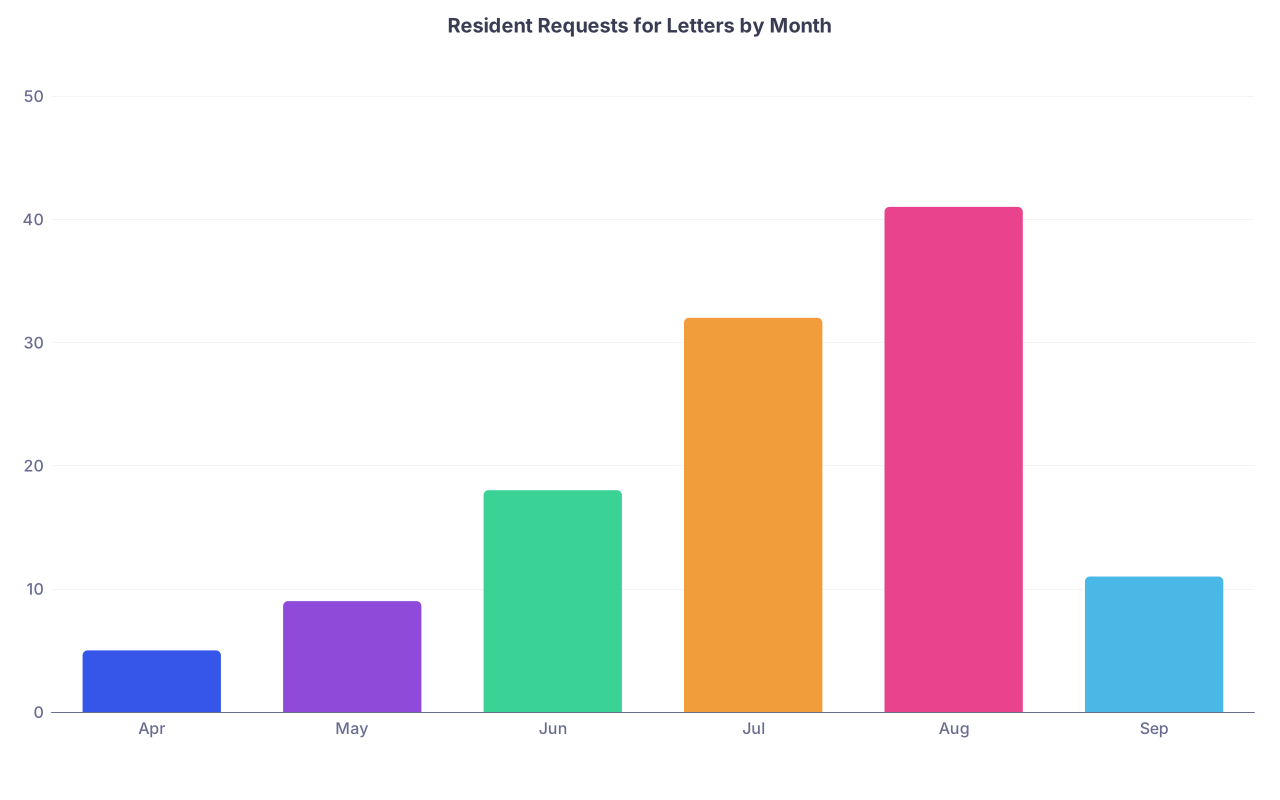
Most residents crowd into July–August. Your letter is then one more task in an overstuffed pile. That is how you get generic letters and slow responses.
The safer approach
Ask for support earlier than feels comfortable. Typically:
- For July‑start fellowships (ERAS opening in June): start conversations in February–March.
- Ask for letters in April–May, even if your materials are in draft form.
You can say, “My personal statement will likely go through a few revisions, but I wanted to confirm your willingness to support my application and get on your calendar.”
Do not wait to feel “ready.” Align with their bandwidth, not your perfectionism.
2. Asking for Letters After ERAS Opens (or Close to Deadlines)
This one is almost unforgivable. I have watched residents email in late August:
“Dear Dr. X, ERAS just opened and I was hoping you could write me a strong letter of recommendation by next week.”
That is not a request. That is an ambush.
Here is what goes wrong when you cut it that close:
- The letter becomes rushed, vague, and impersonal.
- The faculty member reuses an old template from another resident.
- They forget specific cases, projects, or strengths that could differentiate you.
- Worst case, they simply say no or ghost you because the ask is unreasonable.

How much lead time is actually reasonable?
Minimum: 4–6 weeks before you want ERAS submitted and before your program’s internal deadline. Many programs set internal letter deadlines for a reason—so faculty are not writing at midnight the day before submission.
A safer rule:
- Decide your target ERAS submission week.
- Count back 6–8 weeks.
- That is your true deadline for asking for letters and support.
| Step | Typical Timeframe (for July-start fellowship) |
|---|---|
| Initial interest discussion | Jan–Feb PGY-2 / early PGY-3 |
| Formal support conversation | Feb–Mar |
| Letter requests sent | Apr–May |
| Materials to letter writers | May–Jun |
| ERAS submission window | Late Jun–Jul |
If you are asking after ERAS is already open or within 2–3 weeks of when you “plan to submit,” you are already in the danger zone.
3. Ignoring Your Program’s Internal Deadlines (Or Pretending They’re Flexible)
Another rookie mistake: treating the program’s “internal deadlines” like suggestions.
They are not suggestions.
There is usually a hidden infrastructure behind those dates:
- Admins tracking who is applying to which fields.
- PDs preparing to advocate for you on calls or in emails.
- Divisions deciding which candidates they can strongly support.
When you ignore or blow through those dates:
- You look disorganized and less serious about your goal.
- Your PD has less time to make phone calls or send targeted emails.
- You may get dropped from lists for institutional support or departmental funds.

| Step | Description |
|---|---|
| Step 1 | Resident decides to apply |
| Step 2 | Inform program director |
| Step 3 | Program sets internal deadlines |
| Step 4 | Resident submits materials on time |
| Step 5 | Letters and advocacy coordinated |
| Step 6 | Resident misses deadline |
| Step 7 | Reduced support and rushed letters |
Residents often assume, “They like me, they will bend the rules.” Sometimes that is true. But the cost is still real—your application becomes last‑minute work instead of planned advocacy.
The disciplined move:
- At the start of the academic year, ask your chief or coordinator, “What are the internal fellowship timelines and deadlines?”
- Write those down.
- Work backward from those dates, not just from ERAS or SF Match deadlines.
You are not special enough for deadlines not to apply. No one is.
4. Only Asking for Support After You Have Locked in a Specialty
This is a subtle but dangerous timing problem: staying silent until you are 100% sure of your fellowship choice.
You think you are being respectful: “I will wait until I am certain before bothering my PD or attendings.”
In practice, you are removing their ability to meaningfully help you.
Here is what happens when you wait too long:
- You miss out on targeted rotations early enough to matter.
- You are not steered toward key faculty in your chosen field.
- Research and scholarly work come too late to mature before applications.
I have seen residents tell their PD in May of PGY‑3 that they want GI, after spending the entire prior year doing general wards and ICU with zero GI mentors. At that point, the PD can nod and send nice emails, but the structural support ship has sailed.
When you should start talking, even if you are not sure
You should start signaling possible interests early:
- PGY‑1: “I am leaning toward cardiology or heme/onc, but still exploring.”
- Early PGY‑2: Narrow that: “Right now, heme/onc is looking most likely, but I am keeping cardiology in mind.”
You are not signing a contract when you say this. You are giving your program a chance to align:
- Rotations
- Research
- Mentors
- Letters
The mistake is waiting for certainty. You need probable direction early, and then you refine. Silence until you are “sure” is a timing error that kills your runway.
5. Asking Busy Faculty at the End of a Rotation (Instead of Mid‑Rotation)
End of rotation: everyone is exhausted, notes are piled up, discharge summaries are late, sign‑out is chaos.
This is when many residents finally mumble, “By the way, would you be willing to write me a letter for cardiology?”
The attending:
- Is in a rush.
- Has not mentally prepared to think of you that way.
- Will forget half the specific interactions in 2–3 months.
So you end up sending them a reminder email weeks later, and now the letter is both delayed and disconnected from your actual performance.

Better timing:
- If the rotation is 4 weeks, ask around week 2 or early week 3.
- “I am planning to apply to pulmonary/critical care and would really value your support. If things continue to go well, would you be comfortable writing a strong letter?”
Why this works:
- They can pay closer attention for the remaining days.
- They can deliberately observe your growth in specific areas.
- You can then follow up with a well‑timed email while the memory is still fresh.
Do not wait for the farewell speech on the last day. That is sentimental timing, not strategic timing.
6. Asking for “Support” Without Giving People Time To Actually Help
You say, “I would appreciate any support you can provide.”
But you ask only after everything is already fixed:
- Rank list done.
- Program list chosen.
- Personal statement finalized.
At that point, there is almost nothing for mentors or PDs to influence. They cannot:
- Help you identify under‑the‑radar strong programs that would love your profile.
- Warn you about places that are a bad cultural fit for you.
- Connect you to colleagues at specific programs.
- Shape your narrative or help you avoid common content mistakes.
You handed them a finished product and asked for “support.” There is no time left to do anything but nod.
Where timing really matters for meaningful help
There are a few support points you must not push too late:
- Program list building – Talk to your PD and mentors before you lock in your list. Aim for late spring / very early summer.
- Personal statement and CV strategy – Get eyes on drafts at least 4–6 weeks before you hope to upload them.
- Advocacy calls/emails – Give mentors a heads‑up on your top programs before interview offers start going out, not after you are rejected somewhere.
| Category | Value |
|---|---|
| 6 months before | 95 |
| 3 months before | 80 |
| 1 month before | 50 |
| 2 weeks before | 20 |
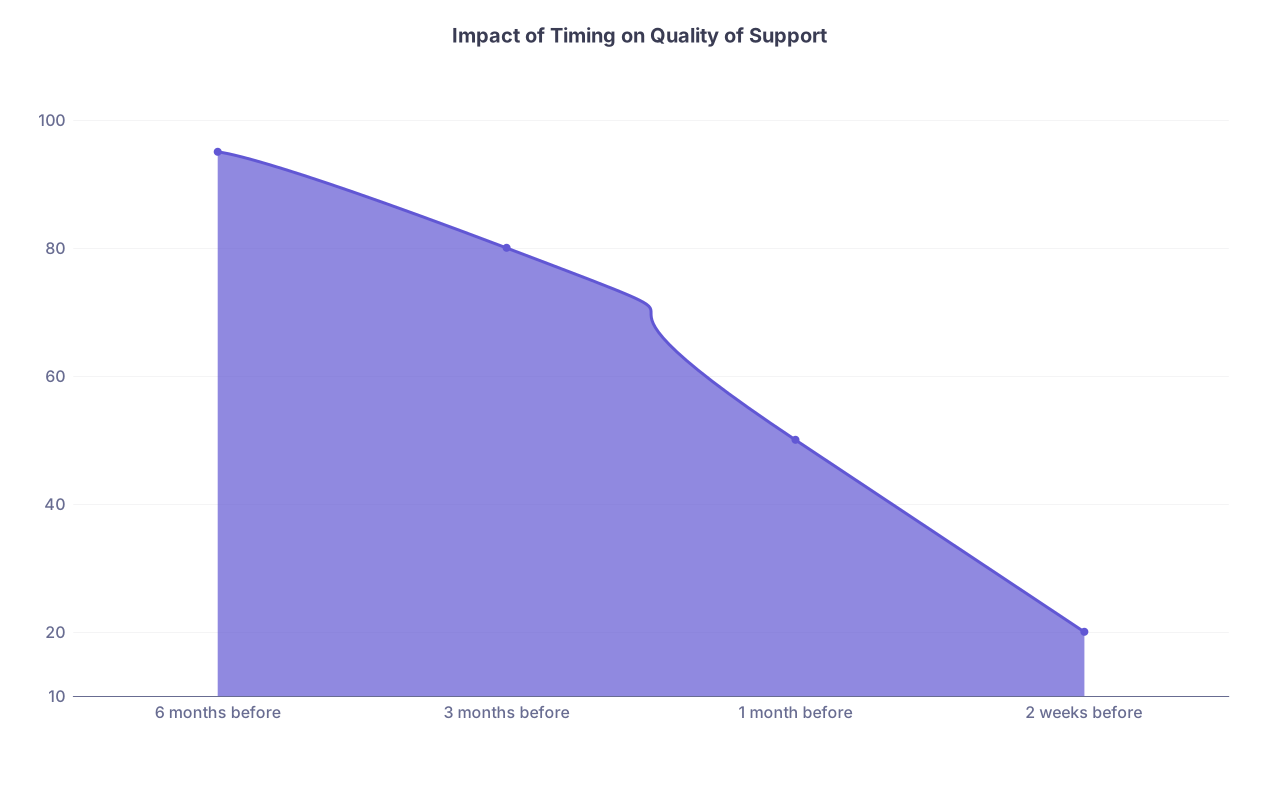
The later you request help, the lower the ceiling on how much they can actually do. You cannot fix a structural timing error by asking “extra nicely.”
7. Misjudging the Interview Season Timing for Asking Extra Advocacy
Another subtle trap: waiting too late in interview season to ask for additional support, or asking for it at completely the wrong time.
Two classic errors:
- Early panicking – Resident has not heard from their “dream program” one week after ERAS submission and already wants PD to call.
- Late desperation – Resident realizes in December they have very few interviews and only then requests a flurry of calls and emails.
Both are poorly timed.
Programs have their own cycles. Some send a bulk of invites early, then a second wave after cancellations. Some are slow by design. If your PD calls too early, it can be ignored or logged but not acted upon. If they call too late, the interview slots are gone.
You need to:
- Watch your field’s typical interview timeline.
- Compare your invite pattern to realistic expectations.
- Ask for targeted advocacy at the right phase, not out of anxiety.
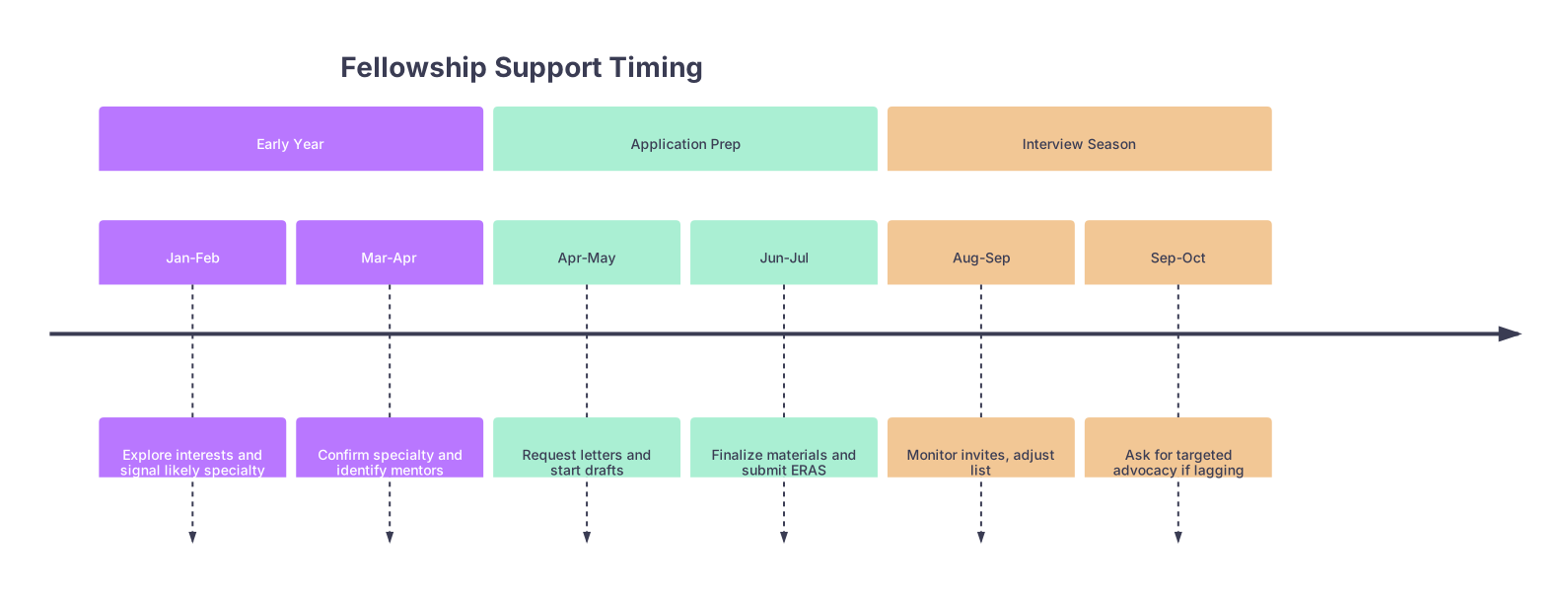
For many internal medicine subspecialties, that often means:
- ERAS submission: late June–July.
- First big wave of invites: August–September.
- Reasonable time to ask for help if you are lagging: mid‑September to early October, not August 1st and not December 20th.
| Period | Event |
|---|---|
| Early Year - Jan-Feb | Explore interests and signal likely specialty |
| Early Year - Mar-Apr | Confirm specialty and identify mentors |
| Application Prep - Apr-May | Request letters and start drafts |
| Application Prep - Jun-Jul | Finalize materials and submit ERAS |
| Interview Season - Aug-Sep | Monitor invites, adjust list |
| Interview Season - Sep-Oct | Ask for targeted advocacy if lagging |
Ask your PD plainly: “At what point in the interview season would it make sense to consider advocacy calls if my invite count is low?” Then respect that timing.
8. Assuming Every Faculty Member Knows the Real Deadlines
Another timing trap no one warns you about: assuming attendings understand ERAS and fellowship deadlines as well as you and your chiefs do.
Many do not.
I have seen this:
- Resident: “The deadline is September 15.”
- Attending hears: “Sometime in September.”
- Letter gets uploaded September 23.
- Program technically “accepts late letters,” but your application was incomplete at the first review wave, which is when most interview decisions are made.
Your application looked half‑finished when it mattered most.

You must:
- Be explicit about hard versus soft deadlines.
- State both the portal deadline and the “I want this in by” date.
- Build a buffer (at least a week, preferably two).
Example email:
“The official ERAS date is September 15, but programs begin reviewing applications immediately, so my goal is to have all letters in by September 1–5. Would that timeline work for you?”
If you tell them “by the 15th,” do not be shocked when they upload on the 15th at 11:59 pm or three days later. That is on you.
9. Forgetting That Timing Looks Different for Competitive vs Less Competitive Paths
Last big timing error: using the same casual timeline for hyper‑competitive fellowships that you would for more forgiving ones.
You cannot treat heme/onc or GI or cardiology like a noncompetitive community hospital fellowship in a less saturated region. The bar and the timeline are not the same.
For competitive fields:
- Research needs to start PGY‑1 or early PGY‑2.
- Mentorship and “I’m serious about this field” conversations need to happen early.
- Letters often come from division leaders who are busier and need more notice.
- Advocacy and internal political positioning start earlier than you think.
If you wait until the same time your colleague uses for a less competitive field, you are not just behind—you are not even on the same playing field.
| Fellowship Type | When Serious Planning Should Start |
|---|---|
| Highly competitive (GI, Cards, Heme/Onc) | PGY-1 to early PGY-2 |
| Moderately competitive | Mid PGY-2 |
| Less competitive / local | Late PGY-2 to early PGY-3 |
Ask the brutally honest question:
“Given my target specialty and my current CV, how early do I need to start positioning myself for strong support?”
If you hear “now” and you are already PGY‑3, that does not mean panic. It does mean you cannot afford any more timing mistakes.
FAQs
1. When is “too early” to talk to my program director about fellowship?
You will not look foolish asking in PGY‑1 about general directions (“I am thinking about cards vs critical care”). You would look foolish pretending in PGY‑3 that this is your first thought. Clear early curiosity is normal. Late, sudden interest with no prior signals looks impulsive and limits how much they can do for you.
2. How far in advance should I ask for letters of recommendation?
Aim for 6–8 weeks before your target submission date, ideally by April–May for July‑start fellowships. Earlier is rarely a problem; later becomes a gamble. If someone is known to be slow or extremely busy, give even more lead time and follow up politely but firmly.
3. What if I changed my mind about fellowship late in residency?
Then you must be aggressive about compressing the usual timeline without making your asks unreasonable. Be transparent: “I pivoted to nephrology recently after X experiences; I know this is later than ideal, and I would appreciate guidance on what is still feasible.” Do not pretend you planned it all along. Own the late shift and let mentors help you triage.
4. How do I avoid annoying faculty with multiple timing reminders?
You avoid annoying them by:
- Asking early enough that reminders are gentle nudges, not emergencies.
- Sending one clear initial email with all needed info (CV, draft PS, deadlines).
- Following up once at 2–3 weeks, then again 1 week before your internal cutoff. What annoys faculty is your panic at the last minute, not steady, respectful reminders. Plan the timeline correctly, and your reminders will feel appropriate, not desperate.
The short version:
- Do not time your asks around your comfort. Time them around faculty bandwidth and real review cycles.
- Start earlier than feels “reasonable” for conversation, letters, and advocacy—late requests cannot be rescued by good intentions.