

The biggest threat to your fellowship application is not your Step score or your program name. It is the way you quietly, consistently undervalue what you have already done.
Let me be blunt: most residents are terrible at recognizing the true weight of their own experience. They sand down every edge, downgrade every achievement to “just doing my job,” and then wonder why their application reads like a generic progress note.
You are sitting on real capital. Clinical, academic, leadership, systems-level capital. If you do not learn to see it—and describe it—programs will not either.
This is preventable. But only if you stop making the same predictable mistakes I see every year.
Mistake #1: Treating “Routine Clinical Work” Like It Does Not Count
If you catch yourself saying “I just did my job,” you are already minimizing yourself.
Residents do this constantly:
- “I have no leadership, I only ran the night float team.”
- “I did not do any big projects, I just improved our sign-out process.”
- “I do not have research; I only helped collect data for a QI project.”
Translation: “I did exactly the kind of work fellowships want, but I am going to label it as trivial.”
The problem is not that you did not do enough. It is that you do not understand how advanced your “routine” actually is compared with a medical student—or even a brand new fellow.
You underestimate:
- Managing cross-cover on 40–60 complex patients
- Running codes or rapid responses at 2 a.m.
- Making independent triage decisions with limited information
- Teaching interns how to think, not just what orders to place
- Negotiating with consultants, social work, case management
Fellowship PDs know this work is the backbone of a good fellow. But if you write about it like you are describing “just another day on the floors,” it disappears.
The mistake:
Describing your core clinical work in flat, generic terms instead of as high‑responsibility, high‑stakes experience.
How to avoid it:
- Stop using vague phrases like “managed patients,” “carried a large census,” “helped with admissions.”
- Start saying things like:
- “Led cross-cover management overnight for 40–60 medically complex inpatients, independently triaging pages and escalating high-risk situations.”
- “Served as code leader on night float, directing ACLS, delegating tasks, and communicating succinctly with ICU teams.”
- “Coordinated multidisciplinary discharge planning for high-utilizer patients with limited social support, reducing readmissions in my continuity panel.”
You are not “embellishing.” You are describing what already happened in language that reflects the level of responsibility you actually had.
If a strong MS4 could credibly claim what you wrote, you wrote it too small.
Mistake #2: Confusing “Not First Author” With “Not Valuable”
The second massive blind spot: residents who think their research or QI “does not count” because they are not first author or it is not in a big journal.
I hear this every season:
- “I only have case reports.”
- “I am just middle author on a retrospective study.”
- “We presented a poster at a regional conference, but it is small.”
And then I look at the project: multi-year data collection, 300+ charts, protocol development, IRB submissions, statistical collaboration. But on the application it shows up as a one‑line entry with no context.
The mistake:
Treating anything less than first-author, high‑impact original research as somehow unworthy of real description.
Let me be clear: fellowship programs know residents are busy. They do not expect you to be an R01‑funded PI. They care more about:
- Can you see a project through?
- Do you understand methods?
- Have you worked with mentors?
- Did you contribute something real, not just lend your name?
If you helped with design, data cleaning, analysis discussions, abstract writing, or presenting—say that. Do not hide behind “middle author.”
Break the habit of erasing your role.
How to avoid it:
- For every project, explicitly identify:
- What YOU did (not what “the group” did)
- The skills you gained (stats, survey design, chart review, protocol creation)
- The outcome (poster, oral, manuscript submitted/in revision/published)
| Type | Weak Description | Strong Description |
|---|---|---|
| Case report | Case report on rare disease | Co-authored case report on X; performed literature review and drafted discussion |
| Retrospective | Middle author on chart review | Contributed to 250-chart review on Y; built REDCap database and cleaned data |
| QI project | Helped with sepsis QI | Co-led sepsis QI; designed order set changes and tracked process metrics |
If you do not explain your contributions, committees assume the minimum. That is on you, not them.
Mistake #3: Calling Leadership “Just Helping Out”
Residents frequently give away leadership credit like it is meaningless.
Typical lines I see:
- “Participated in resident wellness committee.”
- “Helped organize noon conferences.”
- “Worked with PD on schedule optimization.”
No. You did not just “participate.” You solved problems in a chaotic system with limited time and authority. That is leadership.
Examples residents chronically undervalue:
- Creating or revising call schedules so they are actually humane
- Leading resident feedback meetings with faculty
- Serving as chief resident (and then describing it with two generic bullet points)
- Running a teaching series for interns or medical students
- Being the unofficial “go‑to” person for Epic tips, procedures, or rotation survival
The mistake:
Describing leadership work as clerical or social instead of strategic and operational.
Here is what committees actually want to know:
- Did you identify a problem?
- Did you organize people or processes?
- Did something change because of you?
So instead of: “Served on resident wellness committee.”
Say: “Co-led resident wellness committee; implemented protected ‘no-page’ time during noon conference and initiated monthly debrief sessions after high-mortality weeks.”
See the difference? Same role. Completely different perceived value.
Mistake #4: Hiding Teaching Experience Behind One Weak Sentence
Residents do a lot of teaching. They just talk about it like it is an afterthought.
Version I see all the time:
- “Enjoy teaching students during rotations.”
- “Frequently involved in resident and student education.”
That tells a reader nothing. Everyone “enjoys teaching” in their application. They have to say that. It is like saying you “care about patient care.” It is meaningless.
You are probably doing far more than you think:
- Running chalk talks for interns on call
- Orienting students to the ICU or wards
- Giving brief, focused teaching during procedures
- Serving as a near-peer mentor for juniors applying into your field
- Developing one or two go‑to mini talks (e.g., “Approach to hyponatremia,” “Acute GI bleed priorities”)
The mistake:
Failing to convert your informal daily teaching into clearly articulated, concrete educational experience.
How to avoid it: Describe:
- Who you taught (MS3s, MS4s, interns, other residents)
- How often (daily on rounds, weekly workshops, recurring sessions)
- What format (chalk talks, bedside teaching, simulation, case conferences)
- Any feedback or outcomes (invited back, asked to formalize it, recognized with teaching award)
Example: “Developed and delivered recurring 20-minute chalk talks on chest pain evaluation for MS3s and interns during night float; emphasized pattern recognition and safe disposition, informally collected feedback and refined content across the year.”
If you have even one slide deck or a recurring teaching pattern, that is formal enough to count. Do not throw it away with one vague sentence.
Mistake #5: Measuring Yourself Against the Wrong People
Another way residents silently devalue themselves: comparing their experience to unrealistic reference points.
Typical mental comparisons:
- To the superstar resident who has 12 publications and a PhD
- To the legacy applicant whose parent is a nationally known subspecialist
- To faculty who have been in the field for 10–20 years
So your brain quietly tells you:
- “I only have 2 posters, that is nothing.”
- “I have no big leadership roles; I was never chief.”
- “I just did standard residency rotations, nothing special.”
This is the wrong benchmark. Fellowship programs are comparing you to other residents at your training level and context, not to fully formed academic attendings.
The mistake:
Discounting your accomplishments because they are not maximal, instead of asking whether they are meaningful and well used.
You are not being evaluated on raw quantity alone. Committees look for:
- Trajectory: Did you grow, add responsibility, deepen involvement?
- Coherence: Do your experiences make sense for your stated interests?
- Resourcefulness: Did you do something with what was available at your program?
- Ownership: Do you talk about your work with clarity and pride, or like you are apologizing?
Stop writing your application as if you are explaining why you did not become your program’s one rock star. They only have one of those per year for a reason.
Your task is not to be “the best ever.” It is to show that you made smart, meaningful use of the opportunities you had.
Mistake #6: Assuming “No Big Title” Means “No Real Role”
Residents often think if there is no formal title, it is not worth mentioning. That is wrong.
Things I have seen residents hide or bury:
- Being the unofficial point person for EMR templates, order sets, or workflows
- Coordinating a hallway‑level QI fix, like improving handoff between specific teams
- Informally mentoring multiple MS4s through the match in your specialty
- Being asked repeatedly by attendings to orient new team members or visiting residents
You do not need the word “director,” “coordinator,” or “chief” in the title for the experience to matter.
The mistake:
Believing that impact only counts when it comes with a capitalized role name.
How to avoid it: Translate informal roles into structured descriptions:
- “Informal” → “served as primary resource for…”
- “People always asked me to…” → “regularly selected to…”
- “I kind of ran…” → “organized and led…”
Example: Instead of “I was the person everyone asked about Epic stuff,” write: “Served as go‑to resident resource for Epic efficiency; created and shared tip sheets on core workflows, informally trained new interns at the start of each block.”
You are not inflating. You are articulating. Big difference.
Mistake #7: Ignoring Systems-Level Work Because It Felt Small
You probably participated in at least one system or process improvement effort. Residents downplay this constantly.
They say things like:
- “We just adjusted a checklist.”
- “It was only a local protocol change.”
- “I only attended a few QI meetings.”
So they either leave it off entirely or condense it into two useless words: “sepsis QI.”
But from a fellowship perspective, systems thinking is gold. Fellows will be expected to:
- Improve protocols
- Evaluate outcomes
- Work with nursing, pharmacy, admin, and IT
- Advocate for safer, more rational care pathways
Your small project is a rehearsal for that.
The mistake:
Describing systems work only by topic, not by process and impact.
Instead of: “Participated in sepsis QI project.”
Say: “Contributed to multidisciplinary sepsis QI team; helped map existing workflow, identified delays in antibiotic administration, and piloted triage adjustments that decreased door‑to‑antibiotic time on the pilot unit.”
You are not promising randomized controlled trials. You are showing that you know how to engage in the messy reality of improving care.
Mistake #8: Letting Time Blur and Erase What You Did
By PGY‑3 or PGY‑4, most residents cannot clearly describe what they did in PGY‑1. They vaguely remember being tired. The details are gone.
This is dangerous for fellowship applications. Vague memory = vague description. Vague description = undervalued experience.
Your brain compresses years of work into one fuzzy sentence:
- “I did a QI project early in residency.”
- “I think I helped with a teaching curriculum.”
- “I was on some committee for a while.”
The mistake:
Waiting until the ERAS season to reconstruct years of experience from memory.
Your future self will forget:
- Exact roles
- Concrete numbers (how many charts, how many sessions, how many patients)
- Names of collaborators
- Dates and outcomes (submitted vs accepted, local vs national)
You cannot accurately value what you cannot clearly remember.
How to avoid it: Start a simple, running “experience log.” Not a novel. Just specifics:
- Project/role name
- Your role (1–2 sentences)
- Concrete metrics (numbers, frequency, size)
- Outcomes (poster, abstract, local talk, policy change)
- Dates
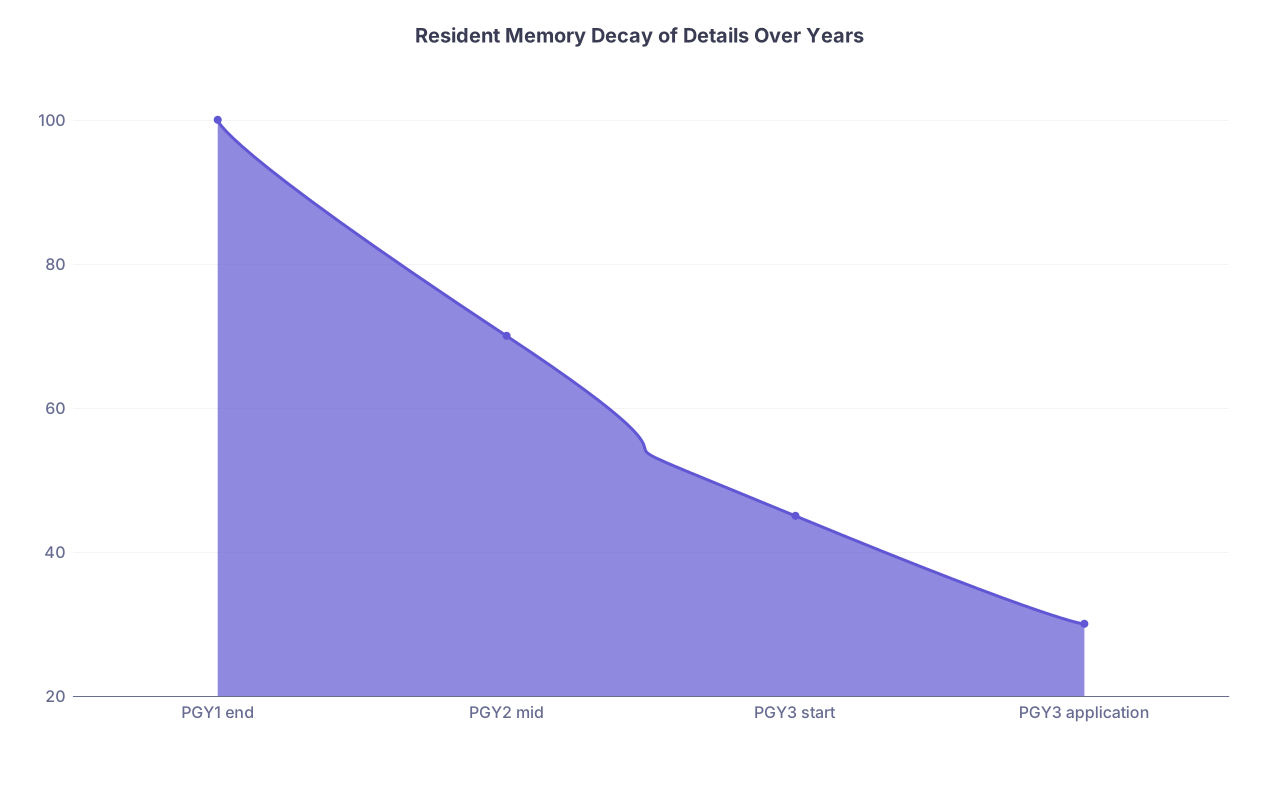
| Category | Value |
|---|---|
| PGY1 end | 100 |
| PGY2 mid | 70 |
| PGY3 start | 45 |
| PGY3 application | 30 |
The percentages are figurative, but the pattern is real. Your clarity drops each year. Beat it by writing things down while they are fresh.
Mistake #9: Using Apologetic Language That Shrinks Everything
Even when residents have strong experiences, they sabotage themselves with how they talk about them.
Common self‑sabotaging phrases:
- “Just a small project…”
- “Only a case report…”
- “I was lucky to be involved, but I did not do much.”
- “Nothing major, but I helped with…”
- “It was only at our institution.”
Read those again. If you write or say things like this on an application or in an interview, you are voluntarily lowering your own stock.
The mistake:
Embedding self‑critique into neutral descriptions—so committees see the criticism first and the work second.
You can be honest about scale without belittling:
- “Single-center retrospective review…”
- “Case report focusing on…”
- “Local QI initiative in our MICU…”
Those are neutral descriptors. They tell the reader what something is, not what it is “worth.”
Cut every “just,” “only,” and “nothing major” from your application. They are verbal price tags. And they always mark you down.
Mistake #10: Failing to Connect Experience to the Fellowship You Want
One more subtle way residents undervalue themselves: by presenting their experiences as a random pile, instead of a coherent story that points directly at fellowship.
You may have:
- Strong ICU rotations
- ED moonlighting
- Multiple QI efforts in a specific clinical area
- Teaching EM residents on airway or resuscitation
- Research in outcomes, systems, or education
But if you just list everything without commentary, you are making the committee do all the work to see how it fits.
They will not.
The mistake:
Presenting everything as separate, unconnected events instead of evidence of deliberate growth toward your chosen field.
You need to interpret your own CV. Explicitly.
For example, if you are applying to cardiology:
- Link your nights on cross-cover and rapid response to your comfort with acute hemodynamic instability.
- Frame your QI work on telemetry or heart failure as genuine systems interest, not busywork.
- Highlight that your teaching often centered on chest pain, arrhythmias, ACS algorithms.
If you are applying to critical care:
- Emphasize longitudinal ICU exposure and increased independence over time.
- Connect your sepsis, ventilator, or sedation projects to your future goals in ICU protocols.
- Underscore your love of multidisciplinary teamwork and complex family discussions.

| Step | Description |
|---|---|
| Step 1 | Resident Experiences |
| Step 2 | Clinical Exposure |
| Step 3 | Research or QI |
| Step 4 | Teaching and Leadership |
| Step 5 | Fellowship Narrative |
| Step 6 | Program Sees Clear Fit |
If you do not draw those lines, most committees will not take the time to draw them for you. That omission makes your experiences feel smaller and more random than they actually are.
Mistake #11: Assuming “Everyone Did This” So It Is Not Special
You probably downplay things because you think all residents did the same.
They did not.
Commonly undervalued “everyone does this” experiences:
- Acting as senior on high-acuity rotations with real autonomy
- Serving as the primary contact for difficult families
- Being asked to precept or supervise more junior trainees
- Getting tapped to pilot a new rotation or workflow
- Being invited by an attending to continue working on a project long‑term
Just because your co‑residents did something similar does not make your specific role meaningless. It still shows:
- Trust from your program
- Repeated exposure to relevant situations
- Real-world readiness for fellowship-level responsibilities
The mistake:
Equating “typical for residents” with “not worth mentioning.”
Fellowships expect some overlap. They know what standard training looks like. What they want is your version of those experiences:
- What you actually did
- What you learned
- How it shaped your readiness for their subspecialty
Never delete something solely because “everyone has that.” The real question is: “Did I do this in a way that shows skills or judgment that matter for fellowship?”
Often the answer is yes. You just have not dissected it properly yet.
Mistake #12: Writing Like a Note, Not a Narrative
Finally, many residents accidentally devalue their experience through the way they write: clipped, telegraphic, stripped of any sense of stakes.
They write their personal statement like an H&P:
- “Rotated on MICU PGY-2.”
- “Completed QI project in sepsis bundle adherence.”
- “Enjoy working with a team.”
No tension. No scale. No human reality.
The mistake:
Documenting instead of conveying. Listing instead of persuading.
You do not need flowery language. You do need:
- Context: Where were you? What was your role?
- Stakes: Why did this matter? To patients, team, system?
- Growth: What changed in your understanding or skill?
Example transformation:
Weak:
“Did sepsis QI project to improve bundle adherence.”
Stronger:
“As a PGY‑2 on our MICU rotation, I led a small QI project after seeing multiple delays in sepsis recognition overnight. Working with nursing and ED leadership, I helped redesign our triage checklist and created a simple paging algorithm that made it easier for front-line staff to escalate concerns quickly.”
Same underlying work. Very different perceived value.
You are not writing to “not look bad.” You are writing to show why your experience actually means something.

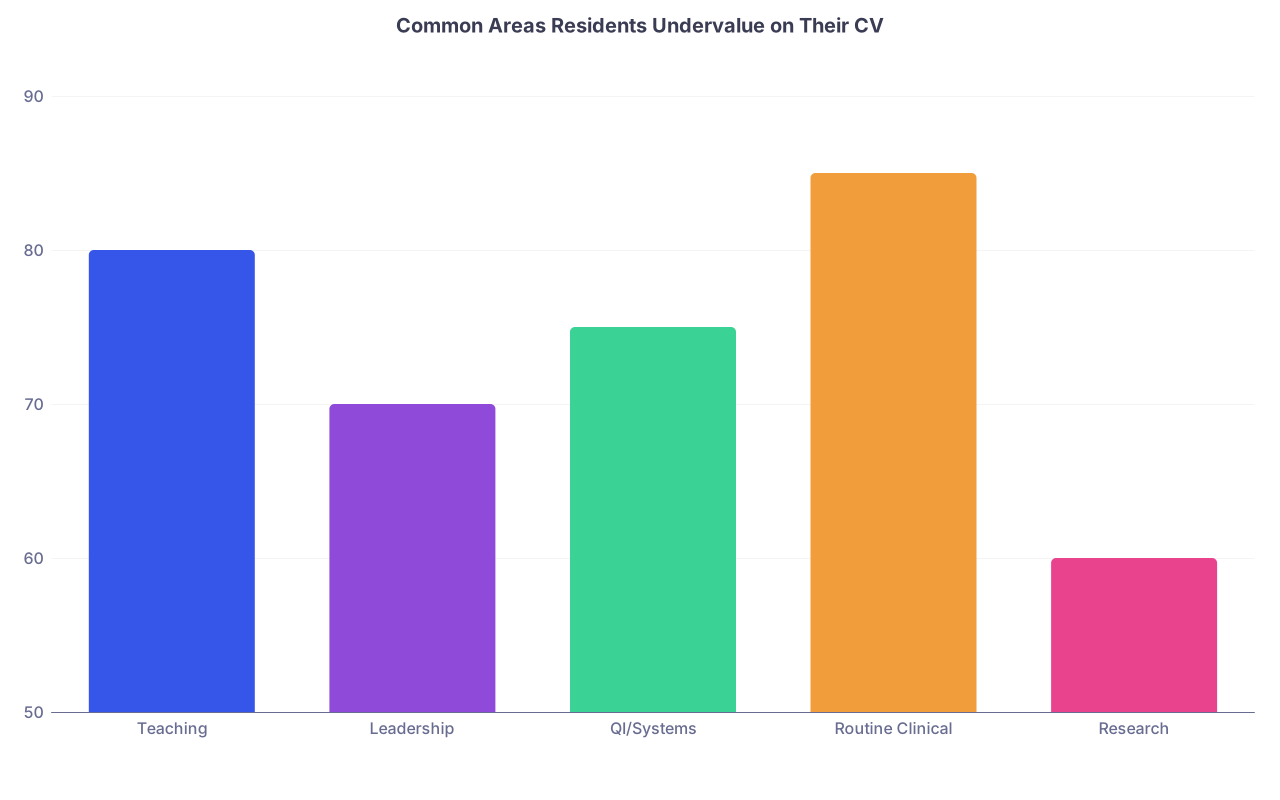
| Category | Value |
|---|---|
| Teaching | 80 |
| Leadership | 70 |
| QI/Systems | 75 |
| Routine Clinical | 85 |
| Research | 60 |

| Step | Description |
|---|---|
| Step 1 | List All Experiences |
| Step 2 | Identify Your Role |
| Step 3 | Quantify Scope and Impact |
| Step 4 | Rewrite Without Apologetic Language |
| Step 5 | Link to Fellowship Goals |
How To Stop Undervaluing Yourself: A Simple Reframe
You are too close to your own training. You see the chaos, the missed lectures, the projects that fizzled. Committees see only what you choose to show them.
To avoid the trap of self‑minimization, do three things:
Describe what you actually did in precise, concrete terms.
Not what you wish you had done. Not a watered‑down version that sounds “humble.” Exact responsibilities, scope, outcomes.Strip out apologetic language.
No “just,” “only,” “nothing big.” Neutral, factual wording is enough. Let the reader decide scale; your job is to be accurate and specific.Tie your experiences directly to fellowship-level skills.
Show how your clinical work, teaching, leadership, systems projects, and research make you ready to function as a fellow in that specific field.
If you do not control that narrative, your application will underprice you. And you will have done that to yourself.
Stop calling your experience “nothing special.” You have already paid for it in sleep, stress, and years of your life. The least you can do is present it at full value.


