
It’s March. You just signed your fellowship contract. Your PD congratulated you. Your co-residents are patting you on the back. And your future fellowship director emails:
“Excited to have you. We have several ongoing projects where you could really shine—happy to loop you in early if you’re interested.”
You’re on night float. You’re tired. But you type back: “Absolutely! I’d love to get involved right away. I can help with manuscripts, QI, data collection—whatever’s needed.”
Three months later, you’re post-call, staring at:
- 8 “gentle reminder” emails
- 3 half-finished drafts
- 1 angry statistician
- A co-author asking why you missed yet another meeting
And you have this realization:
You promised way more than you could possibly deliver. And now your reputation is on the line before you even show up as a fellow.
Let me be blunt: over-promising projects before fellowship starts is one of the quietest, most reputation-damaging mistakes residents make. It feels generous. Ambitious. “Team player.” In reality, it often reads as disorganized, unreliable, and naive.
Let’s walk through the landmines so you do not become the cautionary tale everyone gossips about at journal club.
Why Residents Over-Promise (And Why Your Brain Lies to You Here)
You are not over-committing because you’re stupid. You’re over-committing because you’re human and in a pressure cooker.
The usual drivers:
Fear of being replaceable:
“If I don’t jump on these projects, someone else will, and I’ll show up as the lazy fellow.”Misreading politeness as expectation:
That friendly “we’d be happy to have you involved” email? You hear: “You must prove yourself now or we’ll regret ranking you.”Residency survival mentality:
You’re used to doing impossible things with no time. So your brain believes: “Yeah, I can write a paper on nights. And on vacation. And on ICU blocks.”CV panic:
You start comparing yourself to that co-resident with 10 first-author publications and suddenly you’re saying yes to any abstract, QI project, or case series that breathes.Bad role models:
You’ve seen that one upper-level who seemed to be on every project. You didn’t see the missed deadlines, the burned bridges, and the quiet “we won’t work with them again” conversations.
The result is predictable: a heroic-sounding “yes” followed by months of quiet, messy failure.
The Hidden Costs: What Over-Promising Actually Does to You
This is where people get burned. They think the worst-case scenario is “I’m busy for a while.” No. The worst-case scenario is reputational.
1. You Get Labeled as Unreliable Before Day 1
Programs remember two types of incoming fellows:
- The one who did solid, finished work before arrival
- The one who ghosted on three projects and always had “crazy schedule right now” excuses
Guess which one gets:
- Early access to meaningful projects
- Faculty who advocate for them at promotions committee
- Strong letters down the line
And guess which one gets quietly excluded from serious work.
Reputation in fellowship is sticky. You don’t want the label “flaky” attached to your name at orientation.
2. You Create a Trail of Half-Finished Work With Your Name on It
I’ve seen this too many times. Resident agrees to:
- Write the introduction for a manuscript
- Clean up a dataset
- Draft a conference abstract
Then:
- ICU rotation hits
- Board prep starts
- Their family needs them
- Life does what life does
And those tasks sit. Faculty talk to each other. “Yeah, we had them on a project. Never really followed through.”
You think it’s just one missed email. They see it as a pattern.
3. You Poison Future Opportunities You Haven’t Even Seen Yet
The real damage isn’t the project you drop. It’s the project you never get offered because of it.
Faculty share impressions. Informally. Quietly. This person is “solid,” this one is “eager but not realistic,” this one “over-commits.”
You want to be in the first category. Over-promising puts you firmly in the third.
Where This Most Commonly Blows Up
If you recognize yourself in any of these scenarios, you’re at risk.
Common trap situations:
Pre-fellowship research push
“Let’s try to get 2–3 more abstracts before July.”
Translation: you now owe three different people deliverables while you’re finishing night float, ICU, and maybe chief duties.“We’ll get this submitted before you start” optimism
That “simple” paper with clean data and “almost done” status?
It becomes a 40-email chain and a mess of comments in the Google Doc.Multiple mentors, no clear priorities
You say yes to:- Your current attending (“we should write this up”)
- Your future fellowship PD (“we have a registry you’d be great for”)
- A co-resident (“let’s submit this case series to CHEST”)
Each thinks they’re in your top 2 priorities. In reality, you don’t have a top 2. You have a chaotic 9.
Interview bravado that comes back to haunt you
You told programs:
- “I’m really interested in outcomes research and large datasets.”
- “I’d love to help with your existing trials.”
Faculty remember this. They send follow-up emails. And you feel obligated to back up that shiny interview persona.
The Math You’re Ignoring: Your Actual Capacity vs Your Fantasy
Let’s be coldly realistic and look at what your last 6 months of residency really look like.
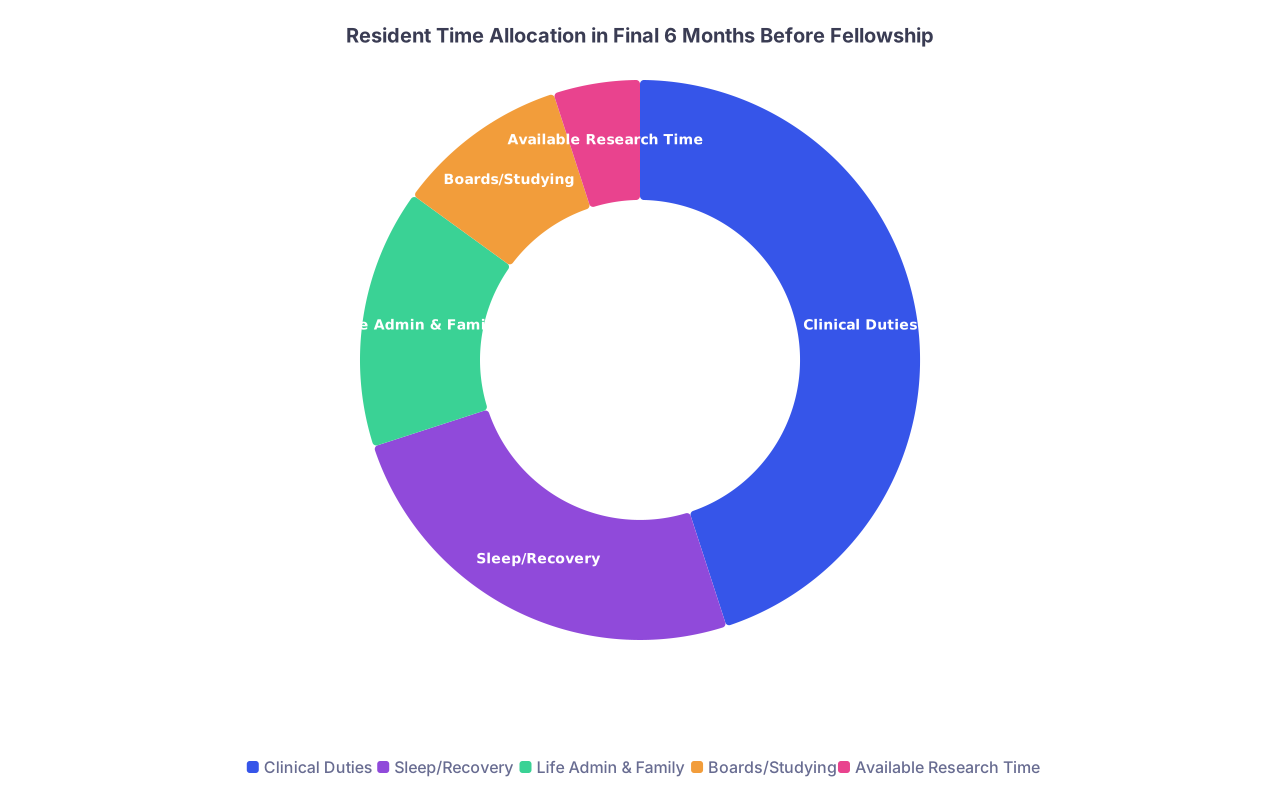
| Category | Value |
|---|---|
| Clinical Duties | 45 |
| Sleep/Recovery | 25 |
| Life Admin & Family | 15 |
| Boards/Studying | 10 |
| Available Research Time | 5 |
That “Available Research Time” slice? That’s what you’re trying to reinflate into 30–40%.
You are making three classic calculation errors:
You count hypothetical time as real time
“I’ll work on this on my days off.”
No you won’t. You’ll be doing laundry, seeing your partner for the first time in a week, and trying not to cry into your coffee.You assume linear productivity
One hour of writing when you’re rested on a chill clinic block is not the same as one hour of writing post-call from the MICU when your brain is soup.You ignore transition friction
Switching between multiple projects, timelines, and writing styles drains you. You lose time just figuring out what “version_final2_REALthisTime.docx” actually is.
How Over-Promising Before Fellowship Specifically Hurts Your Start
This isn’t just a generic “don’t take on too much” lecture. Over-committing before fellowship has some unique traps.
1. You Start Fellowship Already Behind and Guilty
You walk in Day 1 thinking about:
- The manuscript you still owe your old mentor
- The abstract that didn’t get submitted because you were buried
- The “quick edits” your future PD reminded you about… and you ignored for two weeks
So instead of:
- Learning workflows
- Understanding expectations
- Watching how seniors survive
You’re trying to secretly carve out time to fix old mistakes and calm down old collaborators.
2. You Don’t Have Clean Boundaries Between “Old” and “New” Work
You need a dividing line:
- Before fellowship: selective wrap-up
- During fellowship: aligned work that fits your new environment, mentors, and goals
Over-promising blurs that line. Suddenly you’re:
- Doing old institution charting requirements for a QI project
- Coordinating with IRB personnel at a place where you’re no longer on staff
- Fighting for data access from systems you no longer even log into
All while trying to learn your new EMR, clinic templates, and call structure.
3. Your New Program Sees the Fallout Firsthand
When you’re frantically finishing edits for your former mentor during your new clinic block:
- You’re distracted
- You miss small clinical details
- You’re short with nurses or staff
- You look frazzled on rounds
Nobody says, “Ah, they’re just still finalizing an old research paper.” They just see a fellow who looks disorganized.
Red Flags You’re About to Over-Promise (Pay Attention to These)
If you catch yourself thinking or saying any of the following, stop and reassess.
- “It’s only a short manuscript.”
- “The data are already collected, I just have to write.”
- “I’ll work on it on nights.”
- “I can probably knock this out in a weekend.”
- “This will just be a small side project.”
- “I don’t want to disappoint them—they’ve been so supportive.”
Translation of all of those:
“I haven’t done the math and I’m about to say yes because I’m emotionally uncomfortable saying no.”
What To Do Instead: A Safer Approach That Still Makes You Look Good
You don’t need to hide. You don’t need to say “no” to everything. You need to say “yes” in a way that you can actually deliver.
1. Cap the Number of Active Projects
Pick a hard number. For most PGY-3s/4s nearing fellowship start, that number is lower than you think.
Reasonable active project cap before fellowship:
- 1 primary (you are first author / main driver)
- 1 secondary (supporting role: data, figures, small section)
- 1 “low-maintenance” legacy project (truly near-submission, no major analysis or design work)
If you already have 3–4 in motion? You’re done. No new commitments until something is submitted.
2. Interrogate Every New Opportunity With Three Questions
Before you say yes, ask:
Does this clearly align with what I want to be known for in fellowship and beyond?
- If you’re going into cardiology, a random dermatology case report on toenail fungus is probably not your top priority.
- Yes, it’s “another line on the CV.” No, it’s not worth the bandwidth.
Can we realistically get this to submission before my fellowship start date, given my schedule?
Force specifics:- Who’s writing what?
- When is the first draft due?
- Who’s doing analysis, and is that person actually responsive?
What happens if the timeline slips?
If the honest answer is “I’ll be stuck working on this deep into fellowship,” that’s a major red flag.
3. Use Clear, Protective Language When Responding
Stop saying vague yes. Use guarded yes or honest no.
Examples:
Guarded yes (safe)
“I’d be interested, but I want to be transparent that I’m in my final months of residency and starting fellowship July 1. If the core writing and analysis can be wrapped up by mid-June, I can commit. Otherwise, I worry I won’t be able to give it the attention it deserves.”Boundary-setting yes
“I can help with the introduction and discussion, but I won’t be able to take primary responsibility for data cleaning or submission logistics. If that division of labor works, I’m in.”Respectful no
“This sounds like a great project, and I appreciate you thinking of me. I’m at capacity with existing commitments as I transition to fellowship, and I don’t want to take this on and do it halfway. If something shifts and I free up sooner than expected, I’ll reach out.”
That last line—“I don’t want to do it halfway”—signals maturity, not laziness.
Coordinating Old and New Mentors Without Burning Either
This is another place people screw up badly: trying to keep everyone happy and ending up pleasing no one.

| Step | Description |
|---|---|
| Step 1 | New Project Offer |
| Step 2 | Say no or defer |
| Step 3 | Guarded yes with clear scope |
| Step 4 | Clarify roles or decline |
| Step 5 | Already at project cap |
| Step 6 | Aligns with future goals |
| Step 7 | Can be finished before fellowship |
Practical rules:
Tell your future fellowship mentor what you’re finishing up
“I’m first author on one manuscript and a middle author on another, both in late-stage drafting. I expect to have them submitted by August at the latest. Beyond that, I won’t be taking on new work from my residency institution.”Tell your current mentor your real timeline
“I start fellowship July 1. I’d like to get this submitted before then. If it looks like that’s not going to happen by mid-June, I may need to step back or take a smaller role so I don’t over-commit during fellowship.”
You are protecting your name here. Your mentors might be disappointed in the short term, but they will prefer that to a year of ghosting.
Signs You Need to Pull the Emergency Brake Now
If any of these are already true, you should stop taking on anything new and start pruning:
- You have more than 3 projects where your name is the main driver and no submission in sight.
- You are behind on emails for more than 2 weeks on any research thread.
- You’ve already missed one self-imposed deadline (“I’ll get you a draft by Friday”) by more than 7–10 days without warning them in advance.
- You feel dread when you see your future fellowship PD’s name in your inbox.
- You catch yourself thinking, “I’ll just catch up once fellowship starts and things are more stable.”
That last thought is pure fantasy. The first 6 months of fellowship are some of the most destabilizing months of training.
A Quick Comparison: Smart vs. Self-Sabotaging Pre-Fellowship Behavior
| Approach | Outcome |
|---|---|
| Say yes to every “interesting” project | Overdue tasks, damaged reputation, unfinished work |
| Cap active projects at 2–3 | Higher completion rate, stronger relationships |
| Vague commitments (“I’ll help however I can”) | Role confusion, frustration from mentors |
| Specific roles and timelines | Clear expectations, easier accountability |
| Ignore schedule reality | Burnout, missed deadlines |
| Plan around known heavy rotations and boards | Sustainable pace, less anxiety |
How To Clean Up If You Already Over-Promised
You might be reading this thinking, “Too late. I already said yes to everything.”
Fine. Then the goal now is damage control and honest recalibration.
Step 1: Inventory everything
Make a list:
- Project name
- Your role
- Stage (idea / data / draft / revision / submitted)
- Who’s waiting on you
- Realistic hours needed to get to next milestone
Be brutally honest. No “I can probably do that in 2 hours” fantasies.
Step 2: Decide what you will actually see through
Pick:
- 1–2 projects to truly prioritize
- Everything else goes into “I need to step back or downgrade my role”
Step 3: Communicate early, not when people are already angry
Example scripts:
For de-prioritized projects
“I’ve realized I overcommitted across several projects as I approach fellowship. I want to be transparent now rather than continue to be slow and unresponsive. I don’t think I can be the primary driver on this anymore. If it’s possible for me to stay on in a smaller role (e.g., helping with a revision or specific section later), I’d appreciate that, but I understand if that’s not feasible.”For priority projects
“I’m committed to seeing this through and have blocked dedicated time in the next 6 weeks. You can expect [specific deliverable] by [specific date]. If anything changes on my end, I’ll let you know at least a week in advance.”
Notice the pattern: specific, humble, and proactive.
The Bottom Line: What “Impressive” Actually Looks Like to Fellowship Programs
You think they want:
- The resident who says yes to 10 projects
- The one with 20 half-baked abstracts in progress
- The person who replies at 2 a.m. to every “opportunity” email
What they actually respect:
- The resident who finishes what they start
- The one who can say “no” thoughtfully
- The person who is realistic about their limits and protects their reliability
Do not make the mistake of confusing volume with value. Or busyness with professionalism.
Your name is going to follow you for a long time. Protect it now by under-promising and actually delivering, not over-promising and scrambling.
FAQs
1. Won’t saying no to projects before fellowship make me look unmotivated?
No. If you communicate clearly—“I’m at my limit and don’t want to do this halfway”—most serious mentors will respect that. What makes you look unmotivated is agreeing and then disappearing, being perpetually late, or sending half-finished work.
2. How many projects should I realistically have going as I start fellowship?
For most people:
- 1–2 carried-over projects from residency, ideally late-stage (near submission)
- Maybe 1 new, tightly scoped project in fellowship once you understand the workflow
If you’re walking into fellowship with 5–7 “active” projects and nothing submitted, that’s a warning sign.
3. What if my future fellowship PD personally invites me to a project—can I really say no?
You shouldn’t reflexively say no, but you absolutely can set boundaries. Try:
“I’d be very interested, but I’m currently finishing 2 projects that I’ve committed to submit by June. If this timeline is more flexible, I’d be happy to help in a defined role; if you need someone immediately, I worry I may not be the best fit right now.”
4. Is it okay to drop a project completely if I’m overwhelmed?
Yes, but own it early and cleanly. Don’t ghost. Say something like:
“I misjudged my capacity. I don’t think I can contribute meaningfully to this right now. I’m sorry for over-committing earlier. If it makes sense to remove me from authorship, I understand.”
Short-term awkwardness is better than months of slow bleeding.
5. How do I know if a project is “worth it” pre-fellowship?
Quick filter:
- Does it clearly fit your intended specialty and long-term interests?
- Is your role substantial enough to learn something or gain meaningful credit (not just “name somewhere in the middle” busywork)?
- Is there a realistic path to submission before or shortly after fellowship start—with people who have a track record of actually finishing things?
If the answer to any of these is “no,” think twice.
Today’s one action step:
Open your email or notes and make a complete list of every project you’ve said “yes” to in the last 6–9 months. Next to each one, write a brutal, honest estimate of how many hours it will take you to get it to submission. If that number makes your stomach drop, you know what your next job is: start pruning and renegotiating before fellowship starts, not after it implodes.