

It is 11:47 p.m. You are post-call, half-awake, finally opening your laptop to “knock out” those fellowship emails you have been putting off. Your co-resident matched cardiology at a big-name program, your inbox is full of ERAS notifications, and you feel behind.
So you do what most residents do in that anxious moment: you fire off quick emails to program directors, coordinators, anyone whose name you can find. You copy‑paste a template. You hit send without re-reading. You tell yourself, “They know I am busy. It is fine.”
It is not fine.
I have watched excellent applicants quietly sink their chances with one or two terrible email habits. Not low scores. Not weak letters. Just bad email decisions that made them look entitled, careless, or unprofessional. Fellowship program directors will not always reply, but they do notice. And yes, they remember your name.
Let me walk you through the landmines so you do not step on them.
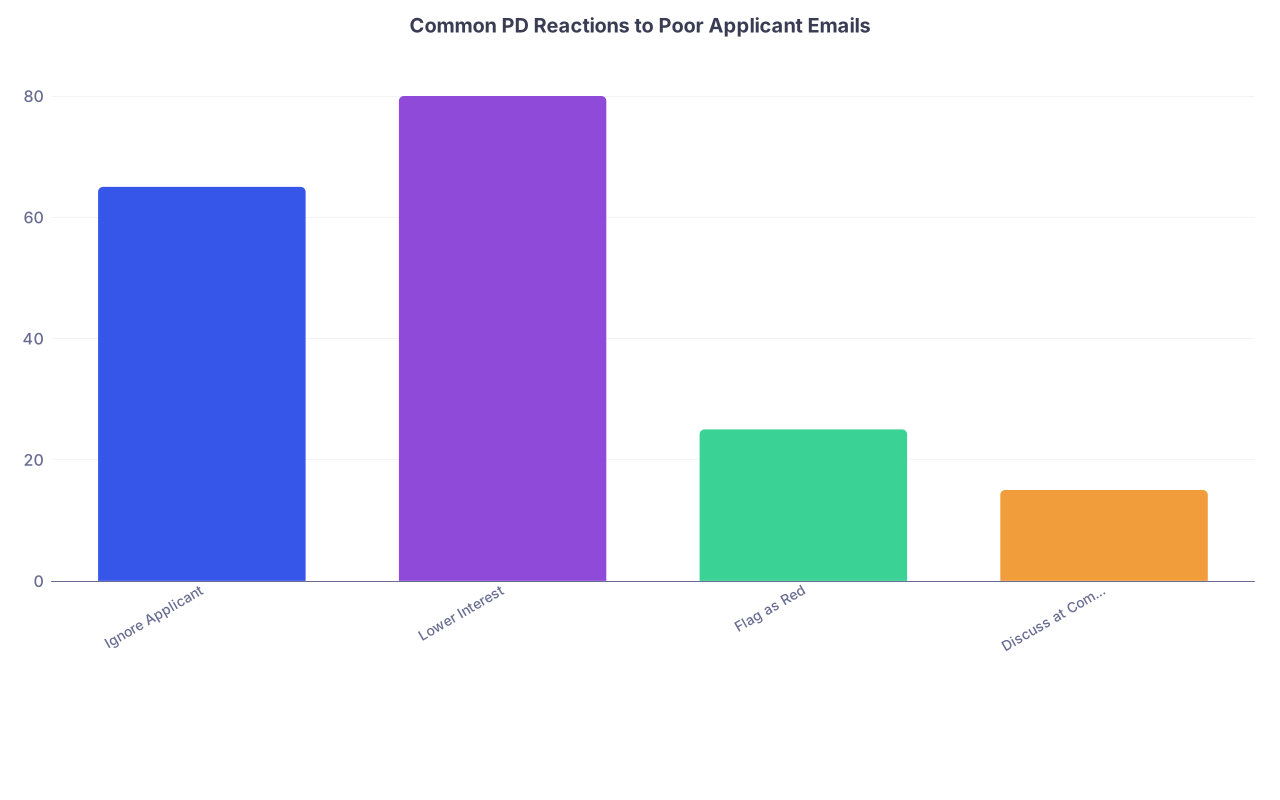
| Category | Value |
|---|---|
| Ignore Applicant | 65 |
| Lower Interest | 80 |
| Flag as Red | 25 |
| Discuss at Committee | 15 |
1. The “Spray and Pray” Mass Email Blast
You sit down and type one generic email:
Dear Program Director,
I am very interested in your prestigious program and would love the opportunity to train at your institution…
You paste it into 30 separate messages. You forget to change the program name twice. You send one email to “Dear Dr. Smith” at a program where the PD is actually Dr. Patel. Another where you say “I am very interested in cardiology” to a pulmonary/critical care program. I have literally seen “your dermatology fellowship” in an ID PD’s inbox.
This is how you look when you do this:
- Lazy
- Desperate
- Unfocused
And here is what PDs do with those:
- Delete
- Mentally tag you as “generic applicant”
- Sometimes show your email on a screen during the selection meeting as a cautionary example
Do not make this mistake.
What you must avoid:
- Copy‑pasting the same 3–4 lines to every program
- Wrong specialty names, wrong city, wrong program name
- Referencing features the program does not have (e.g., “I am drawn to your strong heart failure track” when they do not have one)
- Sending obviously templated emails 5 minutes apart to 20 programs
Better approach (still conservative): Send fewer, targeted emails:
- Only to programs you are genuinely interested in
- Only when you have something specific and accurate to say about that program
- After checking the PD and coordinator names twice
If every sentence in your email could be sent to any other program without changing a word, delete it. You are not ready to send that message.

2. The “I Demand an Update” Email
This one ruins otherwise decent applications.
You applied six weeks ago. No invite yet. Anxiety builds. You open a new message:
Dear Dr. X,
I submitted my application on July 10th and have not heard back regarding an interview. I am writing to inquire about the status of my application and whether I will be invited for an interview.
Or worse:
I have other interviews scheduled and need to finalize my plans, so I would appreciate a prompt update.
Here is how that sounds to a PD:
- “Your timeline should match my anxiety.”
- “I do not understand how busy you are.”
- “I assume you owe me a personal status report.”
They do not. And some will be blunt about it behind closed doors.
Red-flag features of these emails:
- Asking directly, “Will I be invited?”
- Asking them to “prioritize” or “expedite” your review
- Implying their lack of response is unfair or unprofessional
- Sending follow-up status requests multiple times
PDs are reviewing hundreds of applications between service, research, admin, and their own lives. The applicant who politely expresses interest is one thing. The applicant who demands clarity on their internal ranking process is another.
What you can safely do:
- One, well‑crafted, clearly interested email per program
- Focused on fit, not status
- Something like: “If there are any additional materials that would be helpful as you review my application, I would be happy to provide them.”
And then you stop. If they want to interview you, they will. Your third “just checking in” email is not changing anything except their impression of your judgment.
| Email Type | Safe or Dangerous | Why |
|---|---|---|
| Initial interest email | Safe | Shows fit if specific and respectful |
| Update with new score/publication | Safe | Adds objective value to application |
| “What is my status?” email | Dangerous | Sounds entitled and pressures program |
| Multiple follow-up “check-ins” | Dangerous | Signals poor insight and boundaries |
| Mass generic template to all PDs | Dangerous | Looks lazy and insincere |
3. Over‑Sharing Personal Drama or Complaints
There is a line between context and chaos. Too many applicants cross it in email.
You have had a rough residency. Toxic attending. Unfair evaluation. Call schedule from hell. You are exhausted and angry. Instead of processing this with a mentor, you put it in an email to a PD:
I wanted to explain that I had significant conflicts with my residency leadership and felt my evaluations did not reflect my true performance…
Or:
Our program has poor teaching and limited procedures, which is why my numbers are lower…
I have seen this backfire every time.
Here is the harsh truth:
When you complain about your current program in an email, even if you are right, PDs imagine you doing the same about their program later. It reads as: “If things do not go my way, I externalize blame by email.”
Email content that turns PDs off immediately:
- Long explanations of interpersonal conflict with your residency
- Attacking or undermining your current PD or faculty
- Describing your training as “toxic,” “unsafe,” “incompetent” in a casual way
- Rehashing grievance-level detail in a cold email
If you truly had serious systemic issues, those should be:
- In your narrative, crafted very carefully with mentors
- A topic for conversation if and when you have an interview
- Supported by letters or documentation, not casual email venting
Emails are not therapy. PDs are not your grievance board. Do not treat them that way.
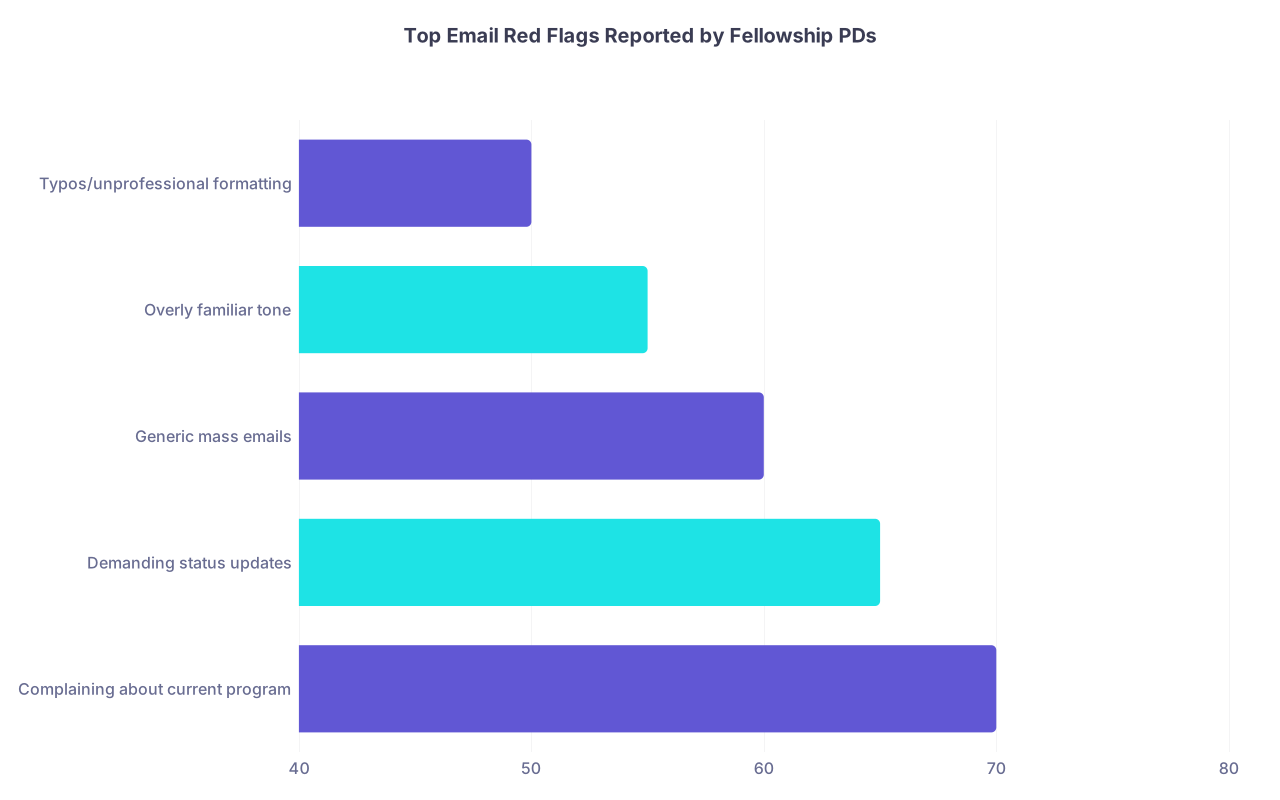
| Category | Value |
|---|---|
| Complaining about current program | 70 |
| Demanding status updates | 65 |
| Generic mass emails | 60 |
| Overly familiar tone | 55 |
| Typos/unprofessional formatting | 50 |
4. Over‑Familiar, Casual, or Flirtatious Tone
You have been in your residency three years. You email attendings daily. It is all “Hi John,” “Thanks!!”, “No worries.”
Then you write to a PD like that.
You start with:
- “Hey Dr. S,”
- “Hi there!”
- Or no greeting at all, just: “Attached is my CV for your cardiology fellowship”
I have seen worse:
- Emojis in emails to PDs
- “Best,” with just your first name and no credentials, no signature block
- Casual jokes that do not translate in writing
- Overly personal compliments: “I saw your photo on the website and you seem so approachable and kind”
That last one? Absolutely not.
Here is what PDs expect in tone:
- Professional greeting: “Dear Dr. [Last Name],” or if unknown, “Dear Program Director,”
- Complete sentences, no texting abbreviations
- No emojis, no exclamation points every line
- Respectful closing: “Sincerely,” or “Best regards,” with full name and PGY level
This is not about being stiff. It is about signaling that you understand boundaries and hierarchy. The PD is not your friend. Not yet.
Red-flag phrases I have actually seen in PD inboxes:
- “Hey, just checking what my chances are.”
- “I would be thrilled to be under your mentorship ;)”
- “You seem really cool from your podcast.”
You may think you sound warm or connected. You do not. You sound risky.

| Step | Description |
|---|---|
| Step 1 | Need to email fellowship PD |
| Step 2 | Do not send |
| Step 3 | Draft email |
| Step 4 | Proofread and send once |
| Step 5 | Why am I emailing? |
| Step 6 | Contains complaints or blame? |
| Step 7 | Program specific and accurate? |
5. Sending Emails at Unhinged Times or Frequencies
No, PDs do not penalize you for sending an email at 11:47 p.m. just because of the timestamp. The system queues messages. Everybody works weird hours.
The problem is not the time. It is what you send and how often you send it.
Patterns that make PDs uneasy:
- Three follow‑ups over 10 days
- Double‑emailing PD and coordinator and associate PD with the same message
- Replying to your own prior email with “Bumping this to the top of your inbox”
- CCing random faculty you met briefly on a Zoom talk with no warning
That screams poor boundaries.
Safe frequency rule:
- Initial email (interest or update)
- At most one follow‑up, 2–3 weeks later, if there is something genuinely new or important to add
- Then stop
If multiple people at a program should be aware, send to the coordinator and PD, not PD + half the division. Do not “loop in” their colleagues without a clear reason. They will talk about it, and not kindly.

6. The Over-Long Autobiography Email
This one is very common among anxious, high-achieving residents.
You open a blank message and dump your entire story:
- Where you were born
- Why you chose medicine
- That time in MS2 you decided critical care was your calling
- Every hardship, every rotation, every meaningful patient
Two screens of text.
PDs do not have time for this. Fellowship recruitment is layered: ERAS application, letters, personal statement, interviews. Email is not the place to reprint your personal statement or rewrite your CV in prose.
Long, rambling emails signal:
- Poor judgment about audience and time
- Difficulty prioritizing key information
- A tendency to overshare
You want your email to be:
- Scannable in < 30 seconds
- 2–3 short paragraphs, max
- Focused on purpose: interest, update, or clarification
If your email starts feeling like a personal essay, stop. Save that content for your statement or for an actual conversation.
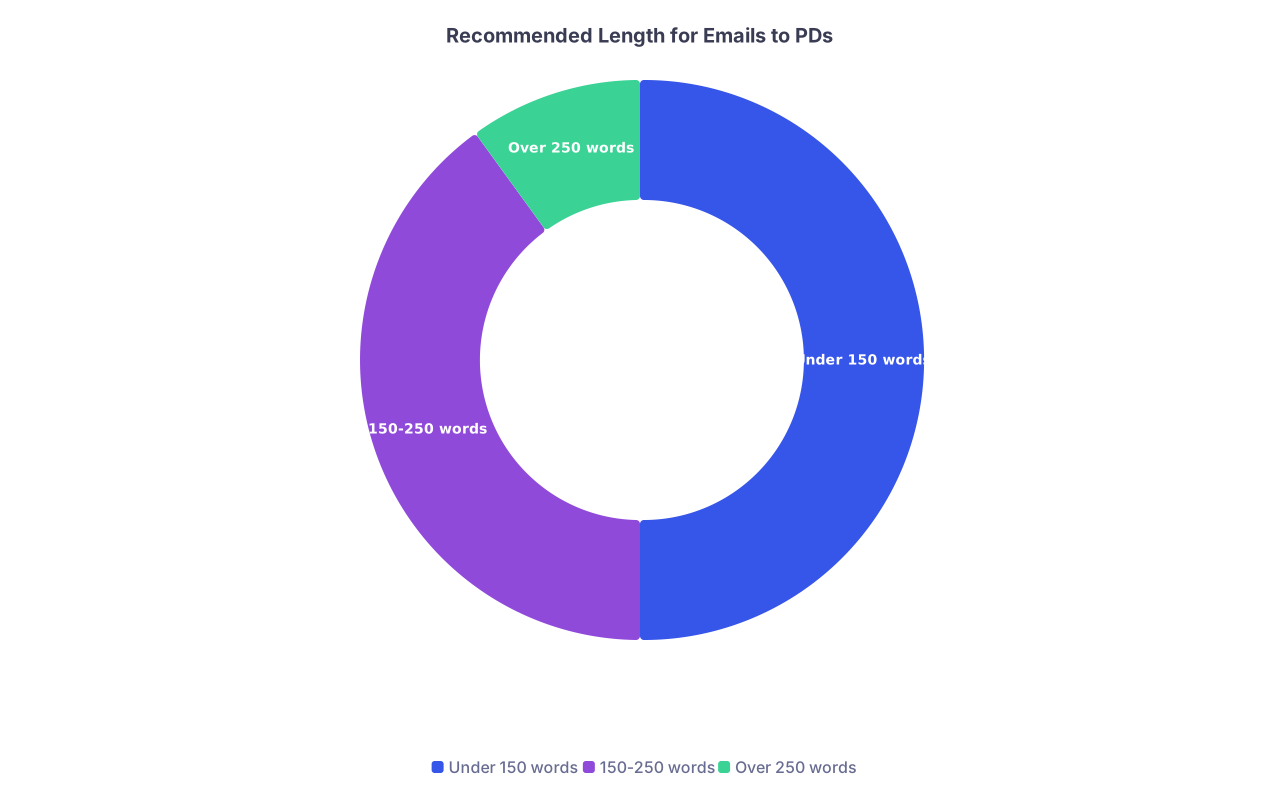
| Category | Value |
|---|---|
| Under 150 words | 50 |
| 150-250 words | 40 |
| Over 250 words | 10 |
7. Ignoring Basic Professionalism: Typos, Formatting, and Attachments
Yes, everyone is tired and busy. No, that does not excuse an email that looks like it was written on a phone during a code stroke.
I have seen:
- “Dear Program Directro”
- Misspelling the PD’s name in the greeting and correctly in the subject line
- Half-finished sentences and random line breaks
- Wrong CV attached. Or no CV attached when the text says “attached is my CV.”
Here is what this tells a PD:
- This is your attention to detail at low stakes
- This is the same attention you might bring to notes, orders, and patient care
You do not want that association.
Avoidable errors that hurt you:
- Misspelling the institution or program name
- Broken or wrong attachments
- Using your med school personal email with a joke address (yes, some still exist)
- Weird fonts, colors, or signatures with inspirational quotes
Write like an adult professional. Use your institutional email if you have it. If not, a simple Gmail with your name is fine.
Minimal signature that looks competent:
- Full name
- PGY level and specialty
- Current institution
- Phone number (optional but helpful)
8. Misusing “Interest” and “Ranking” Language
This one gets surprisingly messy.
Residents think showing “strong interest” means saying:
- “You are my top choice.”
- “I would rank your program very highly.”
- “If offered an interview, I would absolutely attend and very likely rank you #1.”
Then they send the same thing to five programs.
PDs assume this is happening. But when they see that kind of language, they take it seriously. And yes, some of them talk to one another. If they find out you sent “#1” emails to multiple programs, you are done in their minds.
Do not:
- Use “number one” or “top choice” language in emails to multiple programs
- Speculate about how you will rank them months in advance
- Overpromise in ways you cannot keep
You can express genuine interest safely by anchoring yourself in specifics:
- “I am particularly interested in your advanced HF and transplant exposure, which aligns with my long-term goal of…”
- “Your program’s volume in X and your structured research time are exactly what I am seeking.”
You are allowed to have one true #1 program. If you choose to tell them that late in the season, keep it honest and be prepared to back it up in your match list. But do not spray that promise across the country.
9. Going Around the System or Over People’s Heads
Another common misstep: trying to bypass coordinators or formal processes via email.
Examples:
- Emailing the PD to ask about materials clearly explained on the website
- Emailing a division chief or department chair to “advocate” when you have no prior relationship
- CCing the GME office because you did not get a reply in a week
- Asking a random faculty you met at a conference to forward your email directly to the PD “to boost your chances”
Programs notice who respects their systems and who does not.
Coordinators have power. They remember names. If you treat them like secretaries or obstacles, that gets back to the PD. Likewise, if your first interaction with the program involves trying to escalate something above someone’s role, you look like future trouble.
Your rule of thumb:
- Use posted instructions first
- Email the coordinator for logistical questions
- Email the PD only for fit/interest/brief updates that are clearly their lane
Anything that feels like manipulating channels or applying pressure will not help you.
10. The “No Filter” Response Email
One last trap: you get a disappointing email (no interview, waitlist, generic response), and you reply while frustrated.
Things I have seen smart residents send in emotional moments:
- “I am surprised and disappointed by this decision given my strong application.”
- “Can you explain what was deficient in my file?”
- “Is there any way you can reconsider?”
PDs are not your MS4 course directors. This is not a grade appeal.
Those replies rarely get you anything except:
- A quiet red flag from that program
- A story told at the next PD meeting
- A reputation for poor emotional regulation
You are allowed to feel disappointed or angry. You just are not allowed to process that feeling in their inbox.
If you must respond at all, keep it to:
- “Thank you for your consideration.”
And then walk away from your email for a while.
How to Email PDs Without Sabotaging Yourself
Let me boil this down into a simple framework you can use tonight.
Before you send any email to a fellowship PD, ask yourself:
Purpose – Is this email about:
- Genuine interest or fit?
- A short, objective update (new publication, new score)?
If not, do not send it.
Content – Does it:
- Avoid complaints and blame?
- Avoid asking for status or demanding priority?
- Focus on them and fit, not your anxiety?
Tone – Is it:
- Professional but human (not robotic, not chatty)?
- Free of emojis, abbreviations, and sarcasm?
- Respectful of their time (short, clear)?
Accuracy – Have you:
- Verified the program name, PD name, and specialty?
- Removed anything generic that could apply anywhere?
- Checked attachments and signature?
If you fail any of those checks, you are about to make one of the mistakes that quietly sink strong applicants.
FAQ (Exactly 5 Questions)
1. Should I email every fellowship program I apply to?
No. That is one of the biggest mistakes. You should email only a limited number of programs where you have a clear, specific reason to reach out—meaning you can point to concrete aspects of their curriculum, patient population, research opportunities, or geography that match your goals. Mass, generic interest emails make you look unfocused and insincere.
2. Is it ever appropriate to ask about my application status by email?
Very rarely, and almost never in the early or mid-cycle phases. If the program explicitly invites applicants to reach out after a certain date, you can send one brief, respectful inquiry. Otherwise, direct “what is my status” questions come across as entitled and tone‑deaf. Focus your emails on interest and updates, not pressure for decisions.
3. Can I email to explain a red flag, like a low Step score or leave of absence?
Email is usually the wrong place to unpack complicated issues. If you need to address a red flag, that belongs in your application materials or in a structured conversation, not a long, emotional email. At most, you can briefly acknowledge that more context is available if they wish, but do not send a multi-paragraph defense or blame others for the issue.
4. How many follow-up emails are acceptable if I do not get a reply?
One. And only if there is a legitimate reason to follow up—like a significant new publication, major award, or updated score. If your first email went unanswered, assume they saw it and made a decision about whether to act. Multiple follow-ups quickly shift from “persistent” to “problematic” in the PD’s eyes.
5. Do PDs really care about small typos or minor formatting issues?
One tiny typo will not sink you. A pattern will. An email full of errors, sloppy formatting, wrong names, or missing attachments suggests poor attention to detail and low respect for the recipient’s time. In a competitive field, where PDs are choosing between many similar candidates, that kind of sloppiness can absolutely influence how they rank you.
Here is your next step:
Open the last email you sent—or drafted—to a fellowship program. Read only the first three sentences and your subject line. Ask yourself, bluntly: “If I were a PD with 200 emails in my inbox, would I respect this or roll my eyes?” If the answer is anything but a clear yes, rework it before you send another message to any program.


