

What do you do when you want (or need) a fellowship, but you also have a toddler, a partner with a fixed job, aging parents in town, and absolutely zero interest in uprooting everyone to chase a “prestige” program three time zones away?
Let’s be blunt: fellowship advice that ignores family is useless for a huge chunk of residents. So let’s talk about how people actually handle this when there are real obligations at home—kids, spouses, visas, money, caregiving.
You’re not just “an applicant.” You’re the center of a small ecosystem. You cannot pretend that does not exist. The trick is: you also cannot let that ecosystem silently sabotage you because you did not plan around it.
We’re going to deal with both sides: how to protect your family situation and how to still put forward a strong, intentional fellowship application.
Step 1: Get Uncomfortably Clear on Your Non‑Negotiables
Before you look at programs, you need to figure out where reality stops being flexible.
Do this before you fall in love with a dream program in another city. I’ve seen too many residents tie themselves in knots trying to rationalize something their life can’t actually support.
Ask and answer, in writing:
Geography
- Can you relocate at all?
- If yes, how far: within the state, within driving distance of extended family, or truly anywhere?
- Are there places you absolutely cannot go (for your partner’s job, custody agreements, elderly parents)?
Time and schedule
- Are you the primary parent or caregiver most days?
- Do you have backup childcare or only one fragile arrangement that collapses with longer hours?
- Do nights/weekends destroy your family system, or can you absorb some?
Financial boundaries
- Can you afford a high cost-of-living city for 1–3 more years on a fellowship salary?
- Do you rely on extended family nearby for free childcare? Replacing that with paid daycare/nanny is not a trivial swap.
- Are you carrying serious debt where one more move or double rent will break you?
Visa/immigration (if relevant)
- Are you tied to specific states or institutions that sponsor particular visas?
- Does your partner’s status depend on your employer/location?
This stuff is not “nice to think about later.” It is your strategy.
If your real answer is: “I must stay in this metro area because of kids, partner job, and my mom’s care,” then your application strategy is very different from someone who can move anywhere.
Write your constraints down. Then ruthlessly sort programs through that lens.
Step 2: Decide Your Actual Career Goal—Not the Social Media Version
You do not need a fellowship for every career you’ve heard people brag about.
There are three buckets I see:
You must have fellowship for your intended career
Examples: Interventional cards, GI, Heme/Onc, critical care, MFM, neonatology, peds heme/onc.
Without the fellowship, the path you want literally does not exist.Fellowship is optional but helpful
Example: Hospitalist wanting more pay/leadership leverage, primary care doc wanting sports med, anesthesiologist thinking about regional/pain.
Here, “no fellowship” is a valid, honest choice, especially with family pressure.You’re mostly chasing prestige or fear
“Everyone in my program does cards.”
“I feel like I’m wasting my residency if I don't sub-specialize.”
“I’m scared I won’t be competitive later if I don’t do it now.”
If you’re in group 3, pause. With major family obligations, you only sign up for another 1–3 years of intense training if it’s anchored to a concrete life and career benefit, not just vibes.
I’ve watched residents with two kids and a working spouse absolutely torch themselves for a marginal upgrade in cachet that did nothing for their eventual job satisfaction.
Be harsh with yourself:
- “What, exactly, does this fellowship unlock?”
- “What job do I see myself in at 45?”
- “Is this worth 1–3 more years of lower pay, higher stress, more schedule chaos?”
If the answer is yes, great. Then we plan accordingly. If not, you may be forcing a fellowship that your life doesn’t actually need.
Step 3: Build a Short, Realistic Target List Around Your Life
Once you know your constraints and your why, then you construct the actual list.
This is where people with family responsibilities get into trouble—they apply like they’re single and mobile, then panic when interviews and rank lists collide with reality.
You need a tighter, smarter list, not necessarily a longer one.
Here’s how to approach it:
Anchor programs (local/commutable)
These are programs where:- You do not need to move your family, OR
- You move once, reasonably, with a stable support structure
Stretch programs (possible but disruptive)
These may require:- A move that’s tolerable but stressful
- Temporary long-distance with your partner
- Heavier childcare costs, but not impossible
No-go programs (deal breakers)
Even if they’re prestigious.
“Boston with no family, 2 kids, partner cannot leave state.” That’s a no. Not a “we’ll see.”
Create something like this:
| Program Type | Number of Programs | Key Criteria |
|---|---|---|
| Anchor | 3–8 | Local/commutable, family support |
| Stretch | 3–6 | Relocatable with strain allowed |
| No-go (not applying) | Infinite | Violates non-negotiables |
If your non‑negotiables essentially force you into 1–3 realistic programs in your metro, your number one job becomes:
- Making those PDs know you
- Getting strong, personal letters
- Aligning your scholarly work with what those programs actually value
- Being open to “nearby but less sexy” alternatives (like community-based fellowships)
Step 4: Decide How Honest to Be About Family in Your Application
Family obligations are a double‑edged sword in applications. Handled well, they show maturity, resilience, and clear priorities. Handled badly, they set off alarms about reliability and schedule flexibility.
You do not need to pour your entire personal life into ERAS or your personal statement. You do need a strategy.
Where you might use family context:
Personal statement (carefully)
Example: “As the primary caregiver for my father during his chemotherapy, I saw firsthand…” That’s clinical motivation, not schedule conflict.Interviews, when asked about support systems or location preferences
Example: “My partner’s career is here and our kids are in school, so staying in this region is important for us. That’s part of why I’m particularly interested in your program.”Program director meeting (home program)
You should be more explicit with your own PD: “I’m applying in GI, but I’m realistically limited to this state because of my kids and my partner’s job. I’d appreciate honest feedback and any connections you have regionally.”
Where to be careful:
- Leading with “I can’t move” in your personal statement
- Over-emphasizing childcare issues in early interactions (they’ll wonder if you can manage a heavy fellowship workload)
- Presenting family as conflict rather than context
You want to come across as:
- Grounded
- Serious about your field
- Aware of your constraints
- Proactive about your support systems
Not:
- Flaky
- Overwhelmed
- Likely to miss call because daycare closed
If they start to worry you can’t physically perform the fellowship, they will not rank you highly. That’s the brutal truth.
Step 5: Engineer Your Home Program to Be Your Strongest Advocate
If you have significant family obligations and geographic limitations, your home program becomes your most valuable ally. If you waste that, you make your life much harder.
Your goals:
Make sure your PD clearly understands both:
- Your seriousness about the fellowship
- Your real-life constraints (geography, childcare, partner’s job)
Get your PD and key faculty to:
- Pick up the phone for local programs
- Highlight your reliability and professionalism despite family obligations
- Frame you as a low‑risk, high‑maturity candidate
Conversations you should have, explicitly:
With your PD:
“I want to be very transparent. I’m applying to [field]. Because of my kids and my partner’s job, I realistically need to stay within [region]. I know that makes this more competitive for me. What can I do this year to be as strong a candidate as possible for our area?”With mentors in the subspecialty:
“I’m limited geographically, but I’m committed to this field. Are there regional programs where you think I’d be a strong fit, and would you feel comfortable reaching out on my behalf when the time comes?”
This is not “begging.” This is smart coalition building.
And yes, PDs absolutely talk about which residents are managing family plus training like adults.
Step 6: Design Your Interview Strategy Around Your Family Reality
Once interviews roll in, people with kids/family caregiving responsibilities burn out fast if they try to do what their single co‑residents are doing.
You cannot. And you do not have to.
Be strategic about which interviews to accept
Rank programs by:
- Feasibility for your family
- Likelihood you’d actually rank them highly
- Realistic chance of matching there (based on your app and your mentor’s assessment)
If an interview is:
- Low on feasibility
- Low on your actual interest
- Mainly “prestige tourism”
Decline it. Your time, money, and emotional bandwidth are not infinite.
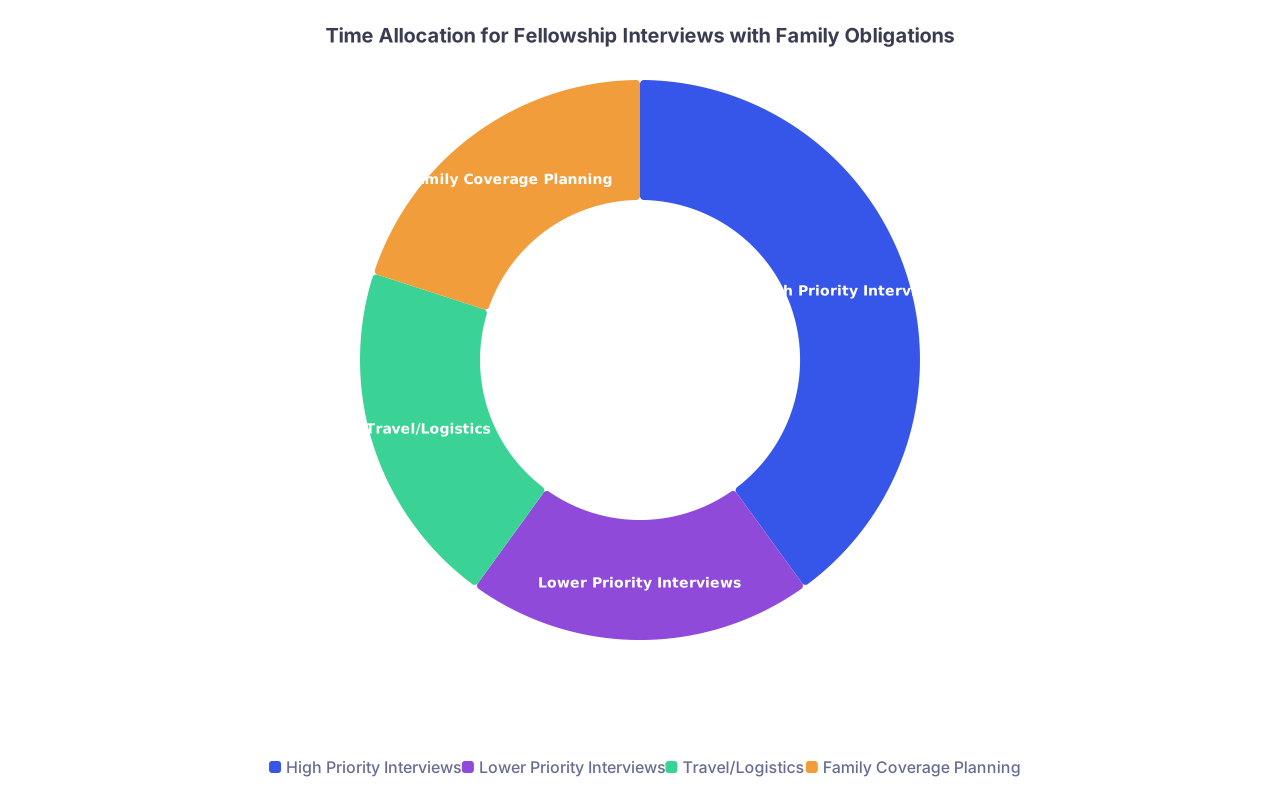
| Category | Value |
|---|---|
| High Priority Interviews | 40 |
| Lower Priority Interviews | 20 |
| Travel/Logistics | 20 |
| Family Coverage Planning | 20 |
Minimize disruption
If travel is needed:
- Batch interviews geographically when possible
- Use PTO or jeopardy days strategically so you’re not constantly swapping shifts
- Arrange backup childcare before interview season, not reactively
Consider this hard question:
If the only way to attend more interviews is to leave your partner barely coping and your kid in a revolving door of last‑minute sitters, is that actually worth it? For some, the answer is yes for one season. For others, it isn’t. You decide.
Step 7: Rank List: Do Not Lie to Yourself
This is where people with family obligations make catastrophic mistakes.
They create a “purely academic” rank list. Then, when Match Day forces them to confront the reality—moving two kids across the country, losing in‑law childcare—they’re stunned and miserable.
Your rank list needs to reflect both:
- Where you’d thrive as a future specialist
- Where your family can survive this final training stretch
You have to ask:
“If I match here, would we actually go?”
If the honest answer is “no way,” take it off your list. Leaving it on is fantasy.
I’ve seen this exact scenario play out:
- Applicant ranks #1: super-elite cross-country program
- Ranks #2–5: solid regional programs near family
- Swears they’d never move the kids that far
- Matches #1
- Spends 3 years trying to recover from the blow
Do not assume “it probably won’t happen.” It can. And it does.
Your rank list is a binding statement of: “If this program chooses me, I am ready and willing to go.” Honor that.
Step 8: If You Cannot Move at All—Play a Different Game
Here’s the harsh version:
If you are fully constrained to one city or one small region, for a moderately competitive fellowship, you’re playing a different game than your peers.
That does not mean you can’t win. It means:
- You must be visibly excellent in that space
- You probably have to be more “all in” for the subspecialty at your home institution
- You may need more than one cycle if the odds are tight
What this looks like, practically:
- Early alignment with your home division (research, QI, clinic)
- Being the go‑to resident for that subspecialty’s service
- Strong personal relationships with subspecialty faculty
- Being open to creative options:
- One‑year non‑ACGME fellowship locally first
- Hospitalist job with heavy subspecialty exposure and ongoing research
- Reapplying with a stronger CV
I’ve watched residents limited to one city finally match on their second attempt because they doubled down locally, became essentially part of the division, and made themselves impossible to ignore.
Is it harder? Yes. Is it impossible? Absolutely not.
Step 9: Protect Your Family During the Process (Or You’ll Pay Later)
Everyone talks about “support systems” like it’s a checkbox. When you have significant family obligations, this is the real ballgame.
Do a pre‑fellowship reality check with your household:
- Show your partner call schedules from current fellows at your target programs
- Ask directly: “If I’m gone 1–2 weekends a month, some nights, and often late, what falls apart at home?”
- Work backward to build supports now:
- Regular sitter
- Backup daycare
- Grandparent calendar
- Budget for help (cleaning, meal services, etc.)
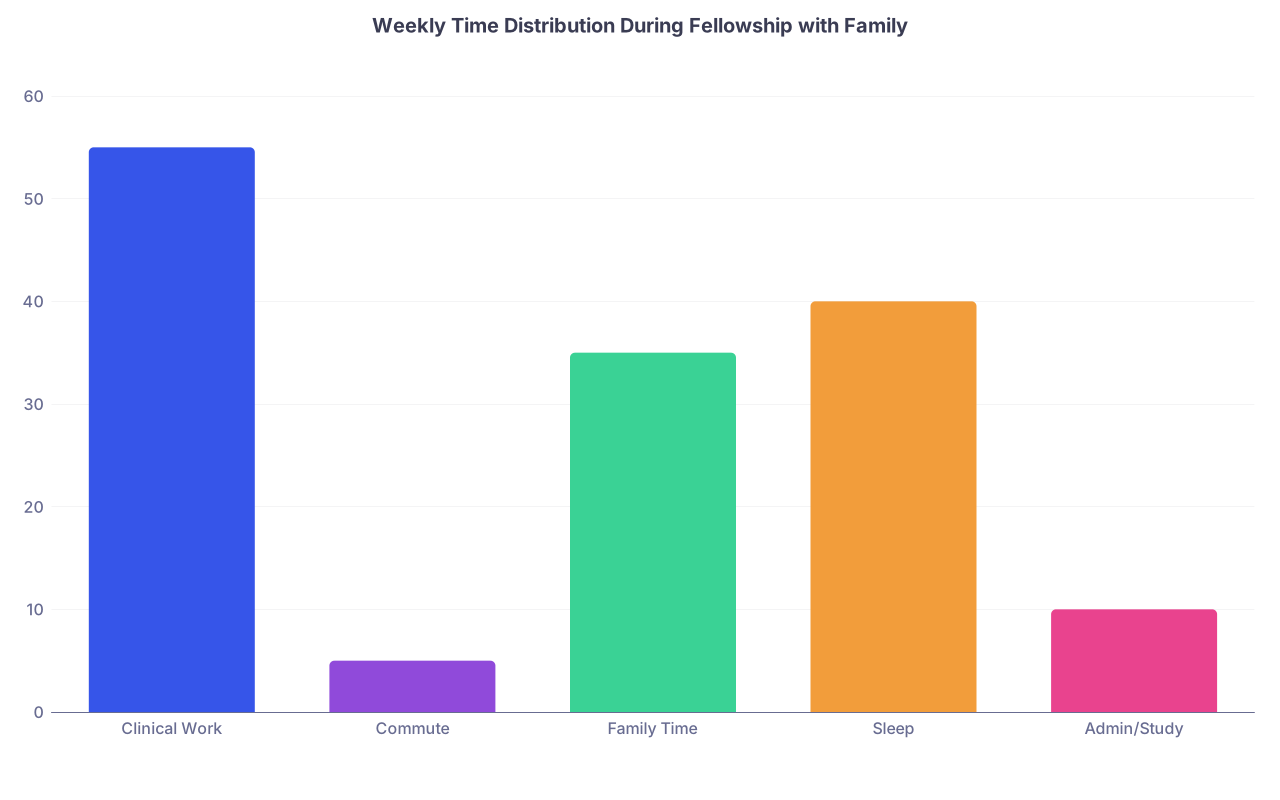
| Category | Value |
|---|---|
| Clinical Work | 55 |
| Commute | 5 |
| Family Time | 35 |
| Sleep | 40 |
| Admin/Study | 10 |
If your support structure is already maxed during residency, adding fellowship intensity without changes is a recipe for resentment, burnout, and relationship damage.
Program directors can smell that dynamic, by the way. When someone talks about their partner with simmering frustration and no plan, it raises red flags.
You don’t need a perfect solution. You do need a plausible one.
Step 10: Mental Framing—You’re Choosing Tradeoffs, Not “Failing” Your Family or Career
You’re not a bad parent for wanting a fellowship.
You’re not a bad doctor for deciding a fellowship is not worth blowing up family stability.
You are choosing between tradeoffs:
- More training vs. earlier attending salary
- Geographic expansion vs. local support networks
- Delayed stability vs. higher long‑term career satisfaction
People without obligations can be reckless. You don’t get that luxury. But you also get something they don’t: clarity.
When you have people depending on you, you tend to get very honest about what matters. That can lead to much better long‑term decisions.
Practical Scripts and Moves You Can Use
Let me give you a few ready‑to‑steal phrases, because fumbling these in real time can hurt you.
Talking to your PD
“Dr. Smith, I’m committed to pursuing [fellowship field]. Because of my kids and my partner’s job, I’m realistically limited to [region/city]. I know that narrows my options, so I’d really value your advice on how to make myself as strong as possible for programs in this area, and whether you think that’s a realistic plan.”
Emailing a local fellowship PD (not your home program)
“Dear Dr. Lee,
I’m a PGY-2 in Internal Medicine at [Hospital]. I’m very interested in pursuing a fellowship in [subspecialty] and, for family reasons, am specifically hoping to remain in [city/region]. I’ve been involved in [brief research/clinical interest] and would appreciate any advice on how to be a competitive applicant for your program when I apply next cycle. If you think it would be appropriate, I’d be grateful for the chance to speak with you briefly or connect with one of your fellows.”
Answering “Why our program?” in interview with family context
“I’m genuinely excited about your clinical volume and the [specific feature] here. On a personal level, my family is rooted in this region—my partner works here and our kids are in school—so the possibility of strong training without uprooting them is a big part of why your program is at the top of my list.”
That’s honest. Grounded. Not apologetic.
Visual Overview: Year Before Fellowship Apps With Family Obligations
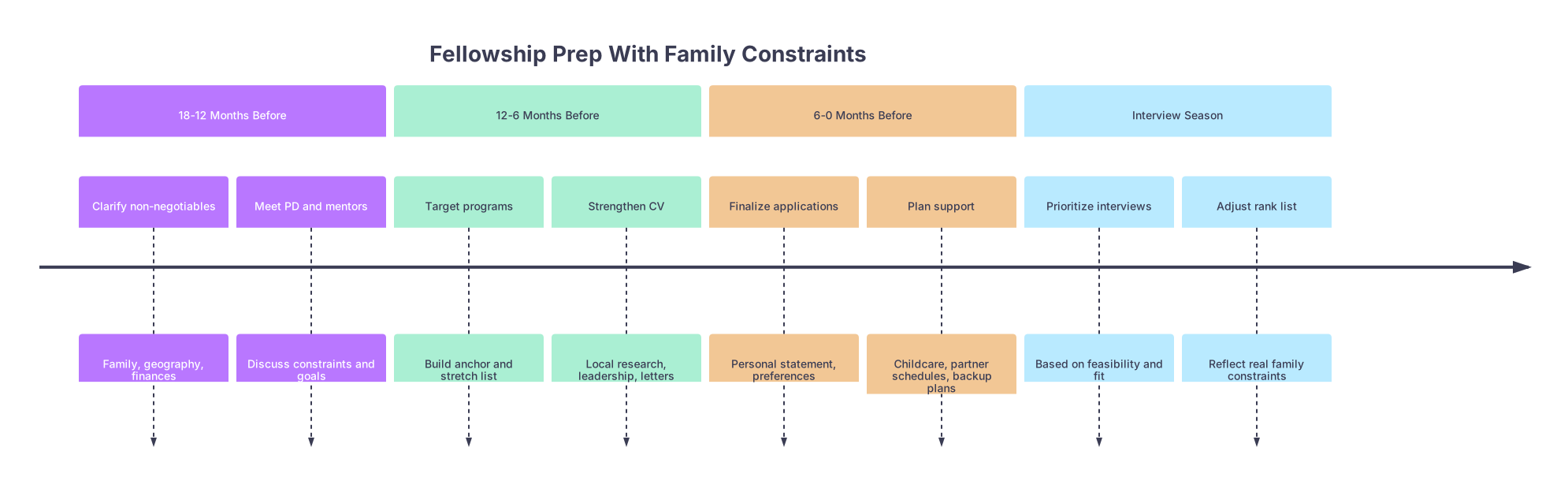
| Period | Event |
|---|---|
| 18-12 Months Before - Clarify non-negotiables | Family, geography, finances |
| 18-12 Months Before - Meet PD and mentors | Discuss constraints and goals |
| 12-6 Months Before - Target programs | Build anchor and stretch list |
| 12-6 Months Before - Strengthen CV | Local research, leadership, letters |
| 6-0 Months Before - Finalize applications | Personal statement, preferences |
| 6-0 Months Before - Plan support | Childcare, partner schedules, backup plans |
| Interview Season - Prioritize interviews | Based on feasibility and fit |
| Interview Season - Adjust rank list | Reflect real family constraints |
When Things Do Not Go As Planned
Sometimes you do everything “right” and still:
- Do not match
- Only get offers from places your family truly cannot move to
- Realize halfway through app season that your support system isn’t as strong as you thought
You have options that are not “give up forever”:
- Take a local attending job and keep working with the subspecialty team, then reapply
- Do a non‑ACGME fellowship locally (if available) to build credibility
- Reassess whether a different subspecialty with more local options fits your interests
- Decide intentionally that your current generalist path actually gives your family the best life
I’ve seen all of these play out into good careers.
The only truly bad path is pretending constraints don’t exist and then letting Match Day decide for you.


