
The myth that only residents from “big-name” programs match good fellowships is lazy and wrong—but weak fellowship connections absolutely make your life harder.
If your residency has limited fellowship ties, you’re not doomed. But you cannot play the match on “easy mode” like the people at powerhouse academic centers. You need a different playbook. A more aggressive, intentional one.
This is that playbook.
Step 1: Get Honest About Your Starting Point
Do not sugarcoat your situation. You need a clear-eyed assessment.
Here’s what “weak fellowship connections” usually looks like in real life:
- Your program sends 0–2 people per year to fellowship, often to “local” or lower-tier places.
- There’s no clear track record for your desired specialty (e.g., no one remembers the last time someone went into GI from your IM program).
- You ask, “Who has matched to Heme/Onc recently?” and people say, “Uh… I think Dr. X like 5–6 years ago?”
- There’s no structured mentorship for fellowship applications. No workshops, no sample personal statements, nobody running mock interviews.
- The attendings say things like, “Yeah, I don’t really know anyone at those places anymore.”
If that sounds familiar, you’re in the “you must self-engineer your path” category.
Your honest questions right now should be:
- From this program, what specialties are realistic for me with work?
- Are there any “hidden” strengths I'm not seeing?
- What timeline gives me the best shot—on-time vs a chief year vs research year?
Start by quietly collecting data.
| Question | Who To Ask |
|---|---|
| Recent matches in your specialty | Chief residents |
| Which attendings write strong letters | Senior fellows, recent grads |
| Whether people have taken research years | PD, APD, trusted faculty |
| How fellowship applicants usually perform | Program coordinator, chiefs |
Have blunt one-on-one conversations with:
- A chief who recently applied or watched others apply
- One or two honest senior residents (not the toxic complainers)
- If possible, a former fellow from your program who matched in the last 3–5 years
Ask very specific questions:
- “Where have recent applicants in [your specialty] matched?”
- “Who here has strong connections in that field, even at just 1–2 programs?”
- “If you were me and wanted [specialty], what would you do differently than others did?”
You’re not looking for comfort. You’re looking for a map of what actually happens to people like you from this residency.
Step 2: Build an External Mentorship Network—On Purpose
If your residency can’t give you the network, you will have to build one. Systematically.
Target: At least 3–5 mentors outside your program
Different roles:
- Field mentor – In your exact fellowship specialty, ideally at an academic center.
- Application mentor – Someone who has recently gone through the fellowship match in your specialty (even if from another residency).
- Letter writer – Someone outside your institution who can credibly say, “This applicant performs at the level of my own residents.”
How to find them if your program has no pipeline:
- Cold email physicians at nearby academic centers
You’re not asking for a letter upfront. You’re asking for a chance to contribute.
Subject line examples:
- “Interested resident seeking [Cardiology] project help”
- “PGY-2 IM resident with strong interest in [Heme/Onc] research”
Body structure:
- 2 sentences about you (program, PGY level, interest).
- 1–2 sentences about your relevant experience (research background, skills).
- 1 clear ask: “Would you be open to a brief call to discuss any ongoing projects I could support?”
Short. Direct. Professional. Not needy.
- Use fellowship program websites like a hunting ground
Look at current fellows at places you care about. Find ones who:
- Graduated from lesser-known residencies
- Or trained in programs similar to yours
Contact them on LinkedIn, Doximity, or via email from their hospital profiles:
“Hi Dr. X, I’m a PGY-2 in IM at [Community/Regional Program]. I noticed you matched into [Heme/Onc/Cardiology/etc] from [non-elite residency]. I’d love to ask a few specific questions about how you approached the match from a smaller program.”
People who came from “non-fancy” backgrounds are often surprisingly generous. They remember the grind.
- Use conferences strategically, not randomly
You’re not going to a conference “to learn.” You’re going to:
- Meet 2–3 people who will remember your name.
- Put real faces to email addresses.
- Convert “I’ve seen your poster” into “Let me know when you apply.”
Pick sessions based on where the people you want to meet will be, not just content that sounds interesting.
Step 3: Manufacture Name Recognition Through Work
If you lack built-in connections, you use output to force people to take you seriously.
That means scholarship. Not in the abstract “I should do research” way. In the “do work that puts your name in front of faculty at other institutions” way.
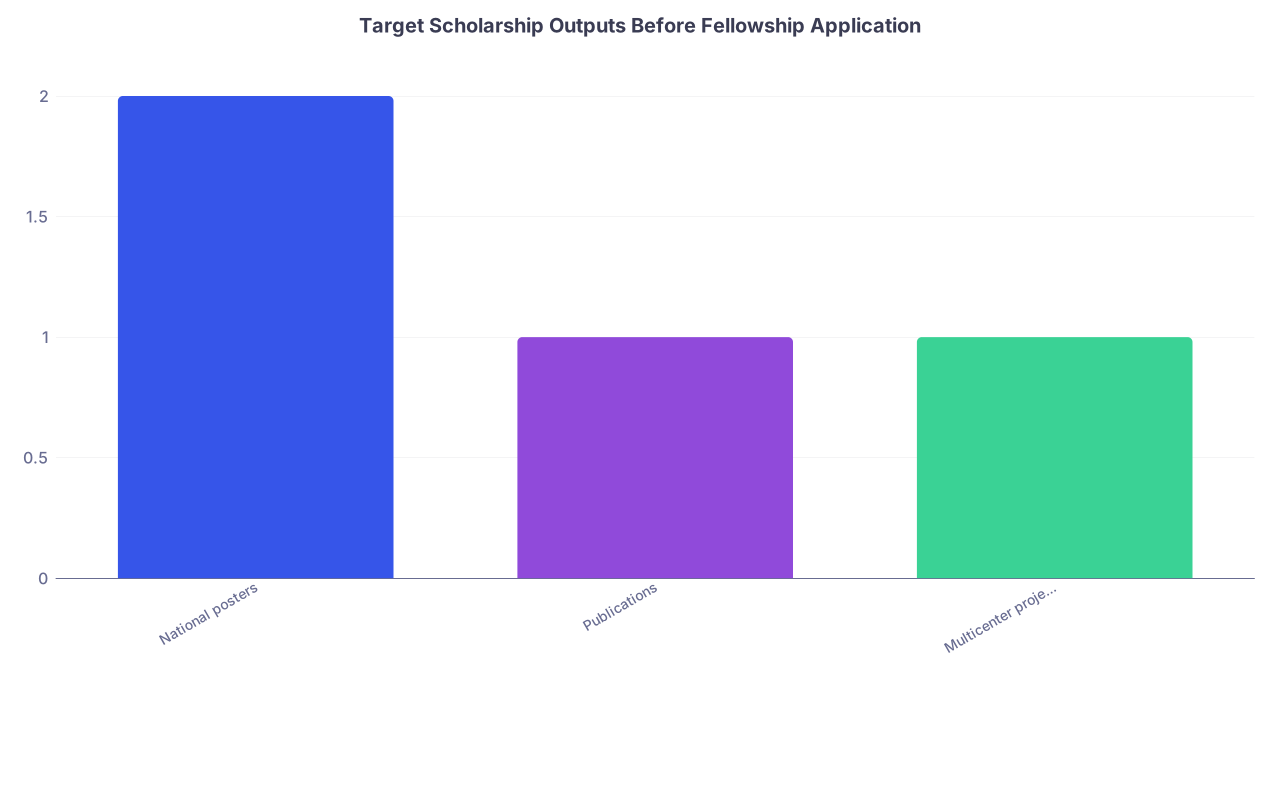
You want at least 2–3 of the following by the time you apply:
- 1–2 abstracts or posters at national meetings in your field
- A review article, case series, or retrospective project with someone from an academic center
- Meaningful contribution to a multicenter project (even if as “data grunt”)
| Category | Value |
|---|---|
| National posters | 2 |
| Publications | 1 |
| Multicenter projects | 1 |
If your home program has no research machine:
Partner with academic centers
- Ask an external mentor: “Do you have any small, discrete projects that need manpower—chart review, data collection, etc?”
- Take the unglamorous work. Do it quickly and well. Reliability is rarer than brilliance.
Low-lift wins from your own hospital
- Interesting cases → case reports or image vignettes.
- QI projects → abstracts at national society meetings.
- Morbidity & mortality themes → small retrospective series.
Use societies targeted to your field
- Many have trainee sections, mentorship programs, and travel grants.
- Example: ACC, ASCO, ATS, AASLD, ENDO, etc. Whatever your field is, there’s a society with a “trainee” tab begging to be used.
You’re trying to create a paper trail that says: “This resident had limited institutional resources but still did real work.” Fellowship PDs respect that more than you think.
Step 4: Optimize Letters When You Don’t Have Famous Names
A weak-connection residency often means your letter writers aren't household names. That’s fine. Famous names are overrated without content.
What you need instead:
- Letters with specific comparative statements: “Top 5% of residents I’ve worked with.”
- Concrete stories: “I watched her handle a crashing patient at 3 a.m.…”
- Evidence the writer actually knows you, not just “pleasant to work with.”
You should aim for:
- 1–2 letters from your home program (PD/APD and a key subspecialist)
- 1 letter from an external institution in your fellowship specialty
- 1 “anchor” letter from someone who can speak to your work ethic and reliability across contexts
How to upgrade ordinary letters:
Pre-meeting packet
- Updated CV
- Brief 1-page document with:
- Bullet points of cases/projects you did with them
- Traits you hope they can comment on (clinical reasoning, ownership, teaching)
- Your target fellowship specialty and target program types (academic vs community, region, etc.)
Say the quiet part out loud
- “I’m at a smaller program without many direct connections to [specialty]. It would help me a lot if you could include any specific comparative language you feel is accurate about where I stand among residents you’ve worked with.”
Good letter writers won’t be offended. They’ll be glad you’re clear about what you need.
Step 5: Expand and Calibrate Your Application List Aggressively
If you’re not coming from a brand-name residency, your margin for error on your application list is thin.
You probably cannot safely apply only to:
- Top-20 university programs
- Prestigious coastal academic centers
- Places where half the fellows are from the same 5 residencies
You need a stratified list:
| Program Tier | Percentage of Applications |
|---|---|
| Reach (top academic) | ~25–30% |
| Mid (solid academic/regional) | ~40–50% |
| Safety (community or newer programs) | ~20–30% |
How to actually build this list:
Scrutinize current fellow lists
- Look for programs that already take residents from a mix of places, not just big-name hospitals.
- Count how many current fellows per year and from where they trained.
Favor programs that:
- Have fellows from community or smaller programs.
- Are in regions where your home institution’s name is at least known (even if not fancy).
- Have more spots per year (3–6 vs 1–2).
Use your mentors for calibration
- “Here are my stats: [Step scores if relevant, research, LORs, etc.]. From your experience, what tier of programs do residents like me typically match?”
If you’re from a weaker program, you compensate by:
- Applying broadly.
- Networking earlier.
- Customizing your outreach to a subset of programs you care most about.
Step 6: Use Away Rotations and Electives Like a Weapon
If your program doesn’t have an in-house fellowship or strong subspecialty division, you may need to physically go where the action is.
Away rotations can:
- Give you an external letter.
- Put you in front of faculty who sit on fellowship selection committees.
- Show you can function at the level of their own residents.
But don’t do random aways. They’re expensive and exhausting.
Target aways when:
- The program has historically taken “outsiders” for fellowship.
- There’s at least one faculty member who is known in the field and actively involved in fellow selection.
- You can arrange it early enough (PGY-2 for 3-year residencies, PGY-3 for 4-year ones) that the letter arrives in time.
On the rotation:
- Be early, prepared, and consistent. Not flashy. Dependable.
- Tell 1–2 faculty members privately: “I’m strongly interested in [this fellowship at your institution / your field]. I’d appreciate any feedback on how I’m doing and whether I’d be competitive here.”
- Ask directly at the end: “Would you feel comfortable supporting my application with a strong letter?”
If aways are impossible (money, visa, family, schedule), then:
- Do virtual electives where available.
- Double down on external research collaborations and mentorship.
- Attend that institution’s conferences or grand rounds remotely and make yourself a known quantity via email questions and follow-up.
Step 7: Tell a Compelling Story About Your “Non-Elite” Path
You can either be defensive about your program’s limitations or you can own them and flip the frame.
In your personal statement and interviews, you want something like:
- “I trained in a resource-limited, high-volume environment, which forced me to develop independence, efficiency, and comfort managing sick patients without layers of backup.”
- “Because my residency does not have an in-house [specialty] fellowship, I proactively sought out mentorship and scholarship through [external institution], leading to [X posters, Y publications].”
- “Working in a community setting, I saw how subspecialty care actually reaches patients, and I want my fellowship training to prepare me for both academic and real-world practice.”
The subtext you’re sending:
“I didn’t get here because my program hand-fed me opportunities. I built this myself. Imagine what I’ll do with your resources.”
You are not apologizing for your residency. You’re demonstrating that you squeezed everything out of it and then went hunting for more.
Step 8: Decide Early If You Need a Gap Year or Chief Year
If your program is weak on fellowship connections and you started late and your CV is light, applying “on time” might be a bad move.
Warning signs you might benefit from a delay:
- You have little or no research in your target field.
- No external letters lined up and you’re already late PGY-2 / early PGY-3 (for a 3-year residency).
- Your faculty are telling you, “You can apply, but your chances would be much better if you waited a year.”
Options:
Chief year at your home program
- Helps most if: your PD and APDs are competent advocates and will actively push your application.
- Hurts less if your program is known and respected regionally.
- Often gives you time for projects, teaching, and stronger letters.
Dedicated research year
- Best if you can physically embed at an academic center in your desired specialty.
- Should produce tangible output: at least 1–2 first-author papers or several solid abstracts.
- You must treat it like a real job, not a “soft” year.
Hybrid year (part-time clinical + research elsewhere)
- Trickier logistically but can work if your program allows moonlighting or joint appointments.
- Requires serious self-discipline.
If you delay, do not drift. The extra year should violently move your application from “borderline” to “obviously competitive.”
Step 9: Work Around Weak PD Advocacy
Some PDs are phenomenal advocates. Some are well-intentioned but ineffective. Some are checked out.
If yours is not well-connected to your target field:
Make their job as easy as possible:
- Give them a draft of your ERAS/other application.
- Provide a “brag sheet” with bullet points they can reference for your PD letter.
- Share a list of your top 10–15 programs so they can selectively reach out if they’re willing.
Supplement their advocacy with:
- External mentors emailing PDs or faculty at target programs: “We have a resident I strongly recommend…”
- Fellows or junior attendings putting in quiet good words where they trained.
Do not rely on informal promises like:
- “We’ll make some calls for you.”
- “We’ll take care of it.”
Ask specifically (and politely):
- “For my top few programs, would you be comfortable reaching out directly to their PDs or faculty on my behalf once my application is in?”
If they hesitate or give vague answers, assume you’re mostly on your own and act accordingly.
Step 10: Execute Interviews and Rank List Like Someone Who Fought For This
By the time interviews come, your story is:
- Non-elite residency.
- Self-built mentorship and scholarship.
- Clear, specific interest in the field.
- Obvious upward trajectory.
On interviews:
- Be ready for the “Why your residency?” question. Answer without sounding defensive.
- Be specific about what you’ve actually done in the field (cases, projects, reading, conferences).
- Ask questions that sound like someone planning a real career, not just someone trying to escape residency.
Ranking strategy with weak home connections:
- Strongly consider programs that felt genuinely excited about you, even if they’re not “brand-name.”
- Don’t over-rank long-shot places just for prestige if the vibe was lukewarm.
- Remember: a supportive mid-tier or community fellowship will launch your career far better than a miserable “name brand” program that barely wanted you.

| Step | Description |
|---|---|
| Step 1 | PGY 1-early 2 - Reality check |
| Step 2 | Build external mentors |
| Step 3 | Start projects and scholarship |
| Step 4 | Secure strong letters |
| Step 5 | Targeted away or electives |
| Step 6 | Apply broadly and strategically |
| Step 7 | Interview and rank intelligently |
FAQ (exactly 4 questions)
1. Is it even realistic to match a competitive fellowship from a small or community program?
Yes, but not on autopilot. I’ve seen residents from community IM match into GI, Cardiology, Heme/Onc, even Pulm/CC at solid academic centers. The pattern was always the same: early planning, external mentorship, tangible scholarship, and at least one strong external letter. If you expect your program name to do the work, you’re cooked. If you treat the next 18–24 months like a focused campaign, your odds go up dramatically.
2. How late is “too late” to start taking this seriously?
If you’re in a 3-year residency and you’re halfway through PGY-3 with no research, no mentors, and no clear letters, you’re probably too late for that cycle. In that case, you either apply very broadly and accept a high risk of not matching, or you plan on a gap year/chief year to fix the fundamentals. If you’re early PGY-2 and just now getting serious, you’re still in the game—if you move fast and deliberately.
3. What if I genuinely cannot get an external letter in my field?
Then you must squeeze every ounce of value from what you do have. That means multiple strong internal letters that are detailed, specific, and enthusiastic. You also double down on scholarship that is visible outside your hospital—national conference posters, society involvement, virtual collaborations. Is it ideal? No. But I’d rather see three muscular letters from non-famous people who clearly know you than one bland “he was fine” letter from a big-name external institution.
4. Should I hide the fact that my residency has a weak fellowship track record?
No, and you can’t hide it anyway—programs know where applicants train and what those programs usually produce. The smarter move is to own your path and reframe it. You trained where you did; you maximized it; you then built outward: external mentors, research, conferences, societies. Fellowship PDs are not stupid. Many of them did not train at the current “top” places themselves. They respect hustle and self-directed growth more than residents think.
Key points: If your residency has weak fellowship connections, you do not wait for it to magically transform. You build your own network, scholarship, and letters outside its walls. You apply broadly, target programs that already accept residents like you, and lean into the story of someone who created opportunities instead of inheriting them.