
The fellowship world does not care that you took the “scenic route” through residency—unless you make them care in the right way.
Extending residency training (extra year, remediation, switching programs, non‑standard path) is not an automatic death sentence for fellowship. But if you handle it badly, it absolutely can be.
Let’s walk through exactly what to do if you’re applying to fellowship with an extended or complicated residency history.
1. First, Get Clear On What You’re Dealing With
Not all “extensions” are created equal. You must call your situation what it actually is, not what you wish it were.
Common scenarios:
- You repeated a year for academic performance (failed rotations, in‑training exams, board failures).
- You took an extra chief year.
- You did an extra research year.
- You transferred programs mid‑residency.
- You took an approved leave (medical, parental, personal) that pushed you off the standard timeline.
- You had professionalism or conduct issues that led to probation or extended training.
Programs look at these differently.
| Scenario | Baseline Reaction |
|---|---|
| Extra chief year | Generally positive |
| Dedicated research year | Positive if productive |
| Parental/medical leave with return | Neutral to slightly positive |
| Program transfer for geography/fit | Neutral if well explained |
| Academic remediation year | Concerned but open |
| Professionalism/probation-related extension | High concern, heavy scrutiny |
If you pretend your academic remediation year is “basically like a research year,” reviewers will smell the dodge. They read hundreds of applications. They’ve seen every version of this.
Your first step: write down your situation in one brutally honest sentence, like you were explaining it to a trusted co-resident:
- “I failed Step 2 twice, repeated PGY-2, and then did well the rest of residency.”
- “I took a one-year medical leave for severe depression and returned at full function.”
- “I switched from a malignant IM program to a better fit after PGY-1 and added a year in the process.”
That sentence will anchor how you frame everything else.
2. Decide: Are You Actually Ready to Apply This Cycle?
Not everyone with an extended path should apply immediately. Some of you should wait a year and fix your story.
Ask yourself, and answer honestly:
- Are your most recent 12–18 months strong? (Evaluations, procedures, faculty trust)
- Are your letters going to say “ready for fellowship now” or “improving but still needs support”?
- Do you have at least one senior advocate in your specialty willing to go to bat for you?
If the answer to any of those is no, your best move might be:
- Take a hospitalist/attending year.
- Do a non‑ACGME fellowship (e.g., hospital medicine, quality, ultrasound, transition year).
- Do a research year with a known name in your field.
That “buffer” year gives you:
- Fresh, strong letters that overshadow the old drama.
- A clear narrative: “I had issues, I rebuilt, here’s the proof.”
- Time to get publications, QI, teaching, or leadership that change how committees see you.
I’ve seen people try to “sneak in” to fellowship the year right after remediation or probation. Programs rarely bite. But those same applicants match the following year after a solid hospitalist year with killer letters. The difference wasn’t their past; it was the recency of proof that they’d truly turned a corner.
3. Build Your Application Strategy Around Your Extension
You don’t just apply “like everyone else” and hope no one notices your path. You design your application around your history.
A. Target the right level of programs
You probably need to cast a wider net than your co-residents with linear paths.
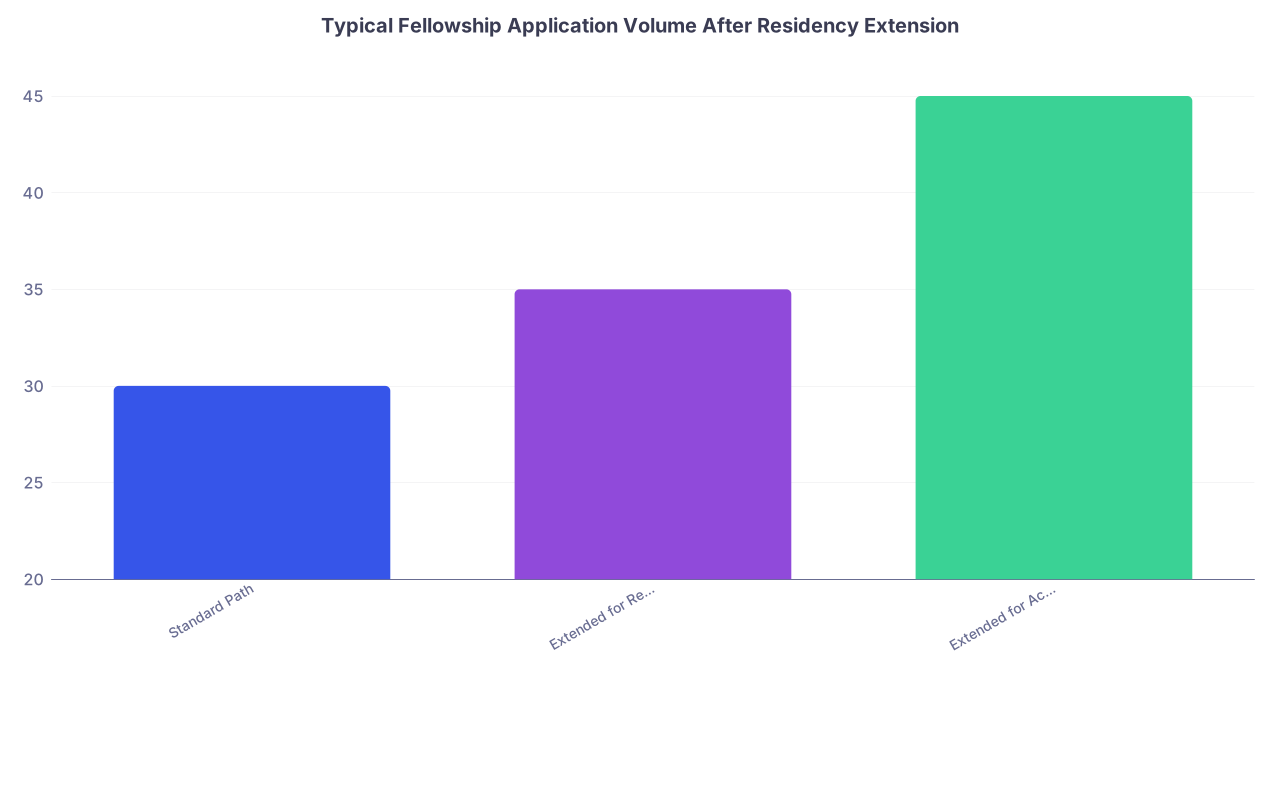
| Category | Value |
|---|---|
| Standard Path | 30 |
| Extended for Research/Chief | 35 |
| Extended for Academic Issues | 45 |
If your record is complicated, that “I’m only applying to top-15 programs” fantasy is exactly that—a fantasy. Apply broadly and strategically:
- Mix academic and community-based fellowships.
- Include programs with a track record of taking non-traditional applicants (ask alumni, current fellows, mentors).
- Include at least a handful of “safety” programs where your stats sit above their usual range.
You are buying options. Pride is expensive; ERAS is cheaper.
B. Leverage geography and relationships
Programs are more flexible with “known quantities.”
- If your residency institution has a fellowship → that’s your best shot. They know you. They’ve seen the growth.
- If you rotated as a resident at outside sites with fellowships → reach out to those attendings now. Ask directly if they’d support your application.
- If you did research with someone who has national name recognition → get them engaged in your application, not just as a silent coauthor on your CV.
4. How to Explain the Extension in Your Application
This is where most people either over-explain (defensive three-paragraph monologue) or under-explain (“briefly mention” something that actually demands context).
You have three main vehicles:
- ERAS application fields (education chronology, leaves)
- Personal statement
- Letters of recommendation
You want consistency across all three. No surprises.
A. The ERAS chronology and forms
Never lie. Never “relabel” an extension as something it wasn’t. If you repeated a year, it should be obvious in the dates and training level.
For leaves or gaps, use plain language in the explanation box, not emotional essays. Example:
- “I took an approved 6-month medical leave during PGY-2, then successfully completed the year upon return.”
- “I transferred from Program A to Program B after PGY-1 due to personal/family relocation, resulting in an additional training year.”
Short, factual, calm. This tells reviewers: “I’m not hiding the ball.”
5. Writing Your Personal Statement With an Extended Path
If your training path is off-cycle or extended, your personal statement has a job: address it like an adult, then move on to why you’re still a strong fellowship candidate.
Here’s the rough structure that works:
- Why this field (brief, not your life story)
- What you’ve done in residency that shows commitment to the field
- The “extension” paragraph – clear, owned, not dramatic
- How you’ve grown and what you bring now
- What you’re looking for in fellowship and career direction
The key paragraph is #3. Examples:
Academic difficulty example:
“Midway through residency, I struggled with time management and test-taking skills, culminating in a failed in-training exam and the decision to repeat my PGY-2 year. That period was humbling and uncomfortable, but it forced me to change how I approached feedback and self-study. With structured coaching, a defined reading schedule, and close mentorship, I not only passed subsequent exams but also began mentoring junior residents who were struggling. The extended training has made me more deliberate, more coachable, and more attentive to trainees who are quietly falling behind.”
Notice what this does:
- Names the issue without wallowing.
- Takes responsibility.
- Ends with growth and concrete improvement.
Medical/mental health leave example:
“During PGY-2, I required a medical leave of absence due to a significant episode of depression. With the support of my program, I stepped away from clinical responsibilities for treatment, then returned at full capacity and successfully completed my training. I now maintain ongoing care, clear boundaries, and habits that allow me to be stable and present for my patients and team. This experience has deepened my empathy for patients facing chronic illness and strengthened my commitment to sustainable practice.”
Again: clear, responsible, anchored in how you function now.
Program transfer example:
“After completing my intern year at Program A, I transferred to Program B due to family relocation needs. While this added an extra year to my overall training, the transition gave me exposure to two very different systems—one large county hospital and one tertiary referral center—and reinforced my interest in cardiology by allowing me to work with high-volume advanced heart failure services at both institutions.”
This one doesn’t even need an apology. Just a frame.
What not to do:
- Blame everyone else.
- Over-share messy interpersonal details.
- Try to litigate your old program’s decisions in your statement.
- Pretend it was all a blessing with no downside—program directors are not stupid.
6. Using Letters of Recommendation to Your Advantage
If your record has bumps, your letters matter more than your Step score. They’re your best shot at convincing a skeptical selection committee that the person you are now is very different from the person in the old evaluations.
You want at least one letter that:
- Knows your story.
- Explicitly addresses the prior concern.
- Testifies to your current reliability, judgment, and readiness for fellowship.
Example language you should hope to see from a letter writer who knows your extended path:
- “While Dr. X required an additional year of training earlier in residency due to academic performance, in the last two years I have seen a resident who is organized, clinically astute, and consistently among the top performers on our inpatient service.”
- “Any reservations I might have had about Dr. X’s readiness for fellowship have been eliminated by their performance this past year, including [specific examples].”
You cannot write this yourself, obviously. But you can have a candid conversation with your letter writers:
- “I’d like to apply to fellowship despite my extended path. Programs will see the extra year and my prior issues. Would you feel comfortable addressing how I’ve grown and where I stand now?”
If they hesitate, that’s your answer: they’re not the right letter writer. You need advocates, not neutral narrators.
Also: prioritize letters from leaders (fellowship director, division chief) who know you. Their title plus a clear endorsement can override a lot of initial skepticism.
7. Handling Interviews: What You Say When They Ask
They will ask.
Sometimes gently: “I noticed there was an extra year in your training—can you tell me about that?”
Sometimes bluntly: “So what happened with your remediation year?”
You need a 60–90 second answer that:
- Is honest but not confessional.
- Accepts your part.
- Ends with what’s different now.
Skeleton structure:
- Brief fact: what happened.
- Brief reason: what led to it (without blaming).
- Action: what you did to address it.
- Outcome: what your recent performance shows.
Example for academic remediation:
“I repeated my PGY-2 year due to a combination of inconsistent exam performance and not asking for help early enough. I was trying to brute-force everything and it caught up with me. During the repeat year, I worked with our program leadership on a structured reading plan, regular check-ins, and I changed how I approached feedback on the wards. Since then I’ve passed all subsequent exams, taken on more responsibility as a senior resident, and my last two years of evaluations have been consistently strong. It was a tough experience, but it forced me to build habits I’m still using now.”
Then stop. Do not keep circling back. If they want more, they’ll ask.
For medical/mental health leaves, you’re not obligated to share granular details:
“I had a medical issue that required a leave during PGY-2. I took time away, received appropriate treatment, and returned with clearance from occupational health. I’ve since completed my training at full capacity, and I maintain the supports that keep me healthy and fully reliable at work.”
If someone pushes for more specifics inappropriately, you can gently hold the line and redirect to performance:
“I prefer to keep the specific diagnosis private, but I can say I’m stable, under regular care, and my clinical performance since returning has been strong, as reflected in my recent evaluations and letters.”
8. Fixing the Other Parts of Your Application So Your Past Isn’t the Only Story
If you’ve extended, you do not have the luxury of a “quiet” application. You need visible strengths that give committees something positive to talk about besides your extension.
Focus on building at least two of these:
- A clear subspecialty niche: specific clinic, project, quality initiative.
- Research or QI work with at least posters/abstracts, ideally a manuscript.
- Teaching roles: chief resident, curriculum development, small group leadership.
- Leadership roles: committees, program initiatives, well-being, diversity, etc.
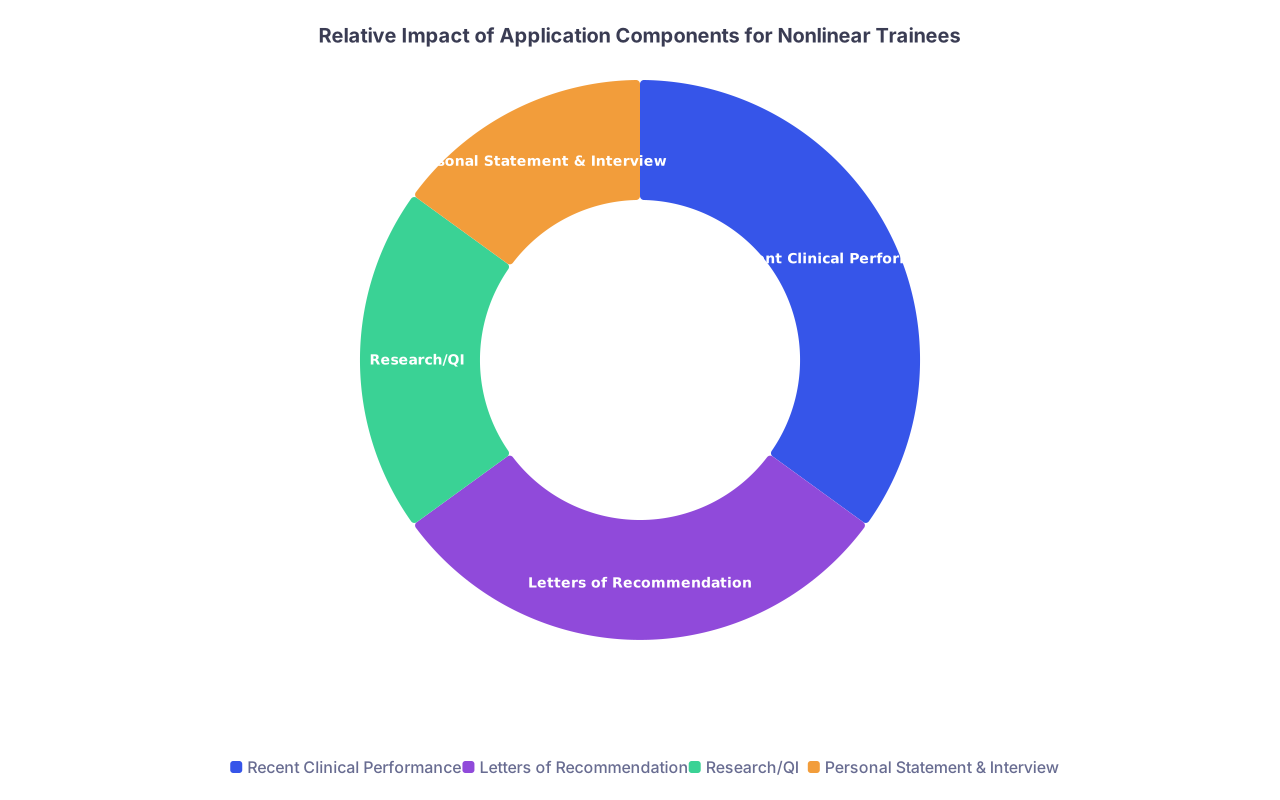
| Category | Value |
|---|---|
| Recent Clinical Performance | 35 |
| Letters of Recommendation | 30 |
| Research/QI | 20 |
| Personal Statement & Interview | 15 |
If all a program sees is “average applicant + extended training + no clear strengths,” the answer will be no. Not because they’re cruel, but because they have plenty of clean, strong files.
You need your last 1–2 years to tell a sharp, focused story:
- “I’m the IM resident who lived in the MICU and ran the ARDS QI project.”
- “I’m the EM resident who became the ultrasound person and taught the juniors.”
- “I’m the peds resident who built the transition-of-care pathway for sickle cell patients.”
When your recent work is that concrete, the old extension becomes a footnote instead of the headline.
9. Timeline and Logistics if You’re Off-Cycle
Extended training often means your completion date doesn’t line up perfectly with fellowship start dates. This is annoying but survivable.
Common patterns:
- You finish residency in September and most fellowships start in July.
- Your leave pushed your graduation by 3–6 months.
- You’re finishing early or late relative to the typical June cycle.
Options:
- Many programs are willing to delay start dates by a few months for the right candidate.
- Some will bring you in as a “clinical instructor” or non‑ACGME fellow for the gap period.
- You can fill gap months with hospitalist shifts at your home institution.
Communicate this clearly in your application and interviews:
- Put your actual anticipated residency completion date accurately.
- In interviews, say: “My program end date is September 30 due to an earlier leave. I’m very open to delayed or off-cycle fellowship starts and have discussed interim staffing options with my current institution.”
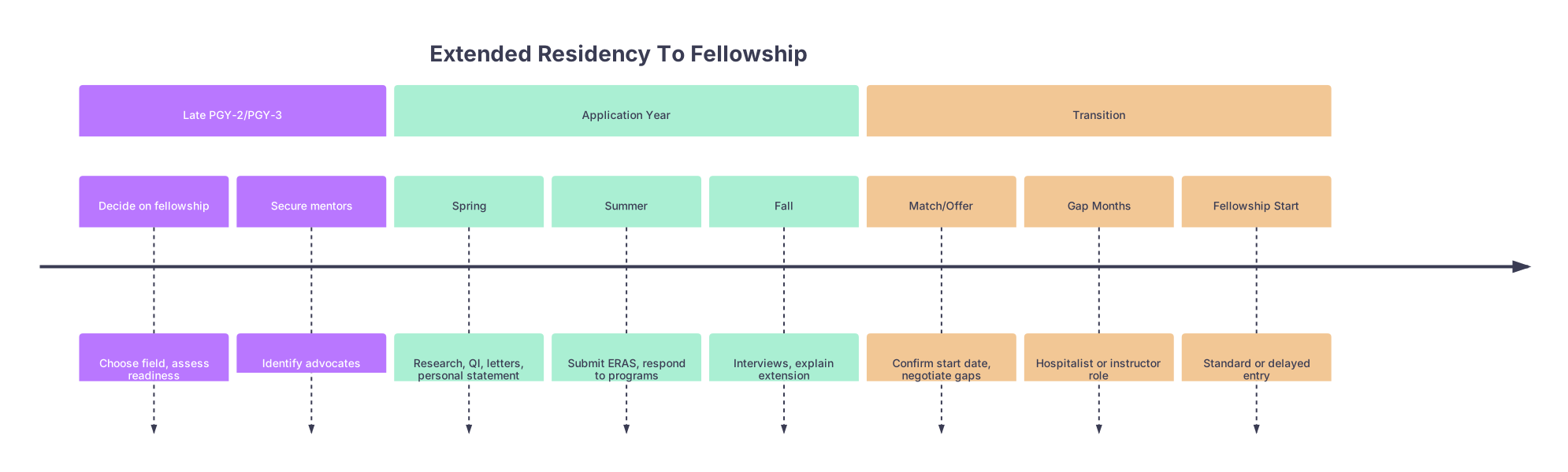
| Period | Event |
|---|---|
| Late PGY-2/PGY-3 - Decide on fellowship | Choose field, assess readiness |
| Late PGY-2/PGY-3 - Secure mentors | Identify advocates |
| Application Year - Spring | Research, QI, letters, personal statement |
| Application Year - Summer | Submit ERAS, respond to programs |
| Application Year - Fall | Interviews, explain extension |
| Transition - Match/Offer | Confirm start date, negotiate gaps |
| Transition - Gap Months | Hospitalist or instructor role |
| Transition - Fellowship Start | Standard or delayed entry |
Off-cycle isn’t fatal. It just needs a rational plan attached.
10. When Your Extension Involved Serious Professionalism Issues
This is the hardest version, and I’m not going to sugarcoat it.
If you were:
- On formal probation for professionalism.
- Suspended.
- Involved in harassment, boundary violations, or major conduct issues.
You’re in a different risk category for fellowship programs. Some doors will stay closed no matter what. Others will consider you if:
- The event was clearly time-limited and not a repeated pattern.
- There is documented remediation and successful completion.
- Senior leaders are willing to state, in writing, that they would rehire you and that they believe you’re safe and ready for fellowship.
You need:
- Brutal honesty with yourself: have you really changed behavior, or just behavior under surveillance?
- A program director letter that doesn’t dance around what happened but shows clear improvement.
- A longer time horizon. You may need several years of clean attending practice before fellowship is realistic.
In interviews, the script is different:
- “This is what happened.”
- “This is what I did wrong and what I own.”
- “This is exactly what I did to change.”
- “This is what the last X years show about who I am now.”
If you’re not prepared to have that conversation without defensiveness, you’re not ready for fellowship applications yet. Harsh, but true.
11. Mental Game: Not Letting the Extension Own You
You will be tempted to carry shame into every email, every draft, every conversation. That shows. Committees can smell applicants who see themselves as damaged goods.
You’re not special because you had a straight path. You’re not doomed because you didn’t.
What matters now is:
- Are you competent?
- Are you safe?
- Are you growing?
- Are you pleasant enough to work with at 2 a.m.?
Your extended path is a chapter, not the book. But you have to stop hiding from it and start telling the story on your own terms.

12. Concrete Step-by-Step Plan (Next 90 Days)
If you’re reading this and the next application cycle is coming, here’s what to actually do.
Next 2 weeks:
- Define your honest one-sentence description of your extension.
- Decide if you’re truly ready for this cycle or need a buffer year.
- Identify 2–3 mentors who know your story and will be blunt with you.
Next month:
- Draft your personal statement with a clear, concise extension paragraph.
- Meet with your program director to discuss your fellowship goal and get their read on your readiness and how they’ll describe your history.
- Secure letter writers; explicitly ask at least one to address your growth after the extension.
Next 2–3 months:
- Stack your schedule with rotations and experiences that align with your fellowship field.
- Finish or start at least one project that will be on your CV as “in progress,” not just “thinking about it.”
- Do 3–5 mock interview questions specifically on your extension until your answers are clean and unflustered.

By the time ERAS opens, you want your extended path to feel like old news in your own head. Something you can describe, own, and move past in under a minute.

Final Takeaways
- Do not hide or minimize your extended residency training. Name it plainly, take responsibility, and pivot quickly to what is different about you now.
- Compensate deliberately: stronger letters, visible recent performance, clear niche, and a broader, more strategic list of fellowship programs.
- Your past year or two matter more than your worst year. Make them so strong—clinically and professionally—that committees see your extension as context, not destiny.