The idea that you should quit your job or “take a research year” to match into fellowship is massively overstated. You can absolutely apply for fellowship while working as a hospitalist—if you treat it like a second job, not a hobby.
You’re not a resident anymore. No program director holding your hand. No built-in “academic half day.” If you try to approach this like residency, you will burn out or blow your application. Or both.
Here’s how to do it like an adult with a full-time job and real responsibilities.
1. Get Honest: Are You Actually Competitive Right Now?
Before you waste nights and post-call days writing essays, you need a hard reality check. Fellowship from a hospitalist role is absolutely doable, but it’s not magic. Programs look at you through a different lens:
- You’ve been in the real world. They expect maturity, clarity of goals, and proof that you still belong in academic training.
- They are suspicious (sometimes unfairly) that you left the training pipeline. You must explain that cleanly and confidently.
Do this first: a 60-minute self-audit.
| Factor | Strong Position | Needs Work |
|---|---|---|
| Board Exams | Passed on first attempt, solid scores | Multiple failures, borderline passes |
| Letters | 2+ strong subspecialty letters | Only generic “good hospitalist” letters |
| Research/Scholarship | Recent project, poster, QI, or publication | Nothing since residency |
| Timeline Gap | ≤3 years out of training, clear trajectory | 5+ years out, unclear path or frequent moves |
| Specialty Fit | Prior electives, cases, CME in target field | Vague interest, no clear focus |
If you’re weak in 2 or more “Needs Work” boxes, you can still apply—but you should:
- Be more strategic about which programs you target.
- Be proactive about strengthening one or two weaknesses before ERAS opens (not after).
If your board performance was shaky or you’ve been out >5 years, your best allies are:
- Strong subspecialty mentors willing to go to bat for you.
- Concrete evidence you’ve grown: QI leadership, teaching, procedural skills, meaningful roles at your hospital.
If you do not have those yet, your next step is not “write a personal statement.” It is “build credibility for 6–12 months.”
2. Build a Fellowship-Friendly Profile From Your Hospitalist Job
You don’t need a lab coat that says “Research Fellow.” You need to stop acting like your job is just admit/discharge and start curating experiences that scream: “This person belongs in fellowship.”
A. Get Visible to the Right People
Email one attending in your target fellowship field at your institution. Subject line close to:
“Hospitalist interested in [Cardiology/Heme-Onc/etc] – looking for ways to get involved”
Your email should:
- State who you are and where you trained (1 line).
- Clarify your goal: applying for [Fellowship X] in [Year].
- Ask for:
- One 20–30 min meeting (Zoom or in person).
- Feedback on how hospitalists from your institution have successfully matched.
- A chance to help with a project, conference, clinic, or teaching.
You’re not groveling. You’re making their future recruitment easier: they get a motivated, already-onboard faculty member as a fellow.
B. Turn Clinical Work Into “Academic Output”
You are seeing cases almost every shift that could become:
- Case reports
- Case series
- QI projects
- Morbidity & Mortality presentations
- Local or regional posters
Pick one of these lanes and commit:
- Identify an interesting case in your target field (e.g., weird cardiomyopathy, complex vasculitis, unusual infection).
- Ask the consult fellow/attending: “This case is fascinating—would you be open to turning it into a case report together?”
- Do most of the grunt work: chart review, first draft, literature search.
Will every case turn into a publication? No. But one or two decent outputs in the 12–18 months before you apply is a strong signal: “This person isn’t drifting. They’re moving intentionally toward this field.”
C. Optimize Teaching and Leadership
If you work at a teaching hospital, you have hidden advantages:
- Residents and students you can teach.
- Noon conferences, journal clubs, workshops.
Be the hospitalist who:
- Runs a focused teaching session once a month on a topic aligned with your desired specialty (e.g., “Approach to AKI in the ICU” for Nephro, “Anticoagulation in cancer patients” for Heme-Onc).
- Documents these sessions (titles, dates, evaluations if available) for your CV.
- Volunteers for at least one committee or QI project relevant to your target field: VTE prophylaxis, sepsis bundle, heart failure readmission reduction, etc.
Those show up very well in ERAS—especially when your letters back them up.
3. Time Management: Fellowship Application as a Second Job
Your biggest enemy is not your CV. It’s your schedule and your fatigue.
You cannot “fit in” fellowship applications in random gaps between notes and pages. You need a system.
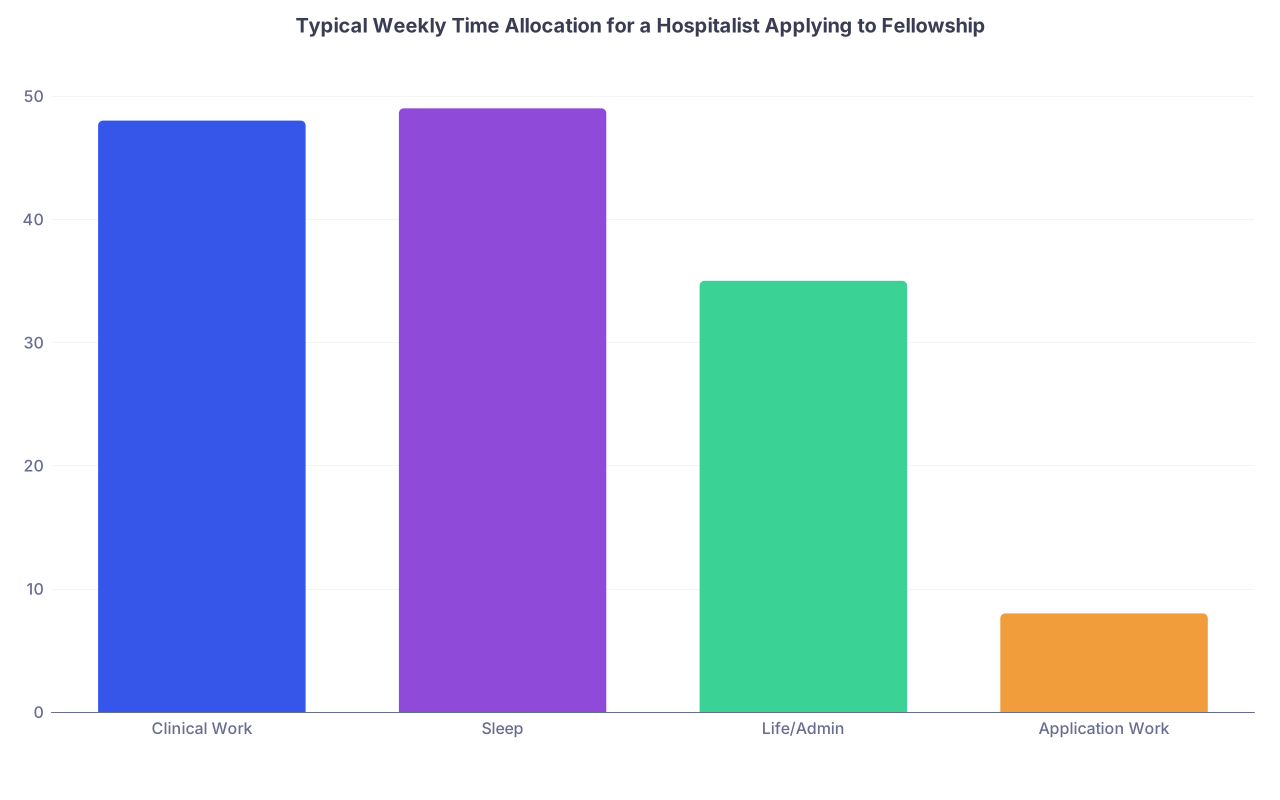
| Category | Value |
|---|---|
| Clinical Work | 48 |
| Sleep | 49 |
| Life/Admin | 35 |
| Application Work | 8 |
On a typical 7-on/7-off or block schedule, I’d structure it like this:
A. During Clinical Blocks
Your goals here are minimalist but consistent:
- 2 focused hours per week on application-related tasks (not scrolling Reddit “about” fellowship).
- Tasks during clinical weeks:
- Email mentors/programs.
- Collect and update CV content.
- Jot quick bullet points for personal statement or experiences.
- Confirm letters are requested and in progress.
Protect one evening or one post-call morning per week as “fellowship time.” Phone on Do Not Disturb. No charting. No errands.
B. During Off Weeks / Lighter Blocks
This is when you do the heavy lifting:
- 8–12 hours per off week for:
- Personal statement drafting.
- ERAS entries.
- Program list building.
- Scholarship (case reports, QI writing, etc).
Do not dump all 8–12 hours into one 14-hour marathon. That will make you hate this process. Split it:
- 3–4 sessions of 2–3 hours each.
- Early morning or late at night depending on your natural rhythm.
If you treat those sessions like a call shift—non-negotiable—you’ll be done before most residents even start.
4. Telling Your Story: Why You’re a Hospitalist Applying Now
This is where many people screw it up. They write:
“I always loved [specialty] since medical school, but due to life circumstances I became a hospitalist…”
Translation to a fellowship selection committee: “I settled and now I’m bored.”
You need a cleaner, more confident narrative:
- Own your hospitalist time as an asset, not a detour.
- “Working as a hospitalist sharpened my ability to manage undifferentiated illness, lead interdisciplinary teams, and recognize when specialized care is needed.”
- Explain the inflection point.
- A pattern of consults that energized you.
- A specific project/case that clarified: “I want deeper training in this.”
- Show evidence of sustained interest during your hospitalist years.
- CME, conferences, regular collaboration with that specialty, QI projects, teaching in that content area.
In your personal statement and interviews, the structure should be:
- Here is who I am as a physician now.
- Here’s how hospitalist work matured me clinically and professionally.
- Here’s why I specifically want [Specialty] training and how I have pursued it while working.
- Here’s how I’ll contribute as a fellow, drawing on those unique experiences.
Do not whine about schedule, burnout, or hospital politics in your application. That may be true, but on paper it reads as “difficult colleague.”
5. Logistics: ERAS, Letters, and Program Strategy as a Working Physician
Here’s the unsexy part, but it’s where a lot of people sink.
A. Letters of Recommendation
You should aim for:
- 2 letters from your target specialty (ideally from fellowship faculty at your hospital or a nearby academic center).
- 1 letter from someone who has seen you as a hospitalist (Chief hospitalist, service director, or respected colleague).
- Optional 4th letter if you have a heavyweight mentor.
How to get strong letters as a hospitalist:
- Work directly with subspecialists on interesting/complex cases; do not avoid them.
- Ask for feedback before you ask for letters: “What could I improve about my consult questions or management plans?” Then actually improve.
- When requesting a letter, ask explicitly:
“Would you be comfortable writing a strong, positive letter in support of my application to [Specialty] fellowship?”
When they say yes, send:
- Updated CV.
- Draft of your personal statement.
- Bullet list of 3–5 cases, projects, or interactions you had with them to jog their memory.
B. ERAS While Full-Time
Treat your ERAS like a clinical note: done in structured passes, not perfection in one sitting.
Recommended sequence:
- CV → Import into ERAS text. Get the skeleton in early.
- Fill “Experiences” by grouping related activities:
- “Hospitalist experience – [Institution]” with sub-bullets for teaching, leadership, committees.
- “Quality improvement: Sepsis and VTE projects” rather than 6 micro-entries.
- Personal statement → Draft, set aside, revise 2–3 times, then stop tinkering.
- Program list → Build in tiers based on your competitiveness and geography.
6. Choosing Programs Realistically as a Hospitalist Applicant
You are not applying from a big-name academic residency anymore. So you have to be slightly more strategic.
Think in tiers, not prestige fantasies.
| Program Type | Odds for Solid Applicant | Notes |
|---|---|---|
| Home institution fellowship | Highest | Leverage relationships and existing reputation |
| Regional academic centers | Moderate | Especially where consultants know your work |
| Community-based fellowships | Moderate-High | Value mature, clinically strong fellows |
| Top 5–10 national programs | Low (but not zero) | Need exceptional letters and story |
Weighted strategy that usually works:
- 30–40% “safer” programs where your profile matches or exceeds their usual.
- 40–50% mid-range programs where you’re realistic but not obvious.
- 10–20% reach programs if you have standout elements.
Also: do not ignore community-based or hybrid programs. Many of them love hospitalist applicants because you hit the ground running.
7. Scheduling Interviews Without Sabotaging Your Job
This is where hospitalists panic. Here’s the reality:
- You will not attend every interview. Nor should you.
- You need to make your chief hospitalist or scheduler your ally, not your adversary.
A. Prepare Your Group Early
2–3 months before interview season, have this conversation with your leader:
“I’m applying for [Specialty] fellowship this year. Interview season will likely be [months]. I want to minimize disruption and use PTO or swaps as much as possible. I’ll give you as much notice as I can for specific dates.”
You want them hearing this before you start emailing last-minute.
B. Prioritize Interviews: Not All Are Equal
When juggling PTO, swaps, and exhaustion, use a simple scoring system for invite emails:
- 3 points – Dream program or home/regional anchor.
- 2 points – Solid fit, good training, realistic match.
- 1 point – Backup or location not ideal.
If you’re overloaded, cancel the 1’s first. Then the 2’s in cities you really don’t care about living in.
C. Negotiate With Programs When Needed
As a hospitalist, you have a bit more leverage than residents living on strict schedules. It is fine to email and say:
“I work as a full-time hospitalist and have limited flexibility on clinical days. Would you have any virtual or alternative interview dates available? I’m very interested in your program.”
Most programs will try to work with you. They like candidates who already function as attendings.
8. Protecting Your Sanity: Burnout and Boundaries
If you do this badly, you’ll end up:
- Working 7-on.
- Charting at home.
- Then spending supposed “off” days writing essays and traveling.
Recipe for burnout and making dumb decisions (like ranking a program too high just because you’re exhausted).
Build 3 non-negotiables:
Protected No-Fellowship Days
At least one day per off-week where you do nothing related to applications. No ERAS. No PubMed. You’re a human.Sleep Floor
Minimum hours you will not go below for more than 2 nights in a row. For most people, that’s 6 hours. You’re not a resident anymore; chronic 4-hour nights will destroy your thinking.Money Reality Check
Fellowship will usually mean a pay cut from hospitalist life. At some point during this process, actually run your numbers: debt, savings, family obligations. Do not let this be an afterthought.
9. Example Timeline: 12–18 Months From “Maybe” to Match
Here’s a pragmatic arc I’ve seen work well.

| Period | Event |
|---|---|
| Months 1-3 - Self-audit and specialty decision | You |
| Months 1-3 - Meet mentors and subspecialists | You |
| Months 1-3 - Join QI or small project | You |
| Months 4-8 - Case report or abstract work | You |
| Months 4-8 - Start teaching sessions | You |
| Months 4-8 - Update CV and ERAS skeleton | You |
| Months 9-12 - Finalize project submissions | You |
| Months 9-12 - Draft personal statement | You |
| Months 9-12 - Request letters of recommendation | You |
| Application Season - Submit ERAS early | You |
| Application Season - Attend interviews | You |
| Application Season - Maintain strong clinical work | You |
| Post-Interviews - Rank list and financial planning | You |
| Post-Interviews - Prepare for potential move | You |
You can compress this into 6–9 months if you already have some academic weight. But the structure is the same:
- Early: build credibility.
- Middle: produce something scholarly and secure letters.
- Late: polish ERAS and survive interviews.
10. If You Don’t Match on the First Try
It happens. Especially with competitive subspecialties (cards, GI, heme-onc, pulm/crit). If you’re applying as a hospitalist, you need a pre-decided Plan B that is more than “feel bad.”
If you don’t match:
Ask for explicit feedback from:
- Trusted mentors.
- 1–2 program directors where you interviewed and felt it went well.
Decide your re-application angle:
- Stronger scholarship (finish that paper, get a poster at a national meeting).
- Additional letters (from new or more senior people).
- Narrow or broaden the programs you target, depending on prior list.
Adjust your hospitalist role if needed:
- Shift to an academic hospitalist position if you’re currently in a purely community setting and want a highly academic fellowship.
- Pick up teaching rotations, ICU blocks, or specialty-aligned services if available.
Do not just “apply again next year” with the exact same file. That is how you become the forever-applicant.
FAQ (Exactly 3 Questions)
1. Is it realistic to match into a competitive fellowship like cardiology or GI from a hospitalist job?
Yes, but only if you stop pretending your hospitalist time is a pause. You need clear specialty-relevant activity: consistent collaboration with that specialty, a project or two (case report, QI, poster), and at least two strong letters from within that field. If you’ve been out of residency 3–5 years and have little academic output, you may need a year of deliberately structured work—academic hospitalist role, heavy QI, dedicated research with that division—before you’re truly competitive. The days of “I liked cards, worked as a hospitalist for a while, now I’m applying, please take me” are mostly gone at top-tier programs, but they still respect mature, clinically excellent applicants with evidence of focus.
2. I trained at a community residency and now work as a community hospitalist. Do I have to move to an academic center before applying?
No. It helps, but it’s not mandatory. You do, however, need some bridge into the academic or subspecialty world: local academic affiliates, tele-consult relationships, regional specialists you can work with on projects, or national society involvement (e.g., ACP, CHEST, AASLD committees or abstracts). If your current hospital has zero teaching, zero QI structure, and no subspecialty collaboration beyond “please take this transfer,” then yes, consider an academic hospitalist job for 1–2 years to build the right experiences and letters. But many “community” hospitals still have teaching, QI committees, and strong subspecialty groups—use them aggressively.
3. How many programs should I apply to as a hospitalist applicant?
More than you think, but not “spray and pray.” For most mid-competitive subspecialties, a hospitalist applicant with a solid file should be in the 25–50 program range, scaled by competitiveness and geography. If you’re cards or GI and not a unicorn candidate, you may push higher, especially if you’re geographically limited. But the key is not just raw numbers—it’s the mix. You need your home institution if it exists, strong regional programs that know your hospital or mentors, community-based programs that respect clinical strength, and a smaller subset of aspirational programs. If you’re below-average on classic academic metrics (research, name-brand training), don’t waste half your list on ultra-elite programs hoping for a miracle.
Today, do one concrete thing: open your calendar for the next 4 weeks and block off three 2-hour “fellowship work” sessions—just like you’d schedule shifts. Those blocks are the difference between “I should apply someday” and a real, competitive application file.