What do you do when your dream fellowship offers you an interview… on your fourth 12‑hour ICU night in a row?
You’re not imagining it. The timing is terrible. Fellowship interview season was not designed for residents working 7-on ICU blocks or brutal night float.
But this is the situation: you’ve got
– a non-negotiable clinical schedule
– multiple fellowship interviews
– limited vacation days
– leadership that “supports” applications in theory… but also expects the unit covered and the pager answered.
Here’s how you handle it without burning bridges, wrecking your health, or tanking your interviews.
Step 1: Reality-check your schedule and non-negotiables
Before you email a single program or talk to your chief, you need a clear picture of your constraints. Vague “I’m kinda busy that week” will get you steamrolled.
Pull up your schedule and actually map your life.

| Step | Description |
|---|---|
| Step 1 | Get full call schedule |
| Step 2 | Mark ICU and night weeks |
| Step 3 | List interview dates offered |
| Step 4 | Accept as is |
| Step 5 | Prioritize interviews |
| Step 6 | Request changes from programs |
| Step 7 | Negotiate with chiefs |
| Step 8 | Overlap with heavy rotations |
Concrete steps:
- Open your master schedule for the entire interview season (usually Aug–Nov).
- Highlight:
- ICU blocks
- Night float
- Q3 or Q4 call weeks
- Elective / clinic weeks
- List every interview offer with:
- Date
- Time zone
- Duration (some are 3–4 hours, some a whole day)
- Format (virtual vs in-person)
Now categorize each potential interview into:
- “Easy” days: elective, clinic with flexible preceptors, golden weekends.
- “Salvageable” days: non-ICU ward months, lighter call days, post-call days if interview is later and virtual.
- “Bad” days: active ICU days, nights, 24-hour calls, cross-cover shifts.
Night float adds another layer. You’re either:
- Post-night (7–8 am off, then interview same day)
- Pre-night (interview then go to work overnight)
- Mid-run (physically and cognitively wrecked)
If you’re on a 6–7 night run, assume days 3–6 you’re not functioning like a normal human. Plan accordingly.
Step 2: Decide which interviews are “must-protect” vs “flex if needed”
You cannot protect every interview perfectly if you’re on heavy services. You’ll burn your co-residents, your program, and probably yourself. You have to rank them.
Here’s the rough hierarchy I’ve seen work:
- Absolute top-choice programs (location + fit + reputation)
- Programs that are realistic but competitive for your profile
- “Safety” programs where you’re reasonably sure of an offer if you interview decently
- Long-shot vanity interviews you don’t actually see yourself ranking highly
Be honest. If you would never move your ICU week to interview at that one random program you applied to “just in case,” don’t pretend it’s high priority now.
Make something like this for yourself:
| Program | Priority Tier | Rotation That Day | Risk Level |
|---|---|---|---|
| Program A | Top Choice | ICU Days 5–6 | High |
| Program B | Mid-tier | Elective | Low |
| Program C | Safety | Night float Day 2 | Medium |
| Program D | Long-shot | ICU Day 1 | High |
| Program E | Mid-tier | Clinic | Low |
Your goal: aggressively protect Tier 1, reasonably protect Tier 2, and accept some imperfection for Tiers 3–4.
Step 3: Use programs’ flexibility before burning your vacation or your co-residents
Most fellowship programs are more flexible than residents assume—if you ask early and ask well.
How to request a different date or time
You don’t write:
“Can I reschedule? I’m on ICU that week.”
You write something like:
Dear [Coordinator/Dr. X],
Thank you very much for the invitation to interview for the [X] fellowship on [original date]. I’m currently scheduled for an ICU rotation with 12-hour clinical duties that day, and our program has asked us to avoid being away from this service whenever possible.
If there’s any flexibility, I’d be very grateful for consideration of the following options, which I’m fully available for:
– [Option 1: specific date/time, with time zone]
– [Option 2]
– [Option 3]I remain very interested in your program and will gladly protect any alternative time offered.
Sincerely,
[Name, PGY, Program, Cell]
Three keys:
- You give them specific alternatives.
- You reference ICU not as “I’m busy” but as a patient care issue.
- You make it clear the program is important to you.
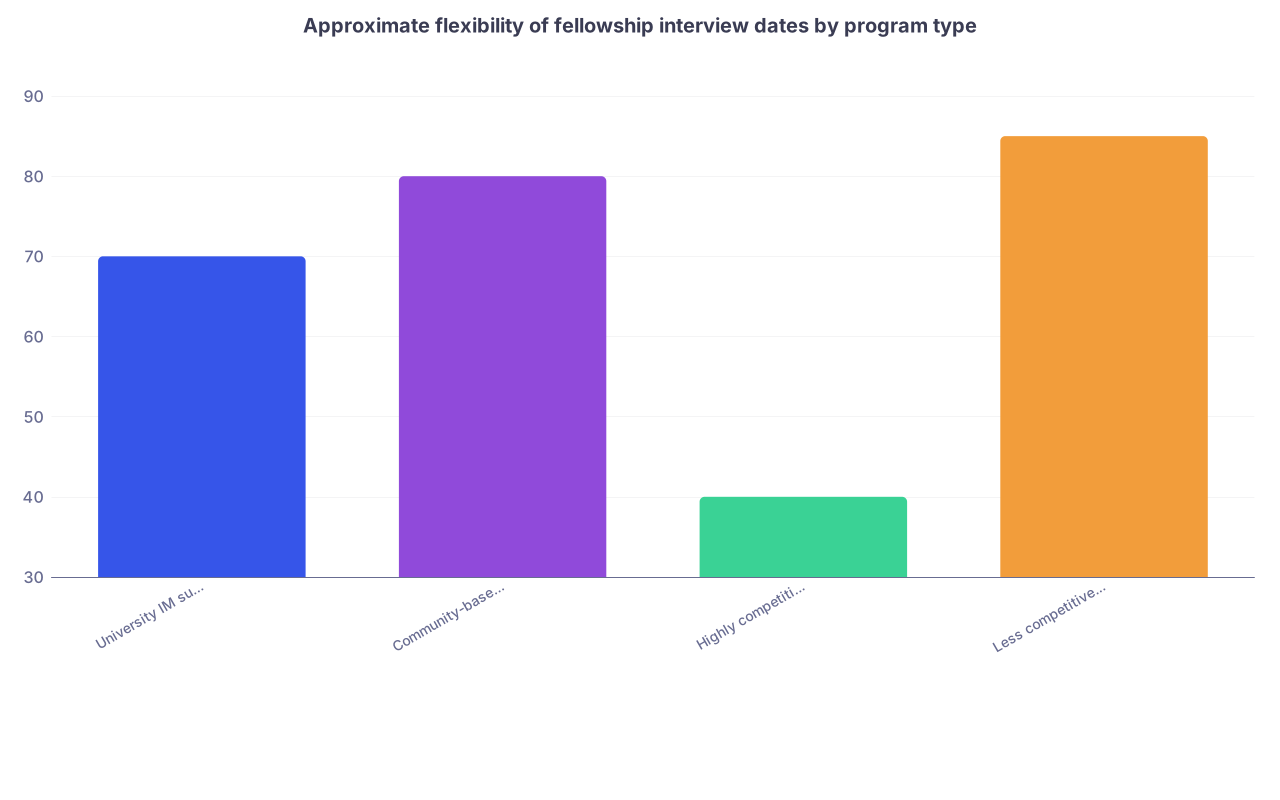
| Category | Value |
|---|---|
| University IM subspecialty | 70 |
| Community-based subspecialty | 80 |
| Highly competitive niche | 40 |
| Less competitive fields | 85 |
Those numbers aren’t exact, but they reflect what I’ve seen: most programs will try, competitive or not.
What’s reasonable to ask for?
Reasonable:
- Moving to another listed interview day
- Shifting to morning vs afternoon block
- Asking if they have a cancellation list if you truly have no other options
Unreasonable:
- “Can you do a completely separate interview day just for me?” (unless they offer)
- “I can only interview at 7 pm Eastern after my shift” (for multi-faculty days)
Ask once, politely. If they say, “We’re very limited, we only have X date,” then your decision is: bend your schedule or accept the conflict.
Step 4: Talk to your chiefs and PD like an adult, not like a victim
Too many residents go to their chiefs with, “My life is a disaster, I don’t know what to do.” That’s not helpful. Go with a plan.
You want to show:
- You’ve already tried to move the interview
- You understand service needs
- You have concrete swap or coverage ideas
Here’s the structure:
- List the dates you cannot move (must-protect).
- List the rotations you’re on those days.
- Bring specific proposals:
- “I can swap my ICU block with X resident who’s on wards.”
- “I’ll cover two of their calls later to repay.”
- “I can do pre-rounding and sign out by 10 am, then log in for the interview.”
And you say something like:
“I’ve been offered interviews on these dates. I’ve already asked the programs for alternate days, but these are the only options. Here are 2–3 ways I think we could make coverage work; I’ve already spoken with [co-resident] and they’re open to swapping if leadership approves.”
That’s someone your chiefs will try to help.
Step 5: ICU and night float specifics – what actually works and what usually doesn’t
This is the part everyone gets burned on: what looks fine on a calendar but destroys you in reality.
ICU days
Bad ideas:
- Full-day virtual interview while scheduled on ICU from 7–7 “but I’ll just step out.”
- Being primary for half the unit and expecting your co-resident to “cover your pager for a few hours.”
Better options:
- Pre-round from 6–9 am, staff quickly, hand off capped list and step away for a half-day interview 10–2, then return to help later.
- Trade that single ICU day for a ward day or jeopardy shift with someone else.
- Use a PTO/vacation half-day if your program allows it without destroying your block.
If your ICU is the kind where you’re literally managing pressors and vents nonstop with minimal backup, you should not be trying to sneak a 4-hour virtual interview from the call room. That’s unsafe for patients and terrible for your performance.
Night float
Night float is actually both the worst and sometimes the only workable option.
Three common setups and how I’d rank them:
| Scenario | Feels Like | Viable? |
|---|---|---|
| Interview 8 am–1 pm after a night shift | Post-call, no sleep | Rarely |
| Sleep 8 am–1 pm, interview 2–5 pm, off that night | Post-night with protected sleep | Sometimes |
| Off one night in the middle of block with true 24h off | Golden | Yes |
If you must pair an interview with night float, the least bad option is:
- Do not try to interview immediately after a 12-hour night. Your brain will be soup.
- Sleep a protected block of 4–5 hours, then interview.
- Have your co-resident or night team expect that you will be slightly off for the next night and try to protect the first half of the shift where possible.
If your program absolutely will not give you relief, and your interview is 7–1 your local time after night float? Strongly consider trying harder to reschedule that interview. I’ve seen too many people bomb those days.
Step 6: In-person interviews when you’re on service
Virtual bought residents a lot of sanity. Some fellowships still want in-person, especially in certain subspecialties or high-prestige programs.
In-person while on ICU or nights usually requires one of three strategies:
- Burn vacation days and fully get out of the rotation for 1–2 days.
- Use a golden weekend strategically and accept red-eye flights, with all the risks.
- Say no to some in-person expectations and prioritize virtual-friendly programs.
Let me be blunt: flying same-day, interviewing, then flying back to do another ICU or night shift is how you end up making dangerous mistakes and resenting the whole process. One such trip is survivable; four of them is demolition.
If you choose the red-eye strategy:
- Don’t do it for programs you barely care about.
- Don’t do it in the middle of a brutal run if you can avoid it—aim for first or last days of a block.
- Build in at least some protected sleep the day before or after.
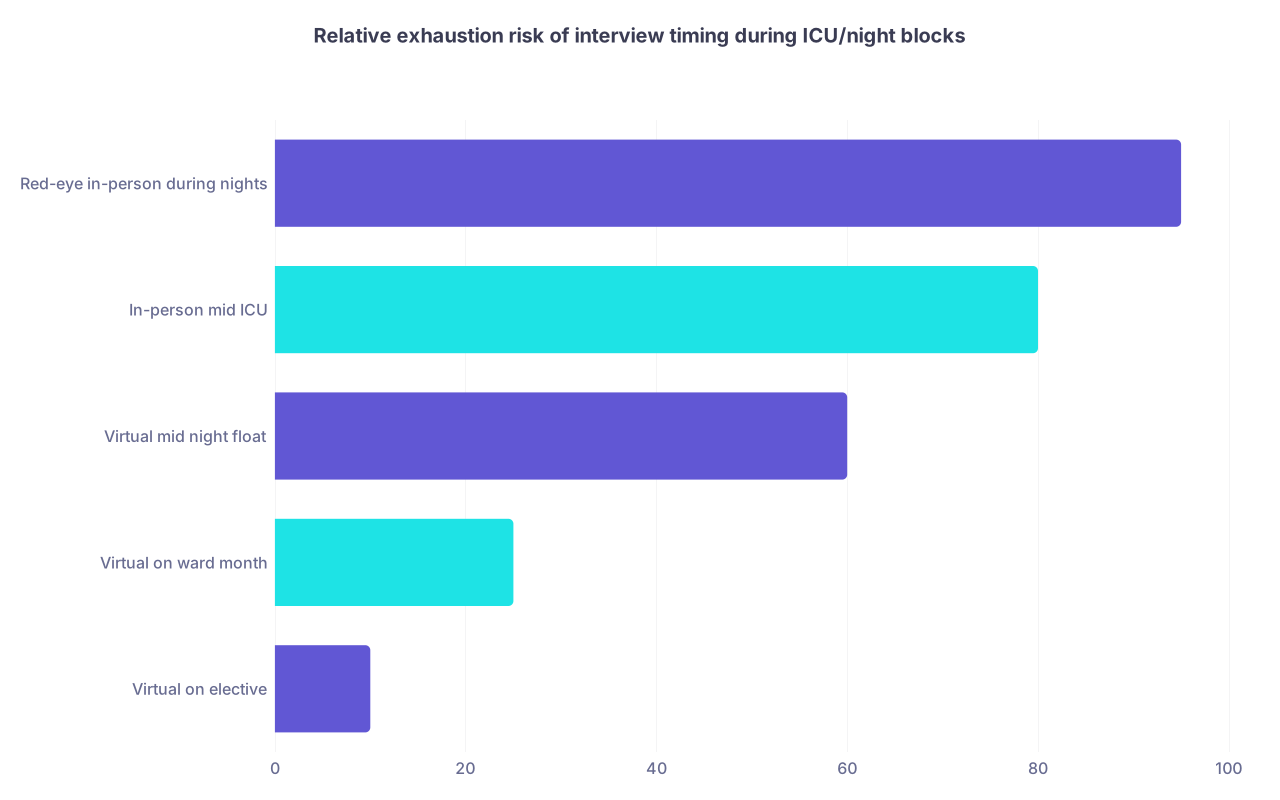
| Category | Value |
|---|---|
| Virtual on elective | 10 |
| Virtual on ward month | 25 |
| Virtual mid night float | 60 |
| In-person mid ICU | 80 |
| Red-eye in-person during nights | 95 |
Again, not hard numbers, but the pattern is obvious.
Step 7: Prepare differently when you’re not on an easy month
You cannot prep for interviews the same way during ICU or nights as you would on a 9–5 elective. Stop pretending you can.
Shift your preparation strategy:
- Front-load: Do the heavy lifting (program research, common questions, polishing your “story”) before the heavy block starts.
- Create a “minimum prep kit” you can run through in 30–40 minutes the day before each interview:
- Skim program website and faculty interests
- Review your own application and personal statement
- Jot 3 specific reasons you like this program
- Prepare 3–5 sharp questions you can ask almost anyone there
Keep your core stories ready:
- Challenging case in your subspecialty
- Times you handled conflict/uncertainty
- Example of teaching, leadership, QI
- One ICU/night story that shows resilience without glorifying overwork
During nights, your brain is slower. Practice out loud when you can. Not in your head at 3 am between pages.
Step 8: Protect your basic functioning the 24 hours around the interview
You will do all this schedule Tetris, and then sabotage yourself by not sleeping, overcaffeinating, and trying to cram last minute.
Minimum baseline around an interview during ICU/nights:
- Sleep: Aim for some consolidated block of 4–6 hours. That might be 9 pm–1 am or 8 am–noon, depending on your call structure. Guard it.
- Caffeine: Don’t triple your usual dose right before. You’ll sound jittery and scattered on Zoom. Use your normal pattern.
- Food: Eat something real 60–90 minutes before. Not only sugar. Not just ICU cookies.
- Location: If virtual, secure a quiet space with decent Wi-Fi. Beg borrow steal an office if you must. The call room with three codes overhead is not it.

Tell your team: “I am out from X to Y for this interview, but I’ll be fully present before and after.” Then mean it.
Step 9: What to tell programs (and what not to say)
Programs do not need the gory details of your call schedule. They do sometimes need to know if you look wrecked on camera.
You can say, very simply:
- “I’m on a night block this week, so if I look a bit tired, that’s why. But I’m really glad to be here.”
- “I’m coming off an ICU stretch, which has been intense but meaningful, especially for this subspecialty.”
You don’t say:
- “I’m so exhausted, our program is horrible, they wouldn’t let me off.”
- “Sorry if I’m not making sense, I’ve worked six nights in a row.”
Own your situation without whining. Programs actually respect residents who can hold hard schedules and still show up prepared. Just don’t make your entire personality “tired martyr.”
Step 10: Decide when to say no
Hard truth: sometimes the right move is to decline an interview rather than destroy yourself or your co-residents.
Situations where declining is reasonable:
- The only offered date is smack in the middle of a 7-night stretch, interview 8 am–2 pm local, and your program refuses to adjust call.
- You already have more interviews than you can rank realistically, and this one is a low-priority program.
- The scheduling contortions would seriously compromise patient care or colleague safety.
If you decline, do it professionally:
Thank you very much for the invitation to interview. Due to immovable ICU/night float responsibilities at my residency program and lack of alternative dates, I’m unfortunately unable to attend. I remain very appreciative of the opportunity and your consideration.
You’re not burning the bridge. And you’re acknowledging reality like an adult.
Quick examples: What’s actually workable?
Let’s run through three real-world style scenarios.
Scenario 1: Virtual interview during ICU
You’re on MICU, 7a–7p, and offered a virtual interview 10a–3p.
Workable plan:
- Negotiate with program: “Any chance of a morning (8–11) or afternoon (1–4) block instead?”
- If no: Ask your ICU attending/chief if you can:
- Pre-round 5–9 am on a capped list
- Present early
- Have your co-resident cover during 10–3 with you available for emergent phone calls only if absolutely necessary
- Return after interview 3:30–7 to help with notes, sign-out, etc.
This requires goodwill and trust. Don’t do it three times in one block. But once or twice? Programs make it work.
Scenario 2: Night float plus virtual interview
You work 7p–7a, and interview is 1–5p.
Workable:
- Leave on time at 7a.
- Sleep from 8a–12p.
- Fully wake, caffeine, light food.
- Interview 1–5p.
- Short nap 6–7p if possible, then back to work.
Brutal but survivable. Not ideal for multiple top-choice programs—try to move at least some.
Scenario 3: In-person interview mid-ICU
You’re on CCU, invited for in-person at a program across the country, one specific date only. No virtual option.
Workable only if:
- You use a vacation day or trade out of ICU for that 24–48 hours.
- Fly out the day before, interview, red-eye back or next-morning flight.
- Have true coverage; not “text me if something happens.”
If your program refuses any of that, ask yourself: is this program high enough on my list to justify real risk to my health and patients? Sometimes yes. Often no.

FAQ – Managing Fellowship Interviews on Heavy ICU or Night Float
1. Should I tell the fellowship program I’m on ICU or nights when asking to reschedule?
Yes, briefly and professionally. You don’t need a sob story. A single line like, “I’m scheduled for 12-hour ICU clinical duties that day, and my residency leadership has asked us to avoid being away from this service if possible,” is enough. It signals that you’re taking patient care seriously, not that you’re disorganized.
2. Is it safe or reasonable to interview right after a 24-hour or 12-hour night shift?
Reasonable? Barely. Safe? Often no, especially repeatedly. One emergency situation like this in a season—you can push through. Making it your standard plan is how you end up exhausted, sloppy in your interview, and dangerous on the back end of your shifts. If the only slot is 8 am–1 pm after a full night and there’s zero local flexibility, that’s an argument for trying harder to reschedule or, in lower-priority cases, declining.
3. How many interviews should I realistically protect aggressively if I’m on heavy rotations?
For most subspecialties, aggressively protect your top 5–7 programs—the ones you’d actually move your life for. For the rest, aim for decent conditions but accept less than ideal. You don’t need perfect sleep and a spa day before every interview. You just need to avoid being totally wrecked for the handful that really matter to you.
4. What if my residency program is completely unsupportive of interview time off?
Then you get strategic and documented. Save emails showing you tried to arrange swaps and negotiate. Use vacation days surgically. Prioritize your truly top programs, and accept that you may have to decline some lower-priority interviews. If things are extreme, loop in your PD early with a specific ask: “I have X interviews, I’d like to identify 3–4 days where coverage can be arranged; here are my proposed options.” Don’t just complain—bring a plan.
5. How bad does it look if I reschedule or ask for alternate dates?
It doesn’t look bad at all if you’re polite, early, and flexible. Coordinators do this every year. What looks bad is last-minute cancellations, ghosting, or repeatedly changing your mind. One reschedule request framed around patient care or immovable night/ICU responsibilities is completely normal. Programs live in the same universe you do—they know what residency schedules look like.
Two things to walk away with:
Protect your top interviews ruthlessly, even if it means asking programs and your chiefs for help. And stop pretending you’re superhuman—build in just enough sleep and structure around those days so you can show the version of yourself you actually want them to see.