
It’s August of your PGY-3 year. You and your co-resident just finished sign-out and are trudging back to the workroom when your program director casually says, “By the way, both of your letters for GI fellowship look very strong. Proud of you both.”
You knew they were applying. They know you’re applying. There are 1–2 realistic fellowship spots in your city. Maybe one at your home program that you both desperately want.
Now every sign-out, every conference question, every new QI project email feels… loaded. You’re on the same team, but not really. At least that’s how it feels in your gut.
Here’s how to handle that without destroying:
- your relationship with your co-resident
- your fellowship chances
- your reputation with faculty
And yes, you actually can protect all three. If you’re deliberate.
Step 1: Get Clear on the Actual Stakes (Not the Imagined Ones)
You’re probably telling yourself a neat, catastrophizing story: “There is one spot. It’s either them or me. Hunger Games.”
Reality is usually messier and less dramatic.
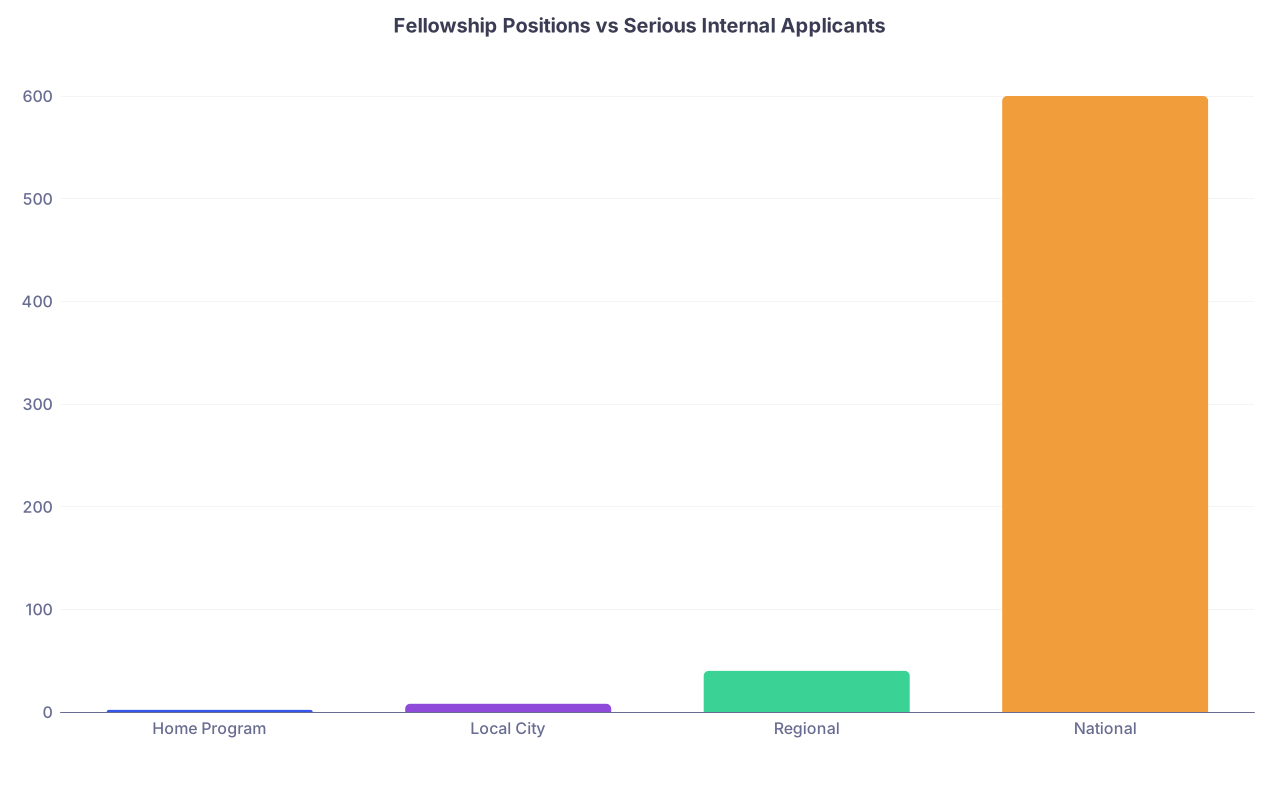
| Category | Value |
|---|---|
| Home Program | 2 |
| Local City | 8 |
| Regional | 40 |
| National | 600 |
Here’s what I’ve seen over and over:
- Home program has 1–2 spots in your subspecialty.
- There are 2–4 serious internal applicants.
- Some stay, some match regionally, some go to larger academic centers.
- Faculty care way more about matching both of you somewhere good than “choosing a favorite child.”
So first move: strip the drama.
Ask yourself, bluntly:
- Do I actually need to stay at this program/city for family/visas/partner?
- Or is this just familiarity and ego?
If you must stay: your strategy is slightly different (we’ll get there).
If you prefer to stay but could go: you need to stop acting like this is a binary life-or-death competition. It’s not.
Step 2: Decide What Kind of Colleague You’re Going to Be
This is the character-defining part. You cannot control how your co-resident behaves. You absolutely control how you show up.
Let me be blunt:
Faculty remember how people act when they’re stressed, threatened, or competing. I’ve seen one resident torpedo their own reputation over fellowship anxiety without realizing it was happening.
Choose your lane before stuff gets weird.
You’ve got three broad options:
- Openly collaborative – “We’re in this together, we’ll help each other, and may the best fit win.”
- Quietly independent – You’re cordial, professional, but don’t really share strategy or materials.
- Subtly adversarial – You downplay their strengths, hoard opportunities, subtly cut them down.
Option 3 feels great for about 10 minutes and then absolutely wrecks you long-term. Word gets around. Fellowship PDs can smell this a mile away.
My recommendation:
Aim for something between 1 and 2.
You do not have to share every draft of your personal statement or your exact rank list. But:
- Do not talk them down to faculty or chiefs.
- Do not try to “scoop” them out of projects they’re already on.
- Do not celebrate their setbacks in your head. That seeps into your behavior.
If they choose adversarial mode while you don’t? Fine. That’s data. You stay clean and professional. They can live with the fallout.
Step 3: Have the Awkward Conversation Once, Not 100 Times in Your Head
Most residents avoid this and then stew about it for months.
You don’t need a big sit-down summit, but you should address the elephant in the room early.
Something like:
“Hey, I know we’re both applying to cardio this year, and our home program only has a couple spots. Just want you to know I’m rooting for both of us to match somewhere we’re happy. I’m planning to stay pretty independent with my application materials, but I’m also not going to undercut you or compete for the sake of competing. I just want to keep our working relationship good.”
That does a few things:
- Names the dynamic.
- Sets a boundary: you’re not co-writing your apps.
- Makes your values clear: no sabotage, no pettiness.
If you do want some level of collaboration, you can add:
“If you ever want to practice interviews together or trade general feedback (not content-stealing), I’m open to that too.”
If they respond stiffly or vaguely (“Yeah, yeah, same” but their face says otherwise), mentally log it. Then keep your guard reasonably up around sensitive details like which faculty you’ve asked for letters or exactly where you’re ranking.
Step 4: Protect Your Reputation With Faculty — This Is Non-Negotiable
This is where people screw up.
Faculty don’t just compare your CVs. They compare:
- Professionalism under stress
- How you handle conflict
- Your generosity towards peers
- The ratio of “I” to “we” when you present anything
A few hard lines you should not cross:
- Don’t ever say anything negative about your co-resident to faculty. Not even “They’ve seemed really stressed lately.” It’s always interpreted as a dig.
- Don’t grab credit for joint work. If a paper or QI project was mostly theirs, say so. Out loud.
- Don’t play the “subtle warning” game: “X is great clinically, they just sometimes struggle with…” That sounds like you’re managing their reputation. You are not their PD.
When asked directly (and you will be, informally):
“How’s X doing on the cardiology track?”
Keep it simple and clean:
“They’re strong. We have different strengths, but I think they’ll do well in fellowship.”
Then stop. You do not need to qualify it.
Faculty notice that kind of graciousness. I’ve seen PDs comment years later: “When both were up for GI, A never once tried to talk down B. That told me a lot.”
Step 5: Play to Your Own Angle — Differentiate Without Trash-Talking
Competing for the same fellowship doesn’t mean programs see you as clones. Or that you should.
Your job is to make your application so clearly you that it’s not “Resident A vs Resident B,” it’s “Strong clinician-educator vs heavy researcher vs leader in QI,” etc.
Ask: what’s my actual edge?
Some options I see a lot:
- Heavier research portfolio / first-author work
- Strong teaching portfolio: chief year, residency curriculum projects, MedEd certificate
- Unique life experience: prior career, language skills, community ties
- Clear niche interest: advanced heart failure, IBD, transplant hepatology etc.
Then lean into it without ever referencing your co-resident.
For example, in your personal statement:
- Talk about your long-term goals and specific fit with this program’s strengths.
- Describe specific patient encounters and project outcomes that belong to you.
But don’t write in code like: “Unlike others, I prioritize patient connection over research productivity.” That’s a cheap side-swipe. Programs read between those lines.
If you truly share almost identical profiles, then your edge is often:
- More polished interview performance
- Better letters
- Clearer narrative
Not more subtle sabotage.
Step 6: Manage Overlapping Opportunities Without Losing Your Mind
This is the real minefield: projects, leadership roles, or letters where it feels like you’re in direct collision.
Letters of recommendation
Yes, you can both ask the same big-name cardiologist/oncologist for a letter. Faculty are grown adults. They’ve seen this before.
What you should not do:
- Don’t ask, “So, whose application do you think is stronger?”
- Don’t hint that they should prioritize you because of X, Y, Z.
- Don’t ask to see what they wrote for the other resident.
Your lane is simple:
“I know you’re writing for both of us. I’d be very grateful if you could speak specifically to my work on [this project/rotation/clinic] and my growth in [these areas].”
That’s it.
Projects and leadership roles
If there’s a single, obvious “best” role — chief resident, fellowship QI lead, big departmental committee — and you’re both eyeing it:
- Apply based on genuine interest, not just optics.
- Don’t peek at or copy their proposals.
- Accept the decision like an adult, especially if they get it and you don’t.
If a project comes up and you know your co-resident is already deeply involved, don’t try to displace them. Ask: “Is there a way for both of us to be involved with different roles?” or find something different.

| Step | Description |
|---|---|
| Step 1 | Shared Opportunity Appears |
| Step 2 | Ask about complementary role |
| Step 3 | Decide if you genuinely want it |
| Step 4 | Clarify roles with mentor |
| Step 5 | Apply or propose role |
| Step 6 | Document roles in email |
| Step 7 | Are they already involved |
Always document roles in a short email so no one can later imply you “took over” or “dumped work.”
Step 7: Handle It If They Start Playing Dirty
Sometimes, unfortunately, the other person does not choose the high road.
Red flags I’ve actually seen:
- They “forget” to cc you on project emails you’re supposed to be on.
- They casually tell faculty, “I’ve basically carried this project since the beginning.” False.
- They drop lines like, “I worry X might have trouble with the research demands of your program,” to attendings.
You’re not required to roll over.
But your response has to be controlled. No nuclear options unless truly necessary.
Basic playbook:
Clarify privately first
“Hey, I’ve noticed I wasn’t on the recent emails about the sepsis QI project. Are you still thinking we’re co-leads? I want to make sure we’re aligned before we meet with Dr. Y.”If it continues, protect yourself with documentation
Keep:- Your initial project proposal
- Emails assigning roles
- Versions of manuscripts with tracked changes
If they misrepresent your work to faculty
Address the fact, not their character.“Just to clarify my role on that sepsis project — I led the data extraction and initial analysis, while X handled the survey component. Happy to send you our role breakdown if that’s helpful.”
No “They lied.” Just correction.
If the behavior is truly egregious (sabotage, undermining you with false info):
Talk to a trusted faculty mentor or APD:
- Stick to specific examples.
- Avoid speculating on motives.
- Focus on impact: “This could affect evaluation of my fellowship application.”
You’re protecting your career, not starting a drama show.
Step 8: Keep Your Performance Solid During Peak Comparison Season
The riskiest period is right as interviews and offers are rolling in. People leak.
You’ll hear:
- “I think I’m getting a really strong letter from Dr. X.”
- “Program Y told me I’m ranked to match.” (Often exaggerated or misinterpreted.)
- “The PD said I’m their top internal candidate.”
Assume 50% of what you hear from peers in this phase is either:
- Misquoted
- Over-optimistic
- Egotistically filtered
Your job during this stretch:
- Show up on rotations like nothing weird is happening.
- Don’t decrease your effort because you “probably” matched somewhere already.
- Don’t increase your theatrics because you’re panicking.
Programs absolutely notice when a PGY-3 suddenly starts “performing fellowship resident” only when the spotlight is on. That kind of late surge rarely offsets two years of normal behavior.
Step 9: Prepare Emotionally for Asymmetric Outcomes
Sometimes you’re the one who matches your dream program and they don’t. Sometimes it’s reversed. Both are emotionally messy.
If you match where you want, and they don’t
Do:
- Tell them simply and kindly, preferably 1:1.
- Acknowledge that this might be hard to hear.
- Offer support without pity.
Do not:
- Gush for 30 minutes about how “perfect” it is.
- Immediately pivot to “You’ll get it next cycle” — you don’t know that.
- Say, “They clearly saw how hard you worked.” That implies the programs that didn’t take them didn’t see their work.
A simple version:
“I wanted to tell you personally — I matched at [Program]. I know we were both aiming there, and I’m really grateful. I also know this might be a bit tough to hear, and I get that. I’m here for you if you want to talk about next steps or just vent.”
Then give them space.
If they match your top choice, and you don’t
You’re allowed to feel like you got punched in the chest. Privately.
But your externally visible behavior matters:
- Congratulate them in a way that doesn’t sound bitter. One sentence is fine.
- Do not fish for, “You were robbed” validation from others. That spreads bitterness.
- Don’t rewrite history in your head as “Everyone liked them better than me.” You honestly don’t know the backroom discussion.
Then go do the real emotional work with:
- Your partner/family
- A trusted co-resident not involved in this
- A therapist if this is hitting ego + burnout + identity all at once
I’ve seen people torpedo perfectly good fellowship offers because they were so fixated on “losing” to their colleague. That’s self-sabotage dressed up as pride.
Step 10: Use This as Rehearsal for Your Whole Career
Last thing, and I’m not saying this to be dramatic:
This exact situation doesn’t end at fellowship.
You’ll compete with colleagues for:
- Faculty positions
- Division chief roles
- Big grants
- Named lectureships
- High-profile committees
Everyone remembers how people behave in zero-sum or perceived zero-sum situations. If you can get through this fellowship cycle:
- Without trashing your co-resident
- Without contorting your personality into a bitter rival
- While still advocating strongly for yourself
You’re practicing a skill that will pay off over decades.
And that’s probably more important than which of you ends up in which GI/Onc/Cardiology program this one particular year.
| Situation | Do | Don't |
|---|---|---|
| Talking to faculty about them | Be brief, positive, factual | Hint at weaknesses or stress issues |
| Shared letter writer | Ask for specific commentary on *you* | Ask who they prefer or compare you |
| Joint project | Clarify roles and give credit | Minimize their contribution |
| Hearing their good news | Congratulate sincerely, briefly | Undercut, question, or minimize it |
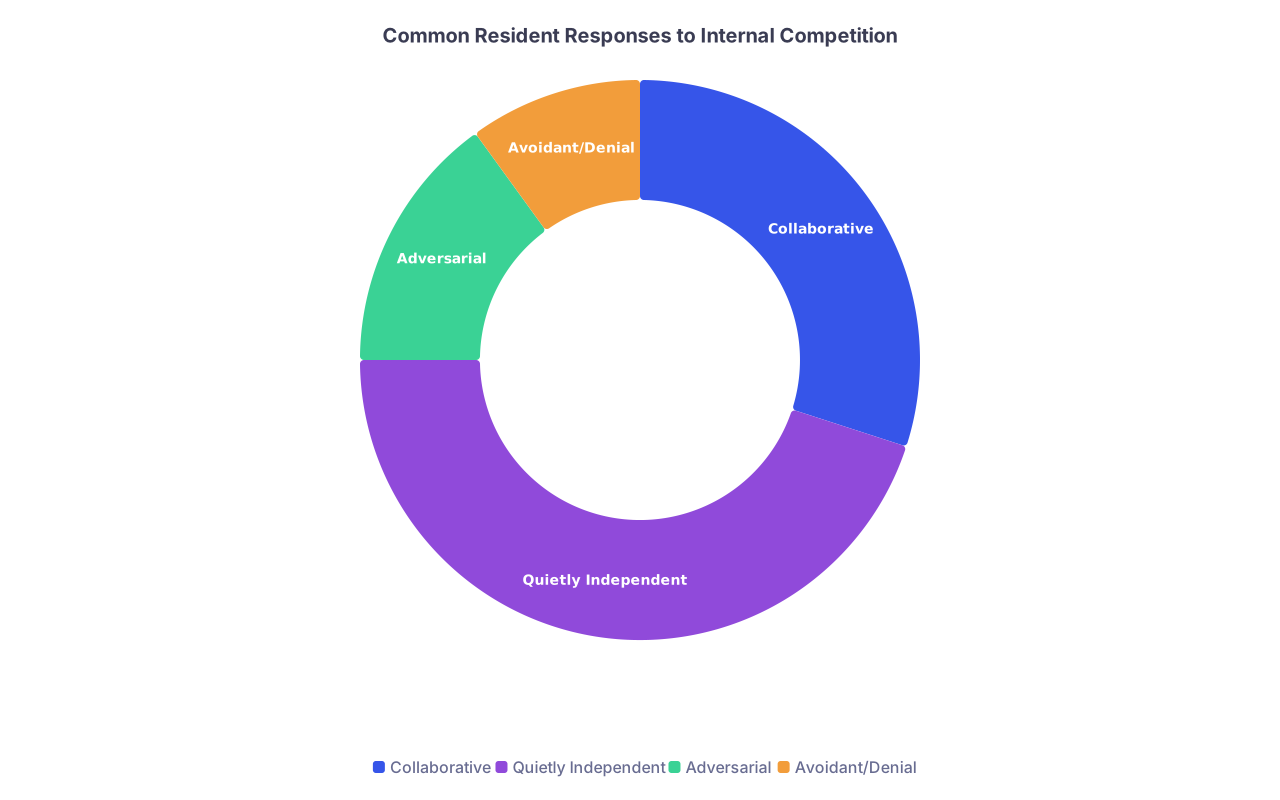
| Category | Value |
|---|---|
| Collaborative | 30 |
| Quietly Independent | 45 |
| Adversarial | 15 |
| Avoidant/Denial | 10 |