

The biggest myth in fellowship applications is that “any red flag is fatal.” That is not how program directors actually think. The truth is harsher and more hopeful at the same time: red flags do not automatically kill you—but how you explain them absolutely can.
Let me walk you through what really happens behind closed doors when cardiology, GI, heme/onc, ICU, and other fellowship program directors dissect your timeline and see gaps, leaves, repeats, or discipline. I’ve been in those rooms. I’ve heard the unfiltered comments. And they’re not what your classmates are telling each other on Reddit.
How PDs Actually Scan Your Application
Here’s the unspoken workflow.
Most fellowship PDs do not sit down and “deep read” your application front to back. They scan in a predictable order. They’re fast. They’re pattern-recognition machines.
Roughly, the sequence looks like this:
- Where you trained and in what (institution + residency specialty).
- Letters—who wrote them and what tone they take.
- Academic record and timeline—any interruptions, repeats, or probation.
- Research and productivity (especially in competitive fields).
- Personal statement—mainly to see if it matches the narrative in your CV.
Only after that does anyone start dissecting details.
So your “red flag” is never seen in isolation. It’s seen relative to everything else. A year off and 3 first-author papers? Very different from a year off and nothing to show for it. Repeated intern year at a struggling community program versus repeated year at a historically malignant service with known structural issues? Also very different.
You need to understand which category your issue falls into and how PDs mentally sort it.
The Red Flag Buckets: What Actually Raises Eyebrows
When PDs talk in the workroom, they don’t say “this applicant has a concerning history of….” They say stuff like:
- “What happened here?”
- “Why did they lose a year?”
- “They left that out. Why?”
- “Do I want to deal with this in my program?”
Most “red flags” that trigger those reactions fall into a few predictable buckets.
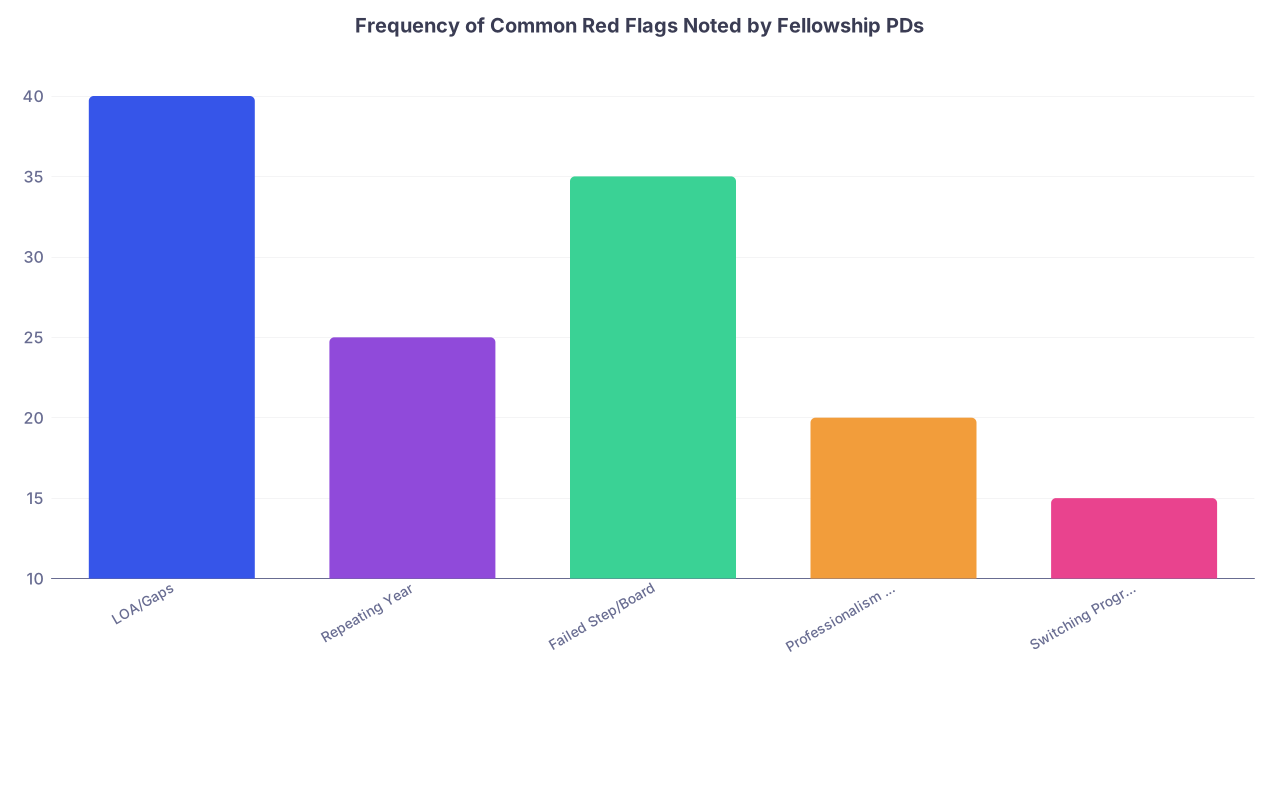
| Category | Value |
|---|---|
| LOA/Gaps | 40 |
| Repeating Year | 25 |
| Failed Step/Board | 35 |
| Professionalism Issues | 20 |
| Switching Programs | 15 |
1. Leaves of absence and timeline gaps
This is the classic one: a “gap” between med school and residency, or between PGY years, or a long unexplained period during residency.
Typical PD questions:
- Was this health-related, academic, or professionalism?
- Was this voluntary (personal choice) or imposed (suspension, remediation)?
- Did they do anything constructive during that time?
A well-documented medical leave with a clear story and full return to function? Usually survivable. A random 8-month gap with zero explanation and vague language like “personal reasons”? That bothers people more than the leave itself.
2. Repeating a year or extended training
Any extra PGY year triggers an immediate mental tab: “Why?”
Internal medicine PDs gossip. Cardiology PDs gossip. An extra year at a known malignant program is a different animal than an extra year at a flexible, supportive program. But if you repeated a year, you have to assume fellowship PDs will notice and will ask their colleagues informally.
What they’re really trying to figure out:
- Was this a skill/knowledge gap, or a behavior/attitude problem?
- Did you eventually meet standards and function well?
- Did you become “that resident everyone had to watch,” or did you grow up?
The story around the repeat matters more than the fact of it.
3. Failed Step or failed in-training/boards
Fellowship PDs are blunt about this one, especially in cognitive specialties (cards, GI, heme/onc):
“If they can’t pass boards, I’m not eager to inherit that headache.”
But a single failed Step 1 (back in the score days) or early stumble is not an automatic black mark if there’s a clear upward trend—strong Step 2, solid in-training exams, passed ABIM on first try.
Repeat failures, or barely-passing repeated attempts, trigger concerns about:
- Test-taking ability
- Reliability under pressure
- Risk of future board failure, which directly hits the program’s stats
4. Professionalism, disciplinary actions, and “problem resident” vibes
This is the one nobody will document fully in writing but everyone talks about off the record.
Patterns that scare PDs the most:
- Recurrent professionalism issues documented in your MSPE or evaluation summaries
- Serious boundary or harassment violations
- Major conflict with nursing, staff, or peers
- Dishonesty—altered notes, billing issues, falsifying work
If your residency PD or faculty hint in a letter that you were a “challenge” or “grew a lot” from early professionalism concerns, fellowship PDs are going to read between the lines. They’ve all done the same thing in letters when they cannot ethically lie but do not want to destroy someone.
5. Switching programs or specialties
This isn’t automatically a red flag, but unexplained moves are suspicious.
Examples:
- IM PGY-1 at a big-name place, then PGY-2–3 at a smaller community program with no explanation.
- Starting in general surgery, switching to IM, then applying to cardiology.
The silent question: “Did they get pushed out or did they pull themselves out?” Both can be okay. What makes people nervous is a vague story you’re clearly afraid to own.
How Different Fellowships Weight Red Flags
This is where applicants get blindsided. Not all specialties care about the same flaws.
| Fellowship | Academic / Test Issues | Professionalism Concerns | Timeline Gaps / LOA |
|---|---|---|---|
| Cardiology | High | High | Moderate |
| GI | Very High | High | Moderate |
| Heme/Onc | High | High | Mild-Moderate |
| Pulm/CCM | Moderate | Very High | Moderate |
| Nephrology | Moderate | High | Mild |
For something visual:
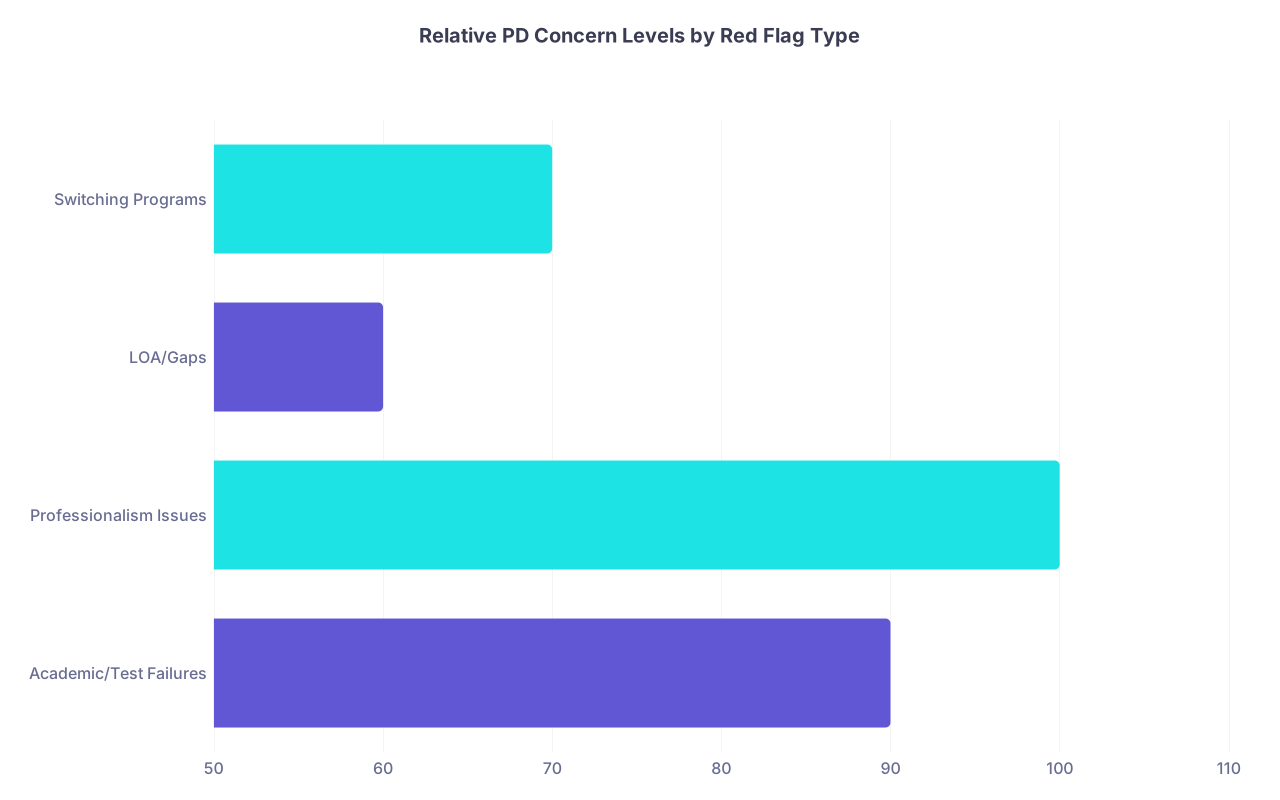
| Category | Value |
|---|---|
| Academic/Test Failures | 90 |
| Professionalism Issues | 100 |
| LOA/Gaps | 60 |
| Switching Programs | 70 |
Those numbers aren’t from a paper. They’re from being in the hallway listening to how people actually talk.
Rough translation:
- Academic/test issues: Especially lethal in GI and cardiology, because board pass rates matter and those fellowships are flooded with strong applicants.
- Professionalism: Universally hated. ICU, ED-based fellowships, and procedure-heavy fields are even more wary because your behavior affects high-stakes team dynamics.
- LOA/gaps: Annoying but explainable, especially post-COVID when burnout and illness are acknowledged realities.
- Switching programs: Needs a clean, consistent narrative. If it sounds like you ran away from problems, that’s trouble.
How PDs Investigate Your Red Flags Behind the Scenes
Let me be brutally clear: the most important conversations about your red flags are not written anywhere. They happen between PDs, on phones, at meetings, and in side chats during conferences.
You’ll never see them—but you need to plan for them.

| Step | Description |
|---|---|
| Step 1 | Notice red flag on application |
| Step 2 | Proceed without extra calls |
| Step 3 | Call residency PD |
| Step 4 | Red flag downgraded |
| Step 5 | Red flag amplified |
| Step 6 | Discuss at selection meeting |
| Step 7 | Serious or unclear? |
| Step 8 | Residency PD supportive? |
Here’s what actually happens:
- PD or associate PD sees something odd in your timeline.
- They ask: “Do I care enough about this person to dig deeper?”
- If yes, they call your residency PD or a trusted faculty at your program. Off the record.
- They ask questions that sound like:
- “If you had another fellowship spot, would you take them?”
- “Is there anything I should know that isn’t on paper?”
- “How much of a lift were they for you?”
If your own PD says, “I’d absolutely take them again; they had a rough PGY-1 but matured a lot,” your red flag softens. If your PD says something like, “They’re very bright but needed a lot of monitoring,” your file becomes radioactive, even if your ERAS looks clean.
You cannot control those off-the-record chats. But you can influence how your PD remembers and frames you by how you handled your issues at the time—and whether you showed insight and change.
What Makes a Red Flag Survivable vs Fatal
Program directors think in risk. Not morality. Not fairness. Risk.
They ask: “If I take this person, what’s the probability they:
- Fail boards and hurt our stats?
- Need remediation and suck time from faculty?
- Melt down in a high-stress call night and blow up team dynamics?
- Leave mid-fellowship and create scheduling chaos?”
A red flag is survivable when you demonstrate three things convincingly:
- You understand what happened—no denial, no minimization.
- You’ve already done the work to fix it—concrete evidence, not vibes.
- The trajectory since then is consistently upward.
Let’s go through common scenarios and how PDs mentally score them.
Scenario 1: Medical or Personal Leave of Absence
You took time off during residency for serious illness, family crisis, or mental health.
Here’s what PDs want to see:
- Clear documentation: Your timeline makes sense; dates are obvious; the reason is not hidden.
- Complete recovery or stable management: You’ve been back at full strength for a substantial period (ideally at least a year) without further issues.
- No evasiveness: You don’t overshare clinical details, but you also don’t dodge the question like a politician.
The worst move? Pretending the leave doesn’t exist and hoping nobody notices. They will.
Reasonable framing in a personal statement or interview sounds like:
“I took a 5-month medical leave during my PGY-2 year related to a new diagnosis of a chronic condition. This was fully treated and is now well controlled. Since returning, I’ve completed 18 months of uninterrupted full-time residency, taken on chief-level responsibilities on the wards, and have not required additional leave. That period forced me to reevaluate my boundaries and habits, and I now manage my workload and health much more proactively.”
You’re giving them exactly what they need: timeline, resolution, and evidence of stability.
Scenario 2: Repeating a Year / Academic Remediation
You repeated intern year or did an extra PGY-3 because of performance concerns.
This makes PDs nervous, so you need a clean, brutally honest narrative. Not self-flagellating, but honest.
They’re asking themselves:
- Was this about knowledge base, efficiency, or professionalism?
- Who took responsibility—just the program, or also the resident?
- Did you plateau at “barely adequate” or did you truly grow?
A strong way to frame this:
“During my PGY-1 year I struggled significantly with time management and prioritization on busy ward services. My program chose to extend my training by one year with a focused remediation plan. I worked closely with my APD and mentors, completed a coaching program, and began using structured task management and pre-rounding strategies. My evaluations from the remediation year show marked improvement, and by the end of PGY-2 and PGY-3 I was consistently rated as performing at or above level. I was then selected as a night float senior because attendings trusted my clinical judgment.”
See what that does? It names the problem, describes a process, and ends on trusted responsibility. That last part matters.
Scenario 3: Failed Step or Board Exam
If you failed Step 1 or Step 2, or ABIM, PDs immediately rank you as “testing risk” until you prove otherwise.
What lowers that risk in their minds:
- Later exams passed comfortably and on first try
- Objective improvements—score jump between attempts, strong ITEs
- Clear, specific changes in how you study and test
You cannot get away with, “I just had a bad day.” Everyone says that. PDs don’t buy it.
Better framing:
“I failed Step 1 on my first attempt due to poor preparation strategy and lack of structured practice. I over-relied on passive reading and underestimated question practice. For Step 2, I created a detailed schedule, used question banks as the core of my prep, and met weekly with a faculty mentor to review challenging topics. I passed Step 2 with a [strong score], and my in-training exams over the last three years have all been above the program mean. That experience forced me to completely overhaul how I approach high-stakes exams, and that new system is now well-tested.”
Now you are a lower-risk bet.
Scenario 4: Professionalism Issues
This is the hardest to rehabilitate, but it’s not impossible if the behavior was mild to moderate and not repeated.
You need three things:
- Acknowledgment: “Yes, this happened. It wasn’t okay.”
- Insight: Why it happened (stress, poor coping, immaturity) but without making excuses.
- Concrete changes: You did something real to address it—coaching, therapy, feedback, documented improvement.
If you had a documented conflict with nursing staff that escalated, you don’t say, “It was all politics.” That is how you get screened out instantly.
A better version:
“In my early PGY-2 year I received formal feedback about my interactions with nursing staff during high-stress codes. I was perceived as abrupt and dismissive when redirecting the team. At the time I was overwhelmed and not fully aware of how I came across. My PD and I agreed on a remediation plan that included communication workshops, debriefing after codes, and 360 evaluations. Over the subsequent year, my evaluations from nursing improved significantly, and I was later asked to help teach ACLS code leadership to interns. I’m very aware now that how I communicate under stress is as important as what I do clinically.”
A PD can work with that.
Scenario 5: Switching Programs or a “Messy” Timeline
If you transferred residency programs, specialty-switched, or had multiple institutional changes, PDs suspect smoke. Your job is to show there’s no fire—or that the fire’s out and you learned from it.
Owned narrative:
“I began my postgraduate training in general surgery. I realized over that first year that what I enjoyed most was the longitudinal medical management of complex patients and the cognitive side of care. After extensive discussion with my mentors and PD, I decided to switch to internal medicine and transferred to my current program. That was a difficult decision that required swallowing a lot of pride, but it’s been the right fit. I have now completed two and a half years of IM with strong evaluations and confirmed my interest in cardiology through both inpatient and outpatient rotations.”
What you don’t say is: “The surgeons were mean and the hours were terrible.” PDs hear that as: “Will blame environment instead of taking ownership.”
Tactical Moves: How To Control the Narrative
You can’t erase your red flags. You can absolutely shape the story.
Here’s what the sharp applicants do that most others don’t.
1. Pre-brief your residency PD and letter writers
You don’t spring your issues on them and hope they get framed well. You have a direct conversation:
- “I know my repeated year will raise questions. Here’s how I’m planning to explain it. Does that align with your understanding?”
- “If PDs call you, what do you feel comfortable saying about how I’ve grown since then?”
You’re not scripting them. You’re aligning realities. Big difference.
2. Use your personal statement strategically, not dramatically
You don’t turn it into a trauma narrative. You drop one tight, controlled paragraph that:
- Names the issue
- States the resolution
- Points to your growth
Then you move on to why you want the fellowship, your clinical and academic interests, and what you bring to the table. If your entire statement is about your red flag, you anchor your entire candidacy there. Bad idea.
3. Make sure your timeline is crystal clear on ERAS/CV
Messy date conventions, omitted months, overlapping roles without explanation—this all makes PDs suspicious. If they have to guess, they assume the worst.
Spell it out. For example:
Internal Medicine Residency, XYZ Medical Center
PGY-1: July 2019 – June 2020
Medical Leave of Absence: July 2020 – October 2020
PGY-1 (extended): November 2020 – June 2021
PGY-2: July 2021 – June 2022
PGY-3: July 2022 – June 2023
No one has to hunt. Or speculate.
4. Be consistent across every document
If your personal statement says one thing, your CV implies another, and your PD letter dances around it differently, PDs smell spin. They start speculating about what you’re leaving out.
Whatever you decide to reveal, lock the story and keep it consistent.
What Actually Gets You Forgiven (And What Doesn’t)
PDs have soft spots. They also have hard lines.
Things they forgive when handled well:
- Early academic stumble with clear sustained improvement
- Short-term LOA with documented recovery and strong performance since
- Personality/communication issues that clearly matured over time
- Switching specialties with an honest story and obvious fit in the new field
Things that almost never get fully forgiven:
- Recurrent dishonesty or falsification
- Multiple professionalism incidents, especially involving harassment or gross disrespect
- Pattern of blaming others for every problem
- Continued poor performance after remediation and second chances
If your issue is in that second group, you’re playing on hard mode. Not impossible, but you’ll need stronger advocacy from your PD and brutally honest, humble self-awareness.
A Quick Reality Check: Competitiveness vs Red Flags
There’s one more piece nobody tells you: the more competitive the specialty and the more desirable the program, the less tolerance there is for risk. Not because they’re cruel. Because they don’t have to take the risk.
A mid-tier nephrology fellowship director might say: “He failed Step 1, but he’s been solid for three years and his PD loves him. We can work with that.”
A top 5 GI fellowship director with 500 applications for 3 spots thinks: “Why would I take this risk when I have 40 perfectly clean applications with excellent research?”
It’s a supply-and-demand problem dressed up as “holistic review.”
Visual: Timeline Hiccups vs PD Perception
To put it all together, here’s a simplified mental model of how disruptive different timeline issues feel from the PD side:
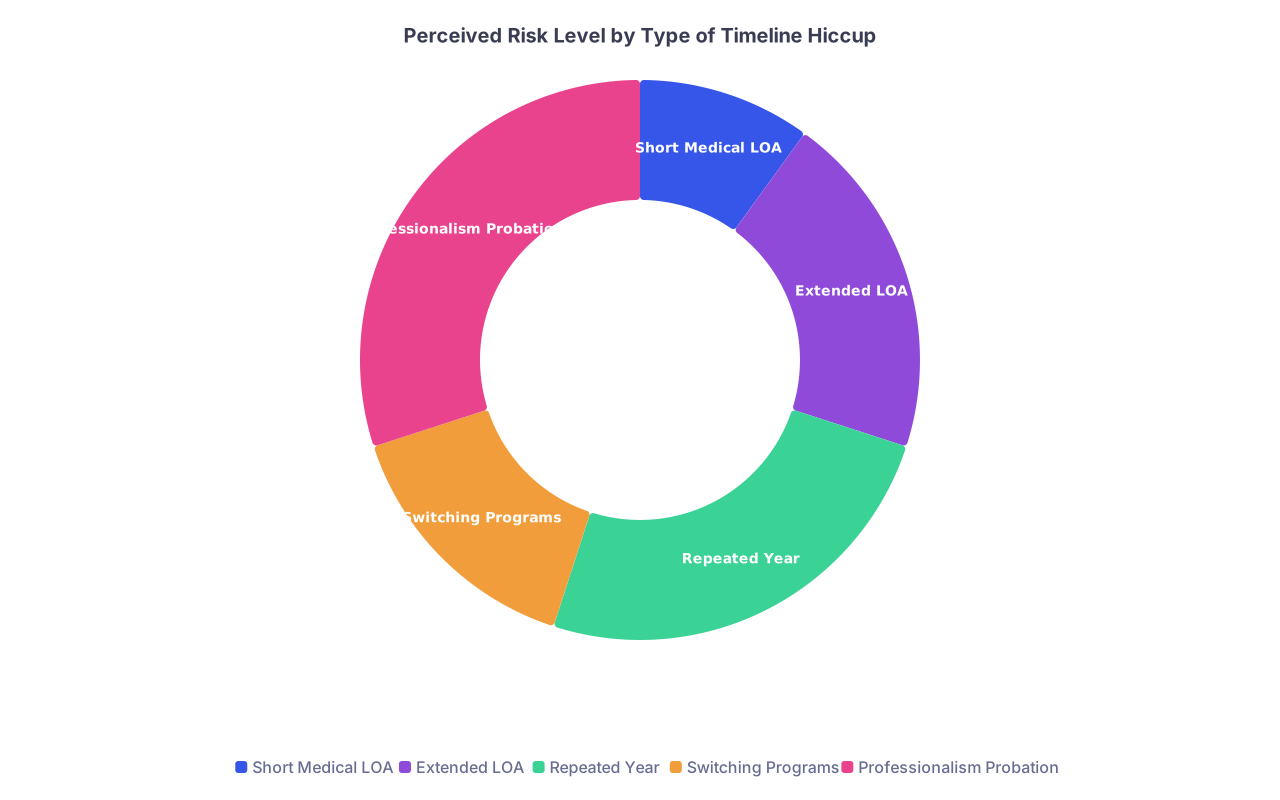
| Category | Value |
|---|---|
| Short Medical LOA | 10 |
| Extended LOA | 20 |
| Repeated Year | 25 |
| Switching Programs | 15 |
| Professionalism Probation | 30 |
Again, not published data. But pretty close to the mood of actual selection committees.
Final Thought: You’re Being Judged On How You Failed, Not Just That You Failed
Let me be blunt. Nobody gets through medical training without cracks. The myth that all successful fellows were pristine, linear, problem-free is just that—a myth kept alive by people too scared to admit where they stumbled.
What separates the applicants who move past their red flags from the ones who get quietly filtered out is not perfection. It’s ownership.
Program directors are watching for whether your worst moments made you bitter, evasive, and defensive—or accountable, reflective, and more solid.
Years from now, you won’t just remember the LOA, the failed exam, or the rough evaluation. You’ll remember whether you faced it head-on and told the story clearly when it mattered. Fellowship selection committees are just the first audience. You’ll be telling that story—to patients, colleagues, and yourself—for a long time.
Handle it like the physician you’re becoming, not the scared trainee you used to be.


