

The residents who get the best fellowship calls are not always the best residents. They’re the ones the chiefs and PDs feel safest vouching for. That’s a different game.
You think it’s about your CV and your letters. That’s only half the story. The other half happens in quiet side conversations, call rooms, and “quick chats” after sign-out where your name comes up and people make decisions you will never hear about.
Let me walk you through what actually happens when chiefs and PDs quietly decide who gets their strongest support for fellowship.
The unspoken ranking list: yes, it exists
There is almost always a mental—or sometimes literal—list of residents your PD and chiefs would:
- Call for without hesitation
- Call for with caveats
- Avoid calling for unless forced
- Refuse to call for, no matter how much you beg
No one will show you this list. But I’ve watched it get built in real time in offices, workrooms, and selection meetings.
Here’s the part people do not tell you: this ranking is often mostly finalized by the start of your PGY-3 year (for IM) or equivalent senior year for other programs. By the time you’re emailing your PD about fellowship goals, they already know exactly what “tier” you’re in.
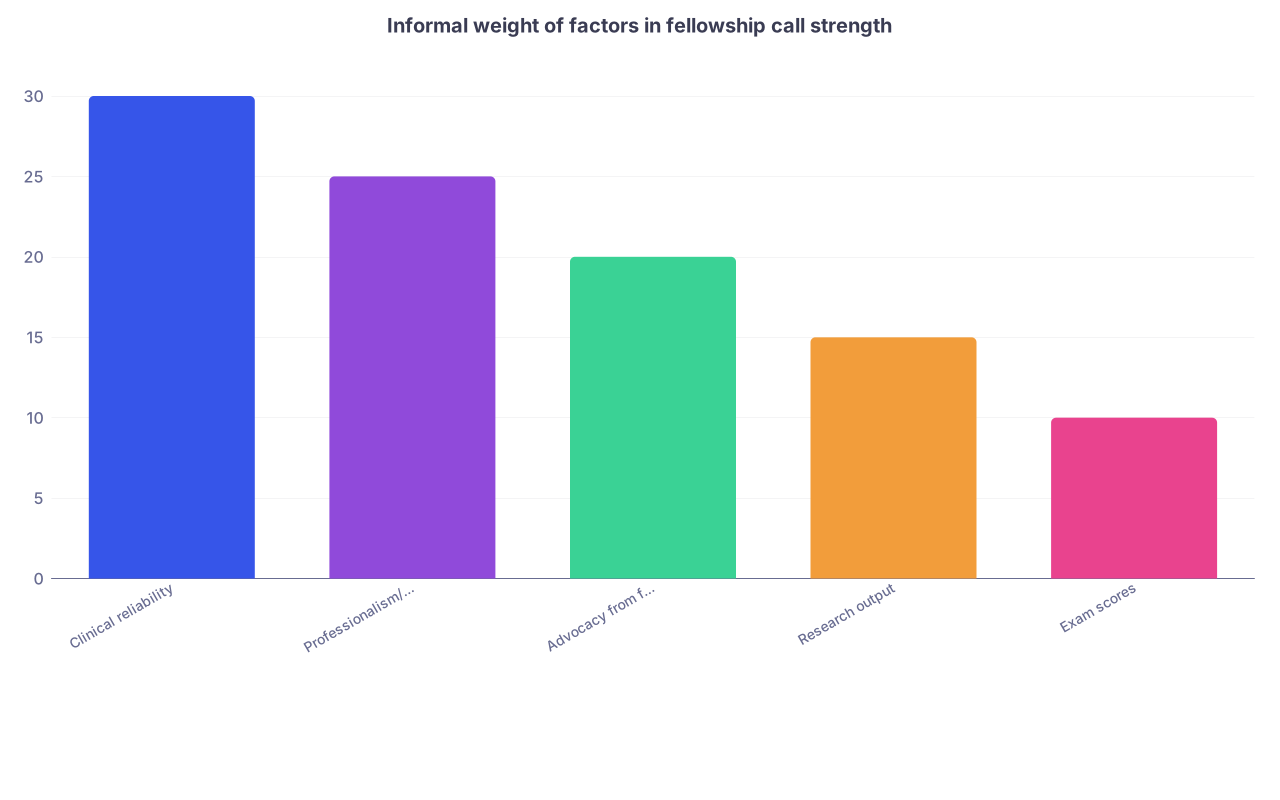
| Category | Value |
|---|---|
| Clinical reliability | 30 |
| Professionalism/reputation | 25 |
| Advocacy from faculty | 20 |
| Research output | 15 |
| Exam scores | 10 |
They won’t tell you that either. They’ll talk about “holistic review” and “overall performance.” Fine. But when the phone rings and a fellowship PD asks, “If you had one spot, which of your residents would you take?”—this hidden list is exactly what they’re going off.
Let’s break down how that list gets built.
The real criteria: what PDs and chiefs actually track
Forget the formal milestones language. That’s for ACGME. Chiefs and PDs speak a different dialect behind closed doors. It sounds more like:
- “Would I want this person on nights alone?”
- “Would I trust them with my own family member?”
- “Are they a headache?”
Your fellowship prospects live or die on those answers.
1. Clinical reliability (this is the non-negotiable)
Not brilliance. Not “great fund of knowledge.” Reliability.
The residents who rise to the top of the internal ranking share a few very specific traits:
- They close the loop. Consultants called. Families updated. Orders placed. Issues not left for the next team because “it was almost sign-out.”
- They do not generate fires. They might miss something occasionally, everyone does, but they’re not the source of constant small disasters.
- Nurses trust them. I have literally heard: “If she says the patient’s fine, I believe it” vs “If he says it’s fine, I go look myself.”
What your PD hears from the floor nurses and night float attendings matters more than your last shelf score. They may not admit that. It’s still true.
Here’s the mental scoring that tends to happen:
| Tier | How PDs quietly describe you |
|---|---|
| A | "Rock solid. I’d let them run the unit." |
| B | "Good. Needs some backup on harder cases." |
| C | "Fine, but I double-check." |
| D | "High risk. Someone has to babysit." |
Tier A and B get confident calls. Tier C gets lukewarm support. Tier D? They’ll stall, redirect you (“maybe consider a hospitalist job first”), or just never send that email.
2. Professionalism and “reputation score”
Let me tell you a frustrating truth: your reputation spreads faster than your clinical growth. Once people “decide” who you are, it takes months to change that narrative.
What do PDs and chiefs pay attention to?
- Chronic lateness. One or two times? Fine. Multiple attendings mentioning it over months? You’re on a list.
- How you respond to feedback. The eye-roll in the hallway after being corrected. The defensive tone in your eval meeting. That stuff travels.
- Off-service behavior. If you’re respectful on home service but act superior or disengaged on, say, anesthesia or radiology, those attendings still email your PD. I’ve seen it.
I sat in a PD office once when an ICU attending’s email popped up about a PGY-2 applying for cards: “Smart, but repeatedly dismissive with nursing and RT. I’d be careful putting my name on them.” That one sentence took that resident from “strongly support” to “support with reservations” for fellowship calls. They never knew why.
3. The “will they embarrass me” factor
You need to understand this: when a PD picks up the phone for you, they’re not just helping you. They’re spending their own reputation capital.
If you go to that fellowship program and:
- Show up late
- Struggle clinically
- Create drama
- Argue with faculty
- Fail an exam or remediation
That fellowship PD does not forget. And they don’t keep it to themselves.
Programs absolutely talk. The worst thing a PD can hear is: “The last resident you sent us was a mess.” You think they’re going to go all-in for the next one from your program? No chance.
So when they’re quietly ranking residents, they’re really asking one big question:
“If I send this person to my friend’s program, could this blow back on me?”
If the answer feels like even a “maybe,” your support drops a tier instantly.
How chiefs actually talk about you when you’re not there
Chiefs have more power in this process than you think. PDs will often say, “What do the chiefs think?” and that single sentence can shift your entire fellowship trajectory.
Here’s how those behind-the-scenes conversations sound:
“Who’s strong for heme/onc this year?”
- “Well, A is the safest choice. Everyone likes working with her. Never heard a bad word.”
- “B is smart but can be a little much on call—some drama with nursing.”
- “C is really into research, but you need to keep an eye on them; they disappear on rounds sometimes.”
Which one of those three sounds like the person who gets the confident phone call?
A chief’s summary sentence about you is incredibly influential. It wraps together 3 years of impressions into one line that your PD will remember when a fellowship director calls.
You should assume every one of these gets discussed:
- “Are they good for team culture?”
- “Would you want them as a co-fellow?”
- “Any red flags I should be aware of?”
If a chief says, “I’d absolutely work with them again,” you’re in strong territory. If they say, “Great on paper, but…” — that “but” is devastating.
The hierarchy of support: what PDs actually do for different residents
Here’s the part people never spell out. There’s a quiet tier system in how much effort a PD or chief chooses to invest in you.
Tier 1: “I will make calls for you before you ask”
These are the residents the PD starts advocating for early. They:
- Get introduced to visiting subspecialists
- Are nudged toward key electives
- Get early conversations like, “If you’re serious about GI, I know the PD at X. Let’s talk strategy.”
When it’s time to apply, the PD sends text messages and direct emails like: “I’ve got someone you should look at seriously for next year. She’s excellent.”
That kind of communication gets you interviews that your stats alone might not.
Tier 2: “I’ll strongly support if asked”
Most solid residents live here. You’ll get:
- A good letter
- A reasonably warm call
- Maybe one or two targeted emails on your behalf
But the energy level is different. The call sounds like: “Yes, they’re very solid, good team player, reliable. I’d be happy to have them back as faculty.”
Nothing wrong with this tier—it just doesn’t give you the extra push at hyper-competitive places.
Tier 3: “I’ll be honest, but I’m not pushing”
This is where your PD is answering questions, not selling you.
The call: “They’re a good resident. They’ve grown a lot. No major concerns.” Translation: safe, but not top of the class. Fellowship PDs hear the absence of enthusiasm.
Sometimes PDs quietly try to steer these residents:
“Have you considered a year as a hospitalist first?”
“Maybe apply to a mix of academic and community programs.”
“Let’s keep some options open.”
That’s not neutral. That’s code.
Tier 4: “I will not call unless cornered”
These are the residents where the PD hopes no one asks for their opinion. If forced, they’ll be factual but very cautious. They give “data,” not praise.
And yes, some residents are here. Usually for patterns, not one incident: repeated professionalism issues, major clinical concerns, or multiple faculty saying “I’m worried about them.”
The factors that matter way more than you think
Some things residents chronically underestimate in this hidden ranking system.
1. How you behave when you’re exhausted
Everyone’s nice at 10 am on rounds. Your real evaluation happens at 2 am on night float when:
- The cross-cover pager will not stop
- The ED wants to turf three admissions in 20 minutes
- ICU is calling about a deteriorating patient
What the night shift nurses and attendings say about you in the weeks after that block is gold. Or poison.
I’ve heard this exact line in a PD office: “Yeah, their evals look fine, but night shift says they snap at people and get flustered under pressure. I’d be cautious sending them to a high-acuity fellowship.”
The worst part? Most residents never see that feedback written down anywhere. It travels informally.
2. How you treat people who “don’t matter”
Let me be blunt. The way you treat:
- Unit secretaries
- Transport
- Housekeeping
- Pharmacy techs
- Med students
Gets back to the people who do matter for your fellowship.
I’ve seen a PD completely change tone about a resident after hearing: “He talks down to the unit clerks. A lot.” That may never show up in MedHub comments, but it absolutely shows up in the PD’s gut when deciding whether to say, “This is one of our very best” versus “They’re a solid resident.”
3. Giving people less work, not more
The residents chiefs and PDs love are the ones who reduce administrative friction for everyone.
Examples that earn you quiet points:
- Pre-charting enough that rounds move quickly
- Anticipating discharge needs and getting PT/OT, social work, and case management involved early
- Not dumping unresolved chaos on the next team every single day
The resident who chronically leaves giant messes at sign-out might still be “smart,” but they’re never at the top of the “I’ll stick my neck out for them” list.
How to move yourself up the internal ranking (without being fake)
You can’t hack this with flattery or pretending. Chiefs and PDs see through that fast. But you can deliberately shape the pattern they see.
1. Pick one block to be visibly exceptional
You don’t need to be a star on every rotation. But if you want your PD to feel genuinely excited to call for you in, say, pulm/crit, then on your MICU block:
- Be early. Always.
- Read on your patients and have a real plan.
- Close every loop: family, consultants, vent changes, sedation plans.
- Be the one intern or resident the nurses actually prefer.
I’ve heard PDs say: “He was good everywhere, but on ICU he was phenomenal.” That’s the rotation that sticks in their head when fellowship comes up.
2. Use 15-minute meetings strategically
The “I’d like to talk about my fellowship plans” meeting with your PD is not just about asking for advice. It’s a subtle audition.
Show up having done your homework:
- Know which programs you’re actually targeting
- Have a draft of your ERAS/CV
- Be able to say why you’re genuinely interested in the field
When a resident comes in scattered, vague, and clearly expects the PD to do all the thinking, that does not inspire strong advocacy.
The quiet thought is: “If they can’t organize their own application, how are they going to handle fellowship?”
3. Ask for specific feedback before it’s too late
Most residents wait until they’re applying to ask, “Do you think I’m competitive?”
Too late.
You want the truth in PGY-1 and early PGY-2:
- “Is there anything in how I work that would make someone hesitate to call for me?”
- “What would I need to improve this year to be one of the residents you’d be really excited to send to fellowship?”
Then—this is the part most people skip—actually fix it. And circle back later: “You’d mentioned my sign-outs were too long earlier this year. Have you noticed improvement?”
PDs and chiefs respect residents who demonstrate change. That’s how you move up the internal ranking.
The timing they never explain to you
Here’s the ugly timeline reality no one spells out:
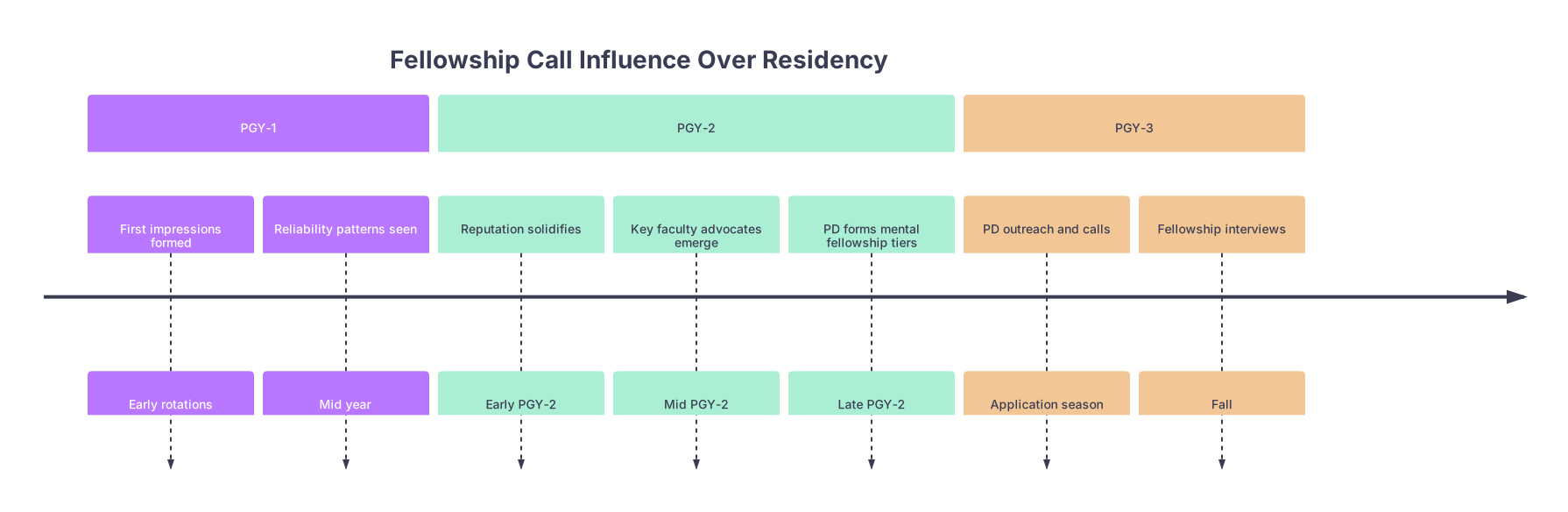
| Period | Event |
|---|---|
| PGY-1 - First impressions formed | Early rotations |
| PGY-1 - Reliability patterns seen | Mid year |
| PGY-2 - Reputation solidifies | Early PGY-2 |
| PGY-2 - Key faculty advocates emerge | Mid PGY-2 |
| PGY-2 - PD forms mental fellowship tiers | Late PGY-2 |
| PGY-3 - PD outreach and calls | Application season |
| PGY-3 - Fellowship interviews | Fall |
By early PGY-2, your reputation trajectory is mostly set. Not impossible to change, but it’s an uphill climb.
By late PGY-2, when you start sending in applications, your PD already knows if you’re in their “absolutely call for,” “support but not push,” or “concerned” category.
So if you’re a PGY-1 reading this, you’re actually early. You can still shape that initial file in your PD’s head. If you’re a late PGY-2, you need targeted, high-yield changes and very honest conversations.
How fellowship PDs read between the lines of calls and letters
One more unpleasant truth: fellowship PDs are experts at decoding tone.
They don’t just listen to what your PD says. They listen to how they say it.
Things that scream “top of the internal list”:
- “She’s one of the best residents we’ve had in the last five years.”
- “If I were sick, I’d want him as my doctor.”
- “We tried to recruit her to stay on as faculty.”
Neutral or weak signals:
- “He meets expectations for his level.”
- “She’s improved over time.”
- “He would do fine in your program.”
Fellowship PDs know the difference. They keep mental lists of which IM programs send them rockstars and which send them headaches wrapped in nice letters.
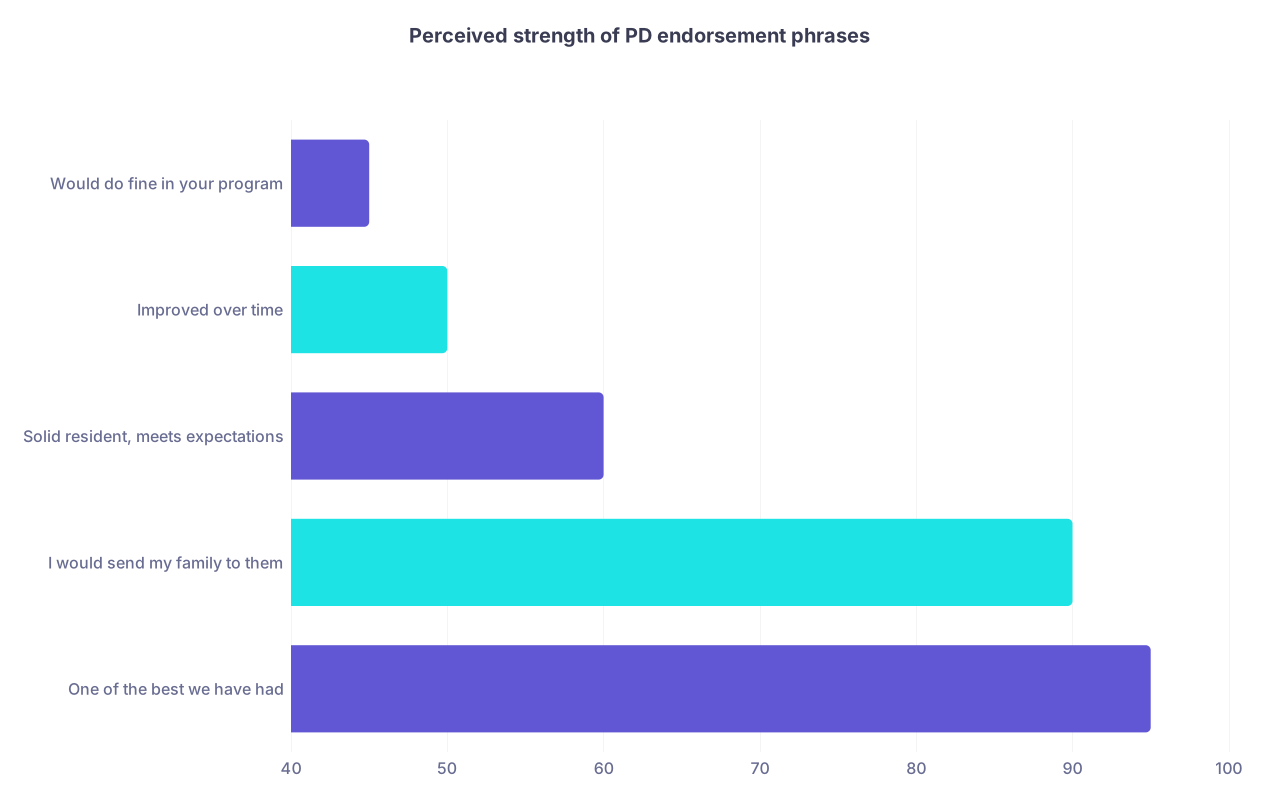
| Category | Value |
|---|---|
| One of the best we have had | 95 |
| I would send my family to them | 90 |
| Solid resident, meets expectations | 60 |
| Improved over time | 50 |
| Would do fine in your program | 45 |
Your job in residency is not just to be “good enough.” It’s to make it easy for your PD to use the strongest version of those phrases with a straight face.
What to do if you suspect you’re not at the top of the list
Some of you reading this know you’re in the PD’s inner circle already. Fine. You still need to not screw it up.
Others have a pit in your stomach because this all feels…uncomfortably familiar.
Here’s the move if you think your PD sees you as “solid but not special”:
- Pick one rotation in your field of interest and overperform so clearly that attendings mention it to the PD without you asking.
- Find one faculty member in that field and ask, “Would you be comfortable strongly advocating for me to the PD?” Watch their face.
- Ask your chief—off the record—“If you were me and wanted GI/pulm/cards, what would you be most worried about in my file?”
You might not love what you hear. But that honest, slightly painful feedback is exactly what you need before your PD is on the phone being politely noncommittal about you.
FAQs
1. Should I explicitly ask my PD how strongly they can support me for fellowship?
Yes—if you’re prepared for an honest answer. The better question is: “If a fellowship PD called you about me, what would you feel comfortable saying?” That forces them to think in concrete language. If their answer sounds generic—“You’re a solid resident, no concerns”—you’re in the middle tier. That’s your signal to ask, “What would it take for you to feel comfortable giving a stronger endorsement?”
2. Can one bad rotation tank my fellowship chances?
One truly bad rotation, with clear documentation and multiple complaints, can absolutely drop you a tier. But most fellowship PDs care more about patterns than one-off disasters. What kills you is: “Struggled on wards,” then “issues on ICU,” then “feedback from ED about communication.” If you have one rough block, you need two excellent ones afterward in high-visibility rotations to rebalance the story.
3. How much do chiefs really matter compared to attendings?
For fellowship calls, chiefs often matter more than any single attending. They see you across services and years. PDs trust their composite judgment: “Who are the three people in your class you’d send to heme/onc?” That answer carries weight. You still need attending champions for letters, but chiefs shape the PD’s gut feeling and confirm (or contradict) what’s in your written evaluations.
4. I started off rough as an intern. Is it too late to fix my reputation?
No, but you don’t fix a bad PGY-1 year with vague “I’ve worked on things.” You fix it with unmissable, concrete change. You want attendings saying, unprompted, “They are a completely different resident this year.” Then you go to your PD and say, “I know my early performance wasn’t where it needed to be. I’ve worked on X, Y, Z. Have you seen a difference?” If they say yes and can give examples, that’s the material they’ll use on the phone when your past comes up.
You now know what almost no one spells out: there’s a quiet internal ranking in every program, and it heavily shapes who gets the strongest fellowship calls.
Your job for the rest of residency is simple, but not easy—make yourself the safest, most reliable, least risky person to advocate for. Do that, and your PD will want to pick up the phone for you. And when they do, the tone of their voice may matter more than any line on your CV.
With that foundation in your head, you’re better equipped than most of your co-residents. The next step is using it strategically—choosing rotations, mentors, and moments so that when fellowship season hits, you’re already at the top of that invisible list. But how you play that year leading into applications—that’s a story for another day.


