

The myth that fellowship committees carefully read every word of your application is exactly that—a myth.
I’m going to walk you through what really happens in the first 90 seconds when your file opens on a fellowship committee member’s screen. I’ve sat in those rooms. I’ve watched people decide your fate between spoonfuls of cold conference-room pasta.
If you understand that first 90 seconds, you’ll understand why some very good residents never even make it to serious discussion—and why a few “average on paper” people somehow keep getting interviews.
Let’s pull back the curtain.
What Actually Happens When Your Application Opens
Picture a Tuesday night, 8:15 p.m. A cardiology PD and two associate PDs are flipping through ERAS on a shared screen after a full day in clinic. They have 450 applications. They can realistically interview maybe 60.
No one is reading 450 personal statements top to bottom.
They’re doing what every human does when faced with too much information and too little time: pattern recognition and fast sorting.
The sequence is almost always the same, and it takes under two minutes for “yes/maybe/no” triage.

| Step | Description |
|---|---|
| Step 1 | Open Application |
| Step 2 | Name and Home Program |
| Step 3 | Board Scores and Exam Status |
| Step 4 | Training History and Red Flags |
| Step 5 | Letters Source and Count |
| Step 6 | Research and CV Scan |
| Step 7 | Personal Statement Glance |
| Step 8 | Interview List |
| Step 9 | Hold For Later Review |
| Step 10 | No Interview |
| Step 11 | Bucket |
They are not starting with your personal statement. They are not admiring your volunteer project in Guatemala. They are asking three ruthless questions:
- Can this person do the job here without making my life harder?
- Do they fit the profile of people we usually match?
- Is there any obvious reason to avoid them?
Everything in that first 90 seconds is just a proxy for those three questions.
The First 10 Seconds: Who Are You and Where Are You Coming From?
The very first thing most faculty look at is your name, current institution, and training path. Not because they care about your name, but because it immediately sets a mental template.
I’ve watched this a hundred times:
“Next one—IM resident, University of X.”
“Oh, that program usually sends us solid people.”
Click. You’ve already started above neutral.
Or the opposite:
“Where is this? Never heard of it. Community program?”
“Yeah, small place, not ACGME accredited until a few years ago.”
Now you’re starting from below neutral, and you have to climb out.
The unspoken hierarchy is real, and pretending it doesn’t exist won’t help you. Certain fellowship-heavy IM or categorical programs are “trusted pipelines.” The committee has muscle memory: residents from those places usually hit the ground running.
That affects how much grace you get for everything else.
If you’re from:
- A well-known academic program with a history of sending fellows, you get the benefit of the doubt.
- A solid but not famous community program, you start neutral.
- A brand-new, small, or lower-reputation program, you start slightly in the hole. Not doomed. But you need something strong elsewhere to pull you up.
This is also where they glance at your training continuity—any weird gaps, sudden transfers, or non-linear paths jump out immediately. A mid-residency transfer, a missing year, a switch from a different specialty… those are all mental sticky notes: “Need to understand story. Possible red flag.”
If you’ve got anything unusual in your path, your job is to control that story. Don’t pretend they won’t notice. They will—within seconds.
Seconds 10–30: Scores, Exams, and Silent Deal-Breakers
Next comes the fast scan of board exams and certification status. Even with USMLE Step 1 pass/fail, committees still look at:
- Step 2 / Level 2 scores
- Pass/fail attempts
- ABIM/ABFM in-training exam results (for medicine/family med based fellowships)
- Board eligibility timeline
Here’s the part people underestimate: many programs have quiet, unofficial cutoffs or “comfort zones.”
No one writes “We don’t interview below X” in the brochure. But I’ve sat in meetings where the PD says very plainly:
“Look, under 220 on Step 2 and a fail? It has to be an extraordinary case to move forward.”
Or:
“We’ve had a bad experience matching people who barely passed boards on second attempt; I’d rather avoid it.”
Is that always fair? No. But that is how risk-averse committees think.
The typical pattern in those 20 seconds:
- Quick confirmation of USMLE/COMLEX passed, no major disasters.
- Any failure or delayed exam triggers a mental “explain this” flag.
- If you have a stellar Step 2 / ITE, you get a small mental bump, especially in competitive subspecialties.
Then they move on. No one is worshipping your 260. It helps you clear the hurdle and breaks ties later. It does not, by itself, get you an interview.
Seconds 30–55: Red Flags and Reliability Check
Now they’re skimming your training history and experience like a pilot doing a pre‑flight checklist.
What they’re really asking is: “Will this person show up, function independently, and not create headaches?”
They look for:
- Any repeated years or extended training
- Unexplained gaps
- Too many program switches
- Very short-lived positions
- Signals of professionalism problems (if you were honest enough to mention them)
I’ve seen PDs pause on details that applicants thought were invisible:
- A 6-month “leave of absence” with no explanation anywhere else
- Multiple “moonlighting at X hospital” positions that looked like you were chasing money more than training
- A pattern of leaving roles quickly
This is where your dean’s letter or summary letter (if included) can quietly sink you. A single sentence like “Resident required additional supervision during the first half of PGY-2” will stick in their mind far more than you think.
If you have any non-traditional element—leave of absence, remediation, serious personal issue—your application needs to show coherence: a clear, believable story of growth, with evidence that people now trust you. Otherwise, in that 20–25 second sweep, you get quietly moved to the “maybe” or “no” pile.
Seconds 55–70: Letters of Recommendation – Who Wrote Them Matters More Than You Think
Now they drop their eyes to the letters section. And here’s the dirty secret: for the initial pass, many committee members don’t read the letters. They read the letter-writers.
They’re scanning names and institutions.
Typical commentary you’ll hear:
“Letters from their PD, division chief, and Dr. S at Big University. OK, that’s solid.”
“Only one subspecialty letter? And two from outside the field? That’s weird.”
“No letter from their fellowship director? Why?”
Or bluntly:
“Who is this? Never heard of them. Any big names?”
Do famous-name letters help? Yes—if the writers are actually known in that subspecialty. A throwaway letter from a big name who barely knows you is not as helpful as mid-level faculty who can speak concretely. But in those first seconds, name recognition absolutely changes how much benefit of the doubt you get.
Patterns that quietly hurt you:
- No letter from someone clearly central to your fellowship interest (e.g., applying to GI with zero GI attendings writing).
- Only generic hospitalists or outpatient faculty writing for a competitive subspecialty.
- Obvious “backfill” letters (fourth letter from some research mentor who met you twice, because you couldn’t get a third clinical one).
By second 70, the committee now has a rough mental composite:
- Training background: trusted vs unknown pipeline
- Exams: clean vs concerning
- Reliability: smooth vs “story needed”
- Letters: strong network vs thin support
You’re not dead without a big-name letter. But if your institution or background is less known, strong, specific letters from people the committee respects can rescue you from the maybe pile.
Seconds 70–90: CV, Research, and the 5-Second Personal Statement Glance
This is where your CV and personal statement get their moment. Very briefly.
The CV Scan
They’re not reading every bullet. They’re scanning for:
- Does this person actually seem interested in this field?
- Have they done anything beyond the bare minimum?
- Do their activities match the story they’re trying to sell?
For a research-heavy subspecialty (cards, GI, heme/onc, pulm/crit at academic places), they’ll glance specifically for:
- Actual publications (PubMed, not just “manuscript in preparation”)
- Abstracts, posters, local or national conference presentations
- Any sign you can see a project through to completion
For more clinically oriented programs, they’ll look more at:
- Leadership roles (chief resident, QI lead, committee work)
- Teaching experience
- Extra clinical experience that suggests maturity
Here’s the part no one tells you: they are not impressed by giant cluttered CVs. A bloated list of 27 “manuscripts in progress” looks desperate. It tells them you don’t understand the difference between noise and signal.
I’ve heard someone say, while scrolling:
“Another ‘manuscript submitted’ with no journal listed. Sure. Next.”
You want clean, credible, verifiable items that line up with your stated interests. Too much fluff in the CV can be as damaging as not enough content, because it suggests lack of judgment.
The 5-Second Personal Statement
Now, finally, the sacred personal statement.
Here’s what really happens on first pass: they skim the top few lines. Maybe the last paragraph. That’s it.
They’re looking for major red flags and category tags, not literary genius.
I’ve watched PDs literally scroll like this:
- Eyes on the first 3–4 lines: “Is this normal?”
- Quick scroll to the bottom: “Anything weird here?”
- Done.
If the first lines read like:
“I have always had a passion for cardiology since medical school when I first saw an EKG…”
You’ve just wasted your one shot at attention with the most generic sentence imaginable. Nobody hates you for it. But nobody remembers you either.
They’re subconsciously looking for three things:
- Does the tone feel normal and professional? (No grandiosity, no melodrama, no bitterness.)
- Does the story match the CV? (You say you’re obsessed with research but have none—credibility problem.)
- Any obvious red flags—anger, unresolved trauma, inappropriate oversharing, or evidence you don’t actually understand the field.
If you force them to work to decode what you’re trying to say, they’ll just mentally mark you “generic” and move on.
Your goal in that 5-second skim is not to blow them away. It’s to make them think, “Okay, seems mature, understands the field, consistent story. No issues.” And maybe, occasionally, “Huh, that’s an interesting angle,” which can lift you from “maybe” to “yes” if you’re borderline.
How You Get Sorted: Yes, Maybe, or No
At the end of those 90 seconds, you’re going into one of three mental buckets.
| Bucket | Typical Outcome |
|---|---|
| Yes | Invited to interview |
| Maybe | Re-reviewed later |
| No | No interview offered |
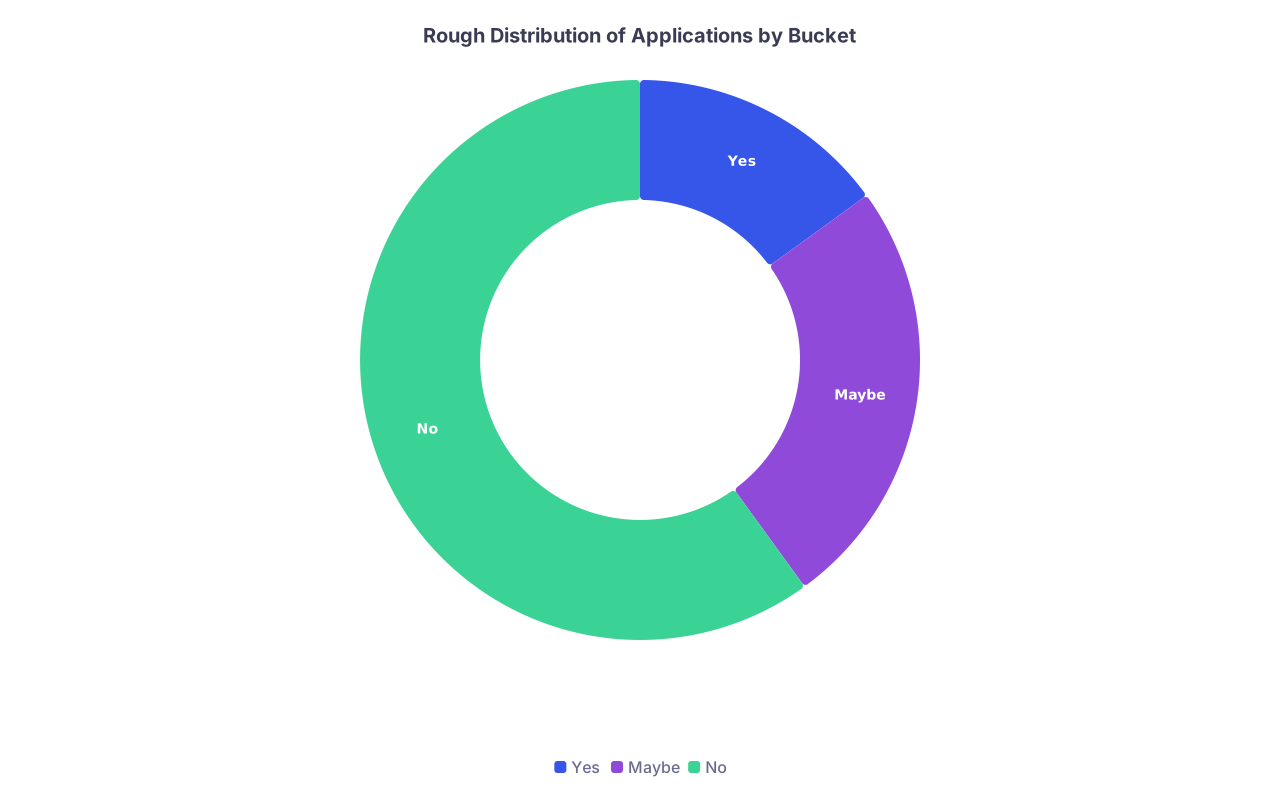
| Category | Value |
|---|---|
| Yes | 15 |
| Maybe | 25 |
| No | 60 |
Those percentages vary by program and specialty, but the logic doesn’t.
“Yes” in 90 Seconds
You land a quick yes if, on fast scan, you hit the program’s comfort zone:
- Familiar or respected home program
- Clean scores and training history
- Strong, relevant letters from recognizable faculty
- Reasonable research/activities for that subspecialty
- Normal, coherent personal statement
They don’t need to be in love with you. They just need to feel no friction. You look like the type of person they’ve successfully trained before.
Later, during in-depth committee review, they’ll go back and actually read more of your materials. But you’ve already cleared the real hurdle: not being cut in the first pass.
“Maybe” in 90 Seconds
This is where most real humans land.
Maybe means, “Something good here, something that worries me, or we’re not sure yet.” Examples:
- Great research, but weaker scores.
- Solid training, but weird gap or exam failure.
- Unknown home program, but impressive letters and projects.
The maybe pile is the battleground. These are the people who might get pulled up or down depending on how many total applicants there are, what the PD values most, and how the rest of the cohort looks.
If you’re in the maybe pile, one very strong, credible letter or a clear explanatory thread through your personal statement and CV can save you. If your story is confusing or inconsistent, the default answer becomes “No” once the interview slots start filling.
“No” in 90 Seconds
What gets you cut quickly?
- Multiple exam failures with no visible comeback story
- Serious professionalism issues hinted in your record or letters
- Zero evidence of interest in the field you’re applying to
- Disorganized or bizarre application that feels risky
Sometimes, cruelty is boring: there are simply too many applications from people with stronger overall profiles. You might be perfectly competent, but if you have nothing that stands out and there are 300 other “competent plus something,” you fall off the list.
Remember: they don’t need a reason to say no. They need a reason to say yes.
How to Engineer Those 90 Seconds in Your Favor
You can’t change your Step score now. You can’t teleport yourself into a different residency. But you can absolutely shape what the committee sees in those first 90 seconds.
Here’s how, from someone who’s watched too many people sabotage themselves.
1. Make Your Trajectory Obvious and Coherent
If there’s anything non-linear in your path—gap, transfer, leave, failed exam—you must assume it will be noticed quickly. Your job is to:
- Acknowledge it briefly and clearly
- Show what changed
- Back it up with current performance
For example: if you failed Step 1 but crushed Step 2 and have strong current ITE scores, you want that pattern to be impossible to miss. Mention it succinctly in your personal statement, have a letter-writer quietly allude to your current reliability, and make sure your CV isn’t full of fluffy distractions.
2. Letters: Prioritize Signal, Not Just Names
The committee is asking, “Who is vouching for you, and do they actually know you?”
Better combination:
- Two subspecialty attendings who supervised you closely and write detailed letters
- One PD or core faculty who can speak to your overall performance
Than:
- One famous name who barely remembers you
- Two generic hospitalists who say, “Pleasure to work with, arrived on time”
If your institution doesn’t have big names, you compensate by making the letters obviously rich and specific. PDs can smell a generic letter in seconds.
3. Clean, Lean, Credible CV
Strip the noise. Committees are allergic to puffery.
- Combine small, related roles into one coherent entry instead of 6 tiny ones.
- Only include “manuscript in preparation” if something tangible exists and you’re genuinely working on it.
- Order items so the most relevant, impressive things for this fellowship sit at the top of each section.
If your CV feels like it respects the reviewer’s time, they immediately think better of you.
4. Use the Personal Statement as a Calibration Tool, Not a Novel
Stop trying to be poetic. The PS, for most faculty, is a calibration instrument: “Is this person normal, reflective, and realistic?”
In the first few lines, do this:
- State clearly why this field, in adult language. Not “I fell in love with GI the first time I saw a colonoscopy.”
- Signal that you understand what the field actually is: the bread-and-butter, the lifestyle, the grind.
- Tie your interest to concrete experiences and your existing CV, not some childhood moment.
Then, if you have any “story” (non-traditional path, big life event that shaped your choices), you can use one brief, grounded paragraph. The rest should be about what you bring and how you’ve already tested that in real life.
Your goal: in 5 seconds of skimming, the reader thinks, “Okay, this person gets it and seems like someone I could stand being on service with at 2 a.m.”
The Part No One Likes to Say Out Loud
A lot of this comes down to risk management, not cosmic fairness.
Program directors are tired. They’re overextended. They’ve been burned by taking chances on people who looked “interesting” but turned out unreliable. So over time, they default to patterns that feel safer:
- Known pipelines
- Clean records
- Clear interest in the field
- Colleagues they trust telling them, “This one is solid”
Your job is to make saying “yes” feel safe.
Not flashy. Not dazzling. Safe.
If you happen to be flashy, great—just don’t forget the fundamentals: reliability, credibility, coherence. Those are the real currencies in the first 90 seconds.


