

The clock on your fellowship interest is not what you think it is. Program directors start judging your “story” long before you think you’ve even decided.
You’re worried because you’re switching fellowship interests “late” in residency. Let me tell you what actually goes through a PD’s head when they see that.
Sometimes they’re impressed.
Sometimes they’re suspicious.
Sometimes they write you off in 20 seconds and you never know why.
I’m going to walk you through how they really interpret late switches, what’s salvageable, what looks fake, and how to reframe your pivot so it works for you instead of killing your chances.
The Timeline PDs Care About (Not the One You Do)
Residents think the timeline is:
“Third year = decide fellowship. Fourth year = apply.”
PDs in competitive subspecialties (cards, GI, heme/onc, PCCM, etc.) think the timeline is very different:
- End of intern year:
“Who’s already orbiting around my specialty?” - Early PGY-2:
“Who’s doing electives with us, asking questions, coming to our conferences?” - Late PGY-2:
“Who’s got at least one project, maybe a poster, who’s acting like they live here?” - Early PGY-3:
“Who’s on our radar strongly enough that I’ll go to bat for them at rank time?”
So when you “switch late,” what they’re really asking is:
“Were you just figuring yourself out…or did you ignore reality until the last second?”
And the answer depends entirely on the pattern they see in your file.
The First Thought: “Is This Real or Is This Panic?”
The first reaction is never neutral. When a PD sees a late pivot, they’re subconsciously sorting you into one of three buckets.
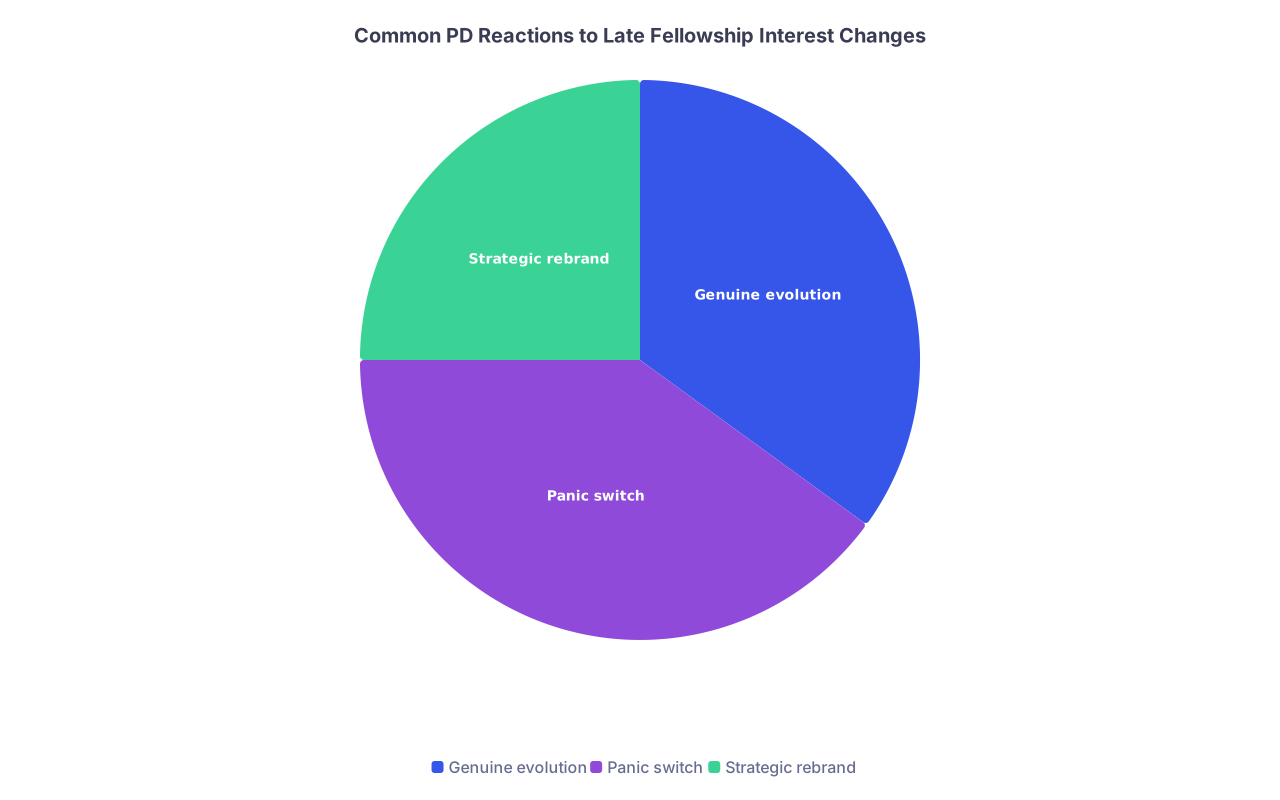
| Category | Value |
|---|---|
| Genuine evolution | 35 |
| Panic switch | 40 |
| Strategic rebrand | 25 |
Here’s the translation.
1. “Genuine evolution” (the good one)
This is the resident who:
- Was reasonably open early on
- Has strong general performance
- Can articulate a clear turning point: a rotation, a mentor, a patient, a meaningful experience
- Has at least some objective alignment with the new field by the time of application (electives, QI, a poster, involvement in clinic, etc.)
PD’s internal monologue:
“Okay, they grew. They matured. They found their thing. Fine. Let me see if their story holds across letters and application.”
2. “Panic switch” (the kiss of death)
This is the resident who:
- Declared interest in something super competitive (say cards or GI) loudly and for a long time
- Did almost nothing serious for it (no sustained research, didn’t show up at conferences, no one in the division really knows them)
- Changes late to a ‘backup’ field without a believable story or track record
PD’s internal monologue:
“Couldn’t make it for their first choice, now they’re shopping for whoever will take them. No thanks.”
3. “Strategic rebrand” (can be good or snake-like)
This is the resident who:
- Was seriously working toward specialty A
- Realistically isn’t competitive there (scores, letters, research, timing)
- Pivots to specialty B with intention and quickly starts building a portfolio: targeted mentors, electives, projects, clinic
PD’s internal monologue:
“This is a redirect. Let me see whether they’re just fleeing or if they actually understand what this new field is and have done their homework.”
You want to look like #1 or a strong version of #3. The line between #2 and #3 is thin and PDs are paid to be suspicious.
What PDs Check Immediately When They Smell a Late Switch
Let me walk you into the actual selection room. The committee has a stack of applications. They pull yours. Someone says:
“Didn’t this person want [other specialty] like five minutes ago?”
Nobody leaves it there. They start hunting for consistency.

Here’s what they look at, in roughly this order:
1. Your letters of recommendation
They’re not just reading for “good resident.” They’re reading for:
- Does this letter actually talk about this specific subspecialty?
- Does the writer sound surprised by your interest? Or like they’ve watched you move toward it?
- Does anyone in the target subspecialty vouch for you personally?
Huge red flag:
Letter from a prior “intended” fellowship saying, “They were very interested in our field but then decided to pursue something else.” That screams panic or lack of commitment.
Whispered red flag that programs won’t tell you:
Letters all from general medicine folks with zero voices from your ‘new’ subspecialty in a big academic center where such letters are easy to get. That signals you never actually walked down the hall to meet them.
2. Your CV timeline
They literally scan your CV dates and think:
“Okay, you did quality improvement in nephrology PGY-1, a case report in ID PGY-2, and only in the last 4 months you show up at our subspecialty’s journal club. That’s not ‘lifelong passion’—that’s triage.”
The trick is not to pretend you were always destined for them. That looks fake. The trick is to show a coherent pivot:
- Early: broad interests, solid IM training
- Middle: honest exploration (it’s okay if your earlier work isn’t in the new field)
- Late: clear, accelerating focus in the new area
3. Your personal statement
This is where most residents blow it.
The PD question is simple:
“Does this sound like revisionist history or an honest story of evolution?”
If your statement reads like:
“I’ve always been drawn to…” and there’s no evidence for years 1–2, they roll their eyes. They’ve read thousands of these. They know.
What actually works:
- You admit you were initially leaning toward X or undecided
- You pinpoint specific rotations / patients / mentors that changed your view
- You show what you physically did about it in real time (joined clinic, started project, sought mentorship)
- You connect that path to where you want to be in 5–10 years
The phrase you’re trying to avoid triggering in their mind is: “backfill fiction.”
Different Fields React Very Differently
Not all fellowships judge late switches the same way. Some are quietly more forgiving; some are ruthlessly suspicious.
| Fellowship | Typical Competitiveness | Tolerance for Late Switch | What PDs Expect |
|---|---|---|---|
| Cardiology | High | Low–Moderate | Early signal, research, strong letters |
| GI | Very High | Low | Longstanding interest, division familiarity |
| Heme/Onc | High | Moderate | Clear narrative, some scholarly work |
| Pulm/CCM | Moderate–High | Moderate–High | Strong clinical fit, ICU performance |
| Nephrology | Moderate | High | Honest story, strong IM foundation |
A few insider truths:
Cardiology and GI: PDs in these fields are used to long-game applicants. Years of prep, often from med school. A PGY-3 flipping into GI with no GI letters and no GI projects? They’ll smile in the rejection email. They do not buy last-minute conversions unless there’s a major, very believable story.
Heme/Onc: Surprisingly open to “I discovered this late” if there’s a serious, authentic patient or research story and at least some heme/onc-related work in the last 9–12 months.
Pulm/CCM: They care a lot about your ICU performance and how you function on teams. If you were a rock-star senior in the unit, they can forgive a later formal “decision” as long as it’s consistent with what they’ve seen clinically.
Nephrology, ID, Endocrine, Rheum: These are far more forgiving of late deciders. They know most residents don’t show up day 1 saying “I was born to do glomeruli.” What they do hate is someone treating them like the consolation prize after bombing out elsewhere.
So no, the rules are not the same everywhere. And yes, PDs talk. If you loudly chased cardiology for two years in a medium-sized academic center, the GI PD, pulm PD, and heme/onc PD already know that before you email them.
The Story That Works vs. The Story That Fails
Let me show you two residents I watched go through this.
Resident A: The believable switch
PGY-1:
Kept it vague: “Thinking heme/onc or endo, not sure yet.” Solid intern. Not a superstar, but good.
PGY-2:
Did an elective in ICU. Crushed it. Great team player. Started picking up extra ICU call. Asked thoughtful questions about physiology. The pulm/CCM folks noticed.
Late PGY-2:
Told mentor honestly, “I thought I wanted heme/onc, but I realized I live for the sick patients in the unit.” Mentor said, “Okay, then act like it.”
Next 8–10 months:
Arranged second ICU elective. Joined a sedation/ventilator QI project that was already running. Went to the weekly CCM conference regularly. Got one of the ICU attendings to know them really well.
Application season:
Personal statement clearly explained the change. Letters from two intensivists who said, “We thought this person was one of us before they even declared it.”
PD reaction:
“Okay, this makes sense. The timeline matches what our faculty saw. They’re not building a personality from scratch in September.”
They matched at a strong pulm/CCM program.
Resident B: The panic switch
PGY-1–2:
Told anyone who would listen: “I’m going into GI.” Did one GI elective. Never followed up on a research opportunity with the division. Floated through wards.
Late PGY-3:
Realized GI was a bloodbath that year. Step scores, research, and letters were mediocre. Panicked. Decided to apply heme/onc and nephro simultaneously “to keep options open.”
Application:
Personal statement for heme/onc: “I’ve always been drawn to longitudinal cancer care…”
Personal statement for nephro: “I’ve always been drawn to the complexity of fluid and electrolytes…”
Neither program was fooled. They read both and smelled the desperation. No one believed either “always been drawn” line.
Outcome:
No heme/onc interviews at serious places. A couple of nephro interviews, but even those PDs said privately, “We’ll rank them low; feels like a backup, not a fit.”
How to Salvage a Late Switch Without Looking Fake
If you’re switching late, you cannot afford magical thinking. You need deliberate, visible moves that PDs and letter writers can actually reference.

| Step | Description |
|---|---|
| Step 1 | Realize late switch |
| Step 2 | Clarify true interest |
| Step 3 | Talk to honest mentor |
| Step 4 | Commit to one primary field |
| Step 5 | Schedule targeted electives |
| Step 6 | Join ongoing project or QI |
| Step 7 | Secure subspecialty mentor |
| Step 8 | Get at least one strong letter |
| Step 9 | Write honest narrative |
Step 1: Stop pretending it’s not late
Own it. With yourself and with mentors.
Go to someone you trust and say:
“I’m late to this field. I know that. I want to make the strongest honest case possible. What’s realistic this cycle vs next cycle?”
PDs do not respect residents who show up in July of application year saying, “So I’ve always loved your field…” when nobody in the division has ever met them.
Step 2: Pick one primary field
The multiple-application gambit (“I’ll apply to GI, heme/onc, and hospitalist fellowships just in case”) looks exactly how you think it looks.
People talk. Division chiefs gossip. PDs will literally say in meetings, “They’re also applying to [other field]. Are we their backup?”
You can have a true “#1 and #2,” but your #1 needs to be very clear:
- Your CV and letters skew toward it
- Your statement for it is richer and more specific
- Your mentors can defend you if another PD calls and asks, “Are they serious about us or just fishing?”
Step 3: Build visible commitment, fast
No, you’re not going to publish three first-author papers in six months. Stop fantasizing.
What you can do:
- Take another elective in the field and be unambiguously excellent
- Join an ongoing project that just needs a chart review, data extraction, or case series—things that can move quickly
- Show up regularly at that division’s conferences, tumor boards, journal clubs
- Ask for genuine feedback from subspecialty attendings on how you perform and where you fit
The goal isn’t to fake a three-year arc. The goal is to make your last 6–12 months so obviously aligned that no one can say, “They just slapped this interest on yesterday.”
What Your PD Really Thinks About Your Switch
Your residency PD is the gatekeeper. Their letter and behind-the-scenes phone calls can save or sink you.
Here’s the internal thought process most will never say to your face:
- “Is this resident running toward something or running away from something?”
- “Have they actually done the work to explore this new interest, or is this because of competitiveness, geography, or lifestyle panic?”
- “Will my name look stupid if I vouch for them in this field?”
If your PD senses:
- You were chasing prestige and then pivoted to whatever would take you
- You’re indifferent and mostly want a job title, any job title
- You’re not actually that interested in the day-to-day of this new specialty
…they will write you a “nice” letter that says nothing. PDs can feel those letters. Empty enthusiasm. No specifics.
On the other hand, if your PD can honestly say to a fellowship director on the phone:
“They figured this out late, yes. But once they did, they moved with purpose. They’ve been excellent on X rotation, took the initiative with Y project, and Dr. Smith in that division thinks very highly of them.”
That sentence undoes most of the damage of a late switch.
The One Thing PDs Care About More Than When You Decided
Here’s the part residents never believe until they see it from the other side.
PDs care less about when you decided and more about:
Do you look like someone who will thrive and stick in this field 5–10 years from now?
They’re trying to avoid:
- Fellows who realize in year 1 they hate the field and bail to hospital medicine
- Personality mismatches that poison a small subspecialty group
- People clearly gaming the system to land anywhere with a prestigious name
If your late switch comes with:
- A believable narrative of “I saw this, I tried it, and it fit better than what I thought I wanted”
- Concrete behaviors that match that realization
- Letters that describe not just competence but fit for the field
They will forgive a lot.
But if your late switch comes with:
- Hand-wavy “I’ve always enjoyed the complexity of…” language copy-pasted from a sample statement
- No one in the division who really knows you
- Obvious signs you were chasing some other field until it did not work out
They will not.
How Honest You Can Be About “Switching for Competitiveness”
You’re thinking it, so let me say it: yes, many people switch because they realize they won’t match in their dream ultra-competitive field.
You cannot write, “I didn’t match cards on my first try, so now I’m applying nephro because I still want a job.” That is suicide.
But you also do not have to lie.
The way to frame it if competitiveness was a factor:
- “I initially explored [very competitive field] and learned that while I appreciated aspects of it, I found myself consistently more engaged with [specific aspects of new field].”
- “Conversations with mentors in both fields helped me recognize a better long-term fit in [new field], clinically and academically.”
If the truth is that you missed the window for serious prep in one field and pivoted to another, then your behavior after the pivot must look like commitment, not resignation.
PDs are surprisingly tolerant of “I grew, I learned, I was wrong earlier.” They are not tolerant of “I pretended to love whichever field I thought might take me.”
Quick Reality Check: Should You Delay a Year?
Sometimes the honest answer is: it’s too late to look credible this cycle.
Here’s when PDs privately say, “I’d respect them more if they waited a year”:
- You have zero subspecialty letters in the new field
- You discovered this interest literally months before the application deadline
- You can’t point to any sustained behavior that matches the new interest
- Your home institution division barely knows you exist
Would a research year, chief year, hospitalist year, or focused year of work in that field improve your story? Often, yes.
I’ve seen residents crash and burn applying too early, then come back the following cycle after one focused year and match at better programs than they originally hoped for.
You do not get points for speed. You get points for coherence and credibility.
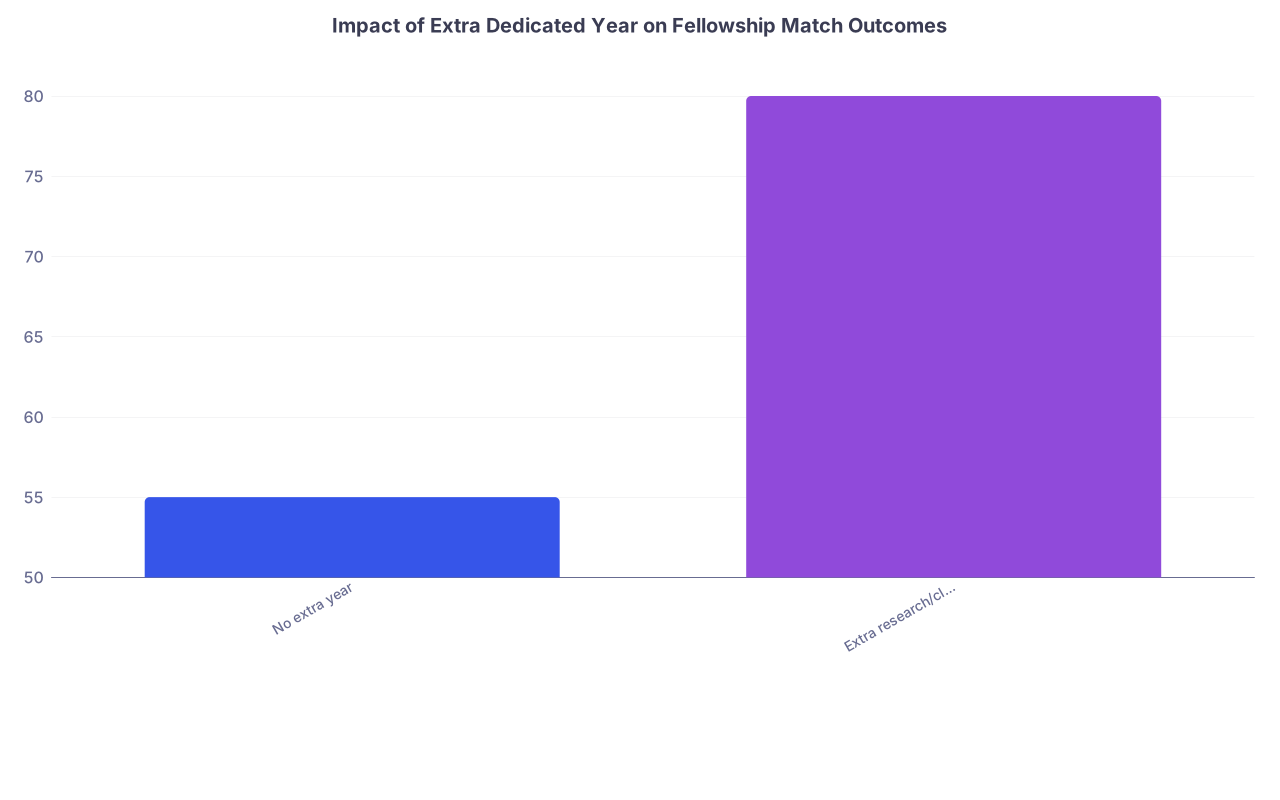
| Category | Value |
|---|---|
| No extra year | 55 |
| Extra research/clinical year | 80 |
FAQ (Read This Before You Panic)
1. If I did early work in another specialty, should I hide it?
No. Trying to scrub your history looks worse. PDs expect residents to explore. What matters is how you explain the transition. Leave the prior work on your CV, but highlight the more recent experiences that shifted your direction. In your statement and interviews, be explicit: “I learned a lot from that experience, but I realized I was more drawn to…” That sounds mature, not flaky.
2. How many months of exposure do I need in the new field to not look fake?
There’s no magic number, but less than 2–3 months of real engagement (electives, clinics, conferences, project involvement) looks thin in most competitive fields. If all you have is one elective and some hand-waving, it will feel late and shallow. For moderately competitive fellowships, you can get away with a shorter runway if your performance and letters are very strong.
3. Can I tell PDs directly that I switched late? Or do I downplay it?
You should acknowledge it calmly, not dramatically. Something like: “I came to this decision later than some of my peers, but once I recognized the fit, I focused my efforts accordingly—doing X, Y, and Z.” You do not need to sell the drama. You need to show intention and follow-through. Over-defensiveness about timing usually makes them more suspicious, not less.
4. Will my earlier loud interest in another fellowship always hurt me?
It depends how you behaved after the pivot. If you loudly proclaimed cards for two years and then quietly ghosted them and suddenly appeared in heme/onc clinic two months before ERAS, yes, that history hurts. But if you were honest with mentors, communicated your change clearly, and then visibly committed to the new area, PDs are surprisingly willing to move on. They care more about your current trajectory and the testimonials of people who work with you now.
Key takeaways:
Late switches aren’t fatal, but lazy, last-minute ones are.
PDs forgive evolution; they don’t forgive fiction.
If you’re going to pivot, do it with visible, deliberate action—and let your behavior, not just your words, prove you mean it.


