
The idea that the “best” fellowship spots always go to the “best” residents is a myth attendings tell in public and roll their eyes at in private.
Let me tell you what really happens.
Every year, some resident who’s “fine but not amazing” on paper lands an elite cards spot at a top-10 place, or a GI fellowship at the big-name university down the road. Meanwhile, the resident who destroyed in-service exams, crushed service, and lived in the hospital somehow ends up at a mid-tier program or doesn’t match at all.
That disconnect is not random. It’s how the system actually works.
You’re going to see it. You might already have a name in your head.
The Myth of the “Average” Resident
First, we need to be honest about what “average” means in this context.
When faculty say, “Yeah, she’s pretty average,” they usually mean one of three different things, and they’re rarely talking about the same dimension you are:
- Average clinically
- Average academically
- Average “on paper”
I’ve been in rank meetings where someone says, “He’s very average,” and the fellowship director responds, “Average for here is still excellent. I’d take him in a heartbeat.”
Translation: you’re comparing yourself to your co-residents; fellowship programs are comparing across the national pool.
And there’s the private truth: a lot of “average” residents in the eyes of their home program are actually more competitive than half the national applicant pool on pure ability. But that’s not why they match elite spots.
They match because of leverage. Because they have something the program wants that’s not easily seen on a CV.
What Fellowship Programs Actually Optimize For
Stop thinking, “They want the smartest person.” That’s not the real objective.
Fellowship directors are optimizing for three things, in roughly this order:
- Reliability and low-risk
- Institutional politics and relationships
- Strategic value to the program (research, prestige, future faculty, niche skill)
Everything else—scores, grades, publications—is just evidence used to support or argue against those three.
Here’s what they’ll never put in a brochure but will absolutely say in a room when the door is closed:
- “I don’t need a superstar who might implode mid-year.”
- “I told [Big-Name Chair] I’d take one of their people this cycle.”
- “She’s not a rockstar, but she’ll be a solid workhorse, and we trust the letter writers.”
You’ll see the pattern if you watch closely enough.
The Real Power Currencies (That Beat “Being Amazing”)
Let me walk through the quiet advantages that “average” residents use—often without fully realizing it—to get elite spots.
1. Branded Training Background
Programs do not weigh all “average” equally.
A resident who is “middle of the pack” at MGH, Hopkins, UCSF, Duke, or any high-octane academic program is not viewed the same as someone who is “top 5%” at a small community program no one’s heard of.
Behind closed doors, the conversation sounds like:
- “He’s middle of the road at [Top-Tier IM Program], but if he survived there, his floor is high.”
- “We know what their ‘average’ looks like—we’ve had their grads. They show up ready.”
This is risk calculus. Directors have been burned by shiny-on-paper applicants from weaker programs who come in undercooked clinically. So they anchor to institutional reputation.
That’s how a resident with no first-author pubs and average evaluations from a well-known shop gets a serious look at elite fellowships, while a stellar resident at an unknown program has to fight twice as hard to even get interviews.
If you’re at a non-name-brand residency, this is the bias you’re going up against. Pretending it’s not there is delusional. You have to counter it deliberately.
2. The “Phone Call” Factor
You want to know the single most unfair, high-yield mechanism in fellowship applications?
The off-the-record phone call.
I’ve seen this happen in real time:
- Rank meeting’s almost done.
- An applicant from Program X is sitting middle of the list.
- Our division chief walks in late and says, “By the way, [Famous Chair] called me about her. She’s one of their best.”
- Someone flips her from mid-list to top 3 in 30 seconds.
No new data. No new publication. Just an upstream power signal.
Programs form quiet alliances. “We take your person this year, you’ll look favorably at ours next year.” Nobody writes that down, but everybody understands it.
That’s why “average” residents from programs with influential leaders suddenly land at places they have no business touching on paper. A well-timed, credible call from a respected name can erase a lot of mediocrity.
You know who does not get those calls? The resident who is excellent but invisible to anyone with real pull.
3. Being “Safe Hands” on Service
Directors don’t want drama. They want people who keep the machine running without catching fire.
Every program has a small group of residents faculty refer to as “safe hands”:
- They don’t blow up the team.
- They don’t disappear at 4:45.
- They don’t melt down under pressure or sabotage co-fellows.
They may not be the fastest diagnosticians. They may not be quoting obscure trials. But attendings can relax when they’re on call. That matters a lot more than residents think.
I’ve heard versions of this many times in selection meetings:
- “He’s probably not going to be a national name, but I’d be glad to have him covering our ICU nights.”
- “She’s a grown-up. You never worry when she’s on.”
That single trait—emotional stability and reliability—lets an “average” resident outperform a brilliant but erratic one.
Programs have long memories of the brilliant malignant fellow who tanked morale and created headaches for GME. They’ll trade raw IQ for stability almost every time.
4. Quiet Alignment With Program Needs
This is where the savvy “average” resident unknowingly plays chess while others are playing checkers.
Elite fellowships are not picking “the best applicants.” They are assembling a class to meet needs:
- One or two research-heavy future faculty
- One community workhorse
- One procedural machine
- One “bridge” person with strong ties to feeder institutions
Now imagine:
You’re not the research star. You’re not the smartest. You’re not the slickest interviewer. But you’ve spent three years doing exactly the kind of clinical work that program is quietly desperate for—say, high-volume GI bleeding, hard ICU nights, or complex heart failure management.
In the rank meeting someone says:
- “Look, she’s not going to be an R01 person. But we need someone who can cover service without crashing. She’s perfect for that slot.”
That’s how an “average” resident shoots up the rank list: they accidentally or intentionally line up with a hole the program needs to fill.
Most applicants send the same generic application to every fellowship. The “average” resident who bothers to understand what this program actually values and signal that alignment will absolutely leapfrog “stronger” applicants who look like a poor fit for the kind of fellow they want this year.
5. Letters That Actually Say Something
Here’s the dirty secret about letters: 80% of them are useless fluff.
“Hardworking, pleasant, clinically strong…” Directors skim and forget them instantly.
What moves the needle is a letter that does one of three things:
- Offers a comparison group (“Top 10% of all residents I’ve supervised in 15 years”)
- Gives concrete anecdotes of performance under pressure
- Signals personal stake (“I would recruit her as faculty without hesitation and hope she returns here”)
An “average” resident with one or two of these letters from powerful, credible people often beats the superstar whose letters are bland because everyone assumed they’d match somewhere great anyway.
And here’s the quiet truth: the residents who help with the unglamorous stuff—covering when a colleague is sick, taking students seriously, helping with division projects—often earn those passionate letters even if they aren’t the top test scorers.
6. Being Known, Not Just Liked
There’s a level above “people like you” that matters far more: “people feel like they know you.”
Directors instinctively rank up the applicant whose story they can remember without notes:
- “She’s the one who ran the QI project that cut readmissions by 15%.”
- “He’s the former engineer who rebuilt their echo reporting template.”
The “average” resident who picked a lane early—chest imaging, health disparities, advanced endoscopy, HFpEF, whatever—and kept showing up in that space becomes easy to advocate for.
I’ve personally watched this play out:
Two applicants with similar stats. One did a bit of everything, all good, nothing memorable. The other had fewer publications, but they were all in one narrow area the fellowship director cared about. Guess who got ranked higher? Every time.
How “Average” Residents Quietly Stack the Deck
Let’s pull this together from the other angle: what are those residents actually doing during residency that sets them up, even if their day-to-day feels “middle of the pack”?
They Pick Their Spots Early
They don’t try to be everything.
They find one mentor in their field. They latch onto one or two projects with that person. They show up at every relevant conference, journal club, and teaching session.
Over time, this creates a simple narrative: “This is a future cardiologist who’s already acting like one.”
When that mentor gets an email—“We’re reviewing apps; tell me about your residents applying this year”—you want to be the first name that pops out of their mouth without hesitation.
That’s not brilliance. That’s alignment and consistency.
They Make Life Easier for the Right People
This one’s uncomfortable, but it’s real.
Residents who get elite spots have often quietly made life easier for people with influence:
- Took on an extra weekend on a research elective to help enroll study patients
- Helped polish slides for a big talk their attending was giving
- Kept a QI initiative running after the older fellow graduated
Faculty remember who helped when it wasn’t mandatory.
You know what I’ve heard more than once?
- “He’s not a superstar, but he’s dependable and took care of that clinic workflow disaster. I’ll go to bat for him.”
That’s your ticket to the phone call that moves your application from the middle to the top of the pile.
They Avoid Burning Their Own Advocates
Here’s a mistake the “high-performing but bitter” residents make: they trash-talk their program, their attendings, and the system loudly and often.
You think people don’t hear? They do. Admin hears. Chiefs hear. The one attending you need to write you a strong letter hears that you’ve been tearing them down to interns.
Insider truth: there are residents who had the stats and the work to win, but multiple faculty independently said some version of, “I can’t fully endorse them; there are professionalism concerns.”
You’re done after that. Directors will not risk it. They will absolutely take the calmer, “average” person instead.
The “average” resident who’s pleasant to be around, doesn’t create chaos, and doesn’t light fires behind people’s backs is low-risk to advocate for. So people actually do it.
If You Feel “Average” Now, What Should You Do?
You’re in the thick of residency, watching others outshine you on rounds or in publications, and you’re wondering if an elite fellowship is already off the table.
It’s not. But you need to stop wasting time on the wrong levers.
Here’s the playbook I’ve seen work for so-called “average” residents who ended up in elite spots.

| Step | Description |
|---|---|
| Step 1 | Decide Target Field |
| Step 2 | Find 1-2 Key Mentors |
| Step 3 | Own 1-2 Focused Projects |
| Step 4 | Be Reliable on Service |
| Step 5 | Get Specific, Strong Letters |
| Step 6 | Leverage Networks and Calls |
| Step 7 | Targeted, Aligned Applications |
1. Lock in your field and mentors
Stop dabbling in every specialty by PGY-2. Pick the field you’re most likely to apply in. Then:
- Identify the 1–3 attendings in that division with the most influence (division chief, big NIH grant holder, national committee member, program’s “name”).
- Attach yourself professionally: electives with them, small projects, ask for feedback, ask how you can contribute.
You’re not sucking up. You’re being intentional about whose name will be attached to yours when programs go hunting for backchannel opinions.
2. Become visibly “safe hands” in that field
During your specialty rotations:
- Show up on time (yes, they notice who cuts it close daily).
- Volunteer for hard things occasionally—late admits, complicated consults, night coverage.
- Ask for feedback and actually adjust.
You are building a reputation that will show up in letters and in those pre-interview phone calls that you’ll never know happened.
3. Craft a coherent story, not a maximalist CV
You do not need ten projects. You need a coherent theme.
Example: the “average” IM resident who matched GI at a top-10 program.
On paper:
- USMLE scores: decent but not eye-popping
- No first-author NEJM papers
- No chief resident
But:
- 3 small but related projects in IBD with the same mentor
- Presented posters at DDW two years in a row
- Helped build an IBD patient education series in clinic
Her application screamed, “I know who I am, I know what I like, and I’ve already started doing this work.” Programs loved her. She matched at a place people back home were shocked she got into.
4. Target programs where you’re realistically “above average”
This is the part nobody teaches.
| Resident Profile | Most Realistic Target Tier |
|---|---|
| Low-name residency, limited research | Solid regional / mid-tier academic |
| Strong home name, average portfolio | Mid to high academic, some elite |
| Strong research, average clinical | Research-heavy academic programs |
| Great letters, “safe hands” rep | Wide range, including elite |
You don’t spray and pray. You aim where your particular combination of:
- Home institution name
- Letters
- Narrative alignment
- Reliability rep
will place you above the median of their applicant pool.
The “average” resident who does that will often outperform the “superstar” who blindly applies to every elite name without thinking about fit.
5. Explicitly ask for advocacy, not just letters
This is the step almost no one takes, and it’s where the “average” residents with good relationships quietly walk past everyone else.
When you ask for a letter, you say something like:
“I’m applying to [these 8–10 programs]. If you feel you can, would you be comfortable reaching out to anyone you know there on my behalf?”
Some will say no. Fine. Others will absolutely say yes, especially if you’ve made their life easier for three years.
That’s how the phantom phone calls get made. And those calls move you from “average on paper” to “top of our rank list.”
What Fellowship Directors Will Never Say on the Record
Let me put the subtext into plain text for you.
Directors are thinking:
- “I would rather take an 80th percentile resident I trust than a 99th percentile wild card who might blow up the program.”
- “Relationships with feeder programs matter. I’m not going to stiff [Chair at Feeder Hospital] when they ask me to look at one of their people.”
- “We need a certain number of fellows who will keep clinical operations running so the research stars can do their thing.”
None of that shows up in glossy brochures or fellowship websites.
But it absolutely shapes who gets the elite spots.
And it’s why every year, you’ll see the “average” resident walking into an elite fellowship while someone “stronger” stays local and pretends that was their first choice.
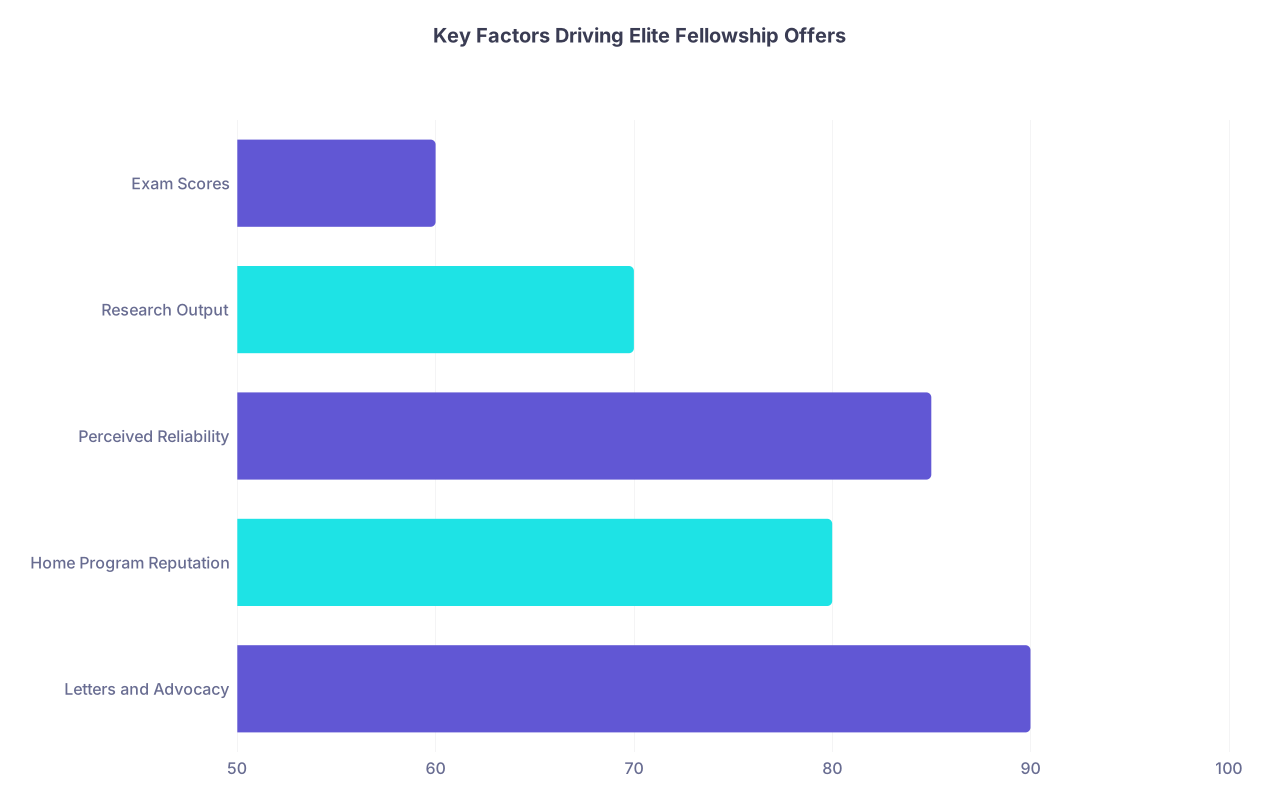
| Category | Value |
|---|---|
| Letters and Advocacy | 90 |
| Home Program Reputation | 80 |
| Perceived Reliability | 85 |
| Research Output | 70 |
| Exam Scores | 60 |
The Bottom Line
If you remember nothing else, remember this:
- Elite fellowships are not purely meritocracies. They’re ecosystems balancing risk, politics, service needs, and future prestige.
- Being “average” on paper does not disqualify you. Having no one willing to go to bat for you does.
- Your job is not to become perfect. Your job is to become the kind of known, reliable, aligned applicant that powerful people feel comfortable staking their name on.
Do that, and you’ll understand why some “average” residents keep walking into “impossible” fellowship spots—while everyone else stands there, staring at the match list, muttering, “How the hell did they get in?”