

The dirty secret about residency evaluations is this: fellowship program directors don’t believe most of what’s written. They’re reading between the lines, hunting for patterns, and zeroing in on a few very specific signals that never show up in the official “milestones” language.
Let me walk you through what actually happens when your fellowship application lands on a PD’s desk and they scroll to your evaluations. Because it is not what your chief residents, or even your own PD, have told you.
How PDs Really Read Your File
First, the reality: most fellowship PDs are not reading every word of every evaluation for every applicant. They do not have that kind of time, and frankly, most evaluations are fluff.
Here’s the usual sequence when we open your file:
- We look at your letters of recommendation.
- We glance at your CV for signals: research, leadership, niche interests.
- Then, if you’re still in the “keep” pile, we start digging into evaluations.
Notice that word: digging. Evaluations are used to confirm or contradict the story your letters and CV are already telling. They’re not the starting point; they’re the proof—or the warning.
If a PD likes you on paper, they go to the evaluations asking two questions:
- “Is this person consistently solid, or are there red flags hiding underneath glowing letters?”
- “Do people who actually worked with them say the same thing their letter writers are saying?”
Most of the time, PDs do not read 40 end-of-rotation comments in detail. They scan. They look for:
- Trends over time
- Outliers (especially bad ones)
- Recurrent coded phrases
- Any “incident” language that hints at professionalism issues or patient safety concerns
If something feels off, then—and only then—they might go back and read more carefully.
The Parts of Evaluations That Actually Matter
Let’s break this down. What parts of your evaluations do fellowship PDs really care about?
1. Global Assessments and Narrative Summaries
Those “global” or “overall” comments from your program director, CCC (Clinical Competency Committee), or semi-annual reviews carry far more weight than the random one-liner from a tired hospitalist at 2 a.m.
When PDs see:
- “One of our top residents this year”
- “I would rank them in the top 5% of residents I’ve worked with in 10 years”
- “A true leader in the program; we rely on them”
That sticks. Those are the lines that end up getting quoted in rank meetings: “This is the person their PD called ‘top 5% in 10 years.’”
On the flip side, there are certain phrases that, to fellowship PDs, are basically code for “we’re being polite, but this is not our star”:
- “Hardworking, dependable resident” (translation: fine, not remarkable)
- “Always willing to help” (often used when there’s not much else to say)
- “Steady improvement over the year” (translation: was not good at first)
- “Will do well with continued supervision” (translation: not fully trusted)
I’ve sat in rank meetings where someone read “hardworking and dependable” and another PD muttered, “So… average.” That’s how those words land.
What you want are comparators and superlatives:
- Top X%
- One of our strongest
- Go-to senior for difficult cases
- Trusted to supervise independently
If those words never appear anywhere in your evaluations or PD summary, you’re not in your program’s top tier on paper, no matter how good you think you are.
2. Patterns Across Rotations, Not One-Offs
PDs know attendings are wildly variable. Some grade everyone high, some are stingy, some are petty. One bad eval will not sink you. A pattern will.
We look for consistency along a few axes:
- Do you show up as strong in both inpatient and outpatient?
- Are ICU/specialty rotations saying the same thing as general ward rotations?
- Do your ratings and comments improve as you move from PGY-1 to PGY-3, or did you plateau?
What really catches PD eyes is discordance. For example:
- ICU: “Excellent clinical reasoning, calm under pressure, strong team leader.”
- Wards, different month: “Struggles with organization, frequently late with notes, slow to make decisions.”
That triggers questions. Which version is real? Is this about the attending? The fit? Burnout? Personality clashes?
Most of us will give you the benefit of the doubt for one weird outlier. But if we see:
- Multiple comments about “organization issues”
- Repeated “needs to work on timeliness”
- Several mentions of “communication challenges with nursing staff”
That’s not noise. That’s a trend. And it will affect how we rank you.
The Coded Language PDs Watch For
The most naïve thing residents do is assume evaluations are “honest.” They’re not. They’re political documents, written by people who know these might someday be read outside the program.
So attendings learn to write in code. And PDs learn to read it.
Here’s some of the real translation, drawn from actual CCC and PD discussions:
| Phrasing in Evaluation | What Fellowship PDs Actually Hear |
|---|---|
| "Hardworking and reliable" | Average performer, good attitude, not exceptional |
| "Quiet but pleasant" | Does not actively engage, possibly passive or withdrawn |
| "Improved with feedback" | Started with real deficiencies, now acceptable |
| "Will be an excellent hospitalist" | We do not see this person as fellowship material |
| "Does best with clear direction" | Struggles with independence or complex decisions |
| "May benefit from further supervision" | Not ready for high-autonomy environments |
That “will be an excellent hospitalist” line especially. I’ve heard multiple subspecialty PDs say, “That’s code for ‘we don’t see them as a future specialist.’” Fair or not, that’s how it’s read.
On the more positive side, there are phrases that act almost like golden tickets:
- “I fully support them for any fellowship they choose.”
- “We trust them with our sickest patients.”
- “Residents and staff look to them when things get tough.”
- “Already functioning at the level of a junior fellow.”
Those sentences can outweigh a mediocre numeric score chart in the same document.
The Numbers: Milestones, Ratings, and Why Most PDs Ignore the Details
Now let’s talk about the milestone scales and numeric ratings. The 1–9 or “below expectations/meets/exceeds” grids your program loves.
Fellowship PDs view these with a huge grain of salt.
Most programs bunch everyone at “meets” or “slightly above” expectations, especially after PGY-1. Grade inflation is rampant. If your program sends us a milestone report where every single resident is “exceeds expectations,” we mentally discount the entire scale.
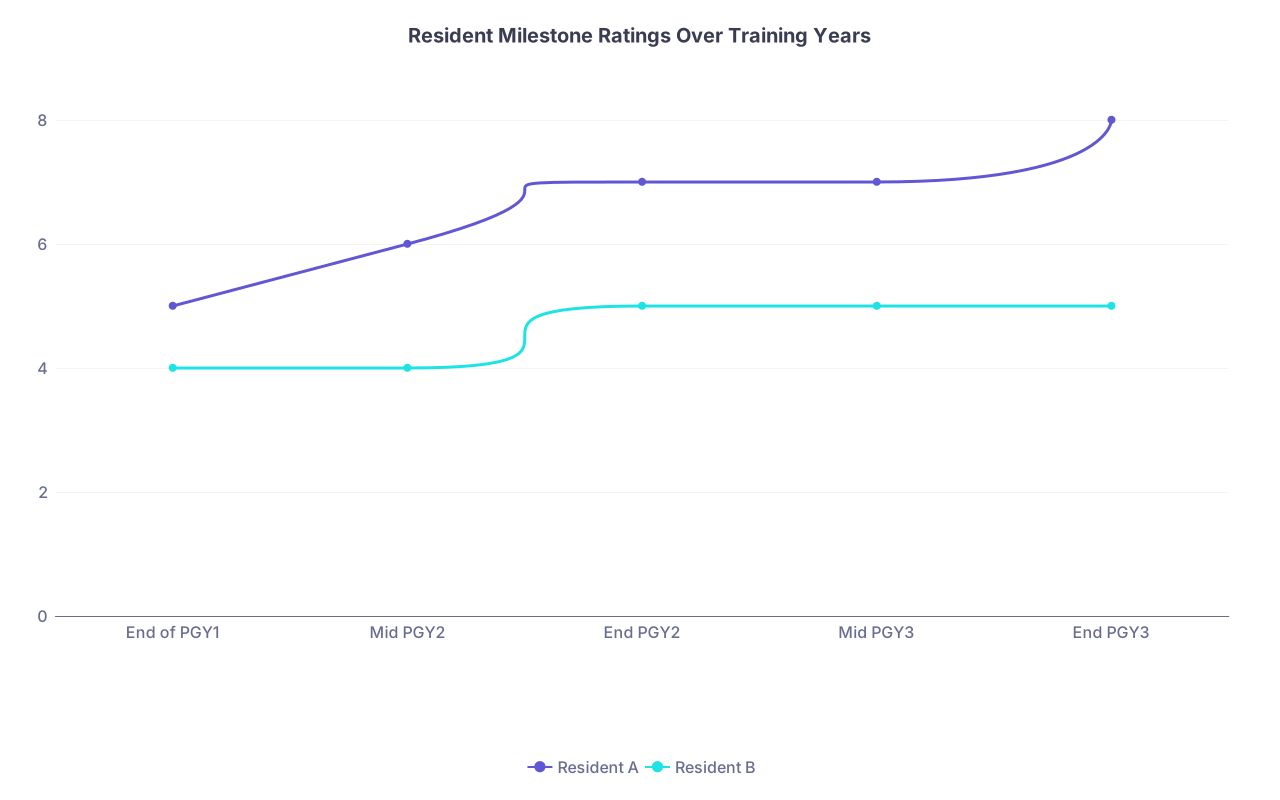
Where numbers matter is at the extremes and in the trajectory.
| Category | Resident A | Resident B |
|---|---|---|
| End of PGY1 | 5 | 4 |
| Mid PGY2 | 6 | 4 |
| End PGY2 | 7 | 5 |
| Mid PGY3 | 7 | 5 |
| End PGY3 | 8 | 5 |
We notice two things:
- Are you clearly below your peers on key domains—especially medical knowledge, clinical reasoning, professionalism, or communication?
- Do your ratings rise over time in a believable way, or are you flat?
A PGY-3 sitting at “borderline meets expectations” on medical knowledge is a major problem. Same for repeatedly flagged professionalism or systems-based practice issues. That gets discussed out loud in selection committees.
But if you’re clustered near where everyone else is, with some mild upward trend? The actual numbers fade. PDs fall back to the narrative comments and the PD summary.
Professionalism: The Landmine You Can’t Out-Score
You can survive mediocre comments about speed, efficiency, even some gaps in knowledge if everything else is strong.
You will not survive recurrent professionalism concerns.
This is where fellowship PDs get very serious. We’re not just training you in a niche field; we’re inheriting your behavioral baggage. Nobody wants the fellow who’s constantly fighting with nurses or vanishing post-call.
Watch for key words that set off alarms:
- “Boundary issues”
- “Has had multiple discussions about punctuality”
- “Required remediation around documentation/attendance”
- “Struggles with feedback”
- “Can become defensive when questioned”
- “Has generated some complaints from staff”
Most PDs understand that residents have bad months. If there was a one-time issue that’s clearly documented as addressed and resolved, some will look past it, especially if your later evaluations show “significant improvement” or “no further concerns.”
But if the same behavior crops up again and again across different rotations and evaluators? That becomes a hard stop at many programs. I’ve seen applicants with excellent research and Step scores quietly dropped down the rank list because the PD did not want to “import someone else’s headache.”
What PDs Do When They See Something Concerning
Here’s the part nobody tells you: if a fellowship PD is seriously interested in you and sees something concerning in your evaluations, they don’t just guess. They pick up the phone.
They call your PD, APD, or someone they know at your institution and ask the question directly:
- “Give me the real story on this person.”
- “I saw a few mentions of organization and communication issues—are those resolved?”
- “Is there anything you’d be worried about if you were taking them as your own fellow?”
The off-the-record conversation matters more than the official written evaluation. A lot more.
I’ve heard PDs say things like:
- “On paper they look fine, but we had ongoing professionalism issues that never made it into the formal summary.”
- “That one incident reads bad, but they really turned it around, I’d take them for my own fellowship.”
- “Strong clinically, but I would not send them to a small program with limited backup.”
You won’t ever see or know those conversations happened. But they happen.
How Subspecialty PDs Weigh Different Parts of Your Evaluations
Not all fellowships look at your evaluations the same way. Some care more about raw clinical horsepower; others care more about teamwork and longitudinal reliability.
Let me give you some real patterns I’ve seen and heard from PDs across fields:
Cards, GI, Heme/Onc – They care a lot about ICU and complex inpatient evaluations. They want to see that, when things are crashing, you’re described as calm, decisive, and trusted. They’re more willing to forgive “a bit slow with notes” than “hesitant in acute situations.”
Pulm/CCM – They read ICU comments like scripture. Any hint that “struggles under pressure” or “needs close supervision in high acuity settings” is poison.
Endocrine, Rheum, Allergy – Often more outpatient and relationship heavy. They look closely at clinic evaluations: communication, follow-through, reliability, ability to own a panel.
Academic-track fellowships across fields – They want to see phrases like “independent learner,” “seeks out feedback,” “drives their own learning.” People who only perform when spoon-fed do not impress them.
Smaller community-based fellowships – They watch for autonomy and trust. Phrases like “ready for independent practice” carry huge weight because they know they will not have the layers of backup an academic center has.
The Biggest Misconceptions Residents Have About Evaluations
Let me dismantle a few myths straight out.
Myth 1: “If I don’t fail anything, I’m fine for fellowship.”
Wrong. The bar for “not unsafe” and the bar for “we want to train you in a competitive subspecialty” are not the same bar.
You can be a perfectly adequate resident and still read as “not standout enough” for certain fellowships. Programs want fellows who will represent them well—for years. They want future faculty, future leaders, or at least reliable, high-level consultants. Being “fine” won’t cut it for a lot of places.
Myth 2: “My evals are private; fellowship PDs will mostly see letters.”
Wrong again. Many programs now include milestone reports, semi-annual summaries, and even full evaluation packets in what’s uploaded or sent with your application. And even if your formal individual evaluations don’t get exported, your PD’s summative letter is built from those evaluations. The subtext bleeds through.
Myth 3: “A single bad rotation will kill my chances.”
Usually false. PDs believe in context and pattern recognition. One bad ICU month early PGY-2, followed by glowing ICU comments later? Narrative: grew, learned, improved. That can actually make you look mature and coachable.
What kills you is the same criticism, cropping up year after year, from different attendings.
How to Steer Your Evaluations While You’re Still in Residency
You’re not powerless in this process. You can’t rewrite what’s already in your file, but you can influence what gets written next.
Here’s what the savvy residents do—quietly.
They ask for specific feedback early
Not “How am I doing?” but “Is there anything I’m doing that would make you hesitate to recommend me for fellowship X in a few years?” That wording jolts people out of autopilot and gets you the real concerns before they become written patterns.
They target the right attendings
You know who the power brokers are in your program. The ICU director. The APD who sits on the CCC. The outpatient chief who’s best friends with several fellowship PDs.
You make damn sure your months with them are your best-prepared, most on-time, most locked-in months of residency. Those evaluations are the ones that get read and quoted.
They address known weaknesses before they fossilize in writing
If you keep hearing “notes late” or “organization” or “communication” in real-time feedback, that is a five-alarm fire. That language, if it lands in written evaluations repeatedly, will haunt your fellowship cycle.
I’ve watched residents turn this around by directly telling attendings the next month: “I’ve gotten feedback that my organization and timeliness need to improve; I’m working hard on that this month. Please let me know if you see me slipping.” That line plants a different narrative: self-aware, coachable, improving.
And you better actually improve, or it backfires.
What If You Already Have Some Bad Evaluations?
You’re PGY-3. There are already a couple of rough evaluations in your file. What now?
Here’s what matters to PDs when they see earlier issues:
- Is there a clear change in tone and content in your later evaluations?
- Does your PD’s summative letter acknowledge the earlier issues and describe real improvement?
- Do your strongest rotations—often in senior year—counterbalance the earlier narrative?
If you know something in your file is bad enough that it might come up, you do not wait for the PD to discover it on their own. You control the narrative.
That means:
- Briefly addressing it in a PD meeting so your PD has your perspective when writing your letter.
- Being prepared, on interviews, with a concise, non-defensive explanation that emphasizes growth, not excuses.
Something like:
“I had an ICU rotation early in PGY-2 where I really struggled with managing multiple critically ill patients at once. That’s reflected in that evaluation. After that, I worked closely with my APD and focused hard on improving my organization and anticipation skills. My later ICU and night float evaluations show that growth, and I now feel much more confident and effective in high-acuity settings.”
That kind of framing reassures PDs: this person is coachable, reflective, and not hiding from their past.
The One Thing That Overrides Almost Everything Else
There’s one piece I haven’t mentioned yet, and it’s brutal in its simplicity:
What your own program director actually says about you to fellowship PDs matters more than any single evaluation.
Off the record, the question that gets asked is some version of:
- “Would you take them as your own fellow?”
- “Would you hire them as faculty?”
- “Any reason I should be worried if I rank them highly?”
You want your PD to be able to say, without hesitation, “Yes, I’d take them here in a heartbeat.”
That answer doesn’t come from one glowing rotation or one nice letter. It comes from the sum total of how you’ve shown up for three years—clinically, professionally, and as part of the program’s culture.
How This All Plays Out During Ranking
Imagine a typical fellowship rank meeting. Fifteen applicants being seriously considered for eight spots. You’re in that group.
For each candidate, someone—often the PD or APD—presents a quick summary:
- Scores, research, letters.
- Key strengths.
- Any “concerns.”
Evaluations show up in that last bucket. The person presenting might say:
- “Strong evaluations across the board; ICU comments excellent; PD calls them top 10%.”
- “Mostly good, but multiple early notes about organization and some tension with nursing; improved by PGY-3 per PD.”
- “Clinically very good, but professionalism flagged twice; PD says improved but still a bit of a wildcard.”
Those few sentences, derived from the dense wall of text in your evaluations, will affect where you land on that list.
They’re not reading every line. They’re extracting the narrative and risk level.
Your Next Move
Here’s where that leaves you.
If you’re early in residency, you now know what actually gets noticed. You don’t need every eval to be perfect. You need a pattern that says: reliable, trusted, growing, easy to work with, strong in the clinical settings that match your target fellowship.
If you’re approaching fellowship applications, you need to understand what’s already “baked in” to your file and what story your evaluations are telling when stitched together. Then make sure your PD and letter writers have the version of that story that emphasizes your growth, strengths, and readiness.
Because once you hit submit on ERAS, your evaluations stop being just numbers and comments. They become the quiet voice in the room when PDs decide whose name moves up—or down—the rank list.
You’re learning what fellowship PDs really notice in your residency evaluations. The next step is even trickier: making sure your letters of recommendation amplify the right parts of that story. And that, frankly, deserves its own deep dive another day.
For now, start by looking at your own evaluations not as grades, but as narrative building blocks. Because that’s exactly how the people holding the fellowship spots are reading them.


