
You’re a PGY-2 or PGY-3, sitting in your PD’s office. You just told them you want to do a fellowship in [insert your dream field], and the look on their face changes. They lean back. Long pause. Then you hear some version of:
“I’m not sure that’s the right path for you.” “I don’t see you as a cardiologist / heme-onc / GI doc.” “You’d be a great hospitalist. Why complicate your life?”
Translation: your PD disagrees with your fellowship choice.
Now you’re walking back to the workroom replaying every word. Are they right? Are they blocking you? Will they tank your letter? Do you switch plans? Do you apply anyway and risk burning a bridge?
This is where you actually are: you’ve got a real gatekeeper with a different agenda from yours, and very limited time to get this right.
Let’s walk through what to do, step by step.
1. Understand What Kind of “Disagreement” You’re Dealing With
Not all pushback is the same. Before you react, you need to diagnose the situation.
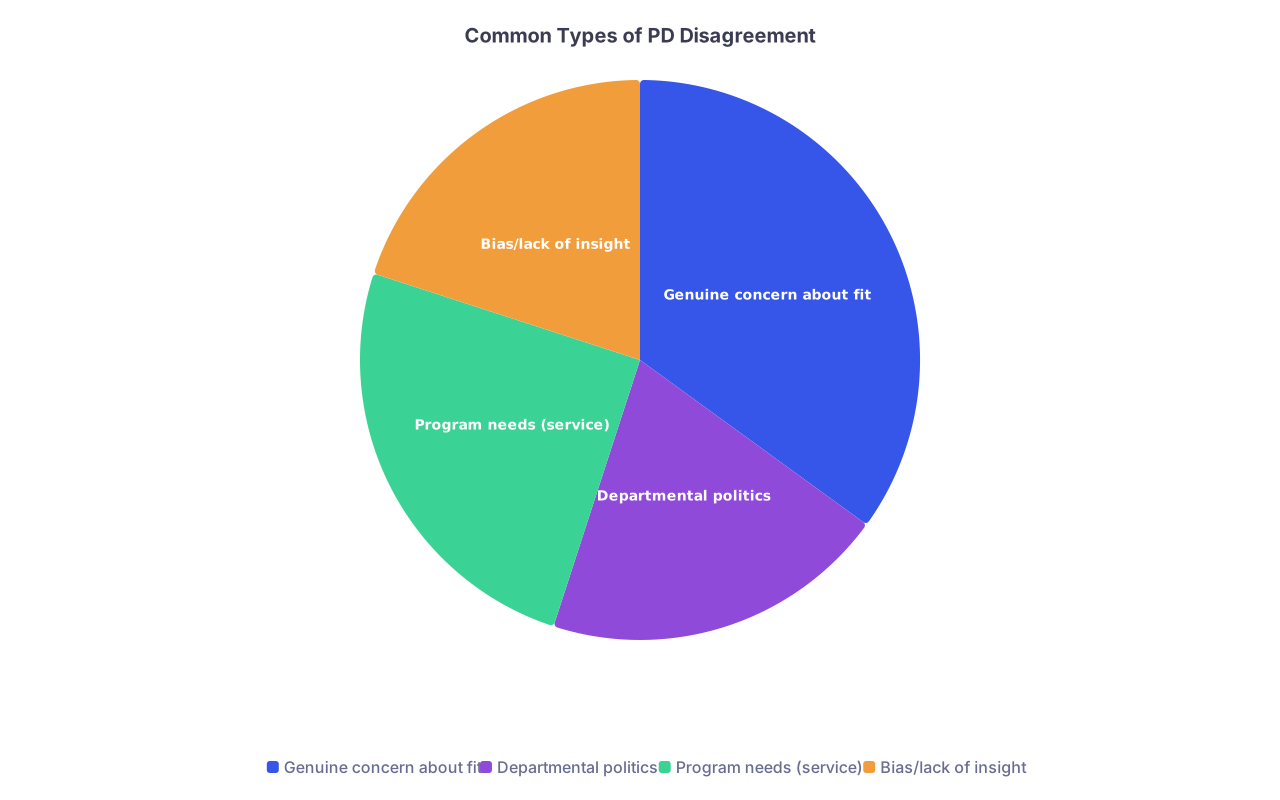
| Category | Value |
|---|---|
| Genuine concern about fit | 35 |
| Departmental politics | 20 |
| Program needs (service) | 25 |
| Bias/lack of insight | 20 |
I’ve seen four main flavors:
Genuine professional concern
- They’ve watched you on the wards and think your strengths don’t match your target field.
- Example: You want interventional cardiology but consistently struggle with procedures and time pressure; they see you shine in longitudinal care and communication.
- Usually comes with specific feedback: “You looked drained on heavy ICU weeks; I worry about you in a procedure-heavy, high-acuity subspecialty.”
Departmental or political reasons
- Your program “loses” residents to certain fellowships and they resent it.
- They want people to stay on as hospitalists or NPs/PA-heavy services need coverage.
- Comments sound like: “Our program is known for producing strong generalists” or “We really need people to stay as hospitalists here.”
Program service needs
- They’re short-staffed. They’re counting on you to be a chief, a hospitalist, or a facultyist.
- You’ll hear: “Have you considered being chief?” or “We’d really like you to stay here; you’d be a great leader on our general service.”
Bias or narrow vision
- They just don’t see people “like you” in that field (gender, race, personality, background).
- Or they only respect a different subspecialty and quietly look down on your choice.
- This surfaces as: “Most people in that field are very aggressive / cut-throat / research-heavy; that’s not really you,” without any real data behind it.
Your first job: figure out which bucket you’re in.
How to quickly test what’s really going on
Schedule one focused follow-up meeting. Go in with three questions:
- “Can you tell me specifically what you see as the main mismatch between me and this field?”
- “If I stayed on this path, what concrete things would I need to improve or demonstrate in the next 6–12 months to be a strong applicant?”
- “Are there fellowship paths in this field you’d feel more comfortable endorsing for me (e.g., different tier, different focus)?”
Their answers will tell you whether this is about:
- You (skills, judgment, professionalism)
- Them (program politics/bias)
- Or both
2. Decide: Are They Right, Half-Right, or Flat-Out Wrong?
You owe yourself one brutally honest self-audit. Not three months of spiraling. One focused week.

Step 1: Get data from people who aren’t your PD
Talk to:
- A subspecialist in your target field who actually knows you (attending, mentor, fellowship director)
- One co-resident who is blunt and not a people-pleaser
- One senior who matched (or tried to) in your target field
Ask them specifically:
- “You’ve seen me on X rotation. If I apply to [fellowship], what are my biggest strengths?”
- “What would be the top 2–3 weaknesses a PD there might flag?”
- “If you were in my shoes and my PD didn’t support my choice fully, would you still apply?”
If three independent people flag the same weakness, that’s signal. If your PD is the only one, that’s something else.
Step 2: Compare your profile to actual fellowship norms
Do not base decisions on vibes. Look at real data.
| Fellowship | Typical Step 2+ | Research Expectation | Letters Weight |
|---|---|---|---|
| Cards | 240+ | Strongly preferred | Critical |
| GI | 240+ | Strongly preferred | Critical |
| Heme/Onc | High 230s–240s | Strongly preferred | High |
| Pulm/CC | Mid 230s+ | Preferred | High |
| ID/Rheum/Endo | 220s–230s | Helpful | Moderate–High |
Then ask:
- Do your scores, evals, and research roughly fit?
- Are you missing something that’s fixable this year (research, letters, specific rotation)?
- Are you so far off that this cycle would basically be a lottery ticket?
This isn’t about perfection. It’s about being realistic about your trajectory.
Step 3: Make a decision
You end up in one of three lanes:
They’re mostly right
Your current profile makes that specific path very low yield this year.
Action: Adjust strategy (maybe 1-year hospitalist + research, different subspecialty, or broaden programs/tiers).They’re partially right
You have some gaps, but they’re fixable with targeted work and a smart list.
Action: Stay the course, but patch holes aggressively.They’re wrong or blocked by politics/bias
Your profile is competitive and multiple trusted people in the field agree.
Action: Prepare to apply anyway, but you’ll need to be tactical about letters and diplomacy.
The worst choice is “I don’t decide and just kind of apply and hope.” Do not do that.
3. The Conversation: How to Push Back Without Torching the Relationship
You’re not going to “win” an argument with your PD. You’re going to negotiate a working truce.
Here’s the move set.
Step 1: Reframe the discussion
Go back for a planned, short meeting. Say something like:
“Thank you for being honest with me about your concerns. I’ve thought a lot about what you said and talked with mentors in [target field]. I still feel strongly about pursuing [fellowship], and I’d like your help making this a successful and realistic process.”
Notice what you’re doing:
- Acknowledging their position
- Showing you didn’t just emotionally react
- Re-centering on: “I am doing this; let’s talk about how, not if”
Step 2: Ask for specific support, not philosophical approval
Three precise asks:
- “If I continue on this path, would you be willing to write a letter that is honest but supportive of my strengths?”
- “Are there particular rotations or attendings you’d recommend I work with to strengthen my application?”
- “Are there any concerns in my file I should proactively address in my personal statement or with program directors?”
If they hedge or say they “don’t feel comfortable” writing a strong letter, do NOT fight that. You just got valuable intel. A lukewarm or negative PD letter will hurt you more than not having one.
You then pivot:
“I appreciate your honesty. In that case, what would you be comfortable providing for my file—perhaps a neutral program verification or a brief summary of my training? I want to make sure I respect your position and also pursue the path I feel is right for me.”
You’re signaling you’re not backing down, but you’re not attacking them either.
4. Letters, Workarounds, and Damage Control
This is where strategy matters. Fellowship PDs care about:
- Your PD’s actual letter (if present)
- Subspecialty letters from their own people
- Patterns in your evaluations

| Step | Description |
|---|---|
| Step 1 | PD disagrees |
| Step 2 | Use PD letter as cornerstone |
| Step 3 | Minimize PD letter weight |
| Step 4 | Maximize subspecialty letters |
| Step 5 | Get chair or APD letter |
| Step 6 | Meet fellowship directors early |
| Step 7 | PD willing to write strong letter |
Scenario A: PD will write a “supportive but honest” letter
Good. You can work with that.
Your job:
- Give them a CV + bullet points of what you’ve actually done in the target field (rotations, research, QI, teaching).
- Ask them explicitly: “Is there anything you plan to include that you think I should be prepared to explain in interviews?”
- Accept that their letter might not be glowing, but if it’s not actively undermining you, you can offset it with strong subspecialty letters.
Scenario B: PD will only write a neutral or lukewarm letter
You need to build a different backbone for your app.
Priority:
2–3 very strong letters from subspecialty attendings
- People in your target field who have seen you on their service.
- Ideally at least one who is known in the fellowship world.
Chair or APD letter
- If your PD is blocking, sometimes the department chair or a different APD will quietly advocate if they believe in you.
- You do not go to them trashing your PD. You go with:
“Dr. X had some concerns about my fit for [field]. I’ve thought deeply about it and still feel committed to pursuing this path. You’ve worked with me in [context]; would you feel comfortable supporting my application with a letter?”
Early conversations with fellowship PDs where you’re applying
- Email: “I’m a PGY-3 at [program], very interested in [your program]. I’ll be rotating with you in [month] / visiting if possible, and would value your feedback on how to best prepare my application.”
- They’re adults. Many have seen strained PD–resident relationships before.
5. If Your PD Tries to Actively Block You
Sometimes it’s not subtle. You get:
- “I will not support you applying in that field.”
- “I cannot in good conscience recommend you for fellowship.”
- Or they refuse to send any letter at all.
This is ugly but not fatal.

Step 1: Protect yourself on paper
You need documentation. Not a novel. Just facts.
Send a brief follow-up email after the tough conversation:
“Thank you for meeting with me today to discuss fellowship plans. I understand from our conversation that you do not feel comfortable providing a strong letter of support for my application to [fellowship] this year due to concerns about [briefly summarize: clinical performance on X, professionalism during Y, etc.]. I appreciate your honesty and will work on these areas.”
Why? Because if later they say, “I fully supported them,” you have a paper trail showing otherwise. This matters if things escalate.
Step 2: Loop in other leadership strategically
Your next step is usually:
- An APD you trust
- The program ombudsperson (if you have one)
- Or the GME office, if this crosses into retaliation or abusive behavior
You’re not filing a lawsuit. You’re saying:
“I want to pursue [fellowship]. Dr. X does not support this and has stated they will not provide a strong letter. I’m concerned this may significantly limit my career options. I’d like guidance on how to proceed and whether there are alternatives for required program letters.”
Many institutions will allow:
- A department-level letter instead of a PD letter, or
- A combined letter from APDs/faculty who know you better
If your PD’s concerns are about genuine performance issues (probation, major professionalism events), that’s a different problem. You must stabilize that first.
6. Choosing Between Applying Now vs Delaying
Sometimes the smartest move is not, “Screw it, I’m applying anyway.” It’s, “I’ll apply next year on stronger footing.”
Here’s how I think about it:
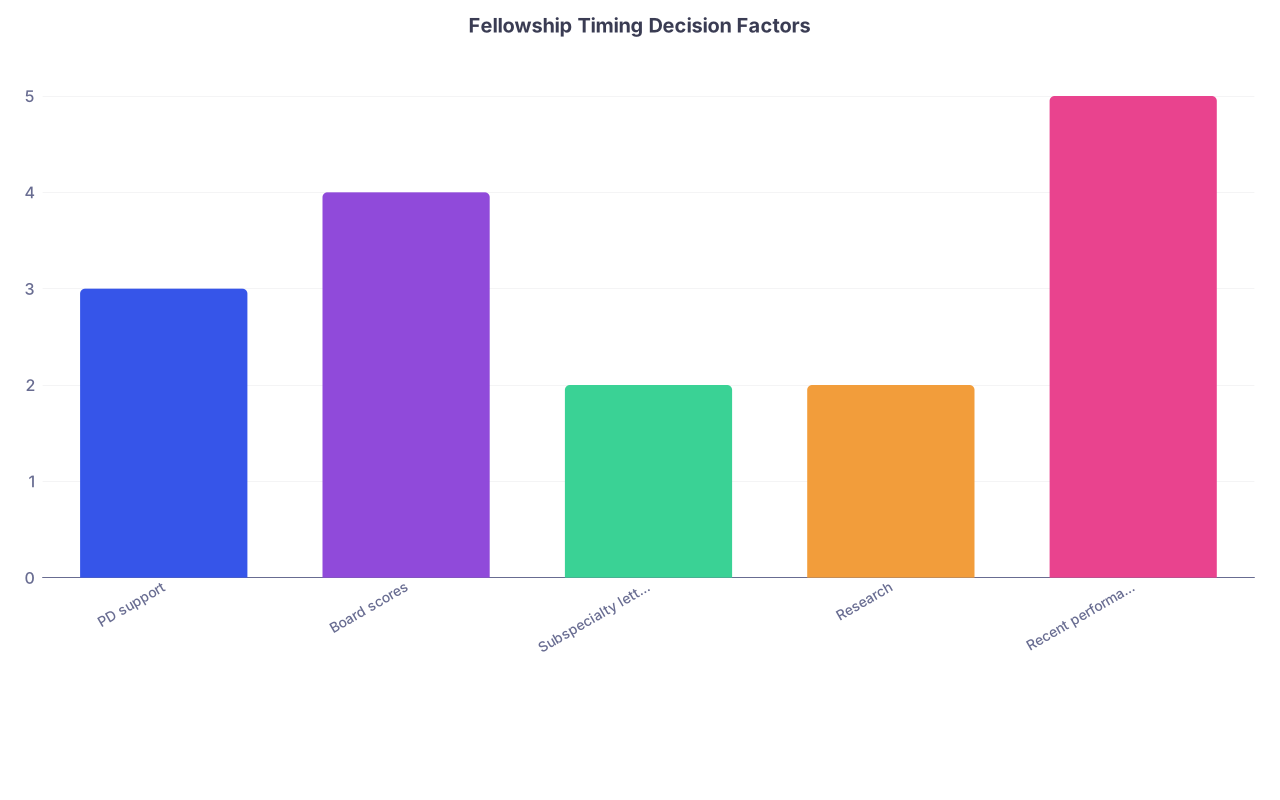
| Category | Value |
|---|---|
| PD support | 3 |
| Board scores | 4 |
| Subspecialty letters | 2 |
| Research | 2 |
| Recent performance issues | 5 |
(5 = major problem, 1 = no issue. If you’ve got multiple 4–5 scores, consider delaying.)
Delaying by 1 year makes sense if:
- You have fresh, significant negative events (probation, recent failing evals).
- You have essentially zero subspecialty exposure or research and are applying to a competitive field.
- Your PD is blocking you now but open to revisiting after demonstrated improvement.
What to do in that gap year:
- Work as a hospitalist or instructor in your target-heavy setting.
- Slam research or QI with someone in the field.
- Get new, strong letters that overshadow older doubts.
Fellowship PDs absolutely respect residents who course-correct, build a stronger record, and come back more competitive. I’ve seen people not match cards, spend a year as a cards hospitalist + echo research, then match solid programs the second time.
7. How to Survive Emotionally While All This Is Going On
This part gets ignored, but it’ll quietly wreck you if you let it.
Your PD is, in many ways, your “work parent.” Disapproval hits hard. There’s a temptation to:
- Ruminate daily
- Bad-mouth them to co-residents
- Spiral into “maybe I’m delusional”
Do not feed that.
Practical guardrails:
- Limit the mental time budget. Give yourself one specific evening a week where you think about strategy, tweak your plan, and talk to mentors. The rest of the week, you’re just executing.
- Pick exactly 1–2 people to vent to. Not the whole residency class. You don’t want your frustration turning into a residency-wide political drama.
- Keep your clinical performance boringly solid. Show up. Be on time. Do your notes. Answer pages. You’re building the record that future PDs will actually see.
You want your narrative to be: “Resident had some bumps, dealt with disagreement maturely, and still delivered good work.” Not “Resident went to war with their PD and got messy.”
8. Quick Scripts You Can Actually Use
You’re going to have to talk about this. A lot. To interviewers, mentors, maybe even your PD again.
Here are a few phrasing templates that keep you out of trouble:
To a mentor in your field: “Dr. X, my PD has expressed concern about my pursuing [fellowship], mostly around [specific issues]. I’ve thought about it and still feel this is the right field for me. You’ve seen me in [context]. Could we talk honestly about how you perceive my fit and what I need to strengthen before and during this application cycle?”
To your PD, if you decide to apply anyway: “I’ve reflected carefully on your feedback and I genuinely appreciate your honesty. After discussing with subspecialty mentors and reviewing my options, I’ve decided to move forward with applying to [fellowship] this cycle. I understand you may not feel comfortable writing a strongly endorsing letter, and I respect that. I hope we can still work together productively for the rest of my training.”
To a fellowship interviewer, if they probe: “My PD and I had some differences in perspective about my pursuing [field]. Their main concern was [concrete issue—e.g., wanting more research, or a desire for me to stay in generalist practice]. I took that seriously, worked on [specific steps], and asked for honest feedback from multiple mentors. Ultimately, I still believe [field] is the best fit for my skills and long-term goals, which is why I’m here.”
That’s it. No drama. No character assassination.
FAQs
1. Do fellowship programs secretly call my PD even if I do not submit their letter?
Yes, sometimes. Especially in smaller fields or when you’re coming from the same region. But the tone of those calls is often, “Anything I should know?” not “Tell me all the dirt.” If your PD is professionally neutral but not glowing, that’s not fatal. If they’re actively negative, that’s harder—but you can blunt it with strong subspecialty letters and a coherent story about growth, especially if the issues are older and you’ve clearly improved.
2. Should I ever switch my fellowship choice just to get my PD’s support?
If your PD’s concerns line up with your own doubts and what other mentors are saying, then yes, it might be smart to pivot or at least broaden your options. But changing purely to please them, when everything else (data, mentors, your own experience on rotations) points the other way? No. You’re the one living this career for 30 years, not them. Adjust tactics, not your entire trajectory, just for their comfort.
3. What if my PD is known to be difficult with everyone—not just me?
Then fellowship programs probably know that too. Every region has “that PD.” In this case, your best bet is to:
- Collect strong letters from people outside the PD.
- Have one senior faculty advocate for you who can quietly reassure fellowship PDs that you’re solid.
- Perform well on away rotations or subspecialty electives where new people can see your work directly. A great month on their turf can outweigh a cranky PD’s reputation.
4. Is it better to apply broadly with a weak PD letter, or wait a year for a stronger app?
If your PD letter is merely lukewarm and your overall application is otherwise reasonable, apply—just be realistic about tiers and cast a wide net. If your PD is actively negative, or your core application pieces (scores, evals, experience in the field) are far below typical for that specialty, I’d seriously consider waiting a year, building a new track record, and then coming back stronger. One strong, well-timed shot is better than burning your name into people’s memory as “the clearly not-ready applicant.”
Open a blank document right now and write three bullet points:
- What your PD said about your fellowship choice,
- What you actually want long-term (not just next year), and
- The one concrete thing you’ll do this month to move your application closer to that goal—whether your PD likes it or not.