The biggest mistake residents make when their home program lacks a relevant fellowship is waiting and hoping someone else will solve it for them. No one is coming. You have to build your own ecosystem.
You can match into a strong fellowship without a home program in your specialty. I have seen residents from tiny community programs land GI, cards, heme/onc, even peds subspecialties. But they did it by engineering opportunities, not by complaining about what their program does not have.
Here is how you do the same.
Step 1: Get Completely Clear on Your Starting Position
Before you start emailing national leaders, you need a brutally honest inventory of what you have and what you lack.
Ask yourself:
- What exact fellowship are you targeting? (e.g., GI vs advanced endoscopy; cards vs EP; heme/onc vs benign heme focus)
- What does your program actually lack?
- No fellowship at all?
- A different fellowship (e.g., strong nephrology but you want cards)?
- Very limited subspecialty faculty (e.g., one part‑time GI doc)?
- What are your current objective metrics?
- USMLE/COMLEX scores
- Class rank / AOA / awards
- Publications / abstracts / posters
- What constraints do you have?
- Geographic (partner, kids, visa)
- Financial (cannot travel to 15 away electives)
- Time (heavy call schedule limiting research time)
Write this out. Literally one page.
Then compare what you have to what typical matched fellows in your target specialty look like.
| Fellowship | Typical Step 2 CK | Publications by Match | Research Type |
|---|---|---|---|
| Cardiology | 240–250+ | 1–3 | QI or clinical |
| GI | 240–250+ | 2–4 | Retrospective, case |
| Heme/Onc | 235–245 | 2–5 | Retrospective, trials |
| Pulm/CC | 235–245 | 1–3 | QI, clinical |
These are not hard cutoffs, but they are reality checks. If you are far below, your strategy must be more aggressive and more carefully executed.
Your diagnosis here drives your treatment plan. Without it you are just throwing emails at attendings and hoping something sticks.
Step 2: Build a “Virtual Home Program” Around Yourself
If your institution does not have your fellowship, you must manufacture the next best thing: a functional equivalent.
You need three things:
- Specialty mentorship
- Specialty exposure
- Specialty‑relevant output (letters, research, leadership)
You will not get them handed to you. So you build.
2.1. Identify All Available In‑House Resources (Even If They Look Weak)
Residents often say, “We have no GI” when what they mean is “We have one GI doc who mostly does endoscopy and is not academic.” That is still an asset.
Do this:
- Pull your hospital’s medical staff directory.
- Filter by:
- Your target specialty (or closely adjacent subspecialty)
- Any faculty who did fellowship in your target field, even if they now practice general
- List:
- Training background (look up their fellowship institution)
- Academic roles (program director, site director, QI lead)
- Any publications in the last 5–10 years
Then set up quick 20–30 minute meetings (in person if possible, Zoom if needed) with each potential ally.
Script you can use:
“I am a PGY-2 in internal medicine interested in pursuing gastroenterology fellowship. Our institution does not have a GI fellowship, so I am working to build a strong application through external mentorship, research, and electives. I would be grateful for 20–30 minutes of your time to get your advice and to see if there might be ways I can contribute to projects or QI in your area.”
Do not ask vaguely for “mentorship.” Ask for advice and concrete ways to be useful.
2.2. Recruit an External Fellowship Mentor
You also need someone who lives in the fellowship world.
Targets:
- Alumni from your residency now in that fellowship or working as attendings
- Former fellows who rotated at your site
- Faculty at institutions where you plan to do away electives
- People from conferences / virtual didactics
Approach strategy:
- Get warm introductions when possible.
- Ask your PD: “Do we have former residents in GI / cards / onc I can speak with?”
- Where you cannot, use a focused cold email.
Structured cold email (short, not a life story):
Subject: IM PGY-2 from [Your Program] seeking GI fellowship guidance
Dear Dr. [Name],
I am a PGY-2 in internal medicine at [Hospital/Program], aiming for a gastroenterology fellowship. Our program does not have a GI fellowship, so I am trying to be deliberate about building mentorship, research, and clinical exposure in GI.
I read your [paper / profile / talk] on [specific topic] and was particularly interested in [1 sentence of substance]. Would you be open to a brief 15–20 minute call in the next few weeks? I would value your perspective on how residents from non‑GI programs can become competitive applicants, and would be glad to help with any ongoing projects where an extra pair of hands might be useful.
Sincerely,
[Name, PGY level, Program, contact info]
You will get a low response rate. That is normal. Send many of these, targeted, over several weeks.
You are trying to build a small “advisory board” of 2–3 people in your field who can:
- Sanity check your plan
- Connect you to projects
- Later, write a meaningful letter
Step 3: Engineer Fellowship‑Level Clinical Exposure
Programs know not every residency has every fellowship. They do not expect you to have a home fellowship. They do expect you to show that you sought serious exposure.
You cannot fix the fact that your hospital does not run a transplant service. You can fix whether your ERAS looks like you did anything about it.
3.1. Maximize What Exists Locally
Pull your rotation schedule and identify:
- Any subspecialty rotations even tangentially related:
- For cards: CCU, step‑down, echo lab, EP lab access, stress testing, vascular lab
- For GI: hepatology clinic, IBD clinic, endoscopy days, inpatient consult service
- For heme/onc: infusion center, inpatient malignant heme, transplant co‑management
- Any elective time that is not already pre‑allocated
Concrete moves:
- Stack subspecialty blocks: Instead of two scattered weeks, push for 4 weeks contiguous. You learn more. You also spend more time with one attending who may later write your letter.
- Volunteer for off‑the‑books days:
- Show up to endoscopy or cath lab on your golden weekends occasionally (not every weekend; do not burn out).
- Tell the attending: “I want to see more of X because I am going into this field.”
Your goal: by the time you apply, you can honestly say you spent substantial, repeated time in that subspecialty, not just a single PGY‑1 block.
3.2. Use Away Electives Intelligently, Not Desperately
Away rotations are expensive and often overhyped. But for residents without a home fellowship, one or two very targeted away electives can be game‑changing.
Your priority ranking:
- Programs where grads from your residency have previously matched
They are already convinced your training is adequate. - Mid‑tier academic programs that actually read applications
Not just “big brand names” where you will be the tenth rotating resident. - Geographic areas you realistically want to match in
Regional familiarity matters more than people admit.
Your away elective should be:
- On a busy service (not just outpatient shadowing)
- With faculty who publish and write letters regularly
- Timed before applications if possible (early PGY‑3), or at least before interview offers ramp up
Make your goal explicit:
“I want to work hard on this rotation and learn as much as possible. I am also hoping to show that residents from non‑GI programs can contribute at the level needed for fellowship.”
If they are impressed, they will often offer to support your application.
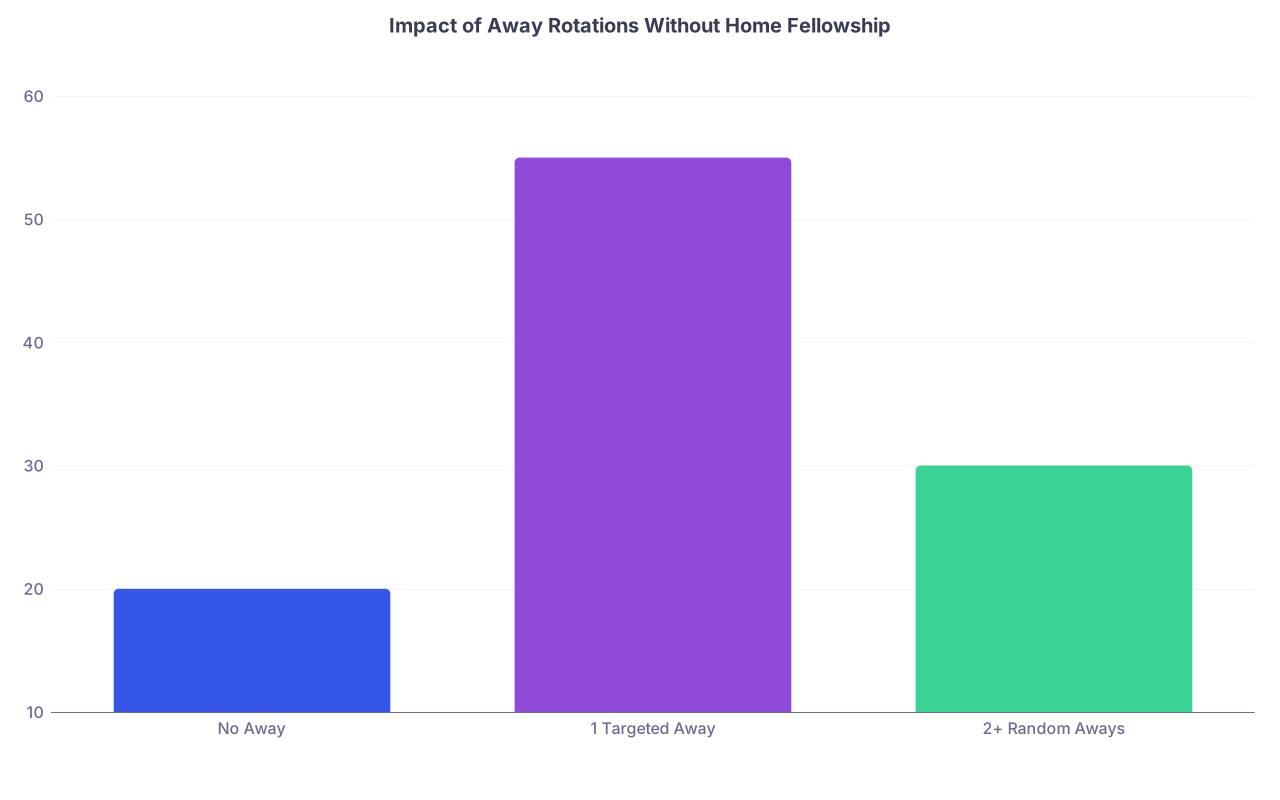
| Category | Value |
|---|---|
| No Away | 20 |
| 1 Targeted Away | 55 |
| 2+ Random Aways | 30 |
(Think of those values as “relative chance of a strong external letter,” not exact percentages. One focused away is usually better than several scattered ones.)
Step 4: Manufacture Research and Scholarly Output Without Built‑In Pipelines
This is where many “no‑home‑fellowship” residents fall behind. They assume that because there is no research machine, there is no path. That is wrong. The path is just more manual.
You do not need R01‑level output. You need credible, completed projects that show discipline and curiosity and connect you to letter writers in your field.
4.1. Start with Fast‑Cycle, High‑Yield Projects
You have limited time. Pick work that can realistically produce something by the time you apply.
Best options:
- Case reports and case series in your target field
- Retrospective chart reviews on:
- Common syndromes in your hospital
- Procedures or interventions relevant to your fellowship
- Quality improvement projects that:
- Have measurable outcomes
- Are presented at institutional or regional conferences
The formula:
- Identify 2–3 attendings with any research bent.
- Ask each: “Do you have small projects that need help finishing?”
- Accept that your first few contributions may be middle authorships or posters. That is fine.
4.2. Partner with External Investigators
If your hospital is not research‑heavy, piggyback on someone else’s infrastructure.
Options:
- Academic center nearby (drive 30–60 minutes once per week)
- Remote data work for a research group at another institution
- Multi‑center registries looking for sites
Your pitch to external investigators:
“I am a medicine resident at a non‑academic hospital with a strong interest in cardiology. We see a high volume of [condition relevant to their work]. I can screen charts, extract data, and help manage the database if you have projects that need additional manpower. Authorship is nice but my primary goal is to contribute and learn how you structure your studies.”
You are selling two things: your time and your population.
Make sure:
- You have confirmation that authorship is on the table if you do substantive work.
- You track what you have done (so it shows up on your CV accurately).
4.3. Be Strategic About Where You Present
Posters at giant national meetings are nice for your selfie, not as necessary for your CV. You want:
- One or two national or major regional presentations in your field
- A few institutional talks that show leadership and teaching
Apply to:
- Your field’s main conference (e.g., ACG, AHA, ASH)
- Subspecialty society meetings
- Regional American College of Physicians or similar
This gives you CV lines that look like you came from a place that takes scholarship seriously, even if you had to bootstrap all of it.
Step 5: Construct Letters of Recommendation That Compensate for No Home Fellowship
Letters are where not having a home fellowship can either hurt you or become almost irrelevant. The key is balance and specificity.
You need:
- 1 letter from your residency program director
- 1–2 letters from core residency faculty who know your clinical work well
- 1–2 letters from subspecialty faculty in your target fellowship, ideally:
- One from your own institution
- One from an away elective or external research mentor
5.1. Make It Easy for Them to Write a Fellowship‑Level Letter
Before you ask, prepare a concise packet:
- Updated CV
- One‑page “fellowship summary”:
- Why this field
- Specific career goals (even if they evolve later)
- Bullet list: “Things I hope you might be able to comment on”
- Draft of your personal statement if you have it
When asking, be direct:
“I am applying for GI fellowship this cycle and would be honored if you could write a strong letter of recommendation on my behalf. I am particularly hoping for comments on my clinical reasoning, work ethic, and ability to function at a GI fellow level during our time together.”
You are inviting them to decline if they cannot be strong. That is good. A lukewarm letter from a big‑name person can absolutely sink you.
5.2. Address the Lack of Home Fellowship Explicitly When Useful
Your PD or a senior faculty member can sometimes defuse concerns:
“While our institution does not have an in‑house cardiology fellowship, we see a high acuity of cardiac illness and Dr. X has proactively sought advanced exposure including an away rotation at [Program] and involvement in ongoing cardiology research projects.”
This reminds programs: the limitation is institutional, not personal. And that you did something about it.
Step 6: Be Ruthlessly Smart About Program Signaling and Targeting
When you come from a non‑home‑fellowship program, you have less margin for random scattershot applications. Your application must scream “deliberate.”
6.1. Build Three Tiers of Fellowship Programs
Use a simple tiered strategy:
- Tier 1 – Reach
Top academic programs, top names, or highly competitive locations. - Tier 2 – Realistic
Solid academic or hybrid programs with a history of taking residents from community or mid‑tier residencies. - Tier 3 – Safety
Newer programs, smaller programs, locations that are less popular but still provide solid training.
You can keep this simple in a table.
| Tier | Program Type | # Programs |
|---|---|---|
| 1 | Big-name academic, top cities | 8–10 |
| 2 | Mid-tier academic / hybrids | 15–25 |
| 3 | Smaller / newer / geographic | 10–15 |
Your personal distribution will depend on your metrics, but the pattern stands: a core of realistic programs with some reach and some safety.
6.2. Use Signals and Contact Wisely
If your specialty uses formal signaling (like preference signals), do not waste them on your wildest reaches. Use them on:
- Programs that have:
- Taken residents from similar backgrounds
- Faculty with whom you already have some connection
- Places where you did:
- Away electives
- Research collaborations
For direct contact:
- Send one concise interest email to a handful of programs where:
- You have a genuine reason for interest
- You can mention specific ties (project, mentor, rotation, geography)
Do not spam 50 program directors.
Step 7: Frame Your Story Correctly in Personal Statement and Interviews
Programs know which residencies have which fellowships. They also know when a resident used that as an excuse.
You want your narrative to sound like this:
- “I recognized early that my program does not have a GI fellowship. So I did X, Y, and Z to get the exposure and mentorship I needed.”
Not this:
- “I am at a disadvantage because my program does not have a GI fellowship.”
7.1. In Your Personal Statement
Hit three points clearly:
- Origin of interest – real cases, moments, not “I like procedures.”
- Deliberate steps you took despite structural limitations
- Subspecialty rotations
- Away elective(s)
- Research or QI
- Where you are headed – what kind of fellow and attending you aim to be.
One clean sentence to address the elephant:
“Although my residency program does not have an in‑house GI fellowship, that gap pushed me to seek mentorship and experience across institutions, which has made me more intentional and proactive about my training.”
Short. Non‑defensive. Clear.
7.2. In Interviews
You will be asked one of:
- “Tell me about your residency program.”
- “How did you get exposure to GI / cards / oncology without a home fellowship?”
Your answer structure:
- Briefly describe your program’s strengths:
- “High volume of X”
- “Strong inpatient exposure”
- Then: how you compensated for the missing fellowship:
- “Because we do not have a fellowship in Y, I arranged Z.”
- End with how that made you better prepared:
- “I had to seek and coordinate these experiences myself, which translates into how I will approach fellowship.”
You are turning a liability into an example of initiative.
Step 8: Manage Time, Burnout, and Politics So You Do Not Self‑Destruct
Here is the part no one likes to say out loud: building your own “home program” is extra work. On top of 70‑hour weeks. You must be strategic or you will flame out.
8.1. Time‑Box the Hustle
Give yourself specific windows:
- “These 4 months I will focus on:
- Launching 1–2 research projects
- Nailing a subspecialty rotation
- Drafting personal statement
- Contacting 3–4 external mentors”
Use a simple weekly structure:
- 1 evening per week – research tasks (data collection, writing)
- 1 shorter block (post‑call afternoon) – emails, planning, CV updates
- Weekends – protected for rest unless there is a critical deadline
You are not a machine. If you treat yourself like one, your application will show it.
8.2. Handle Local Politics Tactfully
Some chiefs or attendings will not understand why you are so “focused on fellowship.” They may interpret away electives and external research as lack of commitment to the residency.
You should:
Loop your PD in early:
“I am strongly interested in XYZ fellowship. Our program does not have one, so I will likely need an away rotation and external research. I want to make sure we plan this in a way that does not hurt service coverage.”Be visibly reliable on the wards:
No one will support your fellowship dreams if you are known as “the person always trying to leave for some GI thing.”Be transparent about schedule asks:
- “I am requesting an away elective in Sept–Oct PGY‑3. I am flexible about which month works best with service needs.”
Most PDs want their residents to succeed. They just do not want their program to implode in the process. Make it clear you understand both sides.
Step 9: Contingency Planning If You Do Not Match the First Time
You might do everything right and still not match. It happens. Especially in ultra‑competitive fields like GI and cards.
Not matching is not the end of the story. It is a data point.
If that happens:
- Get real feedback.
- Ask your mentors and, if possible, a few PDs: “If you were me, what would you change in my application?”
- Decide on a focused gap strategy, not a vague ‘I will reapply.’
Typical high‑yield gap year moves:
- Non‑ACGME clinical fellowship or hospitalist with:
- Heavy exposure to your target field
- Built‑in research time
- Dedicated research year at an academic center in your specialty
- New degree or advanced training only if tightly relevant (e.g., clinical research certificate with heavy publication output, not random MPH with no deliverables)
Map it as a one‑page plan with:
- Specific institution
- Supervisor
- Expected output (X papers, Y abstracts, Z letters)
- Clear reapplication cycle timeline
Do not simply “work as a hospitalist and hope.” That is not a plan.
Visualizing the Overall Strategy
Here is what your path essentially looks like.

| Step | Description |
|---|---|
| Step 1 | Realistic self assessment |
| Step 2 | Build mentors |
| Step 3 | Maximize local subspecialty exposure |
| Step 4 | Plan targeted away elective |
| Step 5 | Start high yield research |
| Step 6 | Secure strong letters |
| Step 7 | Apply strategically |
| Step 8 | Start fellowship |
| Step 9 | Gap year plan |
| Step 10 | Match? |
This is not theoretical. Residents follow exactly this kind of loop every year and succeed.
A Quick Reality Check
You are up against applicants who:
- Train in large academic centers with that exact fellowship.
- Have built‑in division mentorship.
- Collect three subspecialty letters by default.
You do not have those structural advantages. You have two options:
- Complain and treat it as an excuse.
- Treat it as a design problem and build your own structure.
I recommend the second.
Your Concrete Next Step (Do This Today)
Do not try to “remember” this plan. Put it into motion.
Today, not next month:
- Open a blank document and title it:
“[Your Name] – [Target Fellowship] Strategy” - Create three sections:
- Mentors
- Clinical exposure
- Research / scholarly output
- Under each, write:
- What you currently have (names, rotations, projects)
- The one next action you will take this week (email a potential mentor, ask PD about away options, identify a case for a report).
Then actually send that first email or schedule that first meeting before you go to sleep.
One small, deliberate action today is how you stop being “the resident whose home program has no fellowship” and start being “the resident who built their own path into fellowship.”