

You decided on fellowship “late.” The system is not built for you—and you can still absolutely win.
The myth is that if you do not call your shot PGY-1, you are behind forever. I have watched residents match cardiology, GI, heme/onc, critical care, palliative, even super-competitive fellowships after deciding as late as mid‑PGY-2. The ones who failed did not fail because they were late. They failed because they kept their original elective schedule and tried to “talk” their way into competitiveness.
You do not talk your way into a fellowship. You schedule your way into it.
This is about how to tear up your current plan, rebuild your elective calendar, and create enough signal—clinical, research, and networking—to make you a serious candidate in a compressed timeline.
Step 1: Get Clear on Your New Target and Your Time Window
Before you touch the schedule, you need two things on paper:
- Which fellowship?
- When is your application cycle? (And therefore, how many months you have.)
For most 3-year IM residencies in the US:
- You apply for fellowship at the end of PGY-2 (ERAS opens around July).
- That means your “build” window is:
- Late PGY-1
- All of PGY-2
- Early PGY-3 only helps for late letters or backup plans.
If you are a PGY-2 right now realizing you want, say, cardiology, your problem is straightforward: can you generate enough targeted exposure, letters, and a small amount of scholarship in the next 6–12 months?
Start with a brutally honest inventory:
- Current PGY year and month.
- Electives already completed.
- Electives already scheduled (and how movable they are).
- Your current research output (if any).
- Mentors in the new field (often zero; that is fine).
Write it down. Not in your head.
Now define the core requirements for your target fellowship. They vary, but there is a general pattern.
| Fellowship | Core Clinical Signal | Research Weight | Procedural/Skill Signal |
|---|---|---|---|
| Cardiology | Cardiology consults, CCU | High | Echo, ICU exposure |
| GI | GI consults, hepatology | High | Endoscopy exposure |
| Heme/Onc | Heme/Onc inpatient/clinic | High | Clinical trials, QI |
| Pulm/CC | MICU, Pulm consults | Moderate-High | Vent mgmt, bronchoscopy |
| ID | ID consults | Moderate | Complex inpatient cases |
You are trying to answer:
“Given when I apply, what must I accomplish before letters are written?”
That falls into four buckets:
- Enough relevant clinical work that your interest is credible.
- At least 2 letters from faculty in that fellowship’s domain.
- Some scholarly or QI work with their names on it.
- Enough face time with the division so someone says in conference, “Yes, I know them—they’re solid.”
Your redesigned electives exist to feed those four outcomes. Nothing else.
Step 2: Map Backwards From Application to Elective Slots
You redesign by starting at the end and walking backwards.
You submit your fellowship application around June–July of the year before fellowship start.
Work backwards:
April–June (just before applications):
- Ideal for a high-impact elective where your performance is fresh in attendings’ minds.
- Also the last push to finalize abstracts, posters, or manuscripts.
January–March:
- Core “anchor” elective blocks in the target field.
- Prime time to prove yourself and secure commitments for letters.
6–12 months before application:
- Launch research or QI projects.
- Arrange your first specialty-specific electives and clinics.
- Start showing up at division conferences and grand rounds.
So your mental template for the year should look like this:
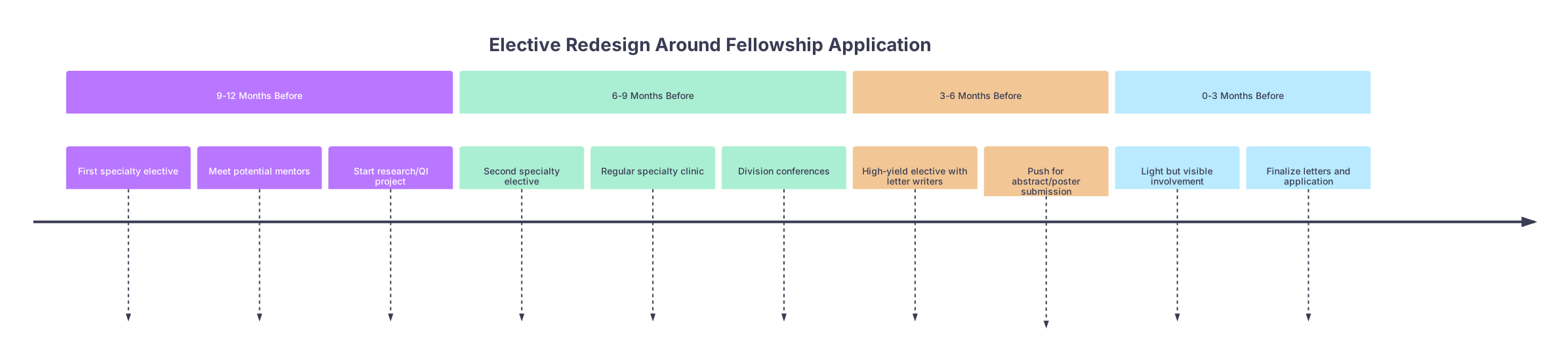
Once that scaffold is in place, you start plugging in real rotations.
Step 3: Identify and Prioritize High-Yield Electives
Not all electives are equal. A late fellowship decision means you cannot afford “tourist” rotations that look fun but do nothing for your application.
You want three categories:
- Direct specialty electives in your target field.
- Adjacent or feeder electives that strengthen your profile.
- Productive research/QI time with actual deliverables.
1. Direct specialty electives
These are your non-negotiables. Examples:
- Cardiology consults, CCU, outpatient cardiology clinic.
- GI consults, hepatology clinic, advanced endoscopy exposure.
- Heme/Onc inpatient service, infusion center, cancer center clinics.
- MICU plus dedicated pulmonary consults or clinic for Pulm/CC.
Priority rules:
- Aim for at least two blocks in the exact field before application.
- At least one of those blocks should be within 3–6 months of letter-writing.
- During those blocks you are “on stage” at all times. You are auditioning, not just rotating.
2. Adjacent / feeder electives
These round out your narrative and show depth. Examples:
- For Cardiology:
- MICU, ED, vascular medicine, cardiac imaging.
- For GI:
- Hepatology, inpatient liver transplant service, nutrition.
- For Heme/Onc:
- Palliative care, bone marrow transplant, hospitalist oncology.
- For Pulm/CC:
- Anesthesia (airway/vent basics), ED, sleep medicine.
These electives are still useful even if you are a bit earlier in training because they:
- Generate cases you can discuss in interviews.
- Show a consistent trajectory toward the specialty.
- Expose you to more potential letter writers who overlap with the division.
3. Research / QI electives that actually produce
This is where many residents waste time. “Research elective” with no project and no supervisor is just an unofficial vacation. You do not have that luxury.
You need:
- A named mentor in the fellowship’s division.
- A specific project that can generate:
- Abstract or poster within 6–9 months.
- Ideally a manuscript in progress by application time.
- Clear expectations: weekly check-ins, deliverables.
Think small and fast:
- Retrospective chart reviews using existing databases.
- Case series, single impactful case report (only if truly unique).
- QI project with measurable outcome and a presentation locally.
Do not chase huge multi-year trials. You are late. You need visible output, not theoretical prestige.
Step 4: Audit Your Current Schedule and Create a “Salvage Plan”
Now you put your current calendar next to what you should have.
Let’s run two concrete scenarios.
Scenario A: PGY-2, just decided on Cardiology in September
Your current PGY-2 plan (example):
- Sep: Nephrology consults
- Oct: Night float
- Nov: Clinic + admin
- Dec: Research (non-cardiology project)
- Jan: Endocrine
- Feb: ICU
- Mar: Elective (open)
- Apr: Geriatrics
- May: Infectious Disease
- Jun: Vacation + wards
You apply for cardiology in July.
Problems:
- Zero cardiology electives before application.
- Your only research is off-topic.
- No obvious cardiology letter writer.
Your salvage plan should target:
- 2 cardiology-heavy months (consults + CCU/clinic) between now and May.
- 1 research/QI month specifically under a cardiologist.
- Protecting your ICU month (good for cards) and maybe repurposing another.
Revised plan (targeted):
- Sep: Keep Nephrology (cardiorenal overlap, fine).
- Oct: Night float (not movable, live with it).
- Nov: Swap Clinic/admin → Cardiology consults.
- Dec: Change non-cardiology research → Cardiology research elective.
- Jan: Swap Endocrine → Cardiology/CCU.
- Feb: ICU (keep, lean into vent/heart failure patients).
- Mar: Elective → Outpatient Cardiology clinic + imaging (if possible).
- Apr: Geriatrics (ask for more HF and AF patients in clinic).
- May: Infectious Disease (fine, but optionally try for Pulm/ID overlap).
- Jun: Leave as is.
Now every single month from November through March feeds your story.
Scenario B: PGY-1, decided on Heme/Onc in April
Good news: you have more time. You are not late; you are “normal but need to be intentional.”
Your moves:
- Ensure at least two Heme/Onc rotations in PGY-2:
- One early (fall/winter) to confirm interest and find mentor.
- One later (spring) to lock in letters.
- Build in:
- 1–2 research/QI blocks dedicated to Heme/Onc.
- Palliative care, inpatient oncology, BMT as adjacent electives.
- Regular oncology clinic one half-day per week if your program allows longitudinal clinics.
Step 5: Renegotiate With Your Program—The Right Way
Too many residents approach scheduling like they are begging for favors. You are not. You are presenting a professional development plan that also benefits the program.
Your goals in these conversations:
- Show that this is a thoughtful, aligned career step.
- Demonstrate flexibility—you are not asking to blow up the whole schedule.
- Rewrite specific blocks with clear justification.
First, know who actually controls what:
- Chief residents typically manage the day-to-day schedule and elective swaps.
- Program director (PD) approves big-picture changes and sign-offs.
- Mentor or Associate PD can advocate for you.
You approach this in order:
Do your homework first.
Talk quietly with fellows or senior residents:- Which months are traditionally lighter?
- Which electives swap easily?
- Which attendings love having fellowship-bound residents?
Draft a concrete proposal.
Not “I want more cardiology.”
Instead:- “I would like to change my December research elective to Cardiology research under Dr. X, and move my Endocrine elective in January to a Cardiology/CCU block if available.”
Email the chiefs and PD with a short, focused message.
Something like:I have decided to pursue cardiology fellowship and would like to adjust my electives this year to better support that goal. I have spoken with Dr. X in Cardiology, who is willing to supervise a research elective in December and have me on the cardiology consult service in January if feasible.
Specifically, I am requesting:
• Change December “Research – General Med” to “Research – Cardiology with Dr. X.”
• Swap my January Endocrine elective for Cardiology/CCU if there is space.I will keep my night float, ICU, and ward assignments unchanged. Happy to discuss alternate months if those are full.
Program leadership likes specificity and flexibility.
- Accept that you will not get everything you ask for.
That is fine. Two high-yield changes can change your trajectory.
Step 6: Design Each Elective to Maximize Fellowship Signal
Securing the right elective is step one. Step two is not wasting it.
During each targeted elective, you should be working on 4 parallel tracks:
- Clinical excellence.
- Relationship-building for letters.
- Scholarship/QI.
- Visibility in the division.
1. Clinical: behave like a junior fellow
Do not act like “a resident who is interested.” Act like “a future fellow in training.”
That means:
- Pre-rounding and reading guidelines relevant to cases you are seeing.
- Volunteering for complex pathologies, not avoiding them.
- Owning follow-up: out-of-hospital labs, imaging, continuity.
The hidden rule: attendings only write strong letters for residents they would trust on their team at 2 a.m.
2. Relationship-building for letters
You need names, not “the department.” Aim for:
- 1 strong letter from a division faculty who directly supervised you.
- 1 from another specialist in that field or closely allied (e.g., MICU attending for Pulm/CC).
- 1 from core IM faculty/PD backing your overall performance.
During the elective:
- Ask for mid-rotation feedback. Let them see your growth.
- State your goal explicitly: “I am planning to apply for cardiology fellowship this coming cycle.”
- Near the end, ask directly:
“Based on our time working together, would you feel comfortable writing me a strong letter for cardiology fellowship?”
If they hesitate, you have your answer: you need additional letter writers.
3. Scholarship/QI: hook a project early in the rotation
On day 1–3 of a targeted elective, ask:
“Are there ongoing projects or QI efforts that I could plug into during this month? I am trying to have something submitted by spring for my fellowship applications.”
You are fishing for:
- A retrospective chart review where you can help with data collection or initial analysis.
- A case series where you do the heavy lifting on writing.
- A local QI project where you can lead an intervention or data review.
Then you protect time:
- Block 2–4 hours per week, calendar it, and treat it like a clinical shift.
- Send weekly progress emails to maintain accountability.
4. Division visibility: show up beyond your rotation
You want people in the division to say, “Oh yes, I have seen them around.”
Tactics:
- Attend every relevant conference during your rotation month.
- Continue dropping into grand rounds or journal club after the month ends.
- If you present a case or a short talk, ask if you can attach your name to the conference schedule email. Small thing, but it signals involvement.
Step 7: Integrate Longitudinal Elements Outside Electives
Your elective calendar is powerful, but not sufficient. You also need habits that run in the background.
Longitudinal clinic
If your program allows you to shape your continuity clinic:
- Shift at least part of it toward your fellowship interest:
- Cardiology: HF clinic, lipid or hypertension clinic if cardiology clinic is unavailable.
- Heme/Onc: survivorship clinic, benign heme.
- Pulm/CC: COPD/asthma or post-ICU follow-up.
Conferences and teaching
Pick one or two recurring commitments:
- Fellow/faculty case conference.
- Tumor board.
- Cath conference, echo conference, ICU M&M.
Show up. Every time. Even on ward months when you can afford it.
This does two things:
- Keeps you clinically sharp in the field.
- Makes you a known quantity to the people who will be ranking you.
Off-service months: align your learning
When you are stuck in rotations unrelated to your fellowship (e.g., Rheum while aiming for Cards):
- Frame your cases mentally in ways that intersect with your specialty:
- On Rheum: vasculitis with cardiac involvement, pericarditis, etc.
- On ID: endocarditis, immunosuppressed oncology patients.
- Save interesting cases that cross boundaries; these make strong interview stories.
Step 8: Use Data to Track Your Progress
You are compressing 2–3 years of “signal” into a shorter runway. Treat this like a project, not vibes.
Create a simple tracking sheet:
| Domain | Target | Current Status |
|---|---|---|
| Core electives | 2 specialty blocks pre-ERAS | 1 scheduled, 1 pending approval |
| Adjacent | 2–3 related electives | 1 ICU done, 1 Palliative planned |
| Research/QI | 1 abstract, 1 manuscript in progress | Retrospective study started |
| Letters | 3 strong letters confirmed | 1 yes, 1 likely, 1 TBD |
| Visibility | 1 presentation, regular conf | Attending weekly case conference |
Review monthly. If you are not moving, you change something—another elective swap, another project, another conversation with mentors.
To see how often residents “cram” this work into the last year, and why you must be intentional, look at a simple time distribution:
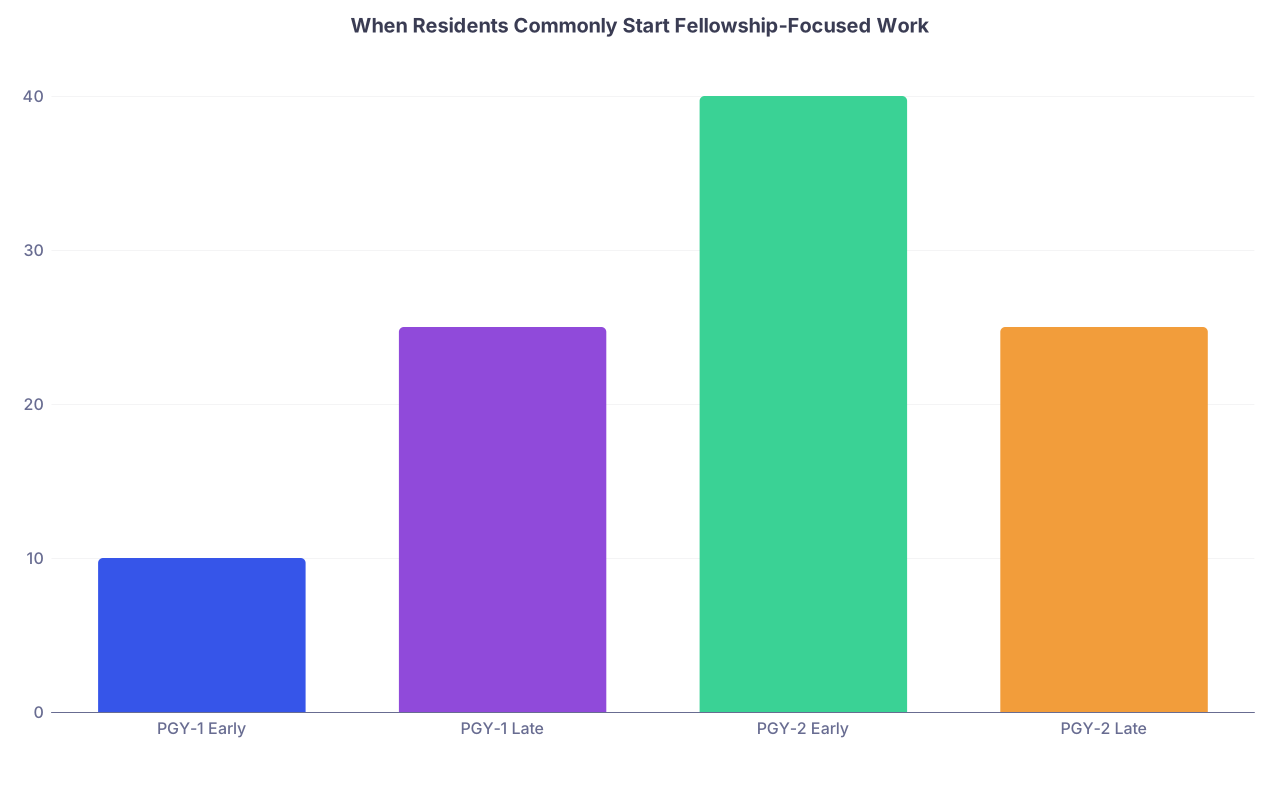
| Category | Value |
|---|---|
| PGY-1 Early | 10 |
| PGY-1 Late | 25 |
| PGY-2 Early | 40 |
| PGY-2 Late | 25 |
Most real momentum happens PGY-2. You are not alone in being “late.” You are only behind if you act like a PGY-1 who still thinks electives are for exploration.
Step 9: Fix Common Failure Patterns
Let me call out the mistakes I see repeatedly. If you avoid these, you already improved your odds.
Failure Pattern 1: “I’ll just say I am interested and that will be enough”
Programs hear “I am very interested in cardiology” 500 times a year. They believe:
- Elective choices.
- Project titles.
- Who wrote your letters.
- How long you have been showing up at their conferences.
Solve it:
- Align your schedule and CV so your story is obvious without explanation.
Failure Pattern 2: Waiting for the perfect research project
Residents get paralyzed chasing “big name” projects. Then it is March, and they have nothing to show.
Solve it:
- Start something small but real now.
- If a better project comes later, fine. Apply with both.
Failure Pattern 3: Overloading late PGY-2 with too many complex asks
People try to jam two ICU months, specialty consults, night float, and a new research project all into the 6 months before ERAS. They burn out and underperform everywhere.
Solve it:
- Protect at least 1 lighter block before applications to finalize research and letters.
- Do not sacrifice your core IM performance; a poor PD letter is fatal.
Failure Pattern 4: Not involving your PD early
Some residents try to rework everything behind the scenes and then spring it on leadership. That rarely works.
Solve it:
- Loop in your PD once you have a draft plan and a potential mentor on board.
- Ask for advice on realism. They know which electives will actually help.
Step 10: Adjust for Different Specialties and Program Types
A few nuances based on where you are.
Community program with limited subspecialty electives
You might not have in-house GI or advanced cards. Then your strategy shifts:
- Max out whatever you do have (e.g., general cards consults, ICU).
- Use away electives during PGY-2:
- Often 1–2 months allowed.
- Choose institutions with fellowships in your field.
- Prioritize research/QI that can be done remotely with mentors at other institutions.
You absolutely can match from community programs. But you cannot be passive.
4-year programs or later application cycles
If your specialty applies during PGY-3 (e.g., certain advanced fellowships):
- You have more time, but you also have more competition.
- Use PGY-2 to set the foundation:
- One specialty elective.
- One research month.
- Use PGY-3 early to:
- Repeat or deepen specialty elective.
- Take on leadership roles in QI or education within the division.
One Example End-to-End: Late Decision Heme/Onc, PGY-2
Let me put all this into a concrete storyline.
You are an IM PGY-2 in October, at a mid-sized academic center. You suddenly realize you love oncology after a tough inpatient rotation. Your current schedule:
- Nov: General elective
- Dec: Wards
- Jan: ICU
- Feb: Research (open)
- Mar: Nephrology
- Apr: Clinic-heavy month
- May: Vacation + wards
- June: “Elective TBD”
You apply in July.
Redesign:
- Nov: Switch general elective → Heme/Onc inpatient.
- Goal: meet attendings, secure 1–2 potential mentors, identify research project.
- Dec: Wards (cannot move).
- Still: attend weekly tumor boards when possible.
- Jan: ICU (keep, good adjacent exposure to sick onc patients).
- Feb: Lock this as Heme/Onc research/QI with Dr. A from Nov rotation.
- Tangible output: retrospective chart review or QI project with abstract by May.
- Mar: Nephrology (fine, overlap with myeloma/chemo nephrotoxicity; mention in interviews).
- Apr: Clinic month → shift half of sessions into oncology or survivorship clinic.
- June: Make this Heme/Onc clinic/consults if possible.
- Goal: finalize letters, get one more strong evaluation, show continuity of interest.
Parallel:
- Start going to Heme/Onc grand rounds every week from November onward.
- Ask Dr. A and Dr. B (from Nov and June) for letters by late May, with updates on research progress.
- Submit at least one abstract by spring conference deadline.
Does this turn you into a flawlessly groomed oncology superstar? No. Does it create a coherent and credible Heme/Onc narrative out of a late decision? Absolutely.
Final Tight Summary
Three things you should not forget:
You redesign from the application date backwards, not from whatever electives you already booked. Start with what fellowship programs need to see, then rebuild your schedule to deliver that.
Every targeted elective must do triple duty: clinical performance, letters, and some form of scholarship or division visibility. If it is not helping at least two of those, fix the setup or change the rotation.
You are not “too late” until you decide to keep a generic schedule and hope your personal statement will save you. It will not. A focused, intentionally rebuilt elective plan will.


