
A lukewarm program director is not the end of your fellowship plans. It is a problem to be managed. Systematically.
Most residents in this situation do the worst possible combination of things: they stew, they guess, they vent to co-residents, and they send half-baked feeler emails to faculty. Then they hope it “works out.”
You are not doing that.
You are going to treat this like a complicated patient with multiple problems and limited time: define the problem precisely, control what you can, mitigate what you cannot, and build redundancies.
Below is a stepwise playbook I have seen work for residents whose PD was tepid, conflicted, or outright unhelpful toward their fellowship goals.
Step 1: Diagnose the Exact Flavor of “Lukewarm”
“Lukewarm” covers a lot of ground. Before you react, you need a working diagnosis.
Common patterns I have seen:
Capacity Concern PD
- Comments like: “This will be a stretch for you,” “These programs are very competitive,” “We should be realistic.”
- Underlying issue: They doubt your competitiveness (scores, letters, performance, professionalism, research).
Mismatched Specialty PD
- Example: You are IM wanting GI; PD is heme-onc and does not know GI culture well.
- Lukewarm because they do not feel equipped, not because they are against you.
Program Loyalty / Coverage PD
- Comments like: “We really need you as a chief,” “Our night float will fall apart without you.”
- They prioritize service needs and fear losing you early or to an away rotation.
Risk-Averse Reputation Protector
- They worry about the program’s “hit rate” and do not want a perceived weak applicant representing their program to top-tier fellowships.
- You hear: “We usually send people to regional programs” when your goal is top-10.
Checked-Out / Disorganized PD
- Emails go unanswered, meetings repeatedly rescheduled, vague promises, no concrete plan.
- Not malicious. Just not helpful.
You handle each differently, so first, name which type you are dealing with. Often it is a mix of two.
Concrete action (this week):
- Write down the exact phrases your PD has used about your fellowship plan.
- Next to each phrase, label what it actually signals (competitiveness, knowledge gap, program needs, etc.).
- That short list becomes your “problem list” for the rest of this process.
Step 2: Structure a Clarifying Meeting (Not a Vent Session)
Unstructured conversations with a lukewarm PD end badly. They ramble. You leave with more anxiety and no plan.
You need a high-yield, agenda-driven meeting.
How to request it
Send a short, focused email:
“Dr. Smith,
I would appreciate 20–30 minutes to review my concrete plans for applying to [Cardiology] fellowship this upcoming cycle and to get your honest assessment of my current competitiveness and gaps. I have a draft CV and programs list ready.
Are you available in the next 2 weeks?
Thank you,
[Name], PGY-[x]”
Set the tone: you are organized, not emotional.
What to bring
- Updated CV (ERAS-style if possible)
- USMLE / COMLEX scores
- List of target programs: “stretch / realistic / safety”
- Brief description of your research / QI
- Any draft letters or emails already in play (optional, but helpful)
Meeting script (yes, script)
Use this structure:
State your goal clearly.
- “My goal is to match into a [Cardiology] fellowship starting July 20XX, ideally at a mid- to high-acuity academic program with strong [EP / imaging / HF] exposure.”
Acknowledge reality.
- “I know there is a lot of variability in fellowship competitiveness, and I want your unfiltered view of where I stand and how we can optimize my application.”
Ask for a direct assessment.
- “On a spectrum from ‘strong candidate for top programs’ to ‘likely to struggle to match anywhere,’ where do you currently see me, and what is driving that assessment?”
Force specifics.
- “Can we go through the main components—clinical evaluations, exam scores, research, letters, and professionalism—and identify my biggest risk factors for this cycle?”
You are steering them away from vague “we’ll see” and into documented, actionable feedback.
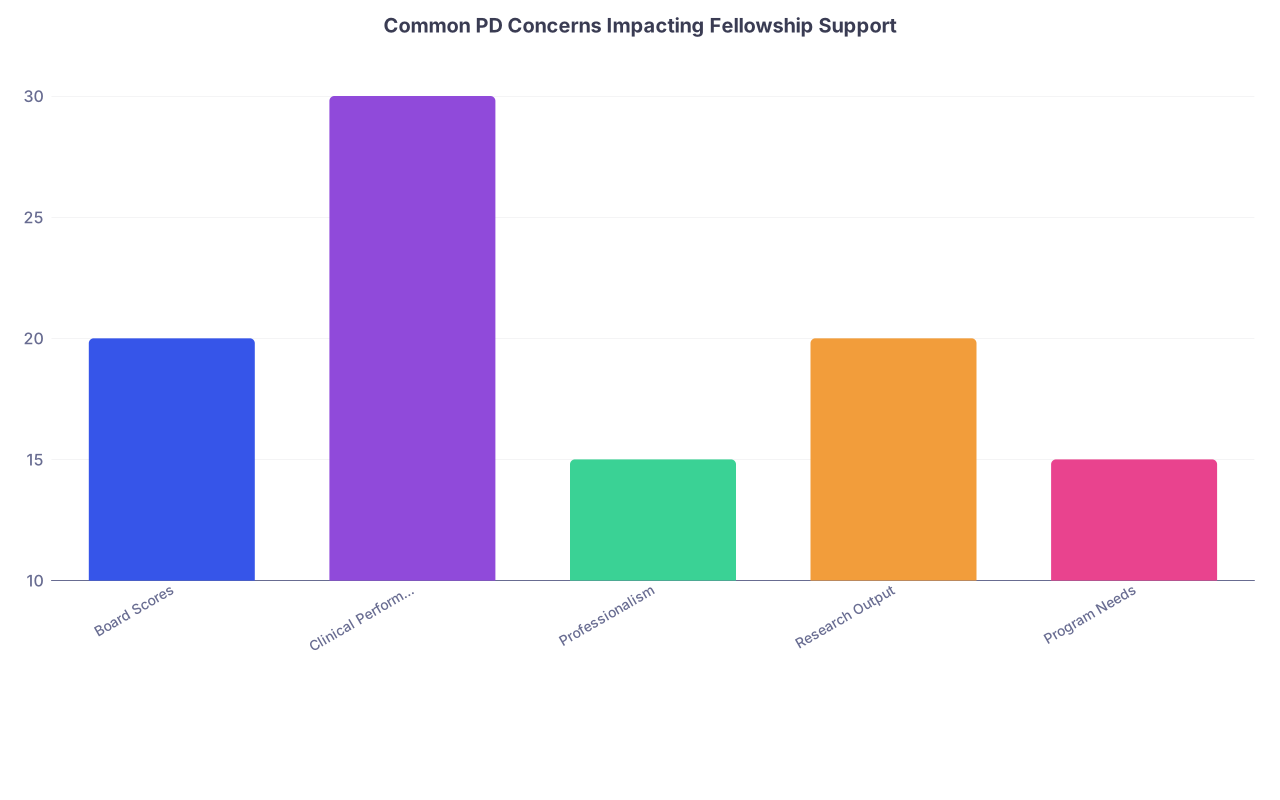
| Category | Value |
|---|---|
| Board Scores | 20 |
| Clinical Performance | 30 |
| Professionalism | 15 |
| Research Output | 20 |
| Program Needs | 15 |
Write down what they say. Word-for-word, if needed.
Step 3: Translate Feedback into a Targeted Fix List
Now you have raw data. Turn it into a plan.
Break it down into concrete domains:
| Domain | Red Flag Examples | Fixable in 6–12 Months? |
|---|---|---|
| Exams | Low Step/ITE, no Step 3 | Partially |
| Clinical | Below-average evals, flags | Yes, if early enough |
| Professionalism | Tardiness, complaints | Yes, with behavior change |
| Research | Minimal or unfocused | Often |
| Visibility | Unknown to key faculty | Definitely |
For each domain your PD flagged:
Define the problem precisely.
- Example: “PGY-1 evals: ‘efficient but occasionally disorganized,’ one professionalism note about late notes.”
Define the target.
- “By end of PGY-2: consistent ‘exceeds expectations’ on organization; no additional professionalism issues.”
Define the interventions.
- Ask to rotate again with high-volume attendings and request explicit mid-rotation feedback.
- Use task lists, checklists, whatever it takes.
Define the timeline.
- Many issues must be cleaned up before letters are written or ITE scores released.
You are turning vague doubt into a measurable remediation plan.
Step 4: Separate “PD Support” from “Fellowship Success”
Here is the thing nobody likes to say out loud:
You can match to fellowship without a fully enthusiastic PD. I have watched it happen multiple times.
You need to know exactly which elements require PD cooperation and which you can bypass or buffer.
What actually requires PD engagement
- Official program letter (varies by specialty; often PD or chair)
- Approval for away rotations or “audition” electives
- Supporting schedule changes for research time in certain programs
- Occasionally, “blessing” phone calls to top programs (nice, but not universal)
What you can build without their help
- Killer letters from other faculty
- Research portfolio and abstracts
- National/institutional networking
- Polished personal statement and application
- Performance on away rotations
- Program list strategy
So do not make your PD’s temperature the sole predictor of your outcome. You need redundancies.
Step 5: Build an Alternative Letter and Advocacy Network
If your PD is not going to be your main champion, you need others who will. Three to five strong advocates beat one lukewarm PD.
Identify your “A-Team” faculty
You are looking for:
- Subspecialists in your target field (e.g., cards faculty for cardiology fellowship)
- People who have seen you work clinically, not just in clinic once
- Anyone who has mentored you on research or QI
- Faculty with known connections to programs you care about
Minimum:
- 1–2 letters from subspecialty faculty
- 1 letter from core residency faculty (APD, firm leader, ward attending) who actually likes you
How to approach them
Use a concise, professional ask:
“Dr. Lee,
I am applying to [Pulmonary/Critical Care] fellowship this upcoming cycle. Working with you on the MICU and on the [ARDS QI project] was a highlight of my training.
Would you feel comfortable writing a strong, detailed letter of recommendation commenting on my clinical performance, work ethic, and suitability for Pulm/CCM?
I can provide you with my updated CV, personal statement draft, and bullet points of cases we shared.
Thank you for considering,
[Name]”
You must explicitly say “strong, detailed letter.” If they hesitate, withdraw gracefully and find someone else. Politely.
Step 6: Decide How Hard to Push Your PD – and Where
Sometimes a PD is lukewarm but persuadable. Sometimes you accept their ceiling and move on.
You need to decide:
- Do I want them to upgrade from lukewarm to supportive?
- Or do I mainly need them not to block me?
Scenario A: Persuadable PD
Signs:
- They gave specific criticisms and clear improvement targets.
- They said things like “If we can strengthen X and Y, I will feel much more comfortable supporting you broadly.”
- They have a track record of supporting past residents once concerns are addressed.
Your play:
Address the issues aggressively for 3–6 months.
Send a concise progress update.
“Dr. Smith,
Thank you again for your honest feedback in March about my fellowship plans. We had identified [clinical efficiency] and [limited research output] as key concerns.
Since then, I have:- Received ‘exceeds expectations’ evaluations on my last 3 inpatient rotations
- Submitted 1 abstract to [Chest 20XX] and am drafting a manuscript with Dr. Jones
I would appreciate a brief follow-up meeting to reassess my fellowship readiness and discuss next steps for this cycle.
Best,
[Name]”
In the follow-up meeting, ask for specific commitments:
- “Would you feel comfortable writing me a supportive program letter?”
- “Are there programs you think I should add or remove given my updated profile?”
Scenario B: Fixed Ceiling PD
Signs:
- They repeat the same vague concerns without giving clear endpoints.
- They make global statements like “Our residents usually do not match at those places.”
- They emphasize program coverage and logistics over your career.
- Their past residents consistently under-match relative to their profiles.
Your play is different:
- Accept that their letter will be neutral, not glowing.
- Make absolutely certain your other letters are phenomenal.
- Lean harder on networking, research mentors, and away rotations.
- Consider subtly narrowing your top-tier targets or including more “realistic” programs based on neutral outside advice (not the PD’s pessimism alone).
Step 7: Optimize the Parts of Your Application You Control 100%
A lukewarm PD makes it non-negotiable: the rest of your application must be tight.
Clinical performance
The fastest way to change faculty perception is 2–3 stellar rotations with known “tough graders.”
- Volunteer for high-visibility rotations in your specialty.
- Show up early, never be late, know your patients cold.
- Ask mid-rotation: “What is one thing I could do this week to function more like a first-year fellow?”
Then actually do it.
Research and scholarly output
You are not going to go from zero to NEJM in a year. But you can go from nothing to “reasonably scholarly.”
Quick-win options:
- Case reports (yes, they still count, especially if well-written and presented)
- Retro chart review with an attending who already has IRB
- QI project with measurable outcomes: LOS, readmissions, CLABSI, etc.
- Secondary analysis of existing dataset
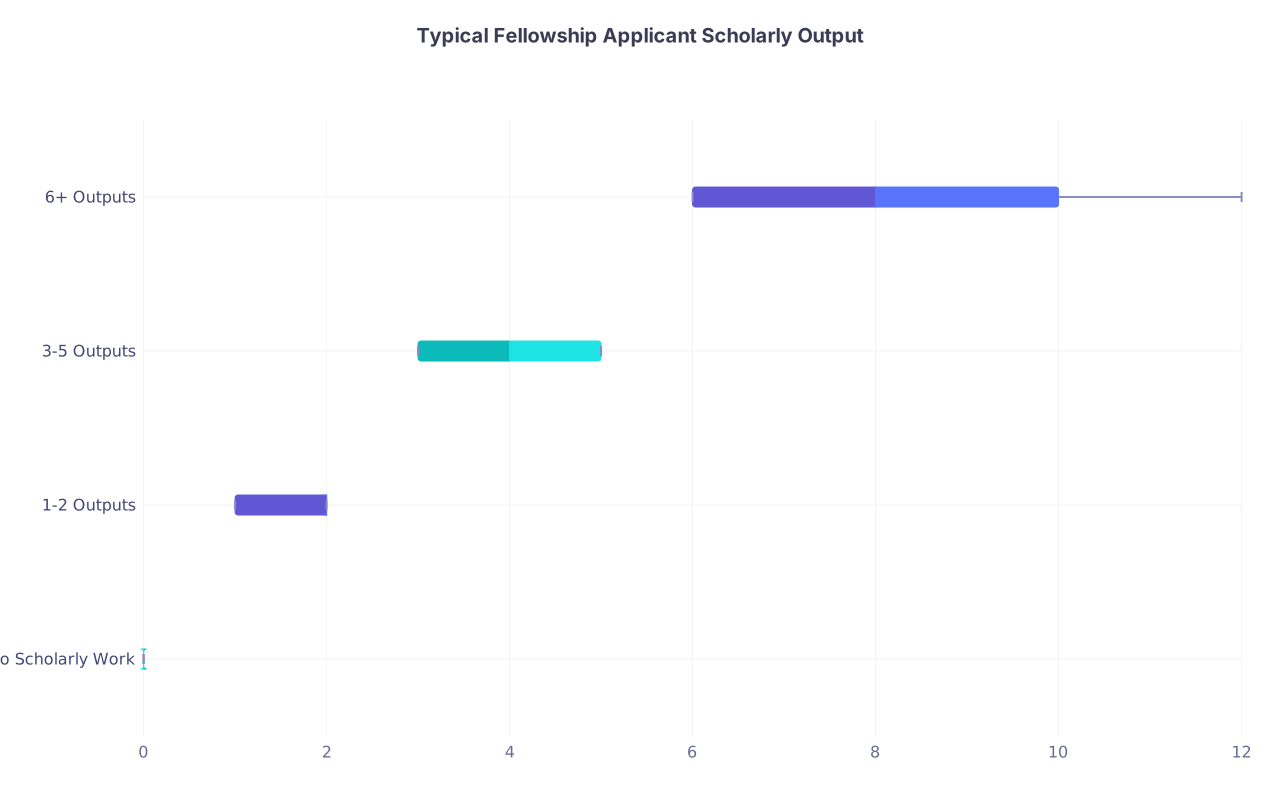
| Category | Min | Q1 | Median | Q3 | Max |
|---|---|---|---|---|---|
| No Scholarly Work | 0 | 0 | 0 | 0 | 0 |
| 1-2 Outputs | 1 | 1 | 2 | 2 | 2 |
| 3-5 Outputs | 3 | 3 | 4 | 5 | 5 |
| 6+ Outputs | 6 | 6 | 8 | 10 | 12 |
You are aiming for the 1–3 output range, not perfection. Doable in 6–12 months with focused effort.
Exam strategy
If Step/COMLEX scores are your weak point:
- Crush your in-training exam.
- Take Step 3 early if your specialty cares and you can realistically do well.
- Document your improvement: “ITE moved from 40th to 75th percentile” is a concrete story.
Step 8: Use Away Rotations and External Mentors Strategically
An away rotation can do three things at once:
- Give you a strong external letter.
- Get you on the radar of a target program.
- Provide an “outside read” on your readiness that does not depend on your PD.
When to use an away rotation
Strongly consider if:
- Your home program has limited subspecialty exposure.
- Your PD is not an ally and you need an external champion.
- You are targeting a geographically specific region or elite program cluster.
How to set it up despite a lukewarm PD
- Learn your institution’s official process for away approval (GME office, coordinator, etc.).
- Frame your request logistically, not emotionally:
- “I would like to do a [1-month] elective in [Transplant Hepatology] at [X] to gain exposure we do not have here and to solidify my career choice.”
- Offer to help with coverage:
- Swap with co-residents.
- Avoid peak coverage months.
During the rotation, act like you are already a fellow there. That is the bar.
Step 9: Control the Narrative in Your Personal Statement and Interviews
If your PD is tepid because of past issues (a professionalism incident, rough intern year), you do not ignore it. You preempt it.
Personal statement
You do not confess every flaw. But you can:
- Highlight your growth arc: “Early in residency, I struggled with [time management / prioritization] and received specific feedback. Over the subsequent year, I implemented [system X] and my evaluations now consistently emphasize [trait Y].”
- Emphasize specific concrete behaviors, not generic “I learned from my mistakes” fluff.
Interviews
You will sometimes get indirect questions that sniff around your PD’s letter or reputation:
- “How would your PD describe you?”
- “What is one piece of constructive feedback you have received?”
Use those to deliver the improved narrative:
- “My PD would say I started out as an enthusiastic but sometimes overextended intern. Over the past 18 months, I have become one of the more organized residents on our service by doing [concrete actions]. That shift is reflected in my recent evaluations and in the roles I’ve taken on, like [X].”
You are giving fellowship PDs a counter-story they can believe, even if your PD’s letter is bland.
Step 10: Timeline: What to Do and When
You cannot fix this in the last month before ERAS opens. Set a rough timeline.
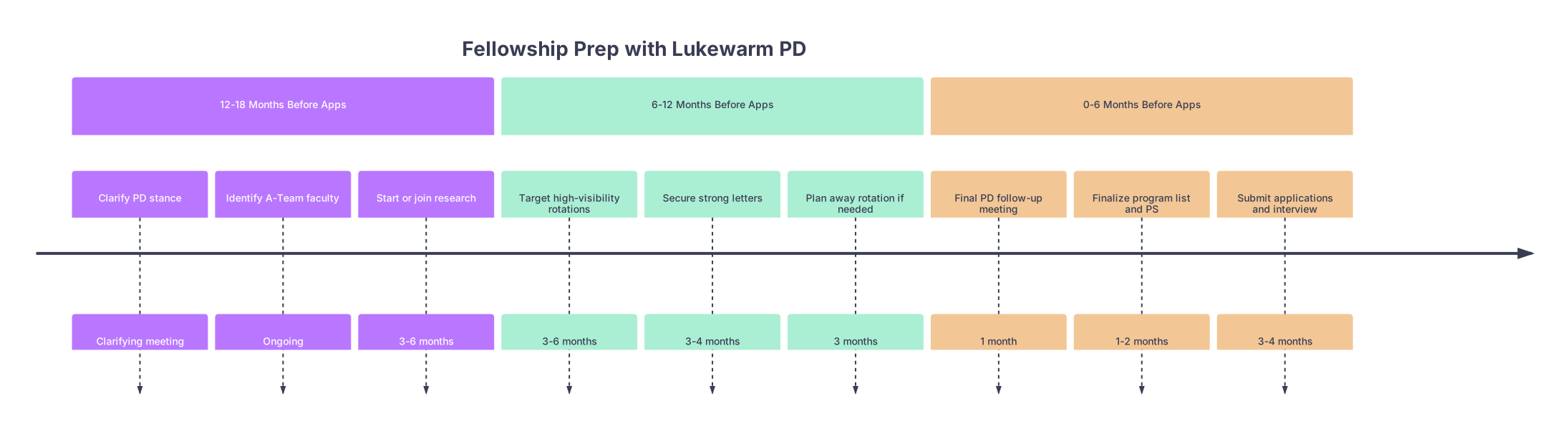
| Period | Event |
|---|---|
| 12-18 Months Before Apps - Clarify PD stance | Clarifying meeting |
| 12-18 Months Before Apps - Identify A-Team faculty | Ongoing |
| 12-18 Months Before Apps - Start or join research | 3-6 months |
| 6-12 Months Before Apps - Target high-visibility rotations | 3-6 months |
| 6-12 Months Before Apps - Secure strong letters | 3-4 months |
| 6-12 Months Before Apps - Plan away rotation if needed | 3 months |
| 0-6 Months Before Apps - Final PD follow-up meeting | 1 month |
| 0-6 Months Before Apps - Finalize program list and PS | 1-2 months |
| 0-6 Months Before Apps - Submit applications and interview | 3-4 months |
If you are closer than 12 months, you compress the sequence but keep the logic:
- Week 1–2: Clarifying meeting with PD + list of risk domains.
- Month 1–3: Tactical sprint on clinical performance, letters, and at least one scholarly output.
- Month 3–4: Final PD follow-up. If still lukewarm, shift fully to alternate advocates and realistic program list expansion.
Step 11: Protect Your Professional Relationship with the PD
There is a dangerous temptation when you feel unsupported: sarcasm, gossip, quiet sabotage. Do not do it.
You still need:
- A program letter that does not poison your application.
- A non-hostile work environment for the rest of residency.
- A clean reputation that will follow you to your fellowship.
Ground rules:
- Do not badmouth your PD to other residents or faculty. Word travels. Fast.
- Be unfailingly professional in all emails and meetings. Short, clear, polite.
- Keep your GME and institutional policies in mind if things escalate beyond lukewarm into unfair or retaliatory; document factual events, not feelings.
I have seen residents salvage decent PD letters from PDs who were privately skeptical, simply by remaining relentlessly professional and solution-focused.
Step 12: Sanity Check from Outside Your Program
Before you finalize your application strategy, you want at least one honest read from outside your home program.
Options:
- Former graduates from your program who matched in your field.
- Mentors from medical school or prior institutions.
- National society mentorship programs (e.g., ACC, ATS, AASLD, etc.).
Send them:
- Your CV
- USMLE/COMLEX scores
- Brief summary of your PD’s stance (facts, not drama)
- Draft program list
Ask them:
- “If you were in my shoes, would you:
- Apply broadly as-is?
- Modify my target tier?
- Consider delaying a year to strengthen my CV?”
Sometimes your PD is overly pessimistic. Sometimes they are quietly right. An external reader helps you tell which.

Step 13: Decide: Apply Now vs. Delay a Year
A lukewarm PD can push you toward the “should I wait” question. That decision should be rational, not emotional.
Reasons to apply now
- You have at least:
- Solid clinical evaluations the last 12 months
- 2–3 genuinely strong letters (even if PD is neutral)
- Scores that are not fatal for your field
- Your life circumstances make delay costly (visa, family, finances).
Reasons to consider delaying 1 year
- Multiple major red flags that cannot be plausibly improved or re-framed in 6–9 months:
- Recent professionalism probation
- Failing or very low ITE with no time for demonstrated improvement
- Absolutely no subspecialty exposure or research in a highly academic field
- You have a clear, realistic plan to use that year to:
- Add meaningful research
- Demonstrate sustained clinical improvement
- Obtain new, powerful letters
This is where that external sanity check matters. Your PD’s lukewarm stance is one data point. Not the only one.
Step 14: Treat This as Training for Real-Life Medicine
You are frustrated because you want unequivocal backing and you are not getting it. Welcome to the rest of your career.
You will spend decades:
- Practicing in systems that are lukewarm about quality improvement.
- Negotiating with colleagues who are lukewarm about evidence-based changes.
- Advocating for patients when consultants are lukewarm about taking them.
The skill you are building here—calmly analyzing a less-than-ideal ally, extracting what value you can, and building parallel supports—is a core physician skill.
Not pleasant. But extremely useful.

Step 15: Make Your 2-Week Action Plan
Reading this without acting is just a more sophisticated form of procrastination. So here is your concrete, short-term checklist.
Within the next 14 days:
- Write down the exact phrases and behaviors that make you label your PD “lukewarm.”
- Request a 20–30 minute meeting with your PD using the script above.
- Prepare your materials for that meeting:
- Updated CV
- Scores
- Draft program list
- After the meeting, create a one-page “risk and fix” list:
- Domain | Concern | Plan | Timeline
- Identify 3–5 potential non-PD advocates and send a tailored, professional email to at least one of them asking for a strong, detailed letter.
- Contact one external mentor or program graduate for an honest read of your current competitiveness and program list.
Do not try to solve everything this month. But do not sit in ambiguity.
Open your email right now and draft that PD meeting request. Once that is sent, you are no longer an anxious resident wondering what your PD “really thinks.” You are the person driving a structured plan to get where you want to go.