

The way most residents ask attendings for letters is lazy, vague, and almost guaranteed to produce a generic LOR that does nothing for your fellowship application.
You are not asking for a favor. You are asking for advocacy. Those are not the same thing.
This is the playbook I wish more residents had: a concrete, word-for-word strategy to get busy attendings to write specific, powerful letters that actually move the needle for fellowship.
1. Understand What “Real Advocacy” Actually Means
Real advocacy is not “Dr. X agreed to write me a letter.”
Real advocacy is:
- The attending knows exactly what you are going for and why.
- They can articulate 2–3 specific stories that show you belong in that fellowship.
- They are willing to spend reputation on you with strong, unambiguous language.
If a letter does not:
- Take a stance.
- Provide concrete examples.
- Position you relative to peers.
…then it will be background noise in ERAS.
Most attendings are not malicious. They are just busy and default to “resident worked hard, was pleasant to work with” because that is all you gave them to work with.
Your job is to make real advocacy the easy option for them.
2. Choose the Right Attendings Before You Ever Ask
Before you worry about scripts, fix your target list. A perfect email to the wrong person is still a weak letter.
Aim for:
- At least one letter from your own specialty (or closely related).
- At least one letter from someone who has seen you in a sustained, demanding setting (inpatient, ICU, heavy consult rotation).
- At least one “big name” IF that person actually knows you. A bland letter from a famous person is worse than a strong letter from a mid-level but invested faculty member.
Use this quick filter.
| Criterion | Good Sign |
|---|---|
| Clinical exposure | >2 weeks direct supervision |
| Feedback history | Gave you specific feedback |
| Enthusiasm | Has praised you unprompted |
| Specialty alignment | Matches or supports your target |
| Reputation | Well-regarded by PD/fellows |
If you are unsure, ask yourself:
“If this person talked honestly about me at a closed-door meeting, would I want to be in the room?”
If the answer is “probably neutral,” do not ask them for a letter unless you are desperate.
3. Time Your Ask Strategically (Not Randomly)
You do not ask for letters “whenever.” You ask when:
- You are fresh in their mind, and
- You just did something hard or high-impact they watched you handle.
Ideal times:
- Last 2–3 days of a rotation.
- Within 1–2 weeks of finishing a strong elective.
- Right after a presentation, teaching session, or QI project they supervised.
If you are months out and need to ask anyway, you will just have to compensate with more specifics and reminders.
4. The Core Principle: Never Ask for “A Letter.” Ask for “A Strong Letter.”
This is the first hard rule.
When you ask, you include the word “strong.” On purpose.
Why?
Because it:
- Signals that you are looking for real advocacy.
- Gives them a clean exit if they cannot honestly support you at that level.
You would rather someone quietly say no than submit a lukewarm letter that drags your whole file down.
5. The Live Ask Script (In Person or Video)
Whenever possible, ask in person or over video. Busy attendings say yes more often when they see you and remember you as a real person, not just a name in an inbox.
Here is the skeleton. You adapt it to your specialty and context.
Step 1: Set the context
“Dr. Smith, do you have a quick minute? I wanted to ask you something about fellowship.”
Short. Respectful. No monologue.
Step 2: Connect their experience of you to your goal
“I am applying for cardiology fellowship this cycle, and your rotation was a big part of confirming that for me. You saw me manage a lot of the CCU cases and present on rounds, and I really valued your feedback about my clinical reasoning.”
You are reminding them when and how they saw you at your best.
Step 3: The actual ask, with the word “strong”
“I wanted to ask if you would feel comfortable writing a strong letter of recommendation on my behalf for cardiology fellowship.”
Then you shut up. Do not keep talking to fill the space.
Step 4: Give them the exit they need (this protects you)
If they hesitate or give a lukewarm “uh, sure,” you add:
“I completely understand if you feel you have not seen me enough for that or if your schedule will not allow it. I only want to ask if you feel you can really advocate for me.”
If they back off at that point, respect it. That just saved your application from a weak letter.
If they say yes enthusiastically (“Absolutely,” “Definitely”), that is your green light.
6. The Email Script When You Cannot Ask Live
Sometimes the attending is off-service, on leave, or just impossible to catch. Then you use a structured email.
Subject line options:
- “Fellowship LOR Request – [Your Name], [Rotation/Year]”
- “Request for Strong Letter of Recommendation for [Specialty] Fellowship”
Use structure and clarity. No vague subject like “Quick question.”
Template:
Dear Dr. [Last Name],
I hope you are doing well. I am applying for [Specialty] fellowship in the upcoming cycle and wanted to ask if you would feel comfortable writing a strong letter of recommendation on my behalf.
We worked together on [rotation] from [dates], where you supervised me on [ICU/wards/consults/clinic]. I especially appreciated your feedback regarding [specific feedback you actually remember – e.g., clinical reasoning in complex cases, communication with patients, presentations on rounds].
I am particularly proud of [1–2 specific examples: a complex patient you managed, a QI project, a teaching session, or a presentation], and I believe your perspective on my performance in those situations could be very helpful to fellowship programs.
If you are able to support me with a strong letter, I would be glad to send:
– My updated CV
– A brief “letter writer packet” with my personal statement draft, ERAS experiences, and 3–5 bullet points you might consider highlighting, based on what you observed
– Any program-specific details or deadlinesI also understand completely if your schedule is too full or if you feel you have not seen me enough to comment at that level.
Thank you for considering this, and for the teaching and feedback you have already given me.
Best regards,
[Full Name, PGY-X – Program]
[Contact info]
That email does three things:
- Anchors them in when they knew you.
- Explicitly asks for strong advocacy.
- Makes it easy to say no without awkwardness.
7. Build a “Letter Writer Packet” That Makes Their Job Stupidly Easy
Most residents send a CV and call it a day. Then they wonder why the letter sounds like a CV reprint.
You will send a mini packet that gives them three things:
- Who you are on paper.
- Who you are clinically.
- What you want them to say.
Here is the structure.
A. 1-page summary sheet (this matters more than your CV)
Title it:
“[Your Name] – [Specialty] Fellowship Letter Writer Summary”
Sections:
Target field and cycle
- “Applying for: Pulmonary/Critical Care Medicine fellowship”
- “Application year: 2025–2026 cycle”
How you know me
- “We worked together on: MICU – 4 weeks (July 2024)”
- “Your role: MICU attending, direct supervision on rounds and procedures”
Key strengths you have seen directly (3–5 bullets, max)
Example:- Managed complex MICU patients with minimal prompting, especially [brief example].
- Communicated clearly with families in high-stress situations (e.g., [short scenario]).
- Took ownership of overnight cross-cover issues and escalated appropriately.
Suggested themes for the letter (if they agree)
- “Clinical reasoning in critically ill patients”
- “Communication and leadership on rounds”
- “Work ethic and reliability under pressure”
This is not manipulative. It is respectful. You are saying: “Here is what you saw and what might be useful to highlight if you agree.” They are free to ignore it.
B. CV and personal statement
Yes, send both. Even if your personal statement is a draft.
They give the attending:
- Your narrative for why you want the field.
- A sense of where your research, leadership, and career goals fit.
C. Fellowship program list + rough timeline
You do not need every program, but give a range:
- “Expecting to apply to: ~35 cardiology programs, mostly academic.”
- “First ERAS deadline for letters: [date].”
- “Ideal date to have letters uploaded: [2–3 weeks before your first deadline].”
You are reducing cognitive friction. That is the point.
8. Make Follow-Up and Logistics Look Professional, Not Needy
Assume they will say yes and then forget. Attendings are drowning in inboxes and EPIC.
Your job is to:
- Track.
- Remind.
- Stay polite but firm.
The ERAS / portal piece
Once they agree:
- Enter their information in ERAS (or the appropriate system).
- Tell them clearly which system will email them and what the email will look like:
“You should receive an email from ERAS in the next 24–48 hours with a link to upload the letter. I will label your letter as ‘Cardiology – Dr Smith – MICU’ so you can recognize it.”
Reminder schedule that does not make you annoying
- Immediately after they agree: Send thank-you email + packet + timeline.
- One week before your internal deadline: Polite reminder if not yet uploaded.
- 3–4 days before final cut-off: Final reminder if still not uploaded.
Sample reminder:
Dear Dr. Smith,
I just wanted to send a brief reminder about the cardiology fellowship letter of recommendation. ERAS shows it has not yet been uploaded. My goal is to have all letters in by [date] so I can certify my application.
I know your schedule is extremely busy, and I am very grateful for your willingness to support my application. Please let me know if there is any additional information I can provide.
Best regards,
[Name]
If they miss the final cut-off, you remove them from your list where possible and shift emphasis to other letters. Do not chase endlessly. You do not control their reliability.
9. How to Get Attendings to Add the High-Impact Details PDs Actually Read
Program directors skim. They have to.
They look for:
Specific comparisons:
- “Top 10% of residents I have worked with in the last 10 years.”
- “Among the strongest PGY-3s in our program this year.”
Concrete stories:
- A specific patient.
- A specific crisis.
- A specific leadership moment.
Clear, decisive language:
- “I give [Name] my highest recommendation for fellowship in [field].”
- “I would be thrilled to have [Name] as a fellow in our own program.”
You cannot tell an attending what to write. But you can seed them with raw material.
In your packet or short email you might add:
“During our time in the MICU, some situations that might be useful to mention if you found them representative were:
– The management of the patient with septic shock and multiorgan failure where we discussed the stepwise escalation of vasopressors.
– My family meetings with the two ARDS patients where we navigated code status and goals of care.
– Leading the fellow teaching session on ventilator management.”
You are not scripting them. You are jogging their memory and pointing to moments that felt significant to you and likely to them.
10. What to Do When You Are Late, Weakly Connected, or Worried About Your Record
Not everyone is the star PGY-3 with perfect timing. Let us address the rougher scenarios.
Scenario 1: You are asking months after the rotation
You compensate with:
- A stronger reminder of who you are and what you did.
- A shorter list of specific cases or projects.
Email tweak:
“We worked together on wards from September–October 2024. To jog your memory, I was the senior resident on [Firm A], and we cared for [brief mention of 1–2 notable patients/cases].”
Attach your packet and give them extra lead time.
Scenario 2: You had a rocky rotation but improved
Do not ask the person who wrote you up for problems. But if you had early struggles and then clearly improved and they acknowledged it, you can use that.
When you ask:
“I especially valued your feedback early in the rotation around [specific area] and worked hard to implement those changes. If you feel you can comment on that growth and where I ultimately landed by the end of the rotation, I would be very grateful for your support with a strong letter.”
If they avoided saying “strong,” walk away. You do not want a backhanded “improvement” letter that makes PDs nervous.
Scenario 3: You do not have many specialty attendings
Then you lean into adjacent credibility:
- ICU attending for pulm/crit.
- ED attending for cards or critical care–oriented fields.
- Hospitalist who saw you run codes, manage complexity, handle cross-cover chaos.
You frame it in your packet:
“While we did not work together in a formal cardiology context, I am hoping your perspective on my acute care management and leadership on night float will be helpful to fellowship programs.”
That is still useful. Many PDs care more about “can this person function under pressure” than clerkship-level exposure to cath lab minutiae.
11. Different Modes: How to Ask Depending on the Setting
You are not always pulling an attending aside in a quiet office. Sometimes you have 30 seconds in a noisy workroom.
On rounds, briefly (but not in front of patients)
“Dr. Chen, when you have a moment later today, could I grab you for 2 minutes about fellowship letters?”
Then follow up in person or by email.
In clinic, at the end
“Dr. Patel, thank you again for letting me see so many follow-ups independently. I am applying for rheumatology this year. Would it be alright if I emailed you about a potential strong letter of recommendation from clinic?”
Again, you are opening the door gently, then moving the detailed request to email.
12. Post-Match: How To Close the Loop (This Pays Off Later)
After interviews and match, you are not done with your letter writers.
You send:
- A short thank-you email once your application is complete.
- A brief update once you match.
Example:
Dear Dr. Smith,
I wanted to thank you again for writing a strong letter of recommendation for my cardiology fellowship applications. My ERAS file is now complete, and I am very grateful for your support.
I will be sure to update you once the Match results are released.
Best regards,
[Name]
And after Match:
Dear Dr. Smith,
I am happy to share that I matched at [Program, City] for cardiology fellowship. Thank you again for your support and for the training and feedback you provided in the MICU.
I hope to carry those lessons forward in fellowship.
Best regards,
[Name]
Why bother? Because you will need people like this again—for job searches, faculty positions, and recommendation calls that never go through you.
You are building a reputation as someone who closes the loop and respects their time.
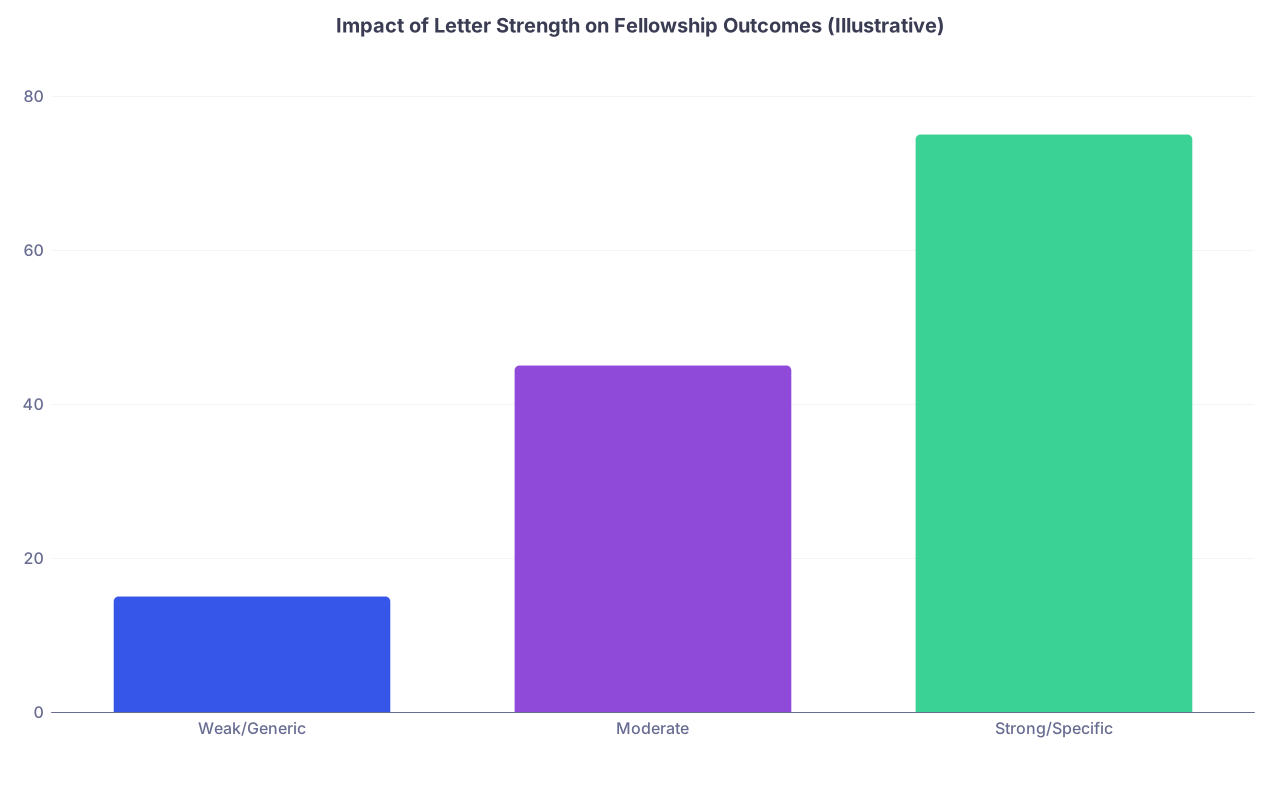
| Category | Value |
|---|---|
| Weak/Generic | 15 |
| Moderate | 45 |
| Strong/Specific | 75 |
13. Quick Workflow: The Advocacy Script in Practice
Here is the whole process, simplified.

| Step | Description |
|---|---|
| Step 1 | Identify Attendings |
| Step 2 | Filter for Strong Supporters |
| Step 3 | Ask In Person or Email |
| Step 4 | Thank and Pivot to Others |
| Step 5 | Send Packet and ERAS Request |
| Step 6 | Track Upload Status |
| Step 7 | Send Polite Reminders |
| Step 8 | Thank and Update After Match |
| Step 9 | Strong Yes? |
| Step 10 | Uploaded On Time? |

14. Example: Full Email You Can Adapt Today
Put it all together.
Subject: Request for Strong Letter of Recommendation – Pulm/CC Fellowship
Dear Dr. Alvarez,
I hope you are doing well. I am applying for Pulmonary/Critical Care fellowship in the 2025–2026 cycle and wanted to ask if you would feel comfortable writing a strong letter of recommendation on my behalf.
We worked together in the MICU for four weeks in October 2024, where you supervised me as the senior resident on the blue team. I especially appreciated your feedback about organizing my daily plans and presenting concise, prioritized assessments on rounds.
During the rotation, I was particularly proud of our management of the patient with septic shock from pneumonia who required escalation to multiple vasopressors, and the family meetings we conducted for two patients with ARDS when discussing goals of care. I believe your perspective on how I handled these situations could be helpful for fellowship programs evaluating my readiness for critical care training.
If you are able to support me with a strong letter, I would be glad to send a brief letter writer packet, including my CV, personal statement draft, and a one-page summary of key experiences and strengths you have observed. ERAS will send you an email with upload instructions once I enter your name, and my goal is to have all letters submitted by August 15.
I also understand completely if your schedule is too full or if you feel you did not see me enough to comment at that level.
Thank you again for your teaching in the MICU and for considering this request.
Best regards,
[Your Name], PGY-3 – Internal Medicine
[Institution]
[Phone] | [Email]
Copy it. Edit it. Send it.

15. Common Mistakes Residents Make (And What To Do Instead)
Let me be blunt. These are the things that torpedo LOR quality.
Mistake 1: Asking, “Can you write me a letter?” with zero qualifiers.
Fix: Always ask, “Would you feel comfortable writing a strong letter of recommendation?”
Mistake 2: Sending only a CV.
Fix: Send a 1-page summary, CV, personal statement, and 3–5 suggested themes or examples.
Mistake 3: Not giving deadlines—or worse, saying “whenever.”
Fix: Give clear dates, ideally 2–3 weeks before your real deadline.
Mistake 4: Avoiding “big names” because they seem intimidating.
Fix: If they know you and have praised you, ask. Just be more prepared and more structured with your packet.
Mistake 5: Assuming a “yes” means a good letter.
Fix: Use the word “strong” and give them an explicit out.

FAQ (Exactly 4 Questions)
1. How many letters of recommendation do I actually need for fellowship?
Most fellowship programs want 3 letters, occasionally 4. A common structure is:
- 1 from your program director or chair.
- 1–2 from subspecialty attendings in your target field.
- 0–1 from a research mentor or another strong clinical supervisor.
Always check specific program requirements, but 3 high-quality letters are usually enough. Four mediocre letters do not beat three excellent ones.
2. What if my program director barely knows me?
You still usually need a PD letter. Your solution is to give them maximal material:
- Updated CV
- Personal statement
- Brief paragraph summarizing your performance and any major accomplishments
- Optional: a shortlist of attendings who know you best, so the PD can ask them for input
Then you rely on your other letters (from attendings who know you well) to provide the rich, story-driven advocacy.
3. Is it okay to draft my own letter if an attending asks me to?
This is common but messy. If they insist, do not write a self-glorifying fantasy. Write a factual, specific, moderate draft with:
- Concrete examples
- Clear but not over-the-top praise
- Honest areas of strength you actually possess
Assume it will be read by people who know your real performance. Many attendings will heavily edit your draft; some will use it as scaffolding. Never include anything untrue or exaggerated.
4. What if I realize too late that a letter is weak or generic?
You usually will not see the content, but red flags include:
- The attending seemed lukewarm when asked.
- They delayed for months and seemed irritated by reminders.
If you suspect a letter may be weak and you still have time, add another strong letter from someone else and prioritize that one for programs that allow choosing which letters to assign. For future rotations, you fix the process: ask earlier, frame the request around “strong” advocacy, and be more selective with who you approach.
Key points to remember:
- You are not asking for a letter. You are asking for strong, specific advocacy.
- Make it easy for attendings: choose wisely, ask clearly, and give them a tight packet with examples and deadlines.
- Protect your application by giving attendings an honest way to decline if they cannot truly support you.


