
You are on night float. It is 2:15 a.m. Between cross-cover pages, you are finishing a QI PowerPoint on reducing blood culture contamination on your ward. The project “went well,” your PD seemed happy, and now you are wondering: is this actually useful for my fellowship applications, or is it just another checkbox?
Here is the honest answer: most residents leave huge value on the table with their local QI work. They do a project because they have to. They put it on their CV as a single bullet. Then they are surprised when fellowship interviews barely mention it.
You can turn a basic, homegrown QI project into a real asset that program directors in cardiology, heme/onc, pulmonary/critical care, whatever, take seriously. But you need to treat it like a serious piece of scholarship, not a residency assignment.
I am going to walk you through exactly how.
Step 1: Start with the End in Mind (Even If the Project Is Already Done)
Most residents do QI backward. They:
- Get assigned a topic.
- Do some Plan–Do–Study–Act cycles.
- Present at noon conference.
- Forget about it.
For fellowship-level impact, you reverse-engineer from what makes a project impressive on applications:
- Clear clinical relevance
- Real data, not vibes
- Demonstrated improvement (or at least a clean negative result)
- Sustainability / spread beyond a single intern’s effort
- Scholarship: poster, abstract, paper, or institution-wide impact
- A clear role for you (leadership, analytics, implementation)
Even if your project is half-done, you can still retrofit it to hit these elements.
Ask yourself today:
- What is the precise clinical problem?
- What specific metric am I trying to move, by how much, and in what time frame?
- Where is the data, and who owns it?
- Who could help me turn this into something presentable (QI office, stats faculty, chief residents)?
- Where could I realistically present this: hospital QI day, regional meeting, national conference?
If you cannot answer these, that is your first fix.
Step 2: Upgrade Your Local Project from “Activity” to “Study”
You want fellowship reviewers to see your QI project and think, “This person knows how to systematically improve care, measure outcomes, and work with a team.” Not “They completed the residency QI requirement.”
To do that, you tighten the project around four pillars: aim, measures, methods, and your role.
2.1 Nail a Fellowship-Ready Aim Statement
Bad aim (what I see constantly):
“Improve discharge summaries.”
“Reduce length of stay.”
Good aim: clear, time-bound, and measurable.
Examples:
- “Reduce 30-day readmissions for heart failure patients on the general medicine service by 20% over 12 months through a standardized discharge checklist and early follow-up scheduling.”
- “Increase appropriate VTE prophylaxis ordering rates from 78% to 95% on the oncology ward within 6 months by implementing an EMR best practice alert and resident education.”
You want:
- A target population
- A specific outcome
- A quantitative improvement goal
- A time frame
- A mechanism or intervention type
Rewrite your aim now. Even if the project is already underway. Then match the work you did to that sharper aim.
2.2 Define Measures Like Someone Who Understands Data
Most fellowship committees do not care that “people liked it” or “nurses were happy.” They care about whether you can:
- Choose appropriate measures
- Collect them cleanly
- Interpret them honestly
You need three kinds of measures:
- Outcome measure – the thing that actually matters (readmissions, CLABSI rate, time to antibiotics, etc.).
- Process measure – how reliably your intervention is delivered (percent of patients getting the checklist, percent of orders placed correctly).
- Balancing measure – making sure you did not accidentally cause harm (extra workload, increased LOS, missed other care).
Example for a sepsis QI project:
- Outcome: Time from ED triage to first antibiotic dose for patients admitted with sepsis.
- Process: Percent of eligible patients receiving antibiotics within 60 minutes.
- Balancing: ED length of stay; antibiotic-related adverse events.
If your current project just has “pre” and “post” bar charts with vague endpoints, fix that now. Go back to your data source (EPIC reports, infection control, pharmacy, QI office) and define these three buckets.
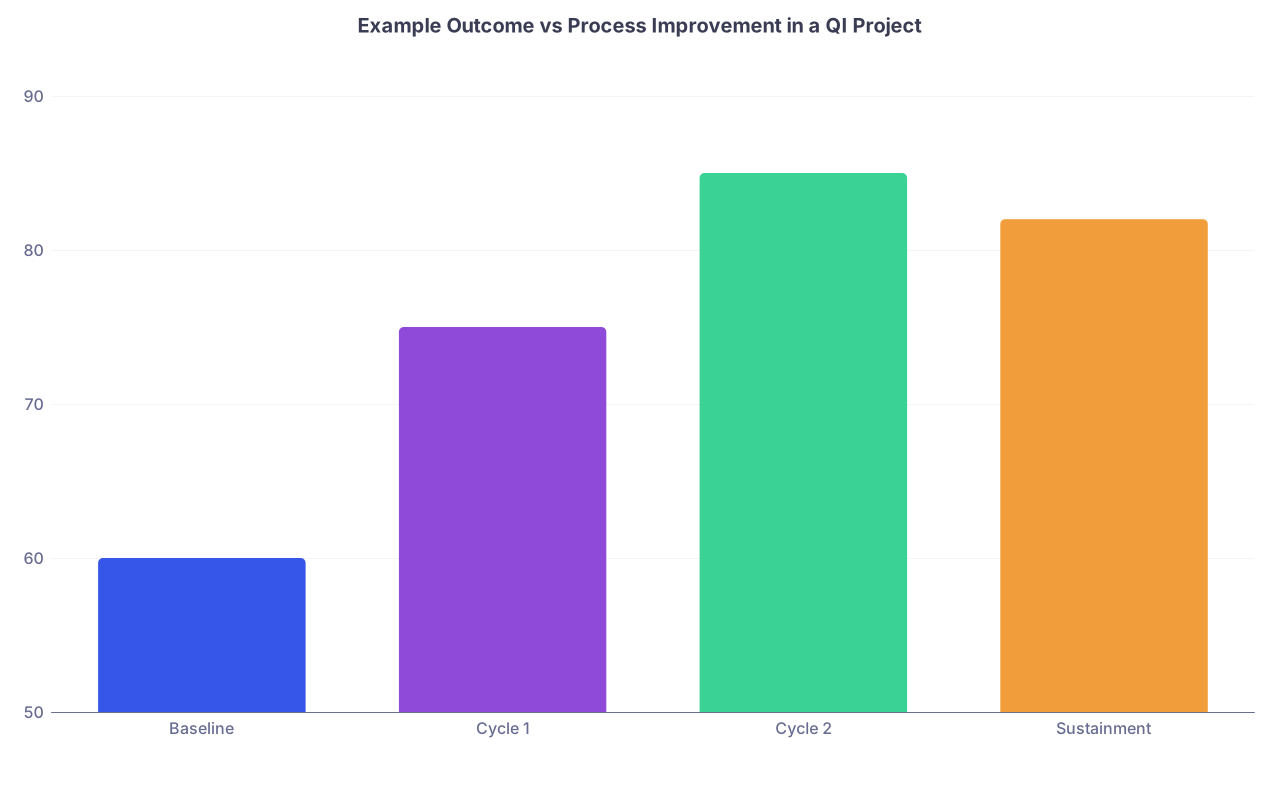
| Category | Value |
|---|---|
| Baseline | 60 |
| Cycle 1 | 75 |
| Cycle 2 | 85 |
| Sustainment | 82 |
(Think of that bar chart as your process compliance, for example. You want that kind of story in your slide deck.)
2.3 Make the Methods Sound Like Real Scholarship
Your “methods” section is where you separate yourself from the checkbox crowd. At minimum, you should be able to describe:
- Data source (EMR query, manual chart review, registry)
- Inclusion/exclusion criteria
- Time windows for pre- and post- data
- Statistical approach (even if simple)
Here is how you might phrase it in a writeup:
We conducted a pre-post quality improvement project on the general medicine service. Adult patients admitted with a primary diagnosis of decompensated heart failure between July–December 2023 (baseline) and January–June 2024 (post-implementation) were included, identified via ICD-10 codes. We compared 30-day all-cause readmission rates before and after implementation using chi-square testing and plotted control charts to assess temporal trends.
That sounds like someone who understands basic methodology. It reads a lot better than, “We did a project and then saw what happened.”
If your project is smaller, fine. You do not need fancy stats. But you must be able to say:
- What data you used
- Over what time period
- How you compared pre vs post
- How you knew whether your change was signal or noise
If you are lost, this is when you ask your hospital QI office or a biostatistician for one 30-minute consult. It pays off.
2.4 Clarify Your Role and Leadership
Weak CV line:
- “Participated in QI project to improve handoff safety.”
Fellowship-level CV line:
- “Led a multidisciplinary QI project to reduce overnight handoff errors on the cardiology service, including project design, data collection, and front-line implementation.”
You need to be able to say exactly what you did:
- Designed the aim and measures
- Built the data collection tool
- Led resident education
- Presented at department QI council
- Coordinated with IT to change the EMR order set
- Wrote the abstract / manuscript
Make a short bullet list for yourself now. That will become both your CV bullets and your talking points in interviews.
Step 3: Turn Your Project into Tangible Scholarly Output
Fellowship PDs skim. They are not reading full project summaries in ERAS. They are scanning for proof that:
- You follow through
- You produce something sharable
- You can work in structured academic formats (abstracts, posters, papers)
Your QI project should generate at least one of these, ideally two:
- Local presentation (department, hospital QI day)
- Regional or national poster or oral presentation
- Peer-reviewed publication or MedEdPortal/QI-specific outlet
- Institutional change (policy update, EMR change, standing process)
3.1 Start Local: Present It Where You Work
Every hospital has some combination of:
- Department grand rounds
- Resident QI days / quality forums
- GME-wide research day
- Hospital quality & safety council
Email the person who runs it: “I have a completed QI project on XYZ with pre/post data and clear outcomes. Could I present at your next forum?”
Design a clean, 10–15 slide deck:
- Background and problem statement
- Aim
- Measures
- Intervention / PDSA cycles
- Run chart / control chart or pre/post data
- Lessons learned and sustainability plan
This alone already levels up your application. Now you are “the resident who presented at hospital QI day,” not just “resident who did a required project.”

3.2 Go Regional or National: Pick Targets You Can Actually Hit
Residents get paralyzed here. They think only of the biggest national meetings and then bail because they feel their project is “too small.”
There are always reasonable targets:
- Specialty society regional meetings
- Hospital medicine (SHM) local or national meetings
- ACP chapter meetings
- Society-specific QI or patient safety conferences
- Institutional GME research day with external judges
You are not trying to win a Nobel prize. You are trying to show fellowship programs that you can:
- Identify a clinical problem
- Improve it
- Communicate that work in a professional forum
Pick one or two realistic conferences and work backward from the abstract deadlines.
| Conference Type | Example Organization | Typical Abstract Deadline |
|---|---|---|
| Specialty National | ACC, ATS, ASH | 6–9 months before meeting |
| Hospital Medicine | SHM | 4–6 months before meeting |
| General Internal Medicine | SGIM | 5–7 months before meeting |
| State/Chapter Meetings | ACP Chapters | 2–4 months before meeting |
| Institutional Research | GME Research Day | 1–3 months before event |
Write the abstract like a mini paper. Use standard sections: Background, Objective, Methods, Results, Conclusions. Stay brutally clear.
If you have no idea where to submit, ask: your PD, a research-oriented attending, or the QI office. They know where past residents have gone.
3.3 Consider Publication—but Be Strategic
Not every QI project needs to be a paper. For some, a strong national poster is enough. But if your project:
- Has clean pre/post data
- Is on a common, high-yield problem (CLABSI, CAUTI, readmissions, sepsis, time to cath, chemo safety)
- Shows a clear, clinically meaningful improvement
…then you should at least consider a manuscript.
Good targets:
- BMJ Open Quality
- American Journal of Medical Quality
- Journal of Hospital Medicine (QI-focused sections)
- Specialty journals with QI columns
- MedEdPortal (if the intervention is strongly educational)
Be realistic: a short, well-written QI report in a modest journal counts. You do not have to land JAMA to impress a fellowship committee.
Step 4: Make the Project Relevant to Your Target Fellowship
You want cardiology? Then your QI project on transfusion thresholds in the ICU is suddenly “perioperative hemodynamic optimization and blood management in critically ill patients,” not “generic transfusion project.” The content did not change. The framing did.
Fellowship directors care about three questions:
- Can you function and lead in their clinical environment?
- Will you contribute to their scholarly output?
- Do your interests align with their program’s strengths?
You present your QI work to answer “yes” to all three.
4.1 Relabel and Reframe Without Lying
You do not fabricate. But you absolutely can emphasize certain angles.
Examples:
- Pulm/CC fellowship
- QI on nighttime rapid response calls → emphasize early recognition of decompensation and escalation systems.
- Cardiology fellowship
- QI on telemetry overuse → frame as improving diagnostic yield and reducing alarm fatigue in patients with suspected arrhythmia.
- Heme/Onc fellowship
- QI on neutropenic fever antibiotic timing → directly on brand.
- GI fellowship
- QI on inpatient GI bleed pathway adherence → emphasize coordination of endoscopy timing, transfusion, and PPI use.
One project. Different lenses.
4.2 Build a Simple Narrative Across Your Application
If you are smart, your QI work is not an isolated bullet. It connects with:
- An elective in quality and safety
- A mentor who lives in your target specialty
- A couple of related case reports or smaller projects
- A personal statement that references system improvement, not just “I like the physiology”
Example narrative for a Pulm/CC applicant:
- QI project: “Reducing time to noninvasive ventilation for COPD exacerbations on the step-down unit”
- Elective: ICU quality and safety rotation
- Presentation: Hospital QI day + poster at SHM
- Personal statement line: “I became interested in how system delays worsen respiratory failure outcomes, leading me to develop a project to shorten time to initiation of appropriate ventilatory support.”
Now your QI project is not just a thing you did. It is evidence that you live in that specialty’s world.
Step 5: Package It Properly on Your CV and ERAS
Most residents torpedo their own work by documenting it poorly. They undersell. Or they drown it in jargon.
You want clean, scannable entries that make your role and impact obvious.
5.1 How to Write a QI Entry on Your CV
Pattern I like:
- Title of project – Role (e.g., Project lead, Resident co-lead)
- Institution, department; Dates
- One or two bullets with outcomes and outputs
Example:
Reducing Time to Antibiotics in Suspected Sepsis on General Medicine – Project lead
University Hospital, Department of Medicine; 2023–2024
- Designed and implemented a standardized sepsis order set and triage protocol, increasing percent of patients receiving antibiotics within 60 minutes from 42% to 78% over 9 months.
- Presented results at Department Quality Council and as a poster at the Society of Hospital Medicine Annual Meeting (2024).
If there is a manuscript, add: “Manuscript under review at BMJ Open Quality” or “Published in [Journal], 2024.”
5.2 Where to Put It in ERAS
Use multiple sections when appropriate:
- Experience section – For the project itself (clearly labeled as QI / Quality & Safety).
- Publications/Presentations – For posters, talks, papers.
- Education/Training – If part of a formal QI track or certificate.
Do not hide it under “Other.” That screams “Not important.”
Step 6: Talk About Your QI Work Like a Future Fellow, Not a Resident Fulfilling a Requirement
You will get some version of this question in interviews:
- “Tell me about a QI project you worked on.”
- “What have you done related to quality and patient safety?”
- “Can you share an example of when you improved a system of care?”
You need a tight 2–3 minute story that hits:
- The problem and why it mattered.
- What you actually did.
- What happened (data).
- What you learned and what you would do differently.
- How this shapes what you want to work on in fellowship.
Here is a skeleton answer you can adapt:
“On our medicine service, time to antibiotics in suspected sepsis was highly variable, and we were consistently missing the 60-minute window. I led a QI project to standardize the process. We defined our aim as increasing the percentage of eligible patients receiving antibiotics within 60 minutes from 40% to 75% over 9 months.
We worked with ED nursing, pharmacy, and IT to create a sepsis triage trigger and pre-defined order set, and I built a simple data pull to track both time to first antibiotic and process adherence. Over 6 months, we increased timely antibiotics to 78% without prolonging ED length of stay. The project was presented at our departmental QI council and as a poster at SHM.
The biggest lesson for me was that the technical solution was the easy part. The real work was stakeholder buy-in and constant feedback from nurses and pharmacists. For fellowship, I am interested in applying similar system-level approaches to [ICU sepsis care / cardio-oncology toxicity monitoring / etc.].”
That answer sounds like someone who can walk into a fellowship program and immediately lead or contribute to ongoing QI.
Step 7: If Your QI Project Is Weak or Half-Baked—Fix It Now
Many of you are reading this thinking, “My project is not like that. It barely has data.” Fine. You are not doomed. But you do need a salvage plan.
Here is a straightforward recovery protocol:
7.1 Diagnose the Problem
Which of these applies?
- No clear aim
- No clean pre/post data
- No documented intervention (just “awareness”)
- No sustainability plan
- No output (no presentation, no abstract)
Write down what is missing. Do not sugarcoat it.
7.2 Rapid Retrofit in 6–8 Weeks
You can do a lot in two months if you stop handwaving and start executing.
Clarify aim and measures
- Rewrite your aim; define outcome/process/balancing measures.
Lock down data
- Meet with someone who can help you pull EMR data or at least do a structured chart review.
- Get baseline and post-period data that align with your aim.
Document the intervention
- What exactly changed, when, and who was involved?
- Even if it was education, describe the sessions, attendance, and content.
Generate at least one graph
- Run chart or bar graph with pre vs post.
- You are not publishing in NEJM. But you must have something visual and concrete.
Present locally
- Schedule a short presentation: morning conference, QI noon talk, hospital QI day.
- Ask for feedback–often this morphs into ideas that strengthen your “lessons learned” section.
Write a basic abstract
- Even if you are late for this year’s big meetings, many regional or chapter meetings have later deadlines.
- Worst case, you have a draft ready for the next cycle.
You cannot go back in time, but you can take a mediocre QI project and make it respectable. I have seen PGY-3s pull this off in the 3–4 months before fellowship applications and move from “nothing to talk about” to “solid QI story.”

| Step | Description |
|---|---|
| Step 1 | Local QI Project |
| Step 2 | Clarify Aim and Measures |
| Step 3 | Clean Data and Methods |
| Step 4 | Local Presentation |
| Step 5 | Regional or National Abstract |
| Step 6 | Publication or Institutional Change |
| Step 7 | Integrate into Fellowship Narrative |
FAQs
1. My QI project did not show improvement. Will that hurt my application?
No, not if you understand and can explain why. A negative or neutral QI project is still valuable if you:
- Defined a clear aim and measures
- Implemented a rational intervention
- Collected and analyzed data properly
- Drew specific lessons about system barriers, stakeholder engagement, or intervention design
Fellowship directors are more suspicious of residents who only present “perfect” success stories. If you can say, “We did not move the primary outcome, but we learned X, Y, and Z and identified what would be needed for the next phase,” you will still come across as thoughtful and credible.
2. I do not want to do research-heavy fellowship. Does QI still matter?
Yes. In some programs, it matters more. Hospitalist, Pulm/CC, cardiology, heme/onc, GI—these specialties live in high-risk, high-throughput systems where quality and safety are front and center. Even in less research-oriented fellowships, directors want fellows who can:
- Lead morbidity and mortality-oriented improvement
- Participate in institutional QI priorities
- Help meet metrics that affect funding and accreditation
You do not have to be a bench researcher. Demonstrating that you can run a concrete QI project shows that you will not be dead weight when the division chief needs someone to lead the next sepsis, readmission, or safety initiative.
3. I am late in residency and only have time for one focused push. What should I prioritize to make my existing QI project stand out?
If time is limited, focus on these three steps, in order:
- Data and clarity – Get your pre/post data into one clean figure and tighten your aim/measures so you can explain them in 2–3 sentences.
- Local visibility – Present at your department or hospital QI forum. You want at least one formal presentation you can list.
- A polished interview narrative – Practice a 2–3 minute story about the project that hits problem, intervention, data, and lessons learned, tied explicitly to why you want that fellowship.
If you can do those three things, even without a publication, you will be ahead of many applicants whose QI work is just a vague, unmeasured “initiative.”
Key takeaways:
- Treat your local QI project like a genuine study: clear aim, defined measures, real data, and a documented intervention.
- Convert the work into visible output—presentations, abstracts, and, when feasible, publications.
- Frame everything in the language of your target fellowship so your QI becomes proof that you will add value to their program from day one.