

You can match a competitive fellowship from a “non-academic” or “non-research” residency. People do it every year. The difference is that they treat it like a multi‑year project, not a wish.
Let me be blunt: if you are in a low‑research, community-heavy residency and want cards, GI, heme/onc, PCCM, or any other competitive fellowship, you do not have the margin for vague plans. You need a system.
Here is that system.
Step 1: Get Your Situation on Paper – Then Exploit Every Hidden Asset
Stop guessing how “bad” or “non‑academic” your program is. You are not optimizing vibes; you are optimizing constraints.
Do this in the next 7 days.
Map your current program reality
- How many graduates in the last 3–5 years matched your desired fellowship or similar competitiveness?
- Who are the known “research people” at your site (or your system’s university affiliate)?
- What protected research time exists officially (even if “nobody uses it”)?
- What conferences residents typically attend (local/state specialty meeting, ACP, CHEST, etc.)?
Schedule three short, surgical conversations
- 1 senior resident who matched or seriously applied to fellowship.
- 1 junior faculty who finished fellowship in the last 5–7 years.
- 1 program leader (PD or APD).
Your script is simple:
- “I am strongly interested in [specialty] fellowship.”
- “I know we are not a research-heavy program, but I want to build a serious application.”
- “What have you seen actually work from residents here?”
- “Who should I talk to if I want to get involved in scholarly projects early?”
Translate vague encouragement into concrete resources If someone says:
- “We have access to the university IRB.”
- “Dr. X is always publishing quality improvement projects.”
- “Residents sometimes present posters at [Regional Meeting].”
Convert that into:
- Names
- Emails
- Rough timelines
- Expectations (e.g., “they usually want you to do data collection first”)
You are building your opportunity map. Non‑research programs usually have:
- One or two productive faculty
- Access to a university partner IRB
- An ignored QI committee that is begging for help
- A couple of alumni who “made it out”
You just need all of this written down and visible. Not floating in your head.
Step 2: Choose a Fellowship Target Early and Commit
“Maybe cards, maybe heme/onc, maybe hospitalist” is not a strategy. You do not need to know your favorite subspecialty on day one, but you do need to narrow the field early enough to build a coherent story.
By end of intern year (PGY‑1), you should:
- Have one primary fellowship target
- Have at most one backup with overlapping skills (e.g., PCCM and sleep; cards and advanced imaging later)
Why it matters:
- Your research, QI, electives, letters, and conferences must echo the same theme.
- Fellowship PDs smell generic applications. They reward trajectories.
If you are unsure:
- Do one elective in a “high stakes” subspecialty (ICU, cardiology, GI).
- Ask attendings there:
- “What do you like and dislike about your field?”
- “What do your fellows complain about?”
- Pay attention to what you are willing to suffer for. That is usually your field.
Once you choose, write this sentence on a page and pin it over your desk:
“I am building a credible application for [X fellowship] from a community-focused residency.”
Every decision now gets filtered through that.
Step 3: Build a Realistic, Year‑by‑Year Fellowship Plan
You are not at a factory program that auto‑generates research. That means your timeline has to be tighter and more intentional.
Use this as a starting template.
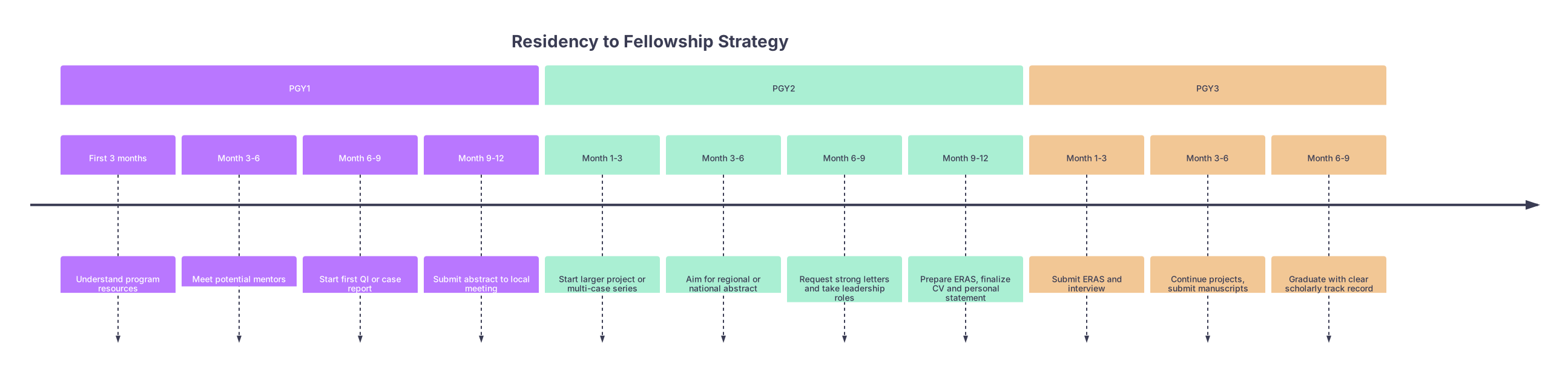
| Period | Event |
|---|---|
| PGY1 - First 3 months | Understand program resources |
| PGY1 - Month 3-6 | Meet potential mentors |
| PGY1 - Month 6-9 | Start first QI or case report |
| PGY1 - Month 9-12 | Submit abstract to local meeting |
| PGY2 - Month 1-3 | Start larger project or multi-case series |
| PGY2 - Month 3-6 | Aim for regional or national abstract |
| PGY2 - Month 6-9 | Request strong letters and take leadership roles |
| PGY2 - Month 9-12 | Prepare ERAS, finalize CV and personal statement |
| PGY3 - Month 1-3 | Submit ERAS and interview |
| PGY3 - Month 3-6 | Continue projects, submit manuscripts |
| PGY3 - Month 6-9 | Graduate with clear scholarly track record |
PGY‑1: Lay the Foundation, Launch Easy Wins
Key objectives:
- Establish reputation as reliable, hardworking, not flaky.
- Secure at least one faculty mentor in or close to your target subspecialty.
- Complete at least one simple scholarly product (case report, QI poster).
Minimum output by end of PGY‑1:
- 1 submitted abstract (local/regional)
- 1 ongoing project with your name clearly attached
PGY‑2: Scale Output, Deepen Specialty Signal
Key objectives:
- Start or join one more substantial project (multi‑case series, retrospective chart review, or robust QI).
- Present at regional or national meeting in your target field.
- Build leadership or teaching credibility (chief of QI project, report leader, curriculum builder).
Minimum output by time you submit ERAS:
- 2–4 scholarly items total (mix of case reports, QI, abstracts, maybe 1 manuscript under review)
- At least two letters from subspecialists who know you well
PGY‑3: Consolidate, Finish, and Signal Trajectory
Key objectives:
- Convert in‑progress projects into submissions.
- Use interviews to reinforce your narrative: “I built this track record without a huge research engine behind me.”
- Keep working on projects even post‑interview; PDs talk, word travels.
By graduation:
- 3–6 scholarly products total
- At least 1 accepted or in‑press manuscript is ideal, but not mandatory for many programs
- Clearly defined “angle” (e.g., sepsis QI in PCCM, HF readmissions in cards, IBD workflows in GI)
Step 4: Create Projects That Fit a Low‑Research Environment
You do not have the bandwidth for multi‑center RCTs. Stop trying to emulate Brigham from a community program of 12 residents.
You need fast‑cycle, feasible projects that check academic boxes with less bureaucracy.
Four high‑yield project types that work almost anywhere
Case reports and small case series
- Lowest barrier.
- Perfect for rare presentations or complications.
- Good first step to learn the mechanics: IRB (if needed), literature review, submission, revisions.
Protocol:
- Start a running list of “interesting” cases on your phone.
- Once a week, review the list with a subspecialty mentor.
- Pick 1–2 per month worth writing up.
- Aim to pair each case with:
- 1 poster (local/regional)
- 1 short manuscript submission (even if to a modest journal)
Quality improvement (QI) projects
- Many community hospitals love QI.
- Faster IRB/administrative pathway.
- Shows impact on systems, which fellowship PDs appreciate.
Target ideas in your field:
- Cards: optimizing HF discharge instructions, reducing missed follow‑up for elevated troponin.
- GI: improving colonoscopy prep quality, reducing inappropriate PPI use.
- Heme/Onc: standardizing febrile neutropenia workup.
Basic QI cycle:
- Identify pain point → collect baseline data → design simple intervention → re‑measure → present → write up.
-
- Slightly heavier lift but high yield.
- Works best if your hospital has decent EMR data access.
Example:
- PCCM: outcomes of ICU patients with COVID versus influenza over 3 years.
- Cards: predictors of readmission post‑NSTEMI in your community hospital.
You must:
- Find a mentor who can help with IRB.
- Define a narrow, clean question.
- Use simple, realistic outcomes (LOS, readmission, mortality, order utilization).
Educational projects
- Curriculum design.
- Simulation scenarios with evaluation data.
- Teaching tools for interns/med students.
These are easier to execute and can still be turned into:
- Posters
- MedEd articles
- Workshop presentations at national meetings
Step 5: Build a Mentorship “Board,” Not a Single Hero
In non‑research residencies, there usually is no single superstar who will carry you. You need a small board.
Aim for 3–5 people:
1 primary clinical mentor in your target field
- Knows your day‑to‑day performance.
- Will likely write your strongest letter.
1–2 project mentors
- May or may not be in your target subspecialty.
- Their job is to help you actually finish work: design, analysis, writing.
1 external mentor if your hospital affiliates with a university
- Someone at the academic partner who can:
- Add prestige to your letter.
- Pull you into more academic projects if you prove yourself.
- Someone at the academic partner who can:
How to approach without being annoying:
- Show up with ideas, not “I want to do research, what do you have?”
- “I noticed we have a lot of readmissions for decompensated HF. I am interested in cards. Could we design a small project around this?”
- Offer to do grunt work:
- Data collection, chart review, lit search, figure formatting.
Your mentors need to see:
- You follow through on tasks.
- You protect deadlines even on busy months.
- You do not disappear post‑abstract.
That is how small projects turn into strong letters.
Step 6: Turn Clinical Work into Scholarly Output Without Burning Out
You cannot treat research as something separate “over there.” You will not have time. You must embed it in clinical care.
Here is how.
Mine your own cases systematically
- Once a week, spend 15–20 minutes skimming:
- Interesting admissions
- Unusual complications
- Complex diagnostic puzzles
- Keep a shared spreadsheet with a mentor:
- MRN (or coded ID)
- Diagnosis
- Key teaching point
- Whether it is case‑reportworthy
- Once a week, spend 15–20 minutes skimming:
Standardize your write‑up workflow
- Keep templates for:
- Case reports
- Abstracts
- Posters
- Use the same structure each time.
- Recycle sections (intro, methods) after you improve them.
- Keep templates for:
Batch your “academic time”
- Pick two fixed time blocks weekly (e.g., Tuesday 7–9 pm, Sunday 2–4 pm).
- Those are research-only:
- No notes.
- No board questions.
- No email.
Say no to random, off‑trajectory projects
- The pathology attending who wants you on a dermatopathology case series when you want GI? Probably no.
- Exception: early in PGY‑1 when you just need your first product fast.
Non‑research residents burn out when they try to do everything. You do not need 15 random posters. You need 3–6 coherent outputs that tell a story.
Step 7: Track and Showcase Your Progress Like a Professional
Fellowship PDs are pattern recognizers. They care less about your one “big project” and more about whether you built visible momentum.
You need a living academic CV and a simple dashboard.
| Category | PGY1 Goal | PGY2 Goal | PGY3 Goal |
|---|---|---|---|
| Abstracts Submitted | 1 | 2–3 | 1–2 |
| Posters Presented | 1 | 2 | 1 |
| Manuscripts Submitted | 0–1 | 1–2 | 1–2 |
| Active Projects | 1–2 | 2–3 | 1–2 |
Keep:
- A CV document updated monthly.
- A one‑page “project status” doc with:
- Project title
- Role (first author, co‑author)
- Status (idea, data, writing, submitted, accepted)
- Target conference/journal
- Collaborators
Send that to mentors quarterly. It signals seriousness and helps them plug you into opportunities.
Step 8: Fix the Two Non‑Negotiables – Scores and Clinical Performance
You will not out‑research a Hopkins applicant from a pure community program. You do not need to. But you cannot have red flags on the basics.
Step 2 / In‑Training Scores
For competitive fellowships:
- High Step 2 CK or strong in‑training exam percentiles are your friend.
- If Step 1 was mediocre, Step 2 becomes more important.
If your tests are average:
- Lean harder on:
- Clean transcripts (no repeats, no remediation).
- Very strong letters emphasizing clinical sense and work ethic.
- Concrete QI/education impact.
Clinical reputation
Ask attendings you trust:
- “If you were writing my letter today, what would you say?”
- “What would keep you from giving me an unqualified recommendation?”
Then actually fix what they say:
- Chronically late notes? Fix your template, pre‑chart.
- Weak presentations? Use bullet formats, practice 1 minute “elevator” case summaries.
- Struggle with procedures? Pick 2–3 high‑yield ones and deliberately track how many you do, ask for feedback.
Fellowship PDs will forgive lower research density from a community program. They will not forgive a weak clinician.
Step 9: Get Real about Program Selection and Networking
Your path is not just “do things where I am.” You must also be deliberate about where you apply and who knows you.
Tier your target programs honestly
Stop obsessing about brand names only. You need programs that:
- Value strong clinical training plus tangible effort.
- Have a history of taking applicants from community residencies.
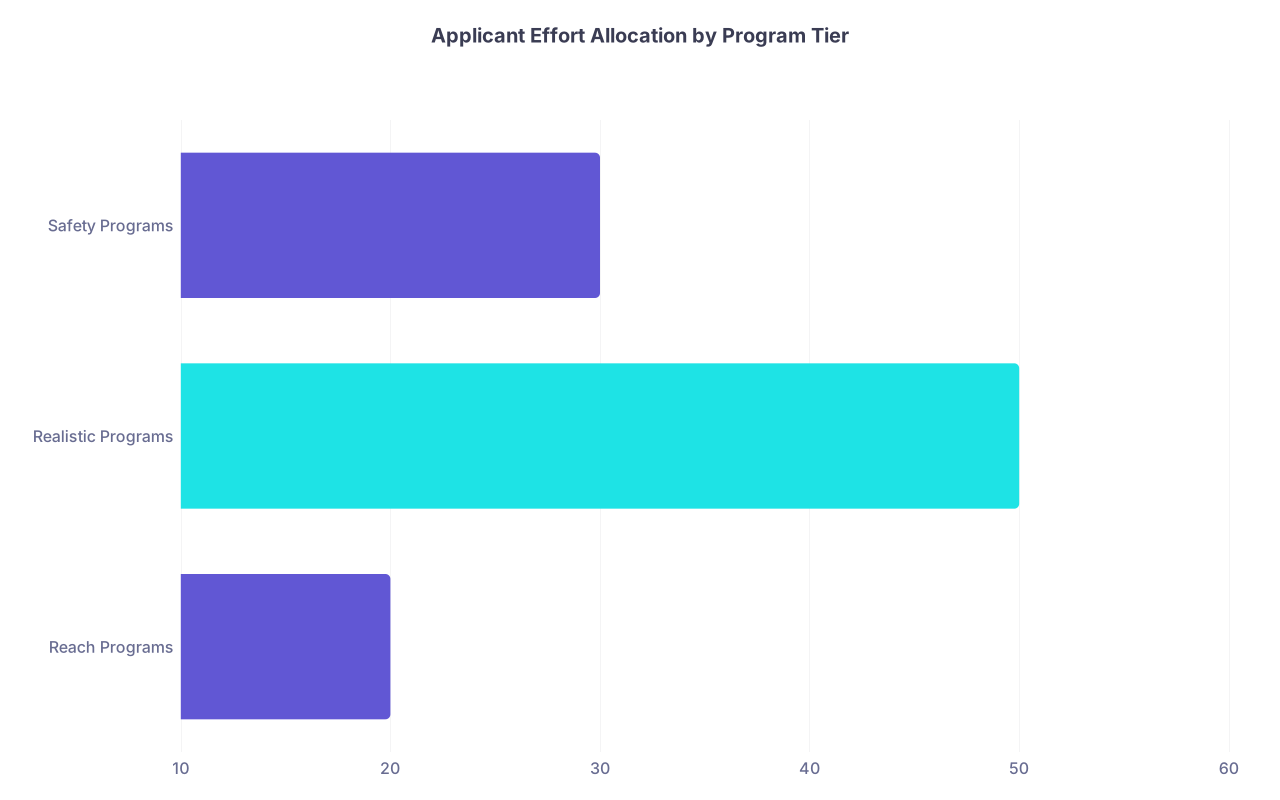
| Category | Value |
|---|---|
| Reach Programs | 20 |
| Realistic Programs | 50 |
| Safety Programs | 30 |
Practical breakdown:
- 20% applications: “reach” academic giants.
- 50%: solid university‑affiliated and mid‑tier programs.
- 30%: community or hybrid fellowships known to take people like you.
How to identify the realistic category:
- Look at current fellows’ residency backgrounds.
- Email recent alumni from your residency who matched there.
- Use national meeting networking: ask people directly, “Have you worked with fellows from community IM/EM/FM programs?”
Use electives strategically
If you get outside electives:
- Do them at institutions with fellowships in your target field.
- Treat them as 4‑week interviews.
On those electives:
- Be early.
- Offer to present a topic.
- Ask for involvement in ongoing research in a limited, clearly defined way.
At the end, if you did well:
- Ask directly: “Do you ever interview residents from community programs? Would I be competitive for your fellowship with my trajectory?”
That answer is intel, not a verdict. Use it to refine your list.
Step 10: Letters of Recommendation That Overcompensate for Your Program
From a non‑research residency, your letters must punch above your institution’s weight.
You want:
- 1 letter from your PD.
- 2–3 letters from subspecialty attendings in or near your target fellowship.
Those subspecialist letters should:
- Explicitly acknowledge your environment:
- “Despite training in a predominantly community program with limited research infrastructure…”
- Highlight your trajectory:
- “Took initiative to design and complete a QI project that reduced X by Y%.”
- Compare you:
- “Comparable or superior to fellows I have worked with at [bigger institution].”
Your job is to feed them content:
- Send your updated CV.
- Summarize your projects and roles.
- Remind them of specific episodes they witnessed (a complex case, a teaching session you led).
Do this 6–8 weeks before ERAS deadlines. Do not assume they remember everything.
Step 11: Tell a Coherent Story in Your Personal Statement and Interviews
You will get the inevitable question, spoken or unspoken:
“You trained at a non‑research heavy, community program. Why should we believe you belong in our academic fellowship?”
Your answer must be practiced and specific. Rough structure:
Own the setting
- “My residency training was primarily community‑based, with heavy clinical exposure and more limited built‑in research infrastructure.”
Show what you extracted from it
- “That environment forced me to be intentional. I sought out mentors, built QI and case-based projects from daily work, and learned how to move projects forward without a large support staff.”
Connect to your trajectory
- “Over three years, that approach led to [X posters, Y manuscripts, Z QI changes] centered on [your specific theme].”
Tie to what you want from them
- “In your program, I am looking for deeper exposure to [specific area], more robust collaboration, and the chance to scale what I started into more formal research.”
You are not apologizing for your residency. You are demonstrating that you squeezed it for all it was worth.
Step 12: Use Conferences and Virtual Events to Punch Above Your Weight
Non‑research residents often treat national meetings like vacations. You cannot afford that.
At each conference:
- Know exactly which programs you are targeting.
- Attend their fellows’ or PDs’ sessions.
- Ask one or two intelligent, concise questions after talks.
- Introduce yourself briefly:
- Name, residency, interest, and a specific reason you care about their program.
If you have a poster:
- Stay at your poster.
- Bring a 30‑second explanation.
- Have a small card or short link to your email/CV if anyone wants to follow up.
Virtual events:
- Many fellowships hold webinars or info sessions.
- Turn your camera on, engage mildly, and ask one thoughtful question.
- It may get your name recognized later when your application hits their pile.
Step 13: Contingency Planning – If You Do Not Match the First Time
Sometimes you do everything right and still do not match. Competitive fields are brutal.
If that happens:
Do not disappear. Email programs that interviewed you:
- “Thank you again for interviewing me. I did not match this cycle. I am very committed to [field]. I would appreciate any specific feedback on how to strengthen my application.”
Consider a research or chief year
- At your home institution or an academic partner.
- Focused on:
- More robust research output.
- Increased teaching/leadership.
- Then reapply with clearly stronger metrics.
Do not burn bridges
- Stay professional with your PD and mentors.
- Their support becomes even more important in a second cycle.
Final Takeaways
A non‑research residency is a constraint, not a death sentence. You can still build a competitive fellowship application if you treat the next 2–3 years like a structured project, not a vague dream.
You win by being intentional: clear fellowship target, realistic projects that fit your environment, a small but active mentor “board,” and a coherent story that ties your clinical work, QI, and research together.
Fellowship PDs are not looking for perfection from community programs. They are looking for momentum, follow‑through, and evidence that you did more than the minimum with what you had. Build that record, and you will be competitive where it counts.


