

How to Fix a Residency CV That Looks “Too General” for Fellowship
You are on an ICU night shift. It is 2:15 a.m. Between pages, you open your CV to add a recent case report. You read it top to bottom and feel that familiar sinking feeling.
It reads like every other resident you know.
Rotations. Generic bullet points. “Presented at morning report.” “Participated in QI.” Nothing that screams, “This is a future cardiologist / heme-onc doc / GI fellow you must interview.”
And now you are a few months out from fellowship applications. Faculty keep saying, “You need to tailor your CV.” You smile, nod, and then stare at the same document you have had since MS4.
Let me be direct: a “general” CV kills momentum before anyone even opens your letters. It tells fellowship programs you have not committed, have not differentiated yourself, and might just be browsing their specialty.
The good news: you can fix this. Even if you are late. Even if you do not have a first-author NEJM paper. You just need to reframe and restructure what you already have, then fill a few strategic gaps.
Here is how to do it, step by step.
Step 1: Diagnose Why Your CV Looks Generic
Before you start editing blindly, you need to know what is wrong. There are typical failure patterns. I have seen the same issues on dozens of residents’ CVs.
The 6 red flags of a “too general” residency CV
If your CV has any of these, you are in the danger zone:
No clear specialty signal
- Nowhere near the top does it say “Career goal: Pulmonary and Critical Care Medicine” or equivalent.
- Your electives list is a mix of everything with no pattern.
- Your research is “internal medicine outcomes” with no subspecialty focus.
Vague, interchangeable bullets
- “Cared for patients with acute and chronic conditions.”
- “Worked in multidisciplinary team to improve patient care.”
- These could belong to any resident in any specialty.
Buried or minimized relevant experiences
- That ICU QI project you did is three bullet points under “Other.”
- Your poster at a subspecialty conference is lost in “Miscellaneous Presentations.”
No specialty-facing leadership or service
- All leadership is generic: chief of wellness committee, intern rep.
- Nothing like: journal club lead in your specialty, subspecialty interest group leader, educational session organizer in your field.
Scattered or unfocused scholarly work
- Case report in cardiology, chart review in nephrology, QI in palliative care.
- Reads like you dabbled in many things, committed to none.
No “voice” that matches the fellowship
- The document reads like a residency application CV, not a subspecialty career document.
- No section that says clearly: “Here is everything I have done that prepares me for X fellowship.”
If you are seeing yourself in most of those, good. We know what we are fixing.
Step 2: Decide Your Specialty Story and Anchor Everything to It
Programs do not need you to be a mini-expert. They want to see a believable trajectory.
Your job is to create a coherent narrative: “This person has been moving toward this field for a while, and their choices make sense.”
Define your target in one sentence
Write this at the top of a scratch sheet (not in your CV yet):
- “I am an IM resident applying to cardiology with a focus on advanced heart failure.”
- “I am a peds resident applying to NICU with a strong interest in neonatal outcomes research.”
- “I am a general surgery resident applying to vascular surgery with a focus on limb preservation.”
That sentence is your filter. Every line on your CV will be:
- Directly relevant,
- Indirectly supportive (skills, leadership, teaching),
- Or expendable / compressible.
If you cannot write that sentence clearly, you do not have a CV problem. You have a career decision problem. Solve that first with a mentor, not with formatting tricks.
Step 3: Rebuild the CV Structure Around the Fellowship
Now you re-organize. Not just tweaking bullets. You change the skeleton.
Here is the structure I recommend for a fellowship-focused CV. The order matters.
- Header / Contact information
- Career Goal or Professional Summary (2–3 lines)
- Education and Training
- Fellowship-Relevant Clinical Experience
- Research and Scholarly Activity (subspecialty-focused)
- Presentations and Publications
- Teaching and Educational Activities
- Leadership and Service (specialty-focused first)
- Honors and Awards
- Certifications, Skills, and Other
Notice what is missing: a giant, undifferentiated “Clinical Experience” blob. You are going to split and emphasize.
Add a short “Career Goal / Professional Summary”
Right under your name and contact info:
Career Goal
Internal Medicine resident pursuing fellowship training in Gastroenterology with a focus on inflammatory bowel disease and clinical outcomes research.
Or:
Professional Summary
Third-year Pediatrics resident with sustained commitment to Neonatal-Perinatal Medicine, combining high-acuity NICU experience, outcomes-focused research, and resident-led quality improvement initiatives.
This is the first place you stop looking “general.”
Step 4: Reframe Your Clinical Experience to Signal the Specialty
You cannot change what rotations you did. You can absolutely change how they are presented.
Create a “Fellowship-Relevant Clinical Experience” section
Pull out any rotations, electives, or roles that clearly point toward your target specialty. Put them above generic residency chronology.
Examples:
- ICU and stepdown rotations for pulm/CCM
- Cardiology wards and CCU electives for cardiology
- NICU / PICU for neonatology / CCM
- Hepatology and advanced endoscopy exposure for GI
- Heme-onc inpatient and infusion center for oncology
Structure it like this:
Fellowship-Relevant Clinical Experience
Internal Medicine Residency – PGY-2 to PGY-3
- Cardiology Inpatient Rotation (4 blocks total) – Managed decompensated heart failure, NSTEMI, complex arrhythmias; daily interaction with heart failure and EP services.
- CCU Rotation (2 blocks) – Primary resident for patients on vasopressors, inotropes, mechanical circulatory support; coordinated care with cardiology fellows and attendings.
- Advanced Heart Failure Elective (2 weeks) – Participated in transplant and LVAD clinics; observed transplant selection meetings and right heart catheterizations.
You are not padding. You are exposing what was already there.
Compress the rest of your clinical work
After that section, you can have:
Additional Clinical Experience
Internal Medicine Residency, XYZ Hospital, 20XX–20XX
- Completed core rotations in general medicine, ED, geriatrics, and subspecialty clinics, caring for a diverse urban patient population.
Do not waste lines describing generic ward duties. Fellowship PDs know what residents do. Use space where it matters.
Step 5: Make Your Research Look Intentional (Even if It Was Not)
A lot of residents panic here. “My research is all over the place.” Fine. You align what you can and deprioritize the rest.
Group research by relevance, not chronology
Within Research and Scholarly Activity, create subsections:
- Subspecialty-Focused Research
- Other Research and Scholarly Work
Example for someone targeting GI:
Research and Scholarly Activity
Gastroenterology-Focused Research
Resident Investigator, Outcomes of Early Biologic Therapy in Moderate to Severe Ulcerative Colitis
Department of Medicine, XYZ Hospital, 2023–present
- Retrospective cohort study of 250 patients assessing time to steroid-free remission and hospitalization rates after early biologic initiation.
- Responsible for data extraction, REDCap database management, and preliminary statistical analysis (logistic regression, Kaplan-Meier).
Co-investigator, QI Initiative to Improve Hepatitis C Screening in Hospitalized Patients
XYZ Hospital, 2022–2023
- Implemented EMR-based prompts and resident education; increased screening completion rate from 52% to 88% over 6 months.
Then:
Other Research and Scholarly Work
- Co-investigator, Medication Reconciliation Accuracy on General Medicine Wards, 2021–2022.
- Contributor, Educational podcast series for internal medicine board review, 2021.
You are not hiding non-GI work. You are controlling what the reader sees first and what seems central to your trajectory.
Step 6: Rewrite Bullets From Generic to Fellowship-Targeted
This is where you stop sounding like a generic resident.
Your goal: every major bullet in key sections should either:
- Use specialty-relevant language, or
- Highlight a transferable skill that matters in that field (procedures, high-acuity care, longitudinal management, data skills, teaching, QI).
Before vs after examples
Generic ICU bullet (bad for any fellowship):
- Managed critically ill patients with multi-organ failure.
Pulm/CCM-oriented:
- Managed ventilated patients with ARDS, COPD exacerbations, and septic shock; independently adjusted ventilator settings and titrated sedation under supervision.
Cardiology CCU rotation:
Bad:
- Cared for patients with cardiac conditions on the CCU.
Better:
- Primary resident for CCU patients with cardiogenic shock, post-MI complications, and complex arrhythmias; coordinated care with heart failure, EP, and interventional teams.
Teaching bullet for a future academic fellow:
Generic:
- Taught medical students during rotation.
Better:
- Led weekly case-based teaching for MS3s on the cardiology service, focusing on EKG interpretation, ACS risk stratification, and evidence-based management.
Aim for 2–4 high-yield bullets under major experiences. Cut the fluff.
Step 7: Fix the “Activities” and “Leadership” Section
This is usually where the generic CV really shows. Random committees. Wellness events. Nothing wrong with that, but you need to prioritize and reframe.
Create a “Specialty-Focused Leadership and Service” subsection
Examples:
Leadership and Service
Cardiology-Focused Activities
- Founder and Coordinator, Resident Cardiology Interest Group, XYZ Hospital, 2022–present
- Organized monthly ECG workshops and case conferences with cardiology faculty; increased resident attendance from 6 to 25 per session.
- Co-organizer, Cardiology Journal Club, 2023–present
- Selected and presented landmark and recent trials (e.g., EMPEROR-Reduced, DAPA-HF) with emphasis on critical appraisal and clinical application.
Then:
Additional Leadership and Service
- Member, Residency Wellness Committee, 2021–2023.
- Volunteer, Student-run free clinic, 2021–2022.
You signal that your leadership is increasingly oriented toward your field.
Do not underestimate “small” specialty activities
Things you might be undervaluing:
- Organizing a specialty board review series.
- Running a case conference or M&M related to your target field.
- Helping with recruitment dinners specifically for that fellowship.
If it ties to your field or shows responsibility within that subspecialty world, it belongs near the top.
Step 8: Make Your Presentations and Publications Work for You
Even with minimal output, you can make this section look purposeful instead of random.
Separate by type, and highlight subspecialty work first
Order:
- Subspecialty-focused oral presentations
- Subspecialty posters
- Other posters / talks
- Publications (if few) mixed into appropriate sections, or separate “Publications” if enough volume
Example:
Presentations and Publications
Subspecialty-Focused
- Doe J, Smith A. Early Biologic Use in Moderate to Severe Ulcerative Colitis. Poster presented at: American College of Gastroenterology Annual Scientific Meeting; October 2023; Vancouver, Canada.
- Doe J. Improving Hepatitis C Screening on a Resident Inpatient Service. Oral presentation, Department of Medicine Quality Improvement Day; June 2022; XYZ Hospital.
Additional Scholarly Presentations
- Doe J. Medication Reconciliation Errors on Admission. Poster presented at: XYZ Hospital Research Day; May 2021.
If you have one relevant poster, it should not be buried as item 7 in a chronological list.
Step 9: Tune the “Other Stuff” – Skills, Certifications, Awards
This area is often an afterthought. It should not be.
Emphasize skills that matter in your fellowship
For instance:
- For ICU / CCM:
- Central lines, arterial lines, intubation exposure, ventilator management, point-of-care ultrasound.
- For cardiology:
- EKG interpretation, echo exposure, cardiac catheterization observation, telemetry review.
- For GI:
- Endoscopy observation, liver biopsy clinic exposure, nutrition support.
Do not lie. Do not oversell. But do not bury either.
Example:
Certifications and Skills
- Advanced Cardiac Life Support (ACLS), current.
- Proficient in EKG interpretation and ACS risk stratification.
- Basic point-of-care ultrasound skills (IVC assessment, lung ultrasound for B-lines and pleural effusions); completed 15 supervised exams.
Awards: move any that align with your field higher in the list.
Step 10: Time Reality Check – What If You Are Late?
Here is the uncomfortable part. Some gaps you cannot fix 3 months before ERAS opens. You cannot magically become first author in a high-impact journal.
But there are focused, realistic moves you can still make in 3–6 months that materially improve how “specialty-specific” your CV feels.
A realistic late-stage action plan

| Step | Description |
|---|---|
| Step 1 | Today |
| Step 2 | Rebuild CV structure |
| Step 3 | Identify specialty-relevant gaps |
| Step 4 | Start quick scholarly project |
| Step 5 | Maximize framing of existing work |
| Step 6 | Submit abstract or case report |
| Step 7 | Add targeted teaching or leadership |
| Step 8 | Have mentor review CV |
| Step 9 | 3-6 months before apps? |
If you have 3–6 months
Prioritize:
- A quick, realistic scholarly product in your specialty
- Case report or case series with a subspecialty fellow or attending.
- Short QI project that touches your field (screening, guideline adherence, order set cleanup).
- Retrospective chart review where the data can be pulled fairly quickly.
Even if it is “abstract submitted” by application time, that is fine.
One visible leadership or teaching activity in the field
- Organize a 2–3 session mini-series (journal club, case conference, board review) in collaboration with faculty.
- Take ownership of updating a teaching module specific to your specialty.
Direct clinical exposure
- Ask to schedule or add an elective in the fellowship’s core area before applications (or at least before interview season).
- If rotation slots are tight, negotiate a focused 1-week mini-rotation or “day per week” shadow schedule with the fellowship program.
If you have less than 3 months
You focus on framing, not acquisition:
- Make sure your most relevant work is clearly labeled and up top.
- Rewrite every vague bullet that touches your target field.
- Ask a faculty member in the specialty to review your CV and highlight where they see relevance that you are not emphasizing.
- Add even small, time-limited leadership/teaching tasks that can be honestly included:
- Leading one subspecialty journal club.
- Giving one noon conference on a topic in the field.
Step 11: Quick Reality Check With a Program Director Lens
At this point, you need an external eye.
The test is simple:
- Hand your CV to a faculty member in your target specialty.
- Ask one question:
“If you saw only this CV, with no personal statement or letters, how clearly would you think I am heading toward [specialty]?”
You want them to say something like:
- “Yes, you look like a reasonable early GI person.”
- “You look like someone genuinely aiming for heme-onc.”
If you get:
- “You look like a solid general IM resident.”
Then you still have work to do on structure and emphasis, not on substance.
Example: Before vs After Snapshot
Let me show you what I mean in compressed form.
| Section | Generic Residency CV | Fellowship-Focused CV |
|---|---|---|
| Top summary | None | Career Goal: Pulmonary and Critical Care Medicine |
| Clinical experience | Big list of all rotations chronologically | Pulm/CCM Clinical Experience section at top |
| Research section | Chronological list, mixed topics | Pulm/CCM research subsection listed first |
| Leadership/activities | Wellness, residency committees only | Pulm interest group, ICU QI leadership highlighted |
| Presentations | All posters mixed together by date | Pulm/CCM abstracts and talks listed separately first |
This is the kind of difference programs pick up in 10–15 seconds of skimming.
Step 12: Format Like Someone Who Knows What They Are Doing
Sloppy formatting screams “I updated this in a rush.”
Basic rules that matter more than you think:
- One font, one size family. Bold for headings, italics for roles. Stick to it.
- Dates all right-aligned, same format (e.g., “2022–2024” or “Jul 2022–Jun 2024”).
- No narrative paragraphs in your CV. Short bullets only.
- Page length:
- PGY-2/3 resident: typically 2–4 pages is fine if content is real and focused.
- Section headings that are scannable:
- “Gastroenterology-Focused Research,” not “Research Projects.”
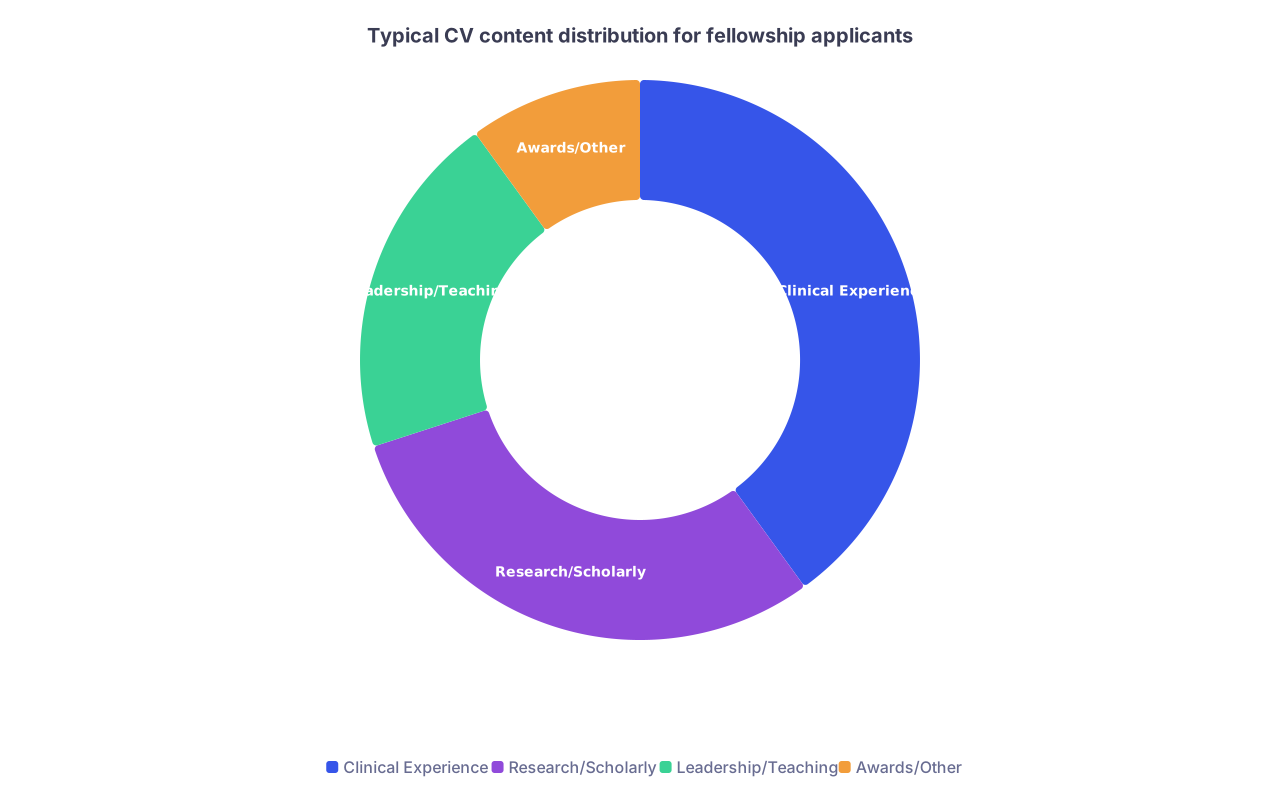
| Category | Value |
|---|---|
| Clinical Experience | 40 |
| Research/Scholarly | 30 |
| Leadership/Teaching | 20 |
| Awards/Other | 10 |
If you are at 80% generic clinical descriptions and 5% research/leadership, you look unprepared for an academic fellowship.
Step 13: Align CV, Personal Statement, and Letters
One more thing applicants forget: your CV does not stand alone.
Fellowships look at:
- CV
- Personal statement
- Letters of recommendation
- Interview
These must all tell a coherent story. Not identical words, but the same spine.
So, after you fix your CV:
- Update your personal statement so the examples and experiences you highlight are the same ones you have elevated in your CV.
- When you talk to letter writers:
- Hand them the updated CV, not the old one.
- Explicitly point them to the experiences you most want emphasized.
- In interviews:
- Be ready to talk, in detail, about anything you put in your “Fellowship-Relevant” sections. If you cannot speak confidently about a project or role, it should not be front and center.

Common Traps You Need to Avoid
A few mistakes I have watched residents make repeatedly:
- Overinflating trivial specialty exposure
- “Managed numerous LVAD patients independently” when you actually wrote a couple of notes under close supervision. Do not do this. Fellows and attendings can smell it.
- Listing “interests” without evidence
- “Interests: cardiology, nephrology, oncology, medical education, global health.” That says you could not pick.
- For fellowship applications, list 1–2 aligned interests that match your CV content.
- Copy-pasting residency job descriptions
- PDs know what interns do. They do not need three bullets on cross-covering floors. If your bullet could appear on 90% of residents’ CVs, rewrite or cut it.
- Ignoring gaps
- “No research in my field” does not mean you skip the section. You frame what you have and start something now, even if it will only be “in progress” on your CV.
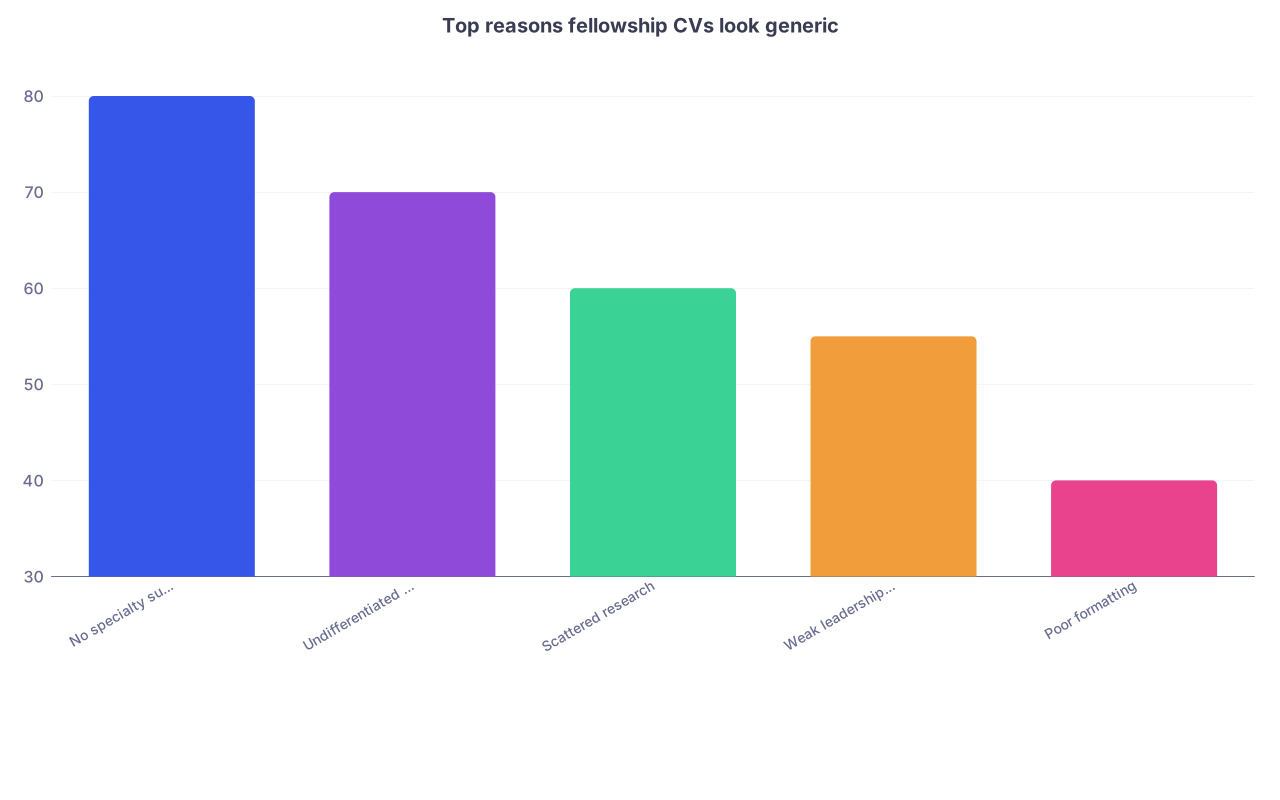
| Category | Value |
|---|---|
| No specialty summary | 80 |
| Undifferentiated clinical section | 70 |
| Scattered research | 60 |
| Weak leadership signal | 55 |
| Poor formatting | 40 |
Put It All Together: A Quick Implementation Checklist
You are busy. Here is the practical sequence.
- Clarify specialty target – One sentence on your trajectory.
- Add Career Goal / Professional Summary – 2–3 lines at top.
- Restructure sections – Move fellowship-relevant clinical, research, and leadership to the top of each corresponding section.
- Rewrite bullets – Kill vague language. Use specialty terms and concrete responsibilities.
- Group and label research and presentations – Subspecialty first, then other.
- Tune “Other” sections – Skills, certifications, and awards that matter for your specialty up front.
- Get a specialty faculty review – Ask bluntly if your CV reads as a serious applicant for that field.
- Make 1–2 fast, targeted moves – Small project, case report, teaching session before apps if time allows.
- Sync with personal statement and letters – Same spine, different angles.

Bottom Line
Three key points and then you can get back to your patients:
- A “too general” CV is usually a structure and emphasis problem, not a talent problem. Rebuild the CV around your target fellowship and lead with the most relevant clinical, research, and leadership experiences.
- You do not need a perfect subspecialty portfolio. You do need a coherent, believable trajectory: your bullets, sections, and ordering all point toward one field.
- Even late in residency, you can make small, high-yield changes—one focused project, one teaching role, better framing—that shift you from “solid resident” to “clear future fellow” on paper.


