

The usual fellowship advice is backward. People tell you to “build your portfolio over years.” You do not have years. You have about six months before your application snapshot freezes. So you need an attack plan, not vibes.
Here is the blunt reality: in most competitive fellowships, your six‑month window (typically January–June of PGY‑2 or early PGY‑3, depending on specialty) decides how your CV looks when ERAS locks in. You cannot redo those months later. But you can engineer them.
This is how you build a targeted, believable, fellowship‑ready portfolio in six months without blowing up your sanity or your residency evaluations.
1. Know Exactly What Your Target Fellowship Wants
You cannot build a “strong” portfolio in six months. You can build a targeted one. Big difference.
First step: define the bullseye.
Step 1: Pick a lane. Even if you are 80% sure.
You cannot optimize for “maybe cards, maybe GI, maybe hospitalist.” Pick one primary fellowship target. You can have a backup in your head, but your actions need a main storyline.
Examples:
- Internal medicine → Cardiology
- Pediatrics → Neonatology
- General surgery → Surgical oncology
- Anesthesia → Critical care or pain
- EM → Critical care or tox
If you are genuinely undecided between two, choose the one that:
- Has more mentors at your institution.
- Has more ongoing projects you can realistically join now.
- Matches your last year’s pattern of experiences (so it looks coherent, not random).
Step 2: Reverse engineer 10–15 programs
You are not guessing what programs value. It is all in front of you.
Do this over one evening:
Pick 10–15 realistic programs
Mix of:- 3–5 “reach”
- 4–7 “realistic matches”
- 3–5 “safety / home-type equivalents”
Pull data from three places for each program:
- Program website (faculty interests, current fellows’ backgrounds)
- Recent fellow bios (usually list med school, residency, research areas)
- Recent fellow publications (PubMed search by fellow name + specialty)
Track patterns in a simple table.
| Program Type | Typical Research | Extra Value-Adds | Common Theme |
|---|---|---|---|
| Academic A | Clinical outcomes, QI | Teaching, chief roles | Research + leadership |
| Academic B | Basic science, translational | MPH/PhD | Lab-heavy profiles |
| Academic C | Clinical trials, registries | Multi-center work | Team science |
| Community A | QI, case reports | Teaching, community engagement | Local impact |
| Community B | Minimal research | Strong letters, work ethic | Clinical strength |
You will usually see 2–3 main patterns:
- Type of research (QI vs trials vs lab vs case series)
- Weight on teaching vs leadership vs pure productivity
- Niche interests (heart failure vs EP, IBD vs motility, etc.)
Your goal in 6 months is to build a credible story that fits one of those patterns.
2. Map a Six-Month Portfolio Blueprint
You are not just “doing research.” You are building four pillars:
- Scholarly output
- Clinical alignment
- Leadership / teaching
- Narrative and documentation
You do not need to max all four. You need:
- 1–2 strong pillars
- 1–2 “good enough” pillars
- 0 glaring holes
Think in three 2‑month sprints.
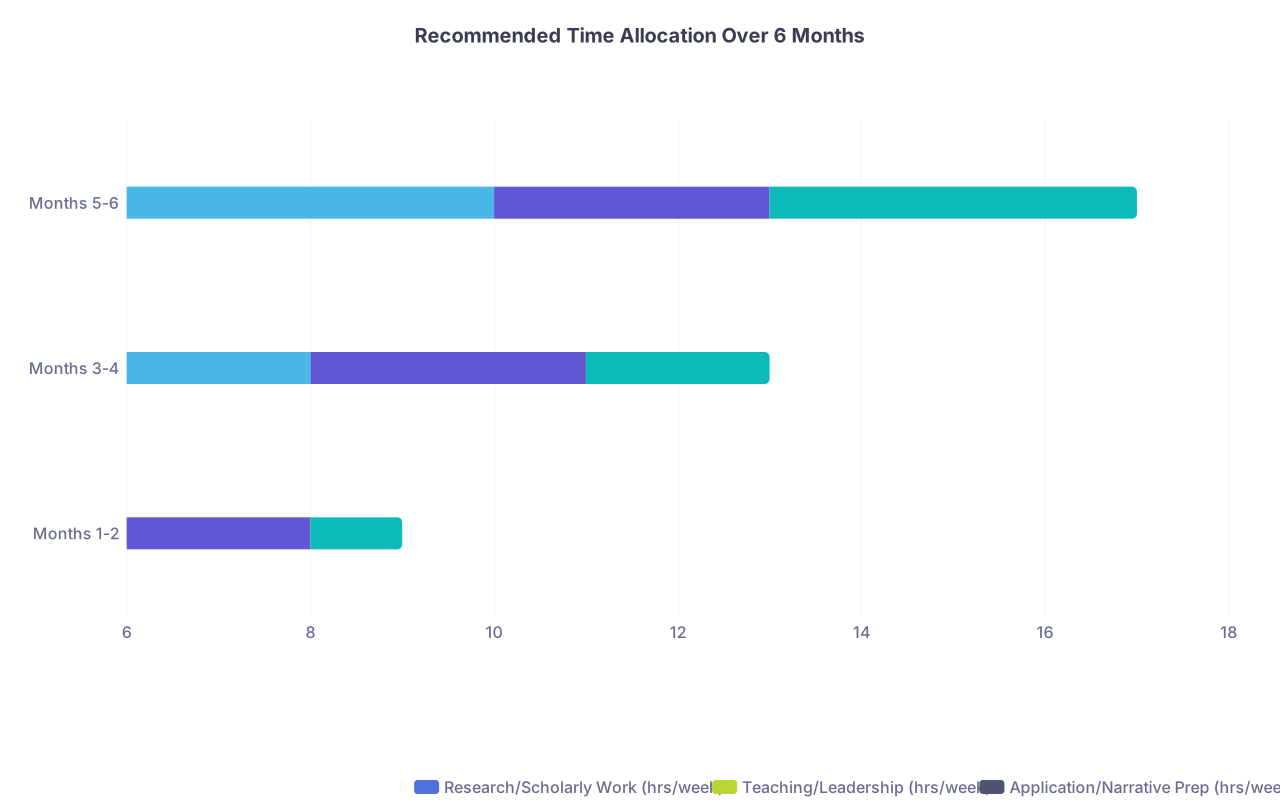
| Category | Research/Scholarly Work (hrs/week) | Teaching/Leadership (hrs/week) | Application/Narrative Prep (hrs/week) |
|---|---|---|---|
| Months 1-2 | 6 | 2 | 1 |
| Months 3-4 | 8 | 3 | 2 |
| Months 5-6 | 10 | 3 | 4 |
Target weekly time (average, knowing rotations vary):
- 8–10 hours/week research & writing
- 2–3 hours/week teaching/leadership
- 1–4 hours/week narrative/CV work (front-loaded lightly, back-loaded more)
If you are on ICU every other month, fine. You compress in lighter months. But this is the bandwidth you are aiming at.
3. Build Fast Scholarly Output That Actually Finishes
This is where most residents blow it. They chase sexy projects that will not finish for a year.
Your rule for a 6‑month window:
If it cannot realistically be submitted by Month 5, it is a bad primary project.
You want short-cycle wins + one medium project that may continue beyond apps.
High-yield project types for a 6‑month timeline
Case reports / case series
- Fastest route to a PubMed‑indexed byline.
- You are literally surrounded by cases. You just are not capturing them.
Retrospective chart reviews with narrow scope
- Single question, single service, single year or two.
- Pre-existing REDCap or database = gold.
Quality improvement project with real outcomes
- Already-required residency QI? Turn it into a presentable abstract/poster.
Education projects
- Curriculum you helped build + simple pre/post survey.
| Project Type | 6-Month Completion Chance | Best Use Case |
|---|---|---|
| Case report | Very high | Early win, niche interest |
| Case series | High | Unique pathology, ICU mix |
| Retrospective review | Moderate–High | Existing data, good mentor |
| QI project | High | Residency-mandated QI |
| Prospective trial | Very low | Do only as add-on, not main |
Month 1–2: Secure 2–3 “fast lane” projects
Script you actually use to email or approach faculty:
Dr. Smith,
I am a PGY‑2 in internal medicine very interested in cardiology fellowship, especially heart failure. I am working to build focused scholarly output over the next 6 months.I would like to get involved in 1–2 projects with a realistic chance of submission by early summer (case reports, small retrospective analyses, or secondary analysis of existing data). I am willing to do the legwork: chart abstraction, data cleaning, drafting manuscripts.
Are there any ongoing or paused projects in your group where an extra pair of hands could help move things to completion on that timeline?
Thank you for considering it,
[Name]
Key parts:
- You specify timeline and willingness to do grunt work.
- You target people already publishing, not “nice but inactive” attendings.
Your goal for Month 1:
- Commit to 1 anchor project (retrospective/QI/educational)
- Identify 2–3 case-report candidates and start drafting at least one
Execution protocol: how to make things actually finish
Define submission target on day 1
- E.g., “We are aiming for submission to Journal X or Y by June 1.”
- Forces scope control.
Lock authorship expectations early
- “If I do the data collection and primary drafting, is first authorship realistic?”
- You say this once. Clearly. Early.
Use a fixed weekly micro-plan
- 1 hour: pure writing (Intro/Methods/Background)
- 1–2 hours: literature pulls & references
- 4–6 hours: data/chart review, coding, REDCap, etc.
Push for small, regular check-ins
- 20–30 minutes every 2–3 weeks.
- Always come with something done: a figure, a table, draft paragraphs.
4. Turn Routine Clinical Work Into Fellowship-Relevant Assets
You do not have time to “add” a ton of extra clinical experiences. You repurpose what you already do.
Align your rotations with your story
Look at your next 6–9 months of schedule:
- Can you swap one general ward month for a subspecialty elective in your target field?
- Can you add a 2–4 week elective with your specialty’s service or lab?
Pick the 2–3 rotations that will appear on your application and say:
“This is where I confirmed my interest in [subspecialty] and built specific skills.”
On those rotations, you:
- Ask for targeted evaluations focusing on fellow-level skills (consultation, procedures, acuity management).
- Identify one attending whose letter you want and behave accordingly: consistent pre‑rounding, concise presentations, visible reliability.
Capture clinical material for scholarship
Every week on a relevant rotation, ask yourself:
Which patient this week would make a good teaching case, case report, or QI trigger?
When you see one:
- Write the MRN down (somewhere secure and HIPAA‑compliant according to your institution).
- Quickly mention to attending:
“This is a fairly unusual presentation of X. Would you be open to us writing this as a case report if it is appropriate?”
Half will say no. Some will say yes. Those are your leads.
5. Build Visible Teaching and Leadership With Minimal Time
Programs like to see that you are more than a data-collecting machine. They want to know you can be a fellow: someone who teaches, organizes, and takes initiative.
You do not have to be chief resident. You do need evidence of leadership and teaching.
Fast, high-yield teaching activities
You can do these in 6 months with 1–2 hours/week:
Create a mini-series of noon conferences in your target area.
- Example: “Three-part series on noninvasive hemodynamics in heart failure.”
- You give 1–2 talks.
- You help coordinate 1–2 others by fellows/attendings.
Regular medical student/Intern teaching
- On your ward or consult blocks, explicitly:
- Offer 10–15 minute chalk talks on 1 topic/day.
- Ask students what topics confuse them and build from there.
- Then:
- Ask your chief or PD to list you as “Teaching Resident” for that block.
- Request feedback that can be quoted in letters.
- On your ward or consult blocks, explicitly:
Involve yourself in residency education committees
- Curriculum committee
- Simulation sessions
- Journal club coordination
Micro-leadership that programs actually respect
You do not need a huge title. You need clear bullet points:
- Led redesign of ICU handoff template used by all residents on X service.
- Organized monthly subspecialty journal club attended by fellows and residents.
- Coordinated resident participation in hospital’s sepsis QI initiative.
If your residency has nothing set up, build a small, contained initiative:
- One journal club
- One simulation session
- One QI handoff tool pilot
Then document it cleanly on the CV.
6. Craft a Coherent Story Instead of a Random CV
By Month 4–5, you will have:
- Projects in progress
- Some submitted abstracts/case reports (maybe accepted)
- Some teaching and leadership entries
- A few strong rotations in your subspecialty
Now you shape the narrative those items will support.
Step 1: Identify your 2–3 “through-lines”
Common themes that actually work:
- “Clinical outcomes in [niche], especially high-risk or complex patients.”
- “Improving transitions of care and follow-up for [disease group].”
- “Medical education in [subspecialty] for residents and students.”
- “Procedural safety and quality in [field].”
Pick one main and one secondary theme.
Everything on your CV that is even vaguely related should be framed to reinforce those themes, without lying or stretching.
Examples:
- Case report on rare myocarditis → framed as part of your interest in complex heart failure presentations.
- QI project on readmission → positioned as part of your interest in longitudinal outcomes.
Step 2: Translate raw work into application-ready bullets
Your CV should not just say “Research assistant, Dr. X.” That is lazy.
Turn roles into impact:
- “Designed REDCap database and abstracted clinical data for 120 patients with [condition], enabling analysis of readmission predictors.”
- “First author on submitted manuscript examining [X] in [Y] population (under review).”
- “Developed and delivered a three-session curriculum for PGY‑1 residents on initial management of decompensated heart failure.”
Step 3: Start drafting personal statement by Month 4
Not in one sitting. You build from notes.
Personal statement outline that works:
- Concrete clinical moment that shows why this field, not generic “I love complex physiology.”
- Bridge to pattern: 2–3 experiences over the last year that were clearly aimed at this field.
- Evidence of discipline: what you actually did in research, teaching, clinical work.
- Forward-looking paragraph: what you want to develop further in fellowship and beyond.
- Tight closing sentence: no poetry, no clichés. Just a clear statement of purpose.
You are not trying to be original. You are trying to be coherent and believable.
7. Operationalize the Six-Month Plan: A Concrete Timeline
Let us put this into a step-by-step schedule.
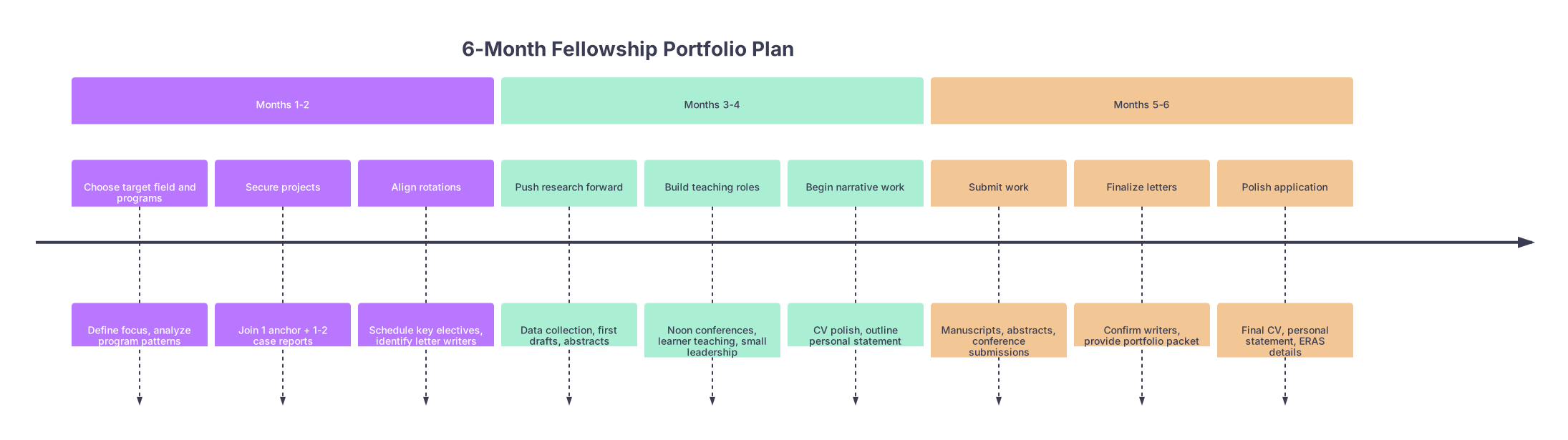
| Period | Event |
|---|---|
| Months 1-2 - Choose target field and programs | Define focus, analyze program patterns |
| Months 1-2 - Secure projects | Join 1 anchor + 1-2 case reports |
| Months 1-2 - Align rotations | Schedule key electives, identify letter writers |
| Months 3-4 - Push research forward | Data collection, first drafts, abstracts |
| Months 3-4 - Build teaching roles | Noon conferences, learner teaching, small leadership |
| Months 3-4 - Begin narrative work | CV polish, outline personal statement |
| Months 5-6 - Submit work | Manuscripts, abstracts, conference submissions |
| Months 5-6 - Finalize letters | Confirm writers, provide portfolio packet |
| Months 5-6 - Polish application | Final CV, personal statement, ERAS details |
Months 1–2: Foundation and commitments
Non-negotiables:
- Decide your primary fellowship field.
- Build your 10–15 program snapshot and identify patterns.
- Secure:
- 1 anchor project with clear endpoint
- At least 1 case report started
- Schedule or request:
- 1–2 subspecialty electives
- Time with 1–2 potential letter writers
Weekly checklist:
- 1–2 emails/meetings with potential mentors
- 6–8 hours actual project work
- 1–2 teaching moments (even informal)
Months 3–4: Production and visibility
Non-negotiables:
- Complete bulk of data collection on anchor project.
- Draft and submit at least 1 abstract or case report.
- Deliver at least 1 formal teaching session (noon conference, journal club).
- Have first full draft of CV updated and formatted.
This is where things feel busiest. You are also still a full-time resident. Expect some evenings and one weekend morning per week dedicated to your portfolio. This is normal for people matching competitive fellowships. The key is structure, not heroics.
Months 5–6: Conversion to application currency
Non-negotiables:
- Aim to submit:
- At least 1 manuscript
- Any remaining case reports
- Abstracts to any conference your specialty respects
- Lock letter writers:
- At least 1 in-field subspecialist
- 1 general program/residency leader (PD/APD/chief)
- 1 additional mentor (research or clinical)
Provide each letter writer a short portfolio packet:
- Current CV
- Brief paragraph on your goals and target subspecialty
- Bullet list of concrete things you did with them (“Ran weekly ICU teaching rounds,” “Collected and cleaned data for 120 patients,” etc.)
- Draft personal statement (even if rough)
This is how you get specific, strong letters instead of “pleasant to work with” fluff.
8. Manage Time and Burnout Without Torpedoing Your Residency
Here is the part no one admits: during this 6‑month push, something has to give. It just cannot be your clinical performance or your sanity.
You can trim:
- Mindless doom-scrolling and random TV.
- Extra “nice to have” committees and side projects that do not feed your fellowship story.
- Unstructured, low-quality “studying” that is really procrastination.
You cannot trim:
- Patient care quality.
- Reliability on call.
- Basic wellness: sleep, food, one humane outlet.
To keep this from imploding:
Hard protect 1–2 no-fellowship evenings per week.
You are useless burnt out. Guard some time.Batch work in 2–3 hour focused blocks.
No half-attention at 11:30 PM with 15 tabs open. That is how projects die.Tell one trusted senior/fellow what you are doing.
They can steer you away from low-yield distractions and warn you when you are overcommitted.
9. Common Mistakes That Kill a 6-Month Portfolio (And How to Avoid Them)
Let me be direct. I see the same self-sabotage patterns repeatedly.
Mistake 1: Chasing prestige journals
You do not have time to game impact factors. You are not a PI.
Fix:
- Aim for appropriate journals where a clean, modest study actually gets accepted.
- Work with mentors who publish regularly, not “once every 3–4 years in a top journal.”
Mistake 2: Agreeing to too many projects
Having your name on 7 “ongoing” projects with nothing submitted is worse than 2 finished pieces.
Fix:
- Limit yourself to:
- 1 anchor project
- 1–3 fast-cycle items (case reports, brief communications)
- You can help collaterally on other work, but not at the expense of your main deliverables.
Mistake 3: Neglecting clinical reputation
Being “that resident who is never on the floor because of research” will absolutely poison letters.
Fix:
- On heavy rotations, scale back project commitments that week. Communicate with mentors:
- “I am on 80-hour ICU this month. I can give 3 hours/week max but will ramp back up next month.”
- Be visibly present, prepared, and reliable where it counts: patient care.
Mistake 4: Waiting to start personal statement and CV
Then you end up with a rushed, generic narrative that undermines all your hard work.
Fix:
- Start outline at Month 3–4.
- Revise over time, not in one painful weekend at the end.
10. What This Looks Like When Done Right
Picture a cardiology fellowship applicant after this 6‑month plan:
Research:
- First author on a submitted retrospective study on predictors of readmission in HFpEF patients.
- Co-author on 2 case reports (Takotsubo in sepsis, rare myocarditis) — one accepted as an abstract at ACC.
- Participant in ongoing registry project with documented role in data extraction.
Clinical:
- Two cardiology ward/elective rotations with strong evals.
- ICU rotation praised for hemodynamic management, documented in letters.
Teaching/Leadership:
- Organized a three-session HF teaching series for interns.
- Led a residency journal club on SGLT2 inhibitors in heart failure.
- Co-led QI project to improve discharge instructions for HF patients.
Narrative:
- Personal statement that opens with a vivid HF admission that went sideways and shows how that led them to focus on readmissions, discharge planning, and outcomes.
- CV cleanly formatted with clear impact bullets.
Is this “perfect”? No. But it is clear, believable, and targeted. Programs reading this file say:
“This is a real future heart failure/cardiology person. They did the work.”
Key Takeaways
- You are not building a generic “strong CV.” You are building a targeted, coherent fellowship story across research, clinical work, and leadership in six months.
- Prioritize fast-cycle, finishable projects (case reports, small retrospectives, QI) with clear submission timelines and active mentors. Completion beats ambition.
- Protect your clinical reputation and sanity while carving out 8–12 focused hours per week for portfolio work, and convert everything you do into concrete, application-ready bullets that support your chosen narrative.


