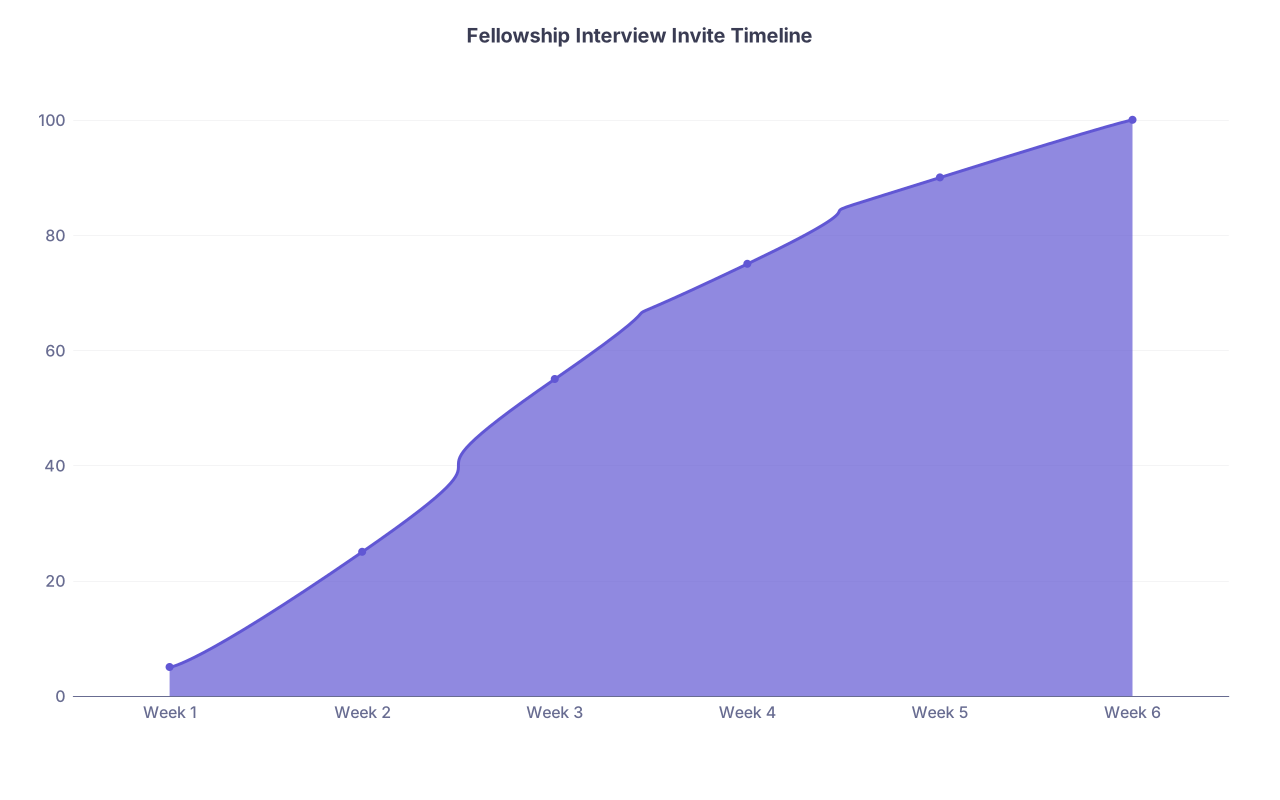
| Category | Value |
|---|---|
| Week 1 | 5 |
| Week 2 | 25 |
| Week 3 | 55 |
| Week 4 | 75 |
| Week 5 | 90 |
| Week 6 | 100 |
You are not “unlucky.” You are behind on strategy.
If you are 3–5 weeks into interview season and your inbox is dead silent, you do not need more positive thinking. You need a structured, aggressive, 4-week correction plan. This is recoverable in many cases, but not if you keep doing what has not worked.
I am going to walk you through a step‑by‑step, no‑nonsense 4‑week action plan. You will:
- Diagnose what is actually wrong with your application.
- Fix what can still be fixed this cycle.
- Use smart, targeted outreach instead of embarrassing mass emails.
- Decide, by the end of 4 weeks, whether to:
- Double down on this cycle, or
- Pivot to a deliberate, high-yield reapplication strategy.
You are not powerless here. But you do have to move.
Step 1: Reality Check – Are You Actually Late, Or Just Paranoid?
Before you start “damage control,” make sure damage has actually occurred.
Most fellowships send a big wave of invites in the first 2–3 weeks after applications are released, then a long tail of sporadic invites and cancellations.
Here’s the rough pattern in many competitive specialties (cards, GI, heme/onc, etc.):
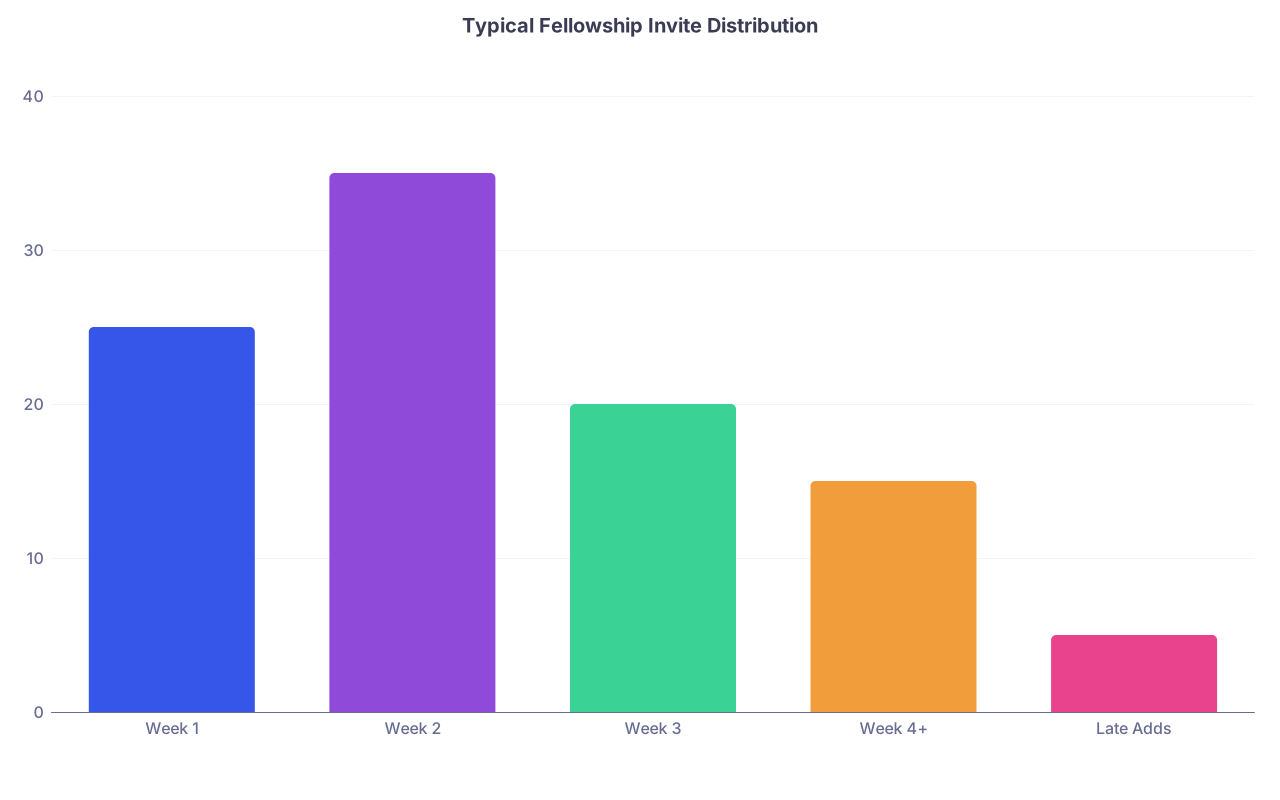
| Category | Value |
|---|---|
| Week 1 | 25 |
| Week 2 | 35 |
| Week 3 | 20 |
| Week 4+ | 15 |
| Late Adds | 5 |
What this means:
- If it is only Week 1–2 since programs downloaded applications:
- Having zero invites is worrying only if your application is clearly weak (major red flags, huge gap, failed boards).
- But you still do Week 1 of this plan. Because tweaking early is cheap.
- If it is Week 3–4:
- Zero or 1–2 invites is a problem. This plan is now mandatory.
- If it is Week 5+:
- You are in salvage mode. You can still pick up late invites, waitlist moves, and spots from cancellations, but you should also plan seriously for a reapplication.
So, first anchor yourself:
- What specialty?
- What week of the invite season are you actually in?
- How many programs did you apply to?
- How many invites so far?
- Any obvious red flags? (Step failure, professionalism issue, visa constraints, big location limitation)
Write those answers down somewhere. You will come back to them.
Step 2: Diagnose the Real Problem (Not the One You Hope It Is)
“I guess programs just have not reviewed my file yet” becomes the resident mantra when they are scared. Sometimes it is true. Far more often, there are real, fixable issues.
You need a harsh, 60-minute autopsy of your application.
2.1 Get Fresh Eyes On Your Application – Fast
Do not do this alone.
In the next 48–72 hours, get 2–3 qualified reviewers to look at:
- ERAS application (including experiences, honors, and “other awards”)
- Personal statement
- Letters (if you can see content or ask the writer for summary)
- Program list
Who counts as “qualified”:
- A fellowship program director or associate PD (dream list, but ask).
- A recent graduate in your specialty who matched at a strong program.
- Your residency PD or APD.
- A faculty mentor who regularly writes letters for fellowship applicants.
Send a short, respectful, specific ask:
“I am 4 weeks into interview season for [specialty] fellowship with no interviews yet. I know you are busy, but I would be very grateful for a harsh, honest review of my application to identify red‑flag weaknesses. Could I send you my ERAS and personal statement, and schedule a 15–20 minute call?”
You are not asking them to “fix” things. You are asking for diagnostic help.
2.2 Use a Simple Scoring Framework
While you wait for feedback, score yourself ruthlessly:
| Domain | Strong (2) | Average (1) | Weak (0) |
|---|---|---|---|
| Step/COMLEX | |||
| Clinical grades | |||
| Home program rep | |||
| Research output | |||
| Letters of rec | |||
| Personal statement | |||
| Program list size |
A total score:
- 10–14: You should have some invites by now in most fields.
- 6–9: Borderline. Strategy errors or weaker profile. Fixable.
- 0–5: You are in underdog territory. You need aggressive strategy and a 1–2 year plan, not false hope.
Do not sugarcoat.
Step 3: The 4‑Week Damage Control Blueprint
Here is the part you came for. Four weeks, each with a clear focus.

| Step | Description |
|---|---|
| Step 1 | Week 1 - Diagnose |
| Step 2 | Week 2 - Optimize and Expand |
| Step 3 | Week 3 - Targeted Outreach |
| Step 4 | Week 4 - Decide and Commit |
You will overlap them a bit, but each week has a priority.
Week 1: Diagnose and Patch Obvious Holes
Goal: Understand why you have no interviews and fix what can still move in real time.
1. Tighten Your Personal Statement – Or Overhaul It
Personal statements rarely get you interviews. But they definitely lose them when they are:
- Generic “I have always wanted to be a cardiologist” fluff.
- Rambling, unfocused, longer than 1 page.
- Negative or drama heavy (long stories about burnout, conflict, illness) without a clear growth arc.
- Full of clichés: “I want to combine research, teaching, and clinical care…”
Fix protocol:
- One page. 3–5 short paragraphs.
- One clear, specific story that:
- Shows you functioning as a fellow-level thinker.
- Demonstrates maturity and insight, not trauma dumping.
- 2–3 concrete fellowship‑relevant themes:
- Academic niche or patient population you care about.
- Skills you bring: QI, informatics, ultrasound, complex communication.
- Clear, realistic career aim: academic, clinician-educator, community expert.
If your mentor reads it and says, “Yeah, this sounds like everyone else,” you are not done.
2. Fix Your Experiences Section
ERAS experience entries kill more applicants than they help. Abrasive truth.
Common mistakes:
- Listing 25 micro‑experiences with vague verbs: “participated”, “involved in”.
- No outcomes: no numbers, no impact.
- Redundant entries for the same research or QI project.
Fix protocol (over 2–3 evenings):
- Pick your top 8–10 experiences.
- For each, use 3–4 lines max:
- One line: what it is.
- One line: what you actually did.
- One line: outcome, numbers, or consequence.
Example of bad vs good:
- Bad: “Participated in QI project to improve heart failure readmissions.”
- Good: “Led a multidisciplinary QI project to reduce 30‑day HF readmissions; implemented standardized discharge checklist and follow‑up calls, reducing readmissions from 22% to 16% over 9 months.”
Programs want impact, not buzzwords.
3. Confirm Your Letters Are Not Sinking You
You will not usually see your letters. But there are clues:
- Did you choose letter writers who know you well, or just big names?
- Do you have at least:
- 1 strong letter from your specialty (ideally from your home PD or division chief)?
- 1–2 letters that can speak to your work ethic and clinical maturity?
Action steps:
- If you fear a letter is weak or generic (e.g., you barely worked with them), do this now:
- Ask a stronger advocate to write an additional letter.
- Have your residency coordinator upload and assign that letter broadly.
- If your fellowship PD or division chief has not written you a letter, ask directly. This alone changes how other PDs see you.
Do not obsess over letter phrasing. Obsess over who your advocates are.
Week 2: Expand, Target, and Update
Goal: You are now patched. Time to widen and sharpen your shot pattern.
1. Expand Your Program List Intelligently
If you applied to 15–20 programs in a competitive field, you under‑applied. This is not 2010 anymore.
General targets:
- Highly competitive specialties (cards, GI, heme/onc, PCCM in certain regions):
- 35–60+ programs, depending on your strength and geography limits.
- Less competitive specialties:
- 25–40 programs.
If you are already at those numbers, you do not need volume. You need targeting.
How to expand smartly:
- Look for:
- Programs in medium cities or less “sexy” locations (Midwest, South, inland states).
- Newer fellowships (<5 years old).
- Programs that match heavily from community residencies (you can see this on their website or recent fellows list).

Do not blow $1500 on throwing apps at every single program in the country. Target where your profile is actually viable.
2. Update ERAS With Any New Material
Anything new since submission?
- Manuscript accepted or major abstract?
- New leadership role or award?
- Significant QI project reached results?
Add it.
Then prepare a 1–2 paragraph “academic update” you can reuse in outreach:
- 1–2 sentences: Who you are, what you are applying for.
- 2–3 bullets: Very concrete new updates (“First‑author manuscript accepted in CHEST on…”, “Presented oral abstract at [meeting] on…”).
- 1 line: Why you remain very interested in their program.
You will use this in Week 3.
Week 3: Targeted, Professional Outreach (Not Spam)
This is the week where you actually email people. Done well, this can move the needle. Done poorly, it makes you look desperate.
1. Who You Should Email
Priority list:
- Your home fellowship program leadership (if you applied there):
- Fellowship PD
- Division chief
- Programs where you have a real connection:
- Rotated there as a resident.
- Strong alum from your residency is a current fellow or junior faculty.
- You have collaborated with someone there on a project.
- Programs that historically interview residents from your institution, even if you did not hear from them this year.
Everyone else? Optional. You do not need a mass email to 60 programs.
2. How To Email Without Sounding Pathetic
Your email should be short, specific, and professional. No begging. No “I’ll take any spot.”
Template skeleton:
Subject: [Your Name] – [Specialty] Fellowship Applicant – Continued Interest
Dear Dr [Last Name],
I am a [PGY-3 internal medicine resident] at [Your Institution] applying to the [Year] [Specialty] fellowship match. I am writing to express my strong continued interest in [Program Name].
Since submitting my ERAS application, I have [very briefly describe 1–2 concrete updates: e.g., “had a first‑author manuscript accepted in…” or “presented an oral abstract at…”]. These experiences have further confirmed my commitment to a career in [field focus – e.g., advanced heart failure, academic hematology with a focus on benign heme].
I would be honored to be considered for an interview, should any additional spots or cancellations become available. I would be happy to provide any additional information.
Respectfully,
[Full Name, credentials]
[Residency program]
[Cell]
Key points:
- You are not asking, “Why did I not get an interview?”
- You are saying: “I remain interested, I am still improving, I am an adult.”
3. Coordinate Advocacy From Your PD or Mentor
This is the one thing that routinely changes “no” to “yes” in borderline cases.
Ask your PD or mentor:
“Would you be comfortable reaching out to 3–5 select programs on my behalf where you think I might be a good fit but I have not yet received an interview?”
Give them:
- A very short list of 3–5 programs.
- 1 sentence per program about why it makes sense (geography, alumni presence, relevant research focus).
That phone call or brief email from a respected PD can flip you into the “interview if cancellations happen” pile.
Week 4: Decide Your Path – Salvage vs Strategic Rebuild
By the end of Week 4, one of three things will have happened:
- You picked up several interviews. Crisis averted. Still stressful, but you are in the game.
- You got 1–2 interviews. Partial salvage. You may match, but risk is high.
- You still have nothing. Time to stop magical thinking and plan a deliberate, higher‑odds reapplication.
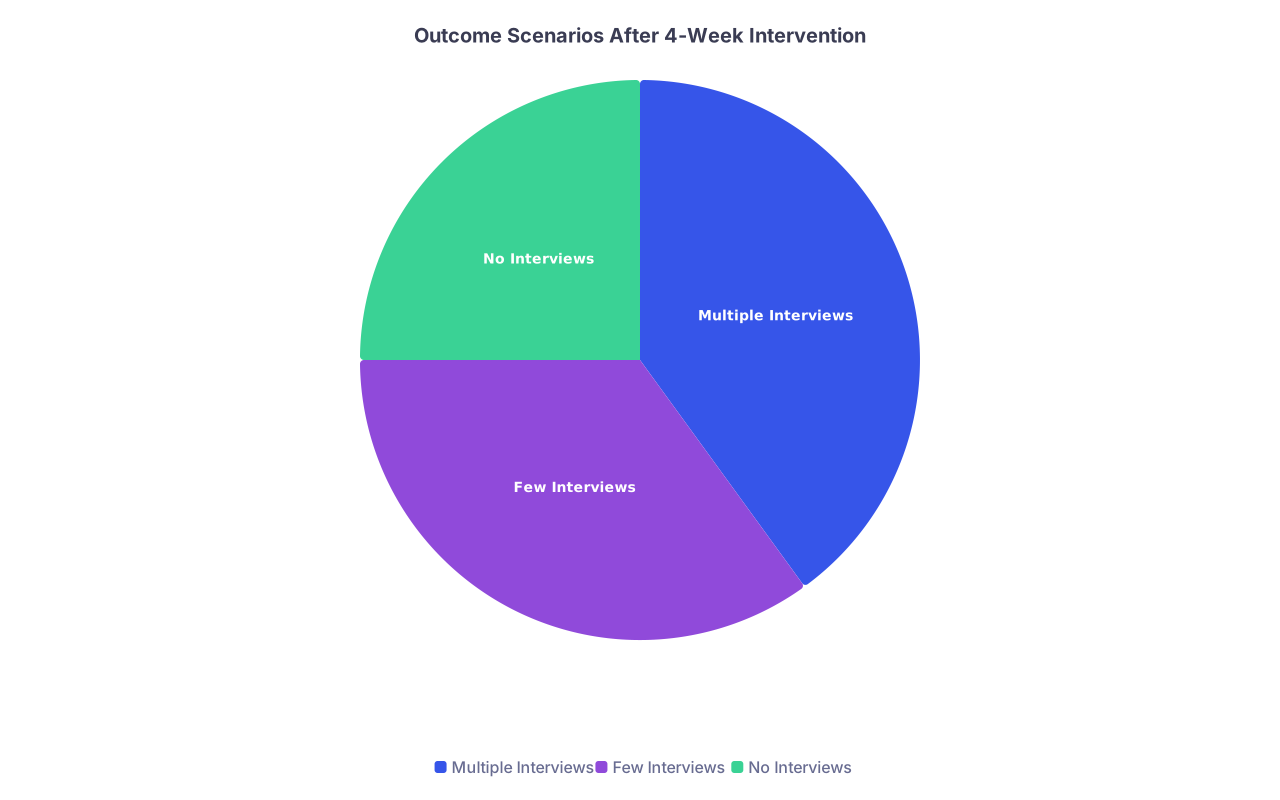
| Category | Value |
|---|---|
| Multiple Interviews | 40 |
| Few Interviews | 35 |
| No Interviews | 25 |
Now you answer brutally honest questions.
1. If You Now Have Several Interviews
You pivot from damage control to preparation mode:
- Do a mock interview with your PD or faculty.
- Have a tight, genuine answer for:
- “Why this specialty?”
- “Why our program?”
- “Explain this blemish on your record…”
- Rehearse your story so it sounds natural, not memorized.
And continue gentle outreach to 3–5 additional programs if you still have bandwidth. You do not stop just because you got one invite.
2. If You Have 0–2 Interviews After All This
You are in high‑risk territory. Here is where most people make a mistake. They cling to this cycle emotionally and avoid planning for the next one. Then they waste an entire year flailing.
Do not do that.
You can absolutely still:
- Attend those 1–2 interviews.
- Do your best.
- Hope for the rare underdog win.
But in parallel, you build a 12–18 month reapplication plan.
If You Need to Reapply: Build a Ruthless High‑Yield Plan
Let me be blunt: reapplicants who just “try again” without changing anything do not match the second time either. You cannot just “hope programs will see how hard I am working now.” You need evidence.
1. Identify Your Biggest Deficit – Then Overcorrect It
From your earlier self‑assessment + mentor feedback, choose your main weak category:
- Research
- Letters/advocacy
- Clinical performance / internal rep
- Overly narrow geography
- Professionalism/communication concerns
Then you design your year around overcorrecting that single biggest problem.
Examples:
- Weak research for an academic fellowship (GI, heme/onc, cards):
- Lock in a 1‑year research chief or research fellowship position.
- Aim for:
- 1–2 first‑author manuscripts.
- 2–4 abstracts at relevant national meetings.
- Mediocre letters/internal advocacy:
- Negotiate an additional year as chief resident or junior faculty hospitalist in your department.
- Work closely with the fellowship division, take extra calls, cover service.
- Make it impossible for them to ignore your work ethic and team value.
- Failed Step / professionalism concern:
- Stack your file with:
- Clear upward trajectory (strong ITEs, good Step 3 if relevant).
- 1–2 letters explicitly describing your reliability and growth.
- A mature, concise personal statement paragraph acknowledging the issue and showing how you corrected it.
- Stack your file with:

2. Fix Your Geography and List Strategy
A common hidden problem: you applied only to the coasts or one metro area because of family, partner, or lifestyle preferences.
Reality: The smaller your geographic footprint, the stronger your profile must be.
When you reapply, you likely need to:
- Open to at least 3–5 regions.
- Include community and mid‑tier academic programs in addition to elite ones.
- Apply early and widely.
If your partner or family constraints are real and inflexible, fine. But then you accept that you may never match in this specialty and need a backup plan (hospitalist with niche, another fellowship, etc.).
3. Get Your PD / Division Chief On Board Early
You cannot do a stealth reapplication. Programs see reapplicants clearly.
Sit down with your PD/division leadership and say:
“I want to reapply in a way that actually fixes the weaknesses in my application, not just repeats the same thing. I am willing to work hard this year to do that. What role could I take on that would also meet your departmental needs?”
You will be surprised how often they respond with concrete options:
- Chief resident.
- QI lead.
- Junior faculty with protected research time.
You then align your year‑long plan with something that makes you indispensable to them and more attractive to outside programs.
Mental Side: How To Not Fall Apart While Doing All This
Let me not pretend this is just “strategy.” It is also demoralizing as hell.
You are watching your co-residents celebrate interview invites on group chats while your phone stays silent. That hits hard.
Here is what I have seen work for people who got through this sane:
- Tighten your circle:
- Mute the fellowship group chat if it is wrecking your mood.
- Pick 1–2 trusted friends you can vent to without shame.
- Set email boundaries:
- Morning check.
- Midday check.
- Evening check.
- Not every 6 minutes. That constant cortisol spike makes you irrational.
- Name the worst case, then plan around it:
- Worst case: Not matching this cycle.
- Answer: You already have a job. An MD. A salary.
You are not unemployed. You are delayed.
Residents who face the worst case head-on and build a Plan B perform better in interviews. Why? Because they come across as grounded, not desperate.
Quick Example: How This Looks In Real Life
Internal medicine PGY‑3, wants heme/onc. Mid‑tier academic residency. No interviews by Week 4.
Profile:
- Step 1 pass, Step 2: 238.
- 1 middle‑author oncology case report, 1 poster.
- Personal statement generic. Applied to 18 mostly coastal top‑tier programs.
- Letters: 2 from hem/onc attendings who hardly know them, 1 from PD.
4‑Week Plan:
- Week 1:
- PS rewritten around a real patient story and specific benign heme interest.
- Experiences rewritten for impact.
- Ask division chief (who actually worked with them) for a new letter.
- Week 2:
- Program list expanded by 25 additional mid‑tier and a few community heme/onc programs in Midwest/South.
- ERAS updated with one newly accepted abstract.
- Week 3:
- Targeted emails to 6 programs with true ties (where residency alumni went).
- PD makes 3 phone calls on their behalf.
- Week 4:
- Net result: 3 interviews. Not great, not hopeless.
- Parallel: Accepts offer to do a 1‑year oncology hospitalist + research role if they do not match.
Outcome:
- They actually do not match the first cycle.
- But in that extra year:
- 2 first‑author papers.
- 3 national abstracts.
- Glowing letters from division chief and research PI.
- Reapplies year 2 to 40 programs across multiple regions.
- Gets 14 interviews. Matches comfortably.
Not magic. Just structured damage control + deliberate rebuild.
FAQs
1. Should I cold‑call fellowship programs asking why I did not get an interview?
No. That almost never helps and often hurts. Program coordinators and PDs are drowning in admin during interview season. A short, respectful email expressing continued interest and sharing meaningful updates is acceptable. Asking them to justify their decision or give you feedback mid‑cycle is not.
2. Does sending “letters of interest” or “love letters” actually work?
Sometimes, but only when:
- You have a genuine connection to the program or region.
- You bring a real update or new information (accepted paper, new leadership role).
- The note is specific and professional, not generic or pleading.
If your PS, CV, and letters are weak, no amount of “interest” email will compensate.
3. I have a failed Step attempt. Am I basically done for competitive fellowships?
You are not automatically done, but you are not playing on easy mode either. You must:
- Show sustained strong performance afterwards (good ITEs, strong Step 3 if applicable).
- Have letters explicitly vouch for your reliability, knowledge, and maturity.
- Address the failure briefly, honestly, and non‑defensively in your PS or interviews. Many programs will still hesitate, but a subset will consider a strong, clearly rebounded candidate.
4. Is taking a chief year worth it if I plan to reapply?
Often yes, if:
- Your residency program has a decent reputation.
- You will actually work closely with the fellowship division and PD.
- You can still carve out time for at least some scholarship (QI, teaching projects with output, or research). Chief year alone does not fix a weak application, but chief + strong letters + concrete output can absolutely tip you from “no chance” to “solid contender.”
Bottom line:
- You do not fix a dead interview season with hope; you fix it with a 4‑week, structured damage control plan.
- If that is not enough, you build a deliberate 12–18 month reapplication strategy that overcorrects your real weaknesses instead of repeating them.