

Most residents waste half their chief year doing scutwork and then wonder why their fellowship application reads like everyone else’s. That is a mistake. Chief year is one of the most powerful levers you will ever have for fellowship—and most people barely touch it.
You are about to be in a role that gives you:
- Access to program leadership.
- Control over schedules and educational content.
- A front‑row seat to how letters get written and who actually gets interviews.
If you treat chief year like a glorified scheduling job, you will come out exhausted with a lukewarm application. If you treat it like a structured, one‑year accelerator for your fellowship goals, you will look like a leadership hire, not just another applicant.
Let’s turn chief duties into fellowship ammunition.
Step 1: Decide What Story Your Chief Year Should Tell
Before you “leverage” anything, you need a target. Fellowship program directors do not care that you were chief in some vague, honorary way. They care what it means about you.
Pick a primary identity you want your chief year to signal:
- Future clinician‑educator
- Future clinical leader / systems builder
- Future researcher / QI leader
- Future niche expert (e.g., HF fellow who built a heart failure curriculum as chief)
Then build your year around it. Explicitly.
Ask yourself:
- If a PD had only my CV and letters, what 2–3 things should scream off the page about my chief year?
- What projects and duties would prove that identity without me having to explain it?
Examples:
- Cards fellowship: Your file should say “ran M&M revamp focusing on hemodynamics and outcomes, led ICU curriculum, QI in cardiology‑adjacent topic.”
- Heme/Onc: “Built continuity oncology teaching block, led goals‑of‑care workshops, research in malignancy/QI.”
- Pulm/CC: “Designed ICU night float handoff system, ventilator education bundle, safety/QI work in sepsis or ARDS.”
Write that identity down. Tape it to your computer. This is the filter for what you say “yes” and “no” to during chief year.
Step 2: Turn Routine Chief Tasks Into Leadership Evidence
Your daily duties are raw material. Most chiefs just survive them; you are going to convert them into measurable, fellowship‑ready achievements.
2.1 Schedule Building → Systems & Fairness Leadership
If you are controlling schedules, you are controlling resident quality of life. That is leadership currency—if you do it thoughtfully.
Do this:
- Identify 2–3 chronic pain points (e.g., uneven night distribution, no protected clinic time, terrible post‑night float transitions).
- Collect baseline data:
- Number of 24+ hour stretches per resident per block.
- Frequency of jeopardy calls.
- Clinic cancellations.
- Design and implement small, clear changes:
- Night float redistribution with hard caps.
- Protected continuity clinic half‑day rule.
- Transparent jeopardy system with advance notice.
Then track outcomes:
- Compare pre‑ and post‑ data.
- Survey residents briefly (3–5 question anonymous poll).
- Document a short “intervention–result” summary.
That is not just “did the schedule.” That is:
- Systems improvement
- Data‑driven decision‑making
- Measurable impact
Exactly what a fellowship PD wants to see.
2.2 Service Coverage & Logistics → Crisis Management Narrative
You will deal with:
- Last‑minute call outs
- Angry attendings
- Overloaded services
- Winter surge chaos
Do not just put out fires. Structure how you handle them.
Concrete protocol:
- Build a clear escalation tree with your PD/APD:
- When census exceeds X, what happens.
- When simultaneous call outs occur, what is the sequence.
- Standardize communication:
- Use one template text/email format when requesting coverage.
- Keep records of significant coverage crises and how they were handled.
- After major crises (e.g., RSV surge, boarding nightmare), do a 15–20 minute debrief with leadership and capture:
- What failed.
- What you changed.
- Outcome of those changes.
Later, this becomes:
- A strong paragraph in your personal statement (“As chief, I… instituted X system that reduced last‑minute jeopardy requests by 40% over 6 months.”)
- Concrete talking points for interviews when you are asked about “a time you led through a crisis.”
Step 3: Weaponize Your Teaching Responsibilities
Teaching is low‑hanging fruit. Most chiefs “run morning report.” Fine. You are going to design something that looks like a fellowship‑relevant educational product.
3.1 Build One Signature Educational Initiative
Not five. One. Make it excellent and relevant to your target fellowship.
Options:
- A longitudinal teaching series (e.g., “ICU Bootcamp,” “Onc Emergencies,” “Advanced EKGs,” “Renal Physiology for the Wards”).
- A revamped M&M structure with clear learning objectives and safety/QI focus.
- A simulation curriculum (codes, rapid response, procedural sim).
Basic design steps:
- Define the gap:
- “Residents feel uncomfortable managing ventilators overnight.”
- “Interns struggle with chemotherapy complications.”
- Get quick baseline:
- 1‑minute pre‑session survey at the first session: comfort rating 1–5.
- Design structure:
- 4–8 sessions, each 30–45 minutes.
- Short, focused, case‑based.
- Track participation and outcomes:
- Attendance list.
- Pre/post self‑rated confidence or brief quiz scores.
Now, on your CV:
- “Developed and implemented an 8‑session ICU Bootcamp for PGY‑2 residents; improved self‑reported ventilator management confidence from 2.1 to 3.8/5.”
Fellowship PDs like this far more than “ran morning report weekly.”
3.2 Use Teaching to Align With Your Future Field
If you want GI, do not spend all your energy building a generic “approach to chest pain” curriculum.
Examples by specialty:
- Cardiology:
- High‑yield EKG series.
- Case‑based CHF management workshop.
- GI:
- Liver disease crash course.
- GI bleed rapid response algorithm teaching.
- ID:
- Antibiotic stewardship teaching with cases.
- Fever in returning traveler sessions.
- PCCM:
- Vent management nights.
- Shock/pressors program.
Then make sure:
- Your name is on the slides.
- You save the session outlines.
- You ask attendings in that field to observe a session or two and give feedback (and later, write about it in letters).
Step 4: Engineer Publication‑Grade QI and Research From Chief Duties
The chief role hands you QI gold if you know where to look. You sit at the crossroads of clinical operations, education, and burnout. All of that is data.
4.1 Identify QI Projects Embedded in Chief Work
Domains ripe for QI:
- Handoffs
- Discharge delays
- Code status documentation
- Night float cross‑cover burden
- Readmission hotspots
- Sepsis bundle compliance
- Clinic no‑show follow‑up
Use a simple 4‑step QI scaffold:
- Define the problem in one sentence with a number.
- “Only 40% of ICU transfers to the floor have a documented handoff in the EMR.”
- Pick a clear goal and time frame.
- “Increase to 80% within 6 months.”
- Design one or two low‑complexity interventions you can actually control as chief:
- Standardized handoff template.
- Daily reminder message at sign‑out.
- Measure monthly:
- Use simple run charts; Excel is fine.
This yields:
- A CV line: “Chief resident QI lead: Improved ICU‑to‑floor handoff documentation from 40% to 82% over 6 months.”
- A strong abstract for a regional/national meeting.
- A project that can be discussed intelligently in interviews.
4.2 Attach Faculty and Aim for Presentations
Do not run QI in a vacuum.
Protocol:
- Early in chief year, meet with:
- Program Director
- QI Director
- Your target specialty division chief (Cards, GI, Pulm, etc.)
- Say explicitly:
- “I want at least one QI project from my chief responsibilities to be presentation‑ready for [CHEST/ACC/ASH/ATS/DDW/etc.]. Can we co‑mentor something aligned with [field]?”
You will be surprised how fast doors open once they realize you are doing work they can put their name on too.
Presentations to aim for:
- Local institution QI day.
- Regional ACP/ATS/ACC/etc.
- National subspecialty meeting.
Even one poster linked to your chief initiatives is worth the time. It signals you can execute a project from idea to dissemination.
Step 5: Use Access to Leadership to Build High‑Impact Letters
Chief year puts you in the room with people who write the letters that move applications from “maybe” to “yes.” Do not waste that access.
5.1 Make It Easy for Leaders to See You at Your Best
Program leadership is busy. You want them to see concrete examples of you problem‑solving, not just hear that “you are nice and residents like you.”
Ways to put yourself in the right rooms:
- Volunteer to:
- Co‑lead recruitment overhaul.
- Sit on the clinical competency committee (CCC) as observer or resident rep.
- Help with program‑wide policy changes (duty hours tracking revamp, new evaluation forms).
Each of these gives:
- Stories of systems thinking and responsibility under supervision.
- Visibility to multiple attendings who later may be asked, “How good is this chief, really?”
5.2 Structure Your Ask for Fellowship Letters
When fellowship season approaches, do not just say, “Can you write me a strong letter?” and walk away. You want a letter that explicitly ties chief responsibilities to your future field.
Provide your letter writers with:
- A 1–2 page “chief year summary” document with:
- Major leadership projects (with numbers).
- Educational initiatives you led.
- QI or research related to their field.
- A short bullet list of what you hope they can comment on:
- “My ability to lead through complex scheduling changes.”
- “My communication and conflict resolution with attendings and residents.”
- “My initiative in developing X educational series in [specialty].”
- Your personal statement draft with your future goals clearly linked to chief experiences.
That is how you get letters that say:
- “As chief resident, Dr. X redesigned our ICU schedule, resulting in a 30% reduction in resident weekly work hours variance, while maintaining coverage. She led a 6‑session ventilator curriculum that has become core to our PGY‑2 training. She is in the top 5% of residents I have worked with in 20 years.”
Instead of:
- “Dr. X was a hardworking and well‑liked chief resident.”
Step 6: Protect Time—Or You Will Burn Out and Achieve Nothing
Here is the ugly truth: chief year can eat you alive with administrative nonsense if you let it. Protected time is not a luxury. It is what separates “busy chief” from “productive chief with a strong fellowship file.”
6.1 Negotiate Structure Up Front
Before chief year starts (or as early as possible), sit with your PD and explicitly carve out:
- 1 half‑day per week for:
- QI/research.
- Fellowship‑relevant reading and project work.
- Clear limits on:
- After‑hours text availability.
- Who covers what when you are on vacation or at conferences.
Put it in writing. Email summary after the meeting:
- “To recap, Wednesdays 1–5 pm will be my protected time for QI/education projects; for urgent issues, residents will page [backup chief/APD].”
Will it be perfect? No. But it gives you a baseline to defend when the job begins to creep.
6.2 Build Systems So You Are Not the Only Fixer
Chiefs who personally solve every minor problem burn out and have nothing to show academically.
Create:
- A simple “FAQ” or guide for residents (jeopardy process, schedule questions, common issues).
- Template messages residents can use for common requests.
- A shared inbox or system for administrative requests that staff can help manage.
Goal: You only get called for:
- True emergencies.
- Decisions that actually require your judgment.
Everything else runs on rails.
Step 7: Make Your Fellowship Application Explicitly Chief‑Forward
By the time you submit ERAS (or SF Match, NRMP fellowship, etc.), you should not assume anyone will “infer” your chief work. You spell out the impact.
7.1 Translate Chief Duties on Your CV
Do not list “chief resident” as a simple title only. Break out major components into discrete entries where appropriate.
Strong examples:
Chief Resident, Internal Medicine
- Elected by peers and faculty to serve as one of four chiefs for a 60‑resident program.
- Oversaw inpatient scheduling for 12 teams; implemented redistribution of night float leading to 25% reduction in duty hour violations over 9 months.
- Led revamp of weekly M&M conference to emphasize systems‑based errors; attendance increased by 30%.
Educational Initiative Lead – ICU Bootcamp
- Developed and delivered 6‑session curriculum on ventilator management and shock for PGY‑2 residents.
- Pre/post self‑assessment showed improvement in ventilator management confidence from 2.3 to 4.0 on a 5‑point Likert scale.
QI Project – Handoff Improvement for ICU Transfers
- Designed and implemented a standardized EMR handoff template for ICU‑to‑floor transfers.
- Handoff documentation increased from 42% to 85% across 4 months.
Those bullets scream competence and impact.
7.2 Tie Chief Experiences Directly into Your Personal Statement
Your personal statement should not be a generic “I like cardiology” essay with a single throwaway line about being chief.
Use chief experiences to prove:
- You understand systems of care in your field.
- You can handle responsibility and ambiguity.
- You have led actual change, not just followed orders.
Example structure for one paragraph:
- Brief context: “As chief resident, I was responsible for redesigning our admission flow to the step‑down unit during a winter surge in heart failure admissions.”
- Specific action: “Working with cardiology faculty and nursing leadership, I helped implement a triage algorithm based on objective criteria and trained residents using case‑based workshops.”
- Result: “Over the next 3 months, we reduced inappropriate ICU admissions by 18% while maintaining safety, and residents reported improved clarity in triage decisions.”
- Interpretation: “That experience solidified my interest in advanced heart failure and systems‑level care, and I want to continue that work in fellowship.”
You are not “mentioning” chief year. You are building your fellowship narrative on top of it.
Step 8: Plan Deliverables and Milestones Early (And Track Them)
If you do not plan concrete outputs, chief year will become: endless texts, constant email, and vibes. You will hit May and realize you have nothing tangible for your application.
Create a simple deliverables plan:
| Timeframe | Deliverable | Fellowship Value |
|---|---|---|
| Month 1–2 | Define 1–2 QI projects with mentors | Shows initiative, direction |
| Month 3–4 | Launch educational series | Education & leadership |
| Month 5–6 | Submit abstract to local/regional meeting | Academic productivity |
| Month 7–8 | Implement schedule/QI changes fully | Systems improvement |
| Month 9–10 | Draft fellowship PS and CV with chief content | Application readiness |
| Month 11–12 | Get letters emphasizing chief leadership | Strong advocacy |
Review this with:
- Your PD
- A mentor in your target fellowship
Ask them bluntly:
- “If I accomplish these things by the end of chief year, will I look like a strong candidate for [specialty] at [tier of programs]?”
Then adjust based on their feedback.
Step 9: Use Your Insider View of Applications to Your Advantage
As chief, you will likely see:
- Interview day logistics.
- How your program weighs letters vs. scores vs. experiences.
- Which applicants impress the committee and why.
Do not ignore that.
9.1 Learn How Committees Actually Talk About Applicants
When you are allowed to sit in or debrief on residency recruitment:
- Listen very carefully to:
- How they discuss “leadership.”
- What they say after reading letters.
- Which red flags matter and which do not.
You will hear things like:
- “The letter from the PD is lukewarm—does not say top X%.”
- “They were chief but there is nothing to show for it.”
- “They led a major curriculum change—that stood out.”
Translate those lessons directly into your own fellowship file.
9.2 Ask for Targeted Feedback on Your Draft Application
By late spring or early summer:
- Show your:
- Draft CV
- PS
- Project summaries to:
- Your PD
- A trusted APD
- One or two faculty in your target field
Ask:
- “If you saw this file as a fellowship PD, what would you think?”
- “What is missing that you expect from a strong applicant?”
Then fix it while you still have time and access.
Step 10: Common Chief‑Year Mistakes That Quietly Weaken Fellowship Apps
Let me be blunt. I have watched smart, hardworking chiefs sabotage their own fellowship odds by falling into these traps.
Watch for:
Being everyone’s friend, no one’s leader.
You avoid conflict, never say no, and never implement any meaningful changes because you do not want to upset anyone. Fellowship PDs can smell this in letters.Doing invisible work only.
Endless scheduling and texting, no documented projects, no data, no presentations. You worked hard. No one can see it.Saying yes to every random committee.
Sitting on 6 low‑impact committees where you are just a warm body instead of owning 1–2 high‑impact projects that actually changed something.Divorcing chief year from your field.
You want pulm/crit, but all your chief contributions are outpatient clinic flow and ambulatory curriculum. Helpful, but not aligned.Waiting until application season to “package” your year.
By then, projects are half‑baked and letters are vague because no one remembers what you did.
If you see yourself drifting into these patterns, stop and recalibrate using the earlier steps.
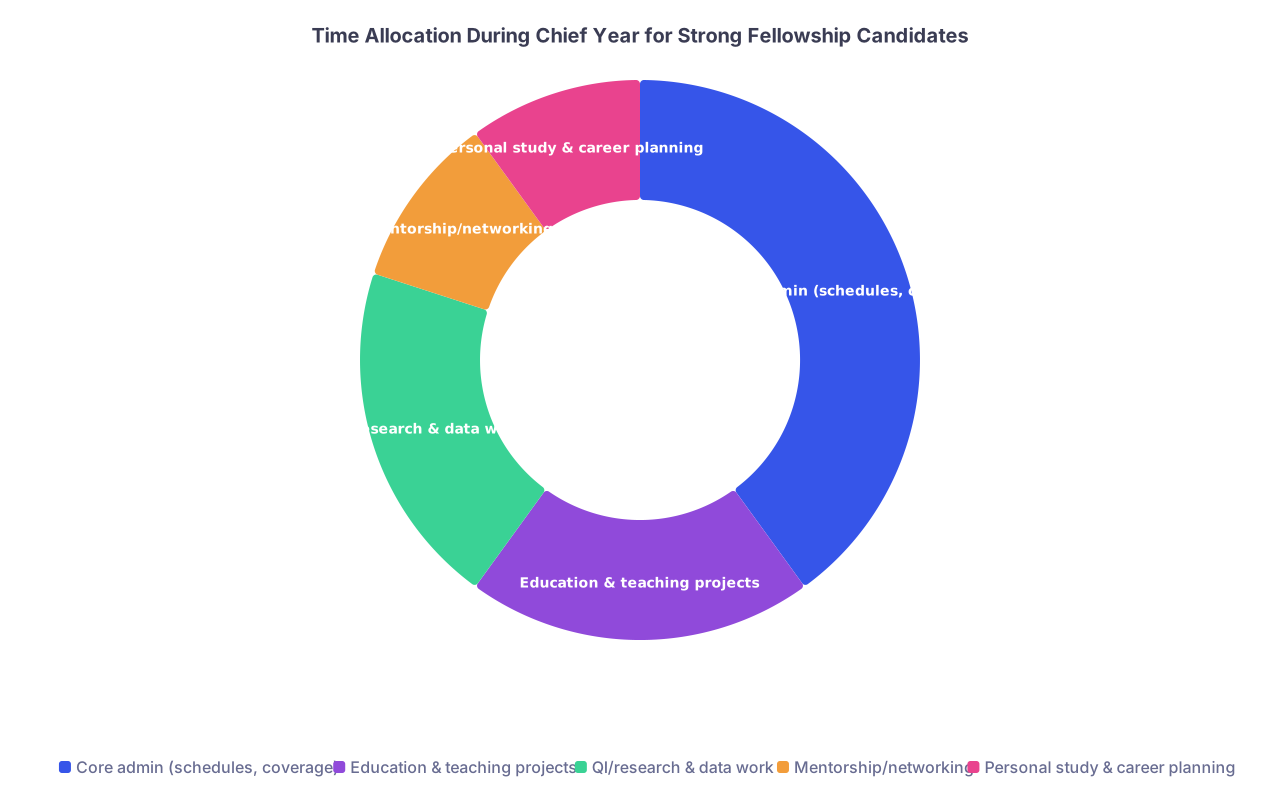
| Category | Value |
|---|---|
| Core admin (schedules, coverage) | 40 |
| Education & teaching projects | 20 |
| QI/research & data work | 20 |
| Mentorship/networking | 10 |
| Personal study & career planning | 10 |

| Step | Description |
|---|---|
| Step 1 | Start Chief Year |
| Step 2 | Choose Fellowship Identity |
| Step 3 | Pick 1-2 Signature Projects |
| Step 4 | Align Teaching and QI with Field |
| Step 5 | Secure Faculty Mentors |
| Step 6 | Track Outcomes and Data |
| Step 7 | Present and Publish |
| Step 8 | Package into CV and PS |
| Step 9 | Request Targeted Letters |
| Step 10 | Submit Fellowship Applications |
The Bottom Line
Three takeaways and then you can get back to your pager:
Chief year is not an honor; it is a tool. Decide early what fellowship‑relevant story you want it to tell, and build your projects, teaching, and QI around that identity.
Document impact aggressively. Turn everyday chief work—schedules, crises, teaching, handoffs—into measurable improvements, abstracts, and concrete CV bullets that fellowship PDs can recognize in 10 seconds.
Exploit proximity to power. Use your access to leadership and your insider view of recruitment to shape high‑impact letters and a polished application that presents you not just as “a former chief,” but as a proven leader in the subspecialty you are aiming for.


