
The worst thing you can do with a nonlinear residency story is pretend it never happened.
Program directors are not stupid. They see the extra year. The LOA. The transfer. The academic bump. The NRMP SOAP. The disciplinary note. The multiple attempts at boards. The “gap year” that is clearly not a gap.
What they want to know is simple: Who are you now, and can they trust you?
This guide will walk you through exactly how to answer that. Clearly. Confidently. Without spin.
You will not erase your nonlinear path. You will convert it into a coherent, professional growth narrative that a fellowship director can believe in.
Step 1: Map Your Nonlinear Story Without Sugarcoating
You cannot reframe what you have not fully faced.
Sit down with a blank page and create a brutally honest timeline.

| Step | Description |
|---|---|
| Step 1 | Residency Start |
| Step 2 | Key Events |
| Step 3 | Disruptions |
| Step 4 | Growth Moments |
| Step 5 | What Happened |
| Step 6 | What You Did |
| Step 7 | What Changed |
A. Build a factual timeline
List key dates and events. Month/year is enough.
- Start of residency (PGY-1)
- Rotations that went very well (honors, strong feedback)
- Rotations that went badly (low evals, remediation)
- Leaves of absence (medical, personal, family, burnout)
- Transfers between programs or specialties
- Board failures or delayed exams
- Disciplinary or professionalism issues
- SOAP experiences or going unmatched
- Research or chief years out of sequence
- Any “extra time” (e.g., repeated PGY year)
Do not interpret yet. Just write what happened.
Example (Internal Medicine resident applying for cards fellowship):
- 06/2020: Started IM residency at Community Hospital A
- 01/2021: First remediation after difficult MICU rotation
- 03/2021: LOA for 3 months (burnout + depression)
- 07/2021: Returned to residency with wellness plan
- 09/2021: Strong evals on cardiology elective; invited to work on research
- 01/2022: Moved to University Hospital B (transfer for family reasons + more academic environment)
- 11/2022: Passed Step 3 on second attempt
- 07/2023: Became unofficial senior mentor for struggling interns
- 09/2023: Submitted paper as second author, QI in heart failure readmissions
That is the raw material.
B. Identify the “problem nodes”
Circle the parts that will raise questions:
- Any LOA
- Failed boards
- Transfers between programs
- Probation or formal remediation
- Gaps in training dates
- Extra or repeated years
- Drastic specialty switches (e.g., surgery → psych → anesthesia)
These are the issues you must control in your narrative. If you do not address them, reviewers will fill in the blank with the worst possible explanation.
C. Write the “harsh version” of each problem
This is for you only. Not for submission.
Example:
- “I burned out so badly that I had to leave for 3 months.”
- “I failed Step 3 because I underestimated it and overestimated myself.”
- “My program did not think I was safe in the ICU; I needed remediation.”
Then translate each into a professional, factual description. No drama. No excuses.
Example reframes:
- “I took a 3‑month medically indicated leave after experiencing significant burnout and depression during my intern year.”
- “I passed Step 3 on my second attempt after restructuring my study approach and working closely with faculty mentors.”
- “After struggling in the ICU rotation, I underwent a structured remediation plan that significantly strengthened my critical care skills.”
You will polish these later. For now, you just need a working, honest version.
Step 2: Extract the Growth, Not the Excuse
Fellowship directors do not care that you suffered. They care what you learned and how you operate now.
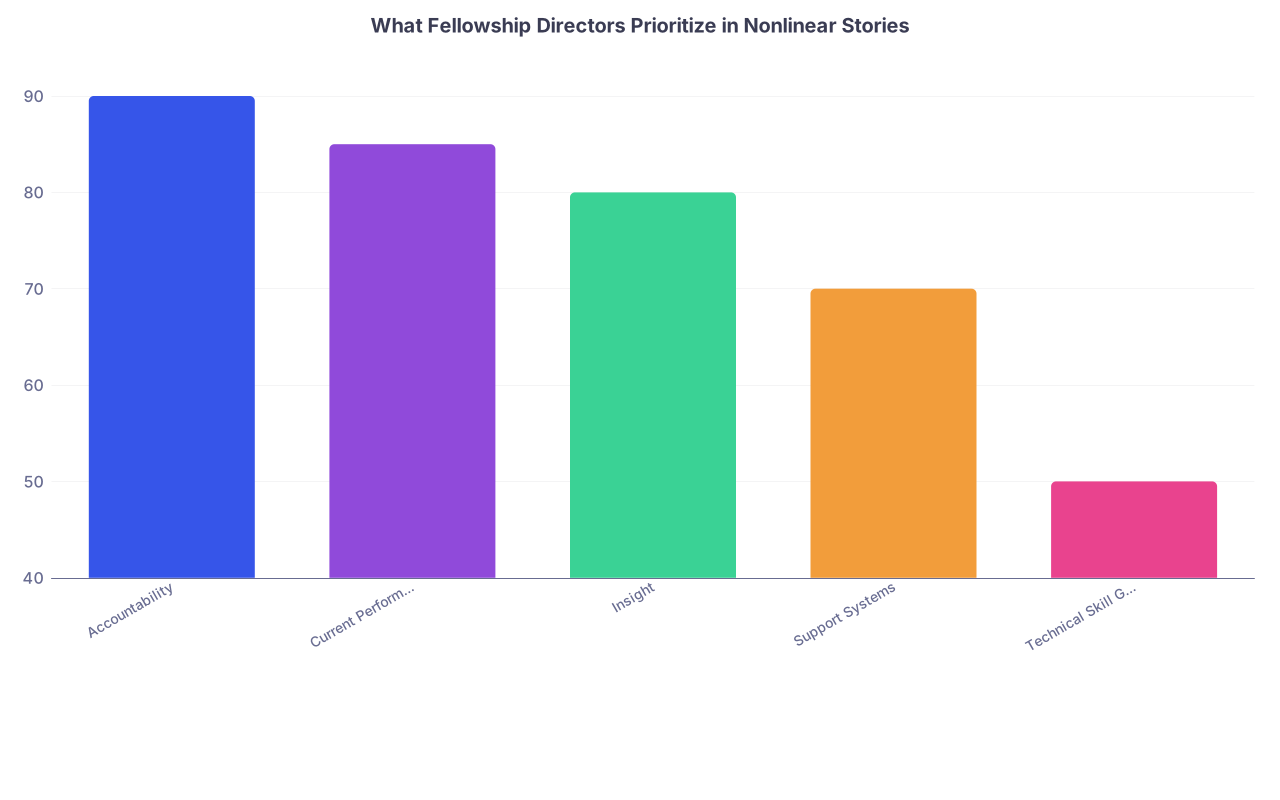
| Category | Value |
|---|---|
| Accountability | 90 |
| Current Performance | 85 |
| Insight | 80 |
| Support Systems | 70 |
| Technical Skill Gaps | 50 |
The growth framework I use with residents has three steps:
- What actually went wrong?
- What did you concretely do in response?
- What is measurably different about you now?
Pick one “problem node” from your timeline and run it through.
A. Define the real cause
Avoid vague fog like “it was a hard time” or “I was adjusting.”
Ask yourself:
- Was the issue knowledge-based? (e.g., weak ICU fundamentals)
- Skill-based? (time management, communication, procedures)
- Health-related? (mental, physical, substance, sleep)
- Context-related? (toxic culture, personal crisis, family responsibilities)
- Insight-related? (arrogance, denial, poor self-assessment)
You probably know the truth. Say it clearly to yourself first.
Example:
“I ignored early signs of burnout, refused to ask for help, and tried to power through. That led to depression significant enough that I could not function safely at work.”
Now carve out blame language. You are not on trial. You are demonstrating insight.
B. List concrete corrective actions
Directors want behaviors, not vibes.
Examples of strong corrective actions:
- Structured therapy or psychiatric care
- Formal coaching (physician coach, remediation mentor)
- Systems changes (calendar, task management, handoff checklists)
- Academic fixes (board review course, question banks, weekly faculty sessions)
- Communication upgrades (SBAR training, difficult conversation workshops)
- Support network built (peer group, supervision, wellness follow-up)
Make this an itemized list for each “node.”
Example:
After burnout / LOA:
- Engaged with a psychiatrist and therapist for 12 months
- Set a stable treatment and sleep plan
- Met monthly with program director for check-ins
- Joined a resident peer-support group
- Learned to escalate early when overwhelmed, rather than hiding it
That list is pure gold. It is your evidence of change.
C. Identify tangible outcomes
Vague: “I came back stronger.”
Useful: “My next 6 rotations were all rated ‘exceeds expectations’ in reliability and teamwork.”
Look for:
- Rotation grades before vs after
- Milestone evaluations
- Step 3 / board scores
- Awards, leadership roles, chief resident selection
- Invitations to teach or mentor
- QI or research completed after the event
- Feedback quotes in evaluations (short, specific lines)
You are building your “after” story. Directors trust patterns, not promises.
Step 3: Build a Coherent Core Narrative
You need one clear through‑line that ties your nonlinear path together.
It is not “I am perfect.”
It is “I am a mature, reliable physician who knows how to handle difficulty and deliver excellent care now.”
A. Choose your central narrative arc
Pick one primary arc. Not three. Not seven.
Strong examples:
- “Early struggle with burnout → developed robust self-awareness and sustainable work habits → now a stable, high-performing senior resident.”
- “Initial failure in high-acuity settings → targeted remediation and intensive study → now trusted for complex cases and teaching juniors.”
- “Mismatch with initial specialty / program → honest reassessment and transfer → now clearly aligned and excelling in chosen field.”
Ask yourself: If a fellowship director could only remember one sentence about me, what should it be?
Write that sentence down. That is your anchor.
B. Align every “weird” element to that arc
Now go back to your timeline. For each nonlinear element, write one or two sentences that connect it to your central arc.
Example central arc: Burnout → insight → stable excellence.
- LOA: “This was my turning point in developing sustainable, self-aware practice.”
- Remediation: “This created structure for me to practice new habits under supervision.”
- Transfer: “This move placed me in an environment that reinforced those habits and offered psychological safety.”
- Later leadership: “This is the proof; I now mentor others facing early-career struggle.”
You are not rewriting history. You are connecting the dots so the director does not have to improvise a story for you.
Step 4: Apply the ARC Formula to Your Written Story
When we fix personal statements and application essays for residents with nonlinear paths, we use a simple formula:
ARC = Acknowledgment → Responsibility → Current Readiness
You can use this for:
- Personal statement
- ERAS “Explain” boxes
- Program Director letter talking points
- Email explanations if needed
A. Acknowledge (direct, brief, factual)
Say what happened. Once. Plainly.
Bad:
- “Life circumstances outside my control significantly impacted my training trajectory.”
Better: - “During my intern year, I took a 3‑month medical leave to address severe burnout and depression.”
Rules for the Acknowledge step:
- 1–3 sentences max
- No self-pity
- No blaming others
- Name the event and the time frame
B. Responsibility (what you did, not how you felt)
You are showing agency, not begging for sympathy.
Example language:
- “I worked closely with my program director and a psychiatrist to…”
- “I enrolled in a structured board review course and adopted a weekly study schedule that…”
- “I requested additional feedback from attendings and set specific goals for each rotation, including…”
This section is usually 2–5 sentences.
You are answering: “Why should I believe this will not happen again?”
C. Current Readiness (evidence, not promises)
This is where many residents fail. They jump straight from “I struggled” to “I am now very committed and passionate.” That is fluff.
Use metrics and concrete roles:
- “Since returning from leave, my last 10 rotations have all been rated ‘meets’ or ‘exceeds expectations’ in reliability, communication, and teamwork.”
- “After my Step 3 failure, I passed on my second attempt with a score of 220, and I have had no further exam difficulties.”
- “In my current program, I am trusted to supervise interns on night float and have received specific feedback about my calmness and clarity during codes.”
That is what sells a nonlinear story.
Step 5: Rebuild Your Personal Statement Around the New Story
Most residents with nonlinear paths write personal statements that are either:
- Overly defensive and apology-heavy
- Or completely ignore the obvious issue and sound fake
Here is the fix: You do not make your problem the headline. You make your growth the spine.
A. Structure that works
Use a simple 4-part structure:
- Present-day snapshot of you doing the specialty as the physician you now are
- Brief backward glance to your nonlinear path and what changed you
- Evidence of sustained performance and why fellowship makes sense now
- Future-oriented close: how you will contribute to the field and program
You are not writing a confession. You are writing a professional trajectory.
B. Example skeleton for a nontraditional IM resident
- Opening: Short story of you managing a complex heart failure patient as a senior, coordinating the team, and reflecting on how differently you would have handled this as an overwhelmed intern.
- Middle: One focused paragraph on your burnout, LOA, and what you did to stabilize and grow.
- Next: Rotations, teaching, QI, research in cardiology that show consistent, high-level functioning since.
- Close: Clear, concrete goals in fellowship (e.g., advanced heart failure, QI in readmissions, mentorship of trainees) tying back to your lived experience.
The key: Only one paragraph is directly about the “problem.” Everything else is about the physician you have become.
Step 6: Coordinate With Your Program Director and Letter Writers
Your story fails if your PD letter contradicts your narrative. Or worse, leaves obvious questions unanswered.
You must be proactive here.

A. Have the hard meeting early
Sit down with your PD and say something like:
“I know my path has not been linear. I want to be transparent in my applications and also make sure the story you tell and the story I tell are aligned and accurate. Can we talk about how to frame my LOA / remediation / transfer so programs understand where I am now?”
Bring:
- Your factual timeline
- Your main narrative arc sentence
- A short draft of how you plan to describe the issue
Ask directly:
- “What do you think fellowship programs will worry about when they see my file?”
- “What strengths do you feel comfortable highlighting that demonstrate my growth?”
You are not scripting your PD. You are aligning perspectives.
B. Give letter writers talking points
For secondary letter writers (faculty, research mentors), you do not need them to relitigate your past. You need them to validate your present.
Give them:
- A 1-page CV or sketch of your key achievements post-issue
- A short paragraph you wrote using the ARC model
- Specific bullet points: “Ways you might describe my growth that would be helpful”
Examples of useful faculty comments:
- “During the time I have worked with Dr. X, they have consistently been among the most reliable and prepared residents on service.”
- “Dr. X openly reflected on previous training challenges with me and sought targeted feedback, which I saw them incorporate rapidly over the course of the rotation.”
- “Colleagues frequently turned to Dr. X for support during busy call nights, and I observed a calm, organized approach to high-acuity care.”
Letters that say, “They are great now, trust me,” are weak. Letters that say, “Here is what I have personally seen that contradicts your fears,” are strong.
Step 7: Decide Where To Disclose What (And How Much)
Not every application field deserves your full saga. You need a disclosure strategy.
| Component | Depth of Detail | Purpose |
|---|---|---|
| Personal Statement | Moderate | Context + growth arc |
| ERAS Gap/Issue Explanations | High | Clear, factual explanation |
| PD Letter | Moderate-High | External validation of growth |
| Faculty Letters | Low-Moderate | Current performance emphasis |
| Interviews | Moderate-High | Nuanced, human explanation |
General rules:
- ERAS explanation sections: Highest factual density. Use the ARC formula more explicitly.
- Personal statement: One clearly written paragraph; do not let it dominate.
- Interviews: Be ready to go a bit deeper emotionally and relationally, but still professional.
If you have multiple “nodes” (e.g., LOA + Step failure + transfer), rank them:
- Must explain in detail
- Brief acknowledgement only
- Can be left alone unless asked
You do not need to re-open every scar if it did not materially shape your performance or trajectory.
Step 8: Practice Your Verbal Story Until It Is Boring
The first 5 times you explain your nonlinear path out loud, you will overshare, under-share, or sound defensive. That is normal.
You need repetition until the story is:
- Calm
- Short
- Consistent
- Non-apologetic but accountable
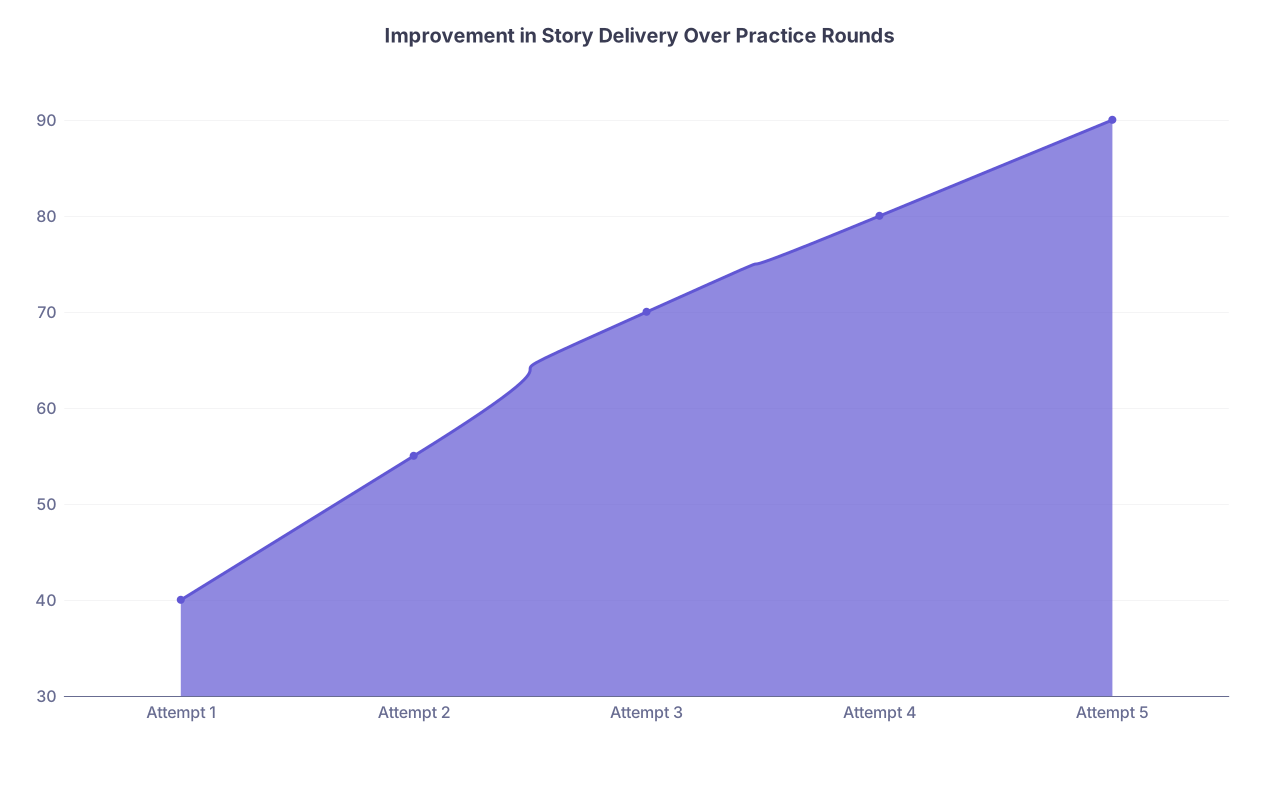
| Category | Value |
|---|---|
| Attempt 1 | 40 |
| Attempt 2 | 55 |
| Attempt 3 | 70 |
| Attempt 4 | 80 |
| Attempt 5 | 90 |
A. Build a 60–90 second version
Template:
- “Early in residency, I…” (what happened)
- “The underlying issue was…” (insight)
- “In response, I…” (corrective actions)
- “Since then, my performance has…” (evidence)
- “This experience changed how I…” (professional identity now)
Example:
“Early in my intern year, I took a three‑month medical leave to address severe burnout and depression. The core issue was that I ignored my own limits and tried to handle everything alone, which was not sustainable in this work. With guidance from my program director and a psychiatrist, I developed a treatment plan, set up a support system, and learned to ask for help early instead of when I am already in crisis. Since returning, I have completed the rest of residency on time, with strong evaluations in reliability and teamwork, and I now serve as an informal mentor to interns who are struggling. This experience has made me a more self-aware and steady physician, especially during high-acuity situations.”
That is enough. If they want more, they will ask.
B. Practice with people who will not flatter you
Run it by:
- A blunt co-resident
- A trusted attending
- Someone in GME or a mentor outside your program
Ask them:
- “Where do I sound defensive?”
- “What parts feel unclear or raise questions?”
- “Do I sound like I am making excuses anywhere?”
Do not try to sound impressive. Try to sound honest and professional.
Step 9: Align Your Future Goals With Your Past Story
Your nonlinear past should inform your future orientation, not contradict it.
If you burned out badly, then say you want to contribute to:
- Resident wellness initiatives
- Sustainable scheduling / staffing projects
- Education around early-warning signs in trainees
If you struggled academically then excelled:
- Future goals in teaching and coaching residents through early rotations
- QI in handoff systems, feedback structures, board support

Fellowship directors like candidates whose goals are clearly shaped by real experience. Not generic “I want to be a leader in the field” fluff.
Tie it together like this:
- “Because I have personally experienced how fragile early-career physicians can feel, I plan to be actively involved in resident education and wellness in fellowship, particularly around…”
- “My own early struggles with time management and clinical reasoning pushed me to develop structured teaching tools that I now use with interns; in fellowship, I hope to expand this work…”
You are turning your past into a reason to trust your future contributions.
Step 10: Know What Not To Do
Let me save you from common self-sabotage moves I see every year.

Do not:
- Over-explain in writing. One polished paragraph is better than an essay.
- Name and shame your prior program or faculty. You will look unprofessional.
- Use therapy language as a shield (“I have processed my trauma”). Stay clinical.
- Declare that you are “completely healed” or “a different person now.” Sounds fake.
- Hide a major issue with vague wording; programs will assume the worst.
- Let your entire application orbit your problem. Let the problem be one planet in a much larger solar system.
Do:
- Treat your nonlinear elements as data points that you interpret for the reader.
- Emphasize longitudinal change, not a single “turning point miracle.”
- Ground everything in observable behavior and external feedback.
- Maintain a steady, unemotional tone when discussing your past difficulties.
Quick Recap: How To Reframe a Nonlinear Residency Story
You are not trying to convince anyone your path was ideal. You are proving that you are now stable, self-aware, and high-performing in reality, not just on paper.
Three core moves:
Own the facts and the causes
- Map your timeline.
- Name what actually went wrong.
- Drop the self-protective fog.
Show the work of change
- Detail the concrete steps you took: clinical, academic, personal.
- Bring evidence: evaluations, roles, responsibilities, outcomes.
- Make your growth impossible to ignore.
Tell one coherent, forward-looking story
- Use the ARC framework: Acknowledge → Responsibility → Current readiness.
- Coordinate with your PD and letter writers.
- Practice a calm 60–90 second verbal version until it is boring.
You cannot edit out the nonlinear parts of your story. You can decide whether they read like loose ends or like the chapters where you became the physician fellowship programs actually want.