
You can recover from a bad PGY‑2 year, but only if you stop hoping it “won’t matter” and start treating it like a problem that needs an aggressive, structured fix.
I have watched residents blow up their fellowship chances by pretending a weak year would be invisible. I have also watched others match into very competitive fellowships after academic probation, mediocre evaluations, even a failed Step 2 attempt. The difference was never luck. It was strategy, timing, and brutal honesty.
This is that strategy.
Step 1: Get Clear on What Went Wrong (and How Bad It Really Is)
Hand‑waving is your enemy. You need a precise diagnosis of your PGY‑2 problems.
Typical weak‑year patterns I see:
- Patchy or poor evaluations (especially on key rotations)
- Marginal or failed in‑training exam scores
- Professionalism flags (lateness, documentation issues, interpersonal conflicts)
- Low productivity: no research, no leadership, no teaching footprint
- Reputation problems: “good clinically, but hard to work with” or the opposite
You cannot fix what you describe vaguely as “not my best year.”
Concrete data check
Pull this together in one sitting:
- Rotation evaluations (especially ICU, cards, heme/onc, pulmonary, etc. for IM residents)
- In‑training exam (ITE) scores for all years
- Any formal letters: remediation plans, probation letters, or warnings
- Procedure logs and clinic metrics (no‑show rate, documentation completion time)
- E‑mails about concerns (yes, the awkward ones)
Now categorize:
- Red flags (must be directly addressed):
- Probation or formal remediation
- Failed board exam or ITE < 20–25th percentile
- Documented professionalism incidents
- Failed rotation or “requires close supervision” comments
- Yellow flags (must be improved and explained indirectly):
- “Meets expectations” everywhere with no standout comments
- One or two bad evaluations without formal action
- Noticeable grade drop from PGY‑1 to PGY‑2
- Minimal scholarly activity when your peers are publishing
If you are not sure how programs will view your situation, sit down with a trusted faculty member who has actually sat on fellowship selection committees. Not someone who “thinks” they know. Someone who has read rank lists.
Have them answer, bluntly:
- “If I applied to your fellowship this year, how would you summarize my risk to your committee?”
- “What specific concerns would you have about my application?”
Write down the exact phrases they use. Those phrases are the ones you will later target and neutralize.
Step 2: Decide Your Timeline – Apply Now vs. Delay a Cycle
Most residents underestimate how much a single strong year can rehabilitate a weak one. But timing matters. You need a realistic view of how much you can change before ERAS opens and letters are written.
Reality: What you can fix in 6–9 months
By the time you are halfway through PGY‑2, key things are already locked in:
- Your PGY‑1 + early PGY‑2 evaluations
- First impression inside your own department
- Any probation history
But you can still significantly move the needle on:
- Recent evaluations (the ones your PD will remember most)
- In‑training exam improvement
- Research productivity (abstracts, case reports, ongoing projects)
- Reputation as “reliable, improving, self‑aware”
Here is a simplified decision framework.

| Step | Description |
|---|---|
| Step 1 | Weak PGY-2 year |
| Step 2 | Delay fellowship 1 year |
| Step 3 | Apply on-time with heavy repair strategy |
| Step 4 | Any red flags? |
| Step 5 | Probation or serious professionalism? |
| Step 6 | Strong improvement possible by end of PGY-2? |
| Step 7 | Major ITE/board problems? |
Blunt version:
You should strongly consider delaying one cycle if:
- You had probation or formal remediation in PGY‑2.
- Your ITE is very low and you cannot realistically show a jump before applications.
- Your PD tells you, “I would not recommend you for a competitive fellowship this year.”
You can apply on time if:
- Problems are limited to weak evals, no big incidents.
- You have at least 9–12 months to show clear upward trajectory.
- Your PD says, “If you keep this up, I can support you this cycle.”
Delaying is not career death. I have seen delayed applicants match at stronger programs than their on‑time classmates because their application was clean, mature, and backed by undeniable improvement.
Step 3: Build a Concrete “Rehabilitation Plan” (Not Vague Resolutions)
You need a written plan for the next 6–18 months. Not mental notes. A plan you could show your PD and mentors.
Think in four domains:
- Clinical performance
- Exams / boards
- Scholarship & CV
- Professional reputation and narrative
1. Clinical performance: Become impossible to ignore
Goal: When programs call your PD, they say some version of, “PGY‑2 was rough, but this year they look like a different resident.”
Pick 2–3 behaviors and metrics to attack hard:
- Show up early, leave late on high‑impact rotations (ICU, subspecialty services)
- Be the person who:
- Volunteers for sick admits and transfers
- Owns difficult family meetings (with supervision if needed)
- Fixes small system issues (order set error, sign‑out template problem)
Ask your chief resident or a trusted attending:
- “What would it look like, concretely, for me to be in the top 25% of residents on this rotation?”
Then implement the answer aggressively.
Document your change:
- Save appreciative e‑mails or comments from attendings, nurses, consultants (yes, keep a folder)
- Track:
- Notes closed by 10 a.m. next day
- On‑time check‑outs
- Fewer missing labs, fewer dropped tasks
You want your PD to feel the difference, and you want traceable evidence that you are more organized and reliable.
2. Exams / boards: Turn a liability into a recovery story
If your ITE or prior exam performance is weak, it cannot stay vague. You must attack it.
Set a concrete target: “PGY‑2 ITE 28th percentile; PGY‑3 ITE ≥ 60–70th percentile.”
Then set up a real study plan, not “I’ll do questions when I can.”
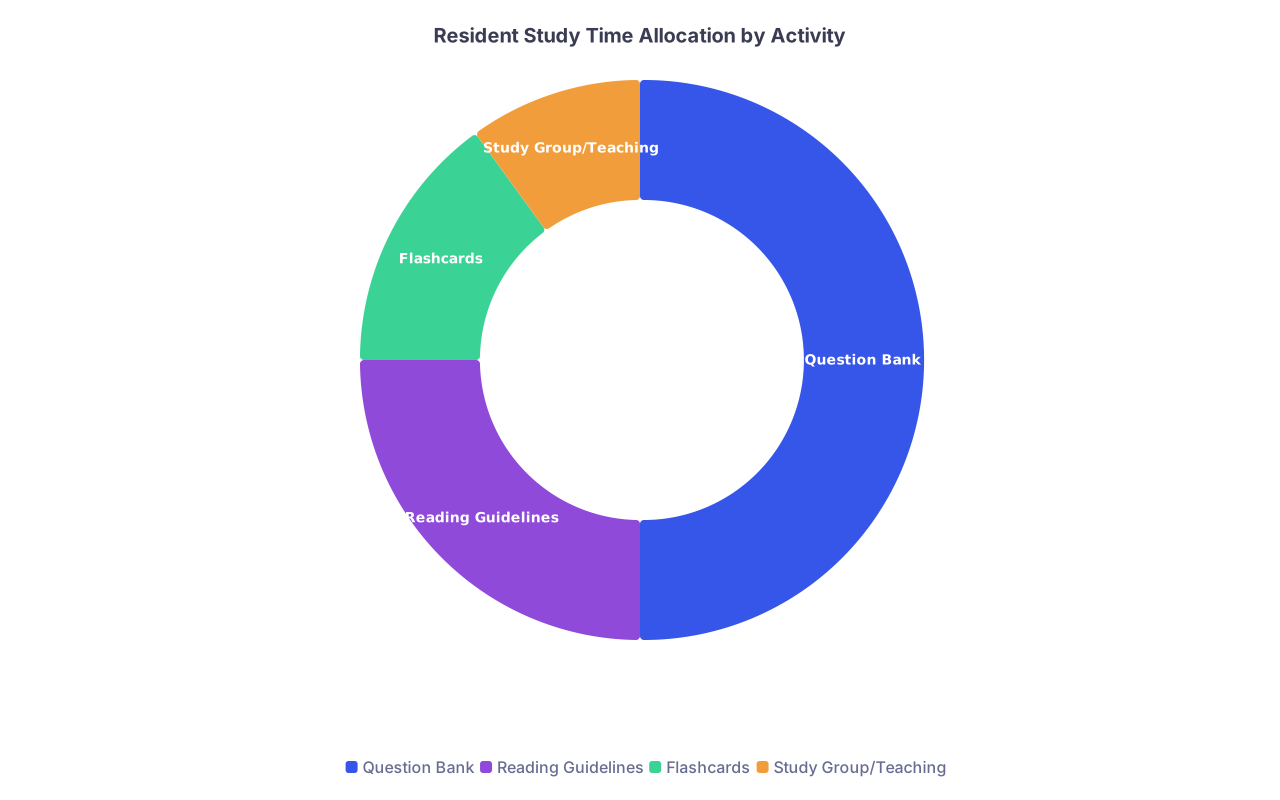
| Category | Value |
|---|---|
| Question Bank | 50 |
| Reading Guidelines | 25 |
| Flashcards | 15 |
| Study Group/Teaching | 10 |
Practical structure:
- Choose 1 primary Q‑bank and commit: e.g., MKSAP, UWorld, or for other fields, a field‑specific qbank.
- Daily minimums:
- On ward months: 10–15 questions/day
- On lighter months: 30–40 questions/day
- Weekly:
- 1–2 hours of guideline reading tied to your question misses
- Brief teaching to interns/med students on your weak topics (forces deeper learning)
If you had a failed board or Step exam, you must:
- Meet with a learning specialist if available.
- Identify the actual failure pattern:
- Time management?
- Poor content base?
- Test anxiety?
- Document your remediation efforts so your PD can write about your structured improvement.
Fellowship programs do not love risk. A clear ITE/board improvement curve is one of the strongest ways to convince them that PGY‑2 was an outlier, not your baseline.
Step 4: Salvage and Upgrade Your Letters of Recommendation
Your letters will either rescue you or bury you. There is not much middle ground when you are coming off a weak year.
You need:
- 1 very strong letter from your PD or APD
- 2–3 strong subspecialty letters (preferably in your chosen field)
- Optional: a research mentor letter if you have real scholarly work
Fix your PD relationship first
If your PD is lukewarm on you, that is the first fire to put out.
Schedule an explicit “repair” meeting:
- “I know my PGY‑2 year has not reflected the physician I want to be. I would like to develop a specific plan for the rest of residency so that, by the time I apply for fellowship, you can honestly say I have addressed your concerns.”
Ask directly:
- “What are the top 3 things that would need to change for you to feel confident writing a strong letter for me?”
Write them down. Read them back. Then execute.
Check back 3–4 months later:
- “Can we review the goals we set a few months ago? I want to know if you are seeing real improvement or if I need to adjust further.”
Programs listen to PDs more than anyone else. If your PD says in their letter, “They had a difficult PGY‑2 year, but I have seen major, sustained growth and I fully support their candidacy,” that line alone can neutralize a lot of suspicion.
Structure your subspecialty letters
For your fellowship field, target attendings who:
- Saw you after you started improving
- Supervised you closely on strong rotations
- Actually like teaching and writing letters
When you ask, do not say, “Can you write me a letter?” Say:
- “Can you write me a strong letter for [specialty] fellowship, even with the context of my weaker PGY‑2 year?”
If they hesitate, thank them and do not use them. A “meh” letter will kill you.
Give them a packet:
- Your updated CV
- A one‑page summary:
- Your PGY‑2 issues in one short, honest paragraph
- The specific steps you took to improve
- Concrete examples of your performance on their rotation (remind them)
- Any research or QI projects you are working on with them
Good letter writers will use your own language to construct a coherent growth story. That is exactly what you want.
Step 5: Build Credible Substance on Your CV – Fast
You do not need ten publications. You do need evidence that you are engaged in your field, teachable, and capable of seeing projects through.
Focus on things you can realistically start and advance within 6–12 months.
High‑yield options:
Case reports or case series
- Identify unusual or instructive cases on your subspecialty rotation.
- Pair with a friendly attending who likes to publish.
- Aim for:
- 1–3 case reports submitted
- Poster or abstract presentations at regional/national meetings
Quality improvement (QI) projects
- Pick a problem that annoys everyone:
- Delayed discharge summaries
- Poor follow‑up on critical labs
- Suboptimal heart failure education
- Build a simple Plan‑Do‑Study‑Act cycle.
- Present results at your hospital QI day or a local meeting.
- Pick a problem that annoys everyone:
Education footprint
- Organize a short lecture series for interns/med students.
- Build a small teaching curriculum in your interest area (e.g., “ICU Basics for Interns”).
- Ask your chiefs if there are standing teaching gaps you can fill.
Do not sign onto some giant R01‑level project that will not result in anything before your application. The fellowship committee does not care how many IRB forms you filled out. They care about output.
| Activity Type | Time to First Output | Impact on Fellowship Apps |
|---|---|---|
| Case Report | 2–4 months | Moderate–High |
| Small QI Project | 4–6 months | High if presented |
| Local Poster | 3–6 months | Moderate |
| National Abstract | 6–12 months | High |
| Large Cohort Study | 12–24 months | Low (for near-term apps) |
The ideal is a mix: 1–2 case reports, 1 scaled QI project, 1–2 presentations, maybe 1 early‑stage retrospective study if you have time.
Step 6: Control the Narrative in Your Personal Statement and Interviews
If you had a weak PGY‑2 year and you pretend it never happened, programs will fill in the story themselves. And they will usually assume the worst.
You must acknowledge it. Briefly. Calmly. With ownership and evidence of growth.
Personal statement structure for a “recovery” story
Keep the damage section short. The statement is not your confession booth.
Brief context
- One paragraph, maximum.
- Example:
- “Midway through my PGY‑2 year, I struggled with efficiency and time management on busy inpatient rotations. My evaluations reflected this, and my program leadership gave me direct feedback that I needed to improve my organization and follow‑through.”
Ownership + no excuses
- “These deficits were my responsibility. They did not reflect a lack of commitment to patients, but they did affect my team and my effectiveness.”
Specific actions you took
- “I met with my program director and developed a structured improvement plan focusing on pre‑round preparation, earlier note completion, and communication with nurses and consultants.”
Objective results
- “Over the subsequent year, my evaluations improved markedly, I moved from the 30th to the 70th percentile on the in‑training exam, and I have consistently been commended for reliability and follow‑through on ICU and subspecialty services.”
Tie back to fellowship readiness
- “Working through this has made me a more deliberate, accountable trainee, and I now bring a much more mature approach to the complex patients that drew me to [fellowship field].”
That is it. Do not spend three pages apologizing. Show growth, then move on to why you want the field and what you bring to it.
Interview responses: No defensiveness, no drama
You will get some version of: “Tell me about a time you struggled in residency” or “Can you explain the dip in your evaluations during PGY‑2?”
Use a clean, three‑part structure:
What happened – 2–3 sentences
- “During my PGY‑2 year, particularly on high‑volume inpatient rotations, I struggled with time management. My notes were sometimes late, and I occasionally missed follow‑up tasks. My evaluations reflected those issues, and my PD gave me direct feedback.”
What you did – concrete actions
- “I asked for a clear improvement plan and started batching tasks, pre‑rounding more systematically, and checking in with nurses twice daily about pending issues. I also set up a weekly meeting with a senior resident mentor to review my workflow.”
How you are different now – objective and relational
- “Over the last year, my evaluations have commented on reliability and team communication, and I moved my ITE percentile from X to Y. I am more organized, but more importantly, I am quicker to ask for feedback early rather than waiting until it becomes a problem.”
Say it cleanly, without self‑pity. Programs hear the difference between someone who learned and someone who just wants to be forgiven.
Step 7: Be Strategic About Where You Apply
After a weak PGY‑2 year, you cannot aim only at the shiny brand‑name programs and hope your charm carries you. You need a rational, diversified list.
Think in tiers:
Stretch programs
- Highly competitive, top‑name places.
- Apply to a limited number where you have:
- Alumni from your residency
- Faculty connections
- Strong research relevance
Core realistic programs
- Strong but not ultra‑elite.
- Historically interview applicants from your residency.
- Value clinical strength and growth over pedigree alone.
Safety / anchor programs
- Places that reliably match residents similar to (or weaker than) your profile.
- Programs with closer ties to your PD or mentors.
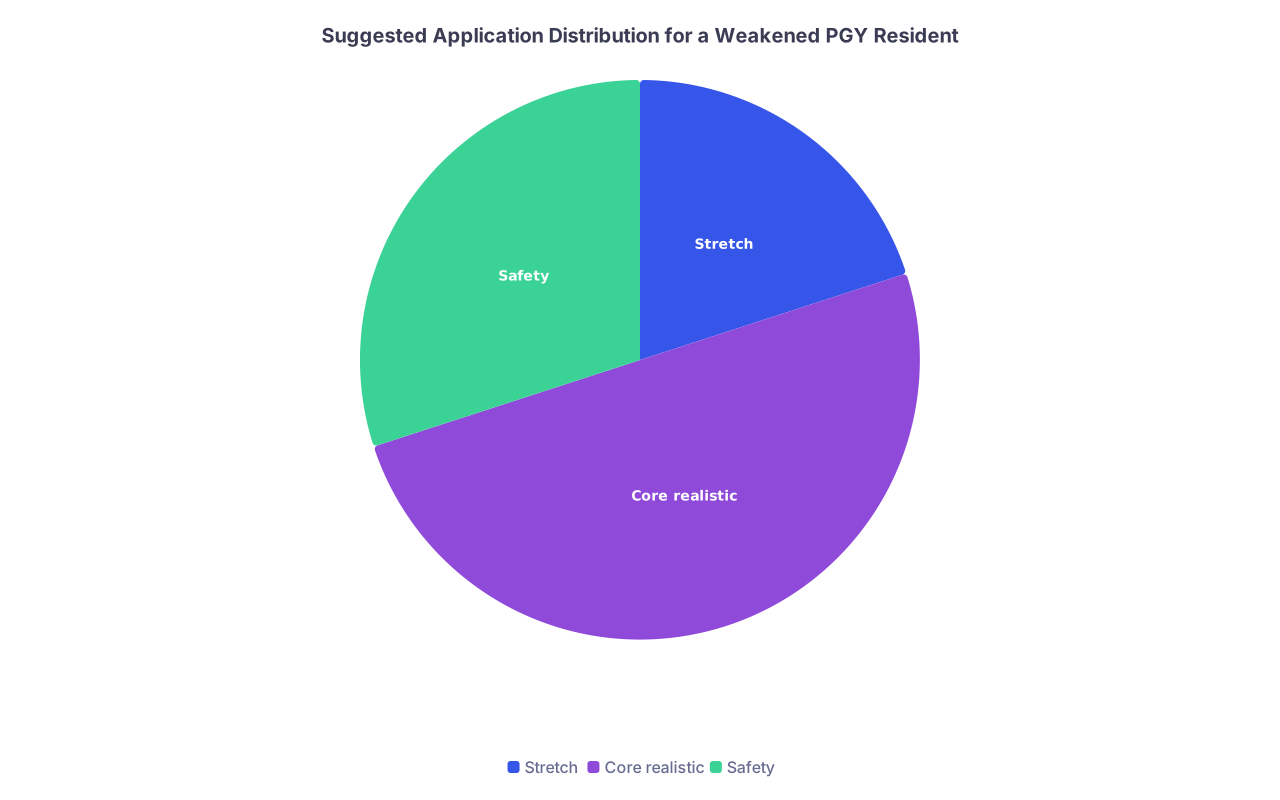
| Category | Value |
|---|---|
| Stretch | 20 |
| Core realistic | 50 |
| Safety | 30 |
On top of that:
- Lean into programs that know your PD well. A phone call from a trusted PD saying, “Yes, PGY‑2 was rough, but I would absolutely take this person as my own fellow,” can outweigh a line or two of weak evals.
- Consider programs that emphasize clinical work and service rather than purely research prestige, especially if your recovery is more clinical than academic.
Step 8: Manage the Emotional Side Without Letting It Drive Decisions
Here is the part people rarely talk about: a bad year hurts. It bruises your ego, your confidence, your identity as “the good student” or “the strong resident.” That emotional drag makes it easy to:
- Avoid feedback
- Procrastinate on hard conversations
- Default to magical thinking (“Maybe programs will not notice”)
You cannot let that happen. But you also cannot pretend you are a robot.
Basic protocol that I see actually work:
One trusted vent outlet
- A co‑resident, therapist, or mentor where you can say, “This sucks,” without needing to be polished.
- Offload your frustration there, not in the hospital, not in front of students.
Micro‑wins log
- Once a week, write down 3 small things you did well:
- “Closed all notes same day on night float.”
- “Handled a difficult family meeting with calm.”
- “Attending explicitly commented on my improved organization.”
- You are rebuilding your identity as a capable physician, brick by brick.
- Once a week, write down 3 small things you did well:
Guardrails against burnout
- You cannot fix PGY‑2 by overworking yourself into collapse.
- Protect:
- 1 consistent sleep anchor time, even on off days.
- Some physical activity, even 10–15 minutes.
- A few hours each week that are completely non‑medical.
Residents who recover best from a weak year are not the ones who punish themselves the hardest. They are the ones who treat the problem like a clinical case: identify, plan, execute, re‑assess.
Step 9: If You Delay a Cycle, Use That Extra Year Intelligently
If you decide (or your PD strongly “recommends”) that you delay fellowship applications by a year, do not limp through an extra year hoping the stigma just fades. You need that year to transform your profile.
Good uses of a gap/extra year:
Chief year with a clear growth story
- If, and only if, your PD believes you will genuinely excel in that role.
- Shows leadership, maturity, and institutional trust.
Hospitalist or academic attending year with targeted involvement
- Take on:
- Teaching roles
- QI projects
- Committee work
- Get a new set of letters from people who only know the “fixed” you.
- Take on:
Research‑heavy year in your subspecialty
- Formal fellowship research year or “pre‑fellowship” position in your field.
- Aim for tangible outputs:
- Abstracts
- Manuscripts
- Involvement in subspecialty conferences
Do not take a year completely disconnected from medicine unless there is a strong, coherent reason (health, family, visa, etc.). That story can be told, but it adds another layer to explain.
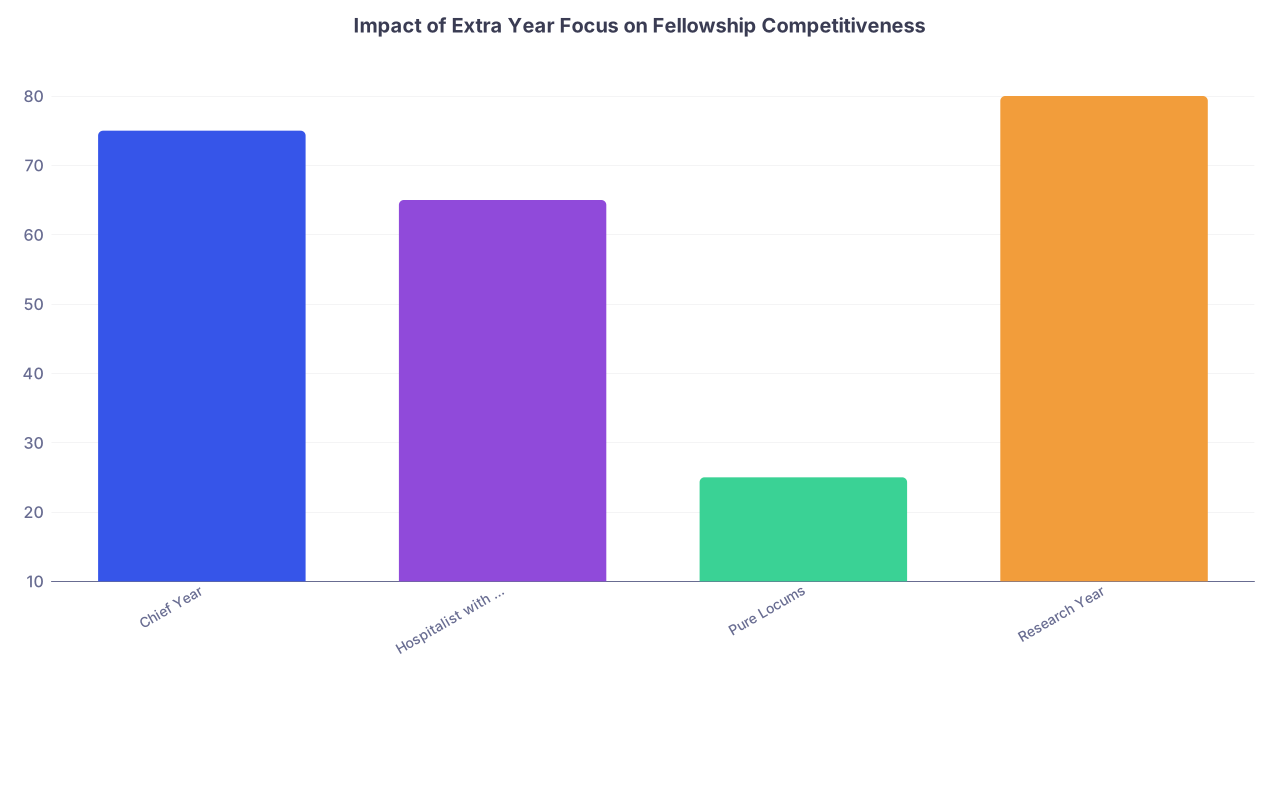
| Category | Value |
|---|---|
| Chief Year | 75 |
| Hospitalist with Teaching | 65 |
| Pure Locums | 25 |
| Research Year | 80 |
(Rough relative impact, not absolute numbers. The point: some paths help a lot more than others.)
Step 10: Know the Four Things Fellowship Committees Actually Want to See
Strip away all the noise. After a weak PGY‑2 year, this is what fellowship PDs are really asking:
Are you safe?
- Clinical competence
- No pattern of dangerous behavior or repeated serious lapses
Will you pass boards?
- Improved ITE/board scores
- Evidence you take exams seriously now
Will you make our lives easier or harder?
- Reputation for reliability, collegiality, teachability
- PD letter that says, “I trust this person”
Do you care enough about this field to contribute?
- Some scholarship, QI, or educational work in the specialty
- A coherent narrative of why this field, not “I just like it”
Every decision you make in your repair plan should be traceable to one of these four.




The Bottom Line
Three points to walk away with:
A weak PGY‑2 year does not end your fellowship chances, but ignoring it probably will. Diagnose the problem precisely, then build a structured repair plan focused on clinical performance, exams, scholarship, and reputation.
Your PD and key attendings are the leverage points. Fix those relationships, earn genuinely strong letters, and make it easy for them to describe a clear, sustained upward trajectory.
Control your timeline and your narrative. If needed, delay a cycle and use that extra time aggressively. Whether you apply now or later, own the weak year briefly, show concrete growth, and present yourself as the safer, more mature version of who you were then.