The second fellowship application hurts more than the first—but it’s usually better.
You’re no longer guessing. You have data: no interviews, too few interviews, late invites, weird feedback. The mistake most residents make is treating the second application like a slightly polished version of the first. That’s how you waste a year and end up in the same spot.
If you’re reapplying to fellowship after an unsuccessful cycle, you don’t need vague encouragement. You need a tactical rebuild. Here’s exactly how to do it.
Step 1: Get brutally clear on why you did not match
“Just bad luck” is almost never the full story.
If you do not diagnose the first cycle, you cannot fix the second. You need to break down your last application like a post-op complication review.
Start with hard data, not feelings:
| Profile Type | Interview Pattern | Typical Issues |
|---|---|---|
| No-interview | 0 invites | Big red flags, weak letters, poor targeting |
| Low-interview | 1–3 invites | Marginal competitiveness, mismatch with program tier/scope |
| Many-interview, no match | 6+ invites | Interview performance, fit concerns, weak narrative |
| Late-applier | Few, late invites | Timing, letters, Step 3, incomplete file |
Now, line up your specifics:
- How many programs did you apply to? Which tiers?
- How many interviews did you get?
- At what time in the season did invites come?
- Where in the season did your best interviews fall?
- Any programs where you thought things went well but you didn’t rank high or match?
Then, you chase feedback. Not vibes. Specifics.
Who to ask:
- Your program director (PD)
- Division chiefs in your desired specialty at your home institution
- A trusted mentor who writes a lot of fellowship letters
- If you had interviews: at least one faculty interviewer who likes you
The script is simple and direct:
“I’m planning to reapply to [specialty] this upcoming cycle. I’d really value your honest assessment of why you think I didn’t match this year and what you’d consider must-change items before reapplying.”
Push for specifics. If you get something vague like, “It’s very competitive,” follow up:
- “Do you think my application was below average, average, or above average for [specialty]?”
- “If you had to pick the weakest part—scores, letters, CV, personal statement, interview—what would it be?”
- “If I change nothing in the next 6–9 months, would you recommend I reapply or not?”
If every answer is “you’re great, just bad luck,” that’s usually code for:
- You’re not strong enough for the tier of programs you targeted.
- They don’t want the conflict of telling you your letters or presence are weak.
- They’re not seeing something compelling enough to advocate for you.
Be very suspicious of the “everything is great” feedback. Programs do match people who are clearly great. If you didn’t match, something didn’t land.
Step 2: Decide if you should reapply now or wait a year
Not everyone should reapply immediately. For some, a rushed reapplication is just another failed cycle with more emotional damage.
You need to answer two questions honestly:
- Can I materially change my application in the next 6–9 months?
- Will staying an extra year (chief, research, hospitalist) realistically change how fellowship PDs see me?
Here’s a blunt framework:
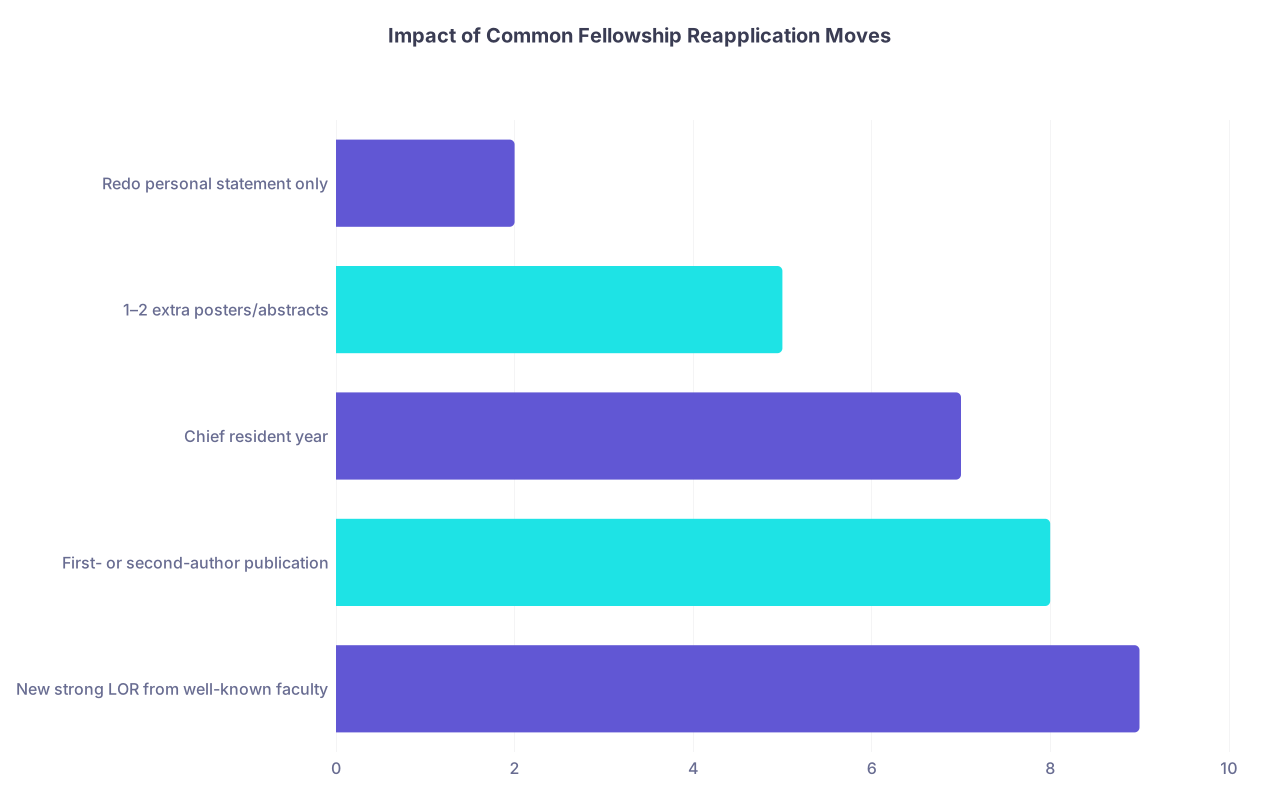
| Category | Value |
|---|---|
| New strong LOR from well-known faculty | 9 |
| First- or second-author publication | 8 |
| Chief resident year | 7 |
| 1–2 extra posters/abstracts | 5 |
| Redo personal statement only | 2 |
If the only thing you’re planning to change is your personal statement and maybe add one poster, that’s not a tactical reapplication. That’s cosmetic.
Reasons to wait a year (or do a structured gap year):
- You need time to produce actual scholarship (not just “submitted”).
- You need to work under a different attending to get a much stronger letter.
- You’re switching fellowship specialties and must build a credible story.
- You had genuine performance issues (leaves, remediation, professionalism) and need clean, documented time showing you’re solid.
Reasons to reapply immediately:
- You had a reasonable number of interviews but did not match. Interview performance and signaling strategy can be fixed in under a year.
- You were late or disorganized the first time (missing LORs, late ERAS completion).
- Your PD and fellowship leadership tell you explicitly: “You should reapply this cycle; we’ll support you differently this time.”
If your PD is lukewarm—“You could reapply if you really want to”—interpret that as “not yet.”
Step 3: Rebuild the three pillars—Letters, CV, and Narrative
You’re not sanding rough edges. You’re re-engineering the structural beams.
1. Letters of recommendation: the non-negotiable upgrade
If your letters don’t change, your outcome probably won’t either.
You need at least one letter that screams: “This person is in the top 10% of applicants I have seen in the last 5–10 years.” Fellowship PDs read between the lines. They know when someone is just “fine.”
Ask yourself, ruthlessly:
- Do I have a letter from someone in this specialty who is known in fellowship circles?
- Does at least one letter come from someone who knows me very well clinically?
- Is my PD letter strong, or just polite?
If you’re not sure, ask directly:
“Would you feel comfortable writing me a very strong letter for [specific fellowship], especially given that I am reapplying? If not, I’d rather know so I can adjust and work to earn that level of support.”
If they hesitate, don’t force it. Work on building a better relationship with someone else and earn that letter:
- Volunteer for extra clinical time on that faculty’s service.
- Do a focused QI or research project with them.
- Ask for direct feedback and visibly implement it.
You’re trying to walk into the next cycle with:
- PD letter that explicitly addresses your growth and current strength.
- At least 2 specialty-specific letters that show detailed, concrete examples of your clinical and team performance.
- At least 1 letter from someone who can speak to your academic potential (research, teaching, QI).
2. CV: make visible upgrades, not fluff
Fellowship PDs are jaded. They’ve seen “submitted manuscripts” graveyards and “projects in progress” that never became anything.
Your task is to create clearly improved signal:
What moves the needle:
- New first- or second-author paper in a relevant journal (does not have to be NEJM; a solid specialty journal counts).
- Actually accepted abstracts/posters/oral presentations at regional or national meetings.
- Measurable leadership with scope: chief resident, curriculum development, leading a QI initiative that changed practice.
- Evidence of commitment to the specific field: imaging conference leadership for cards, continuity clinic focus for GI, ICU time for pulm/crit, etc.
What barely moves the needle:
- One more small poster at a local meeting.
- “Manuscript in preparation” with no timeline or co-authors beyond your co-resident.
- Slapping your name onto a chart review at the last second.
Be strategic. Given your timeline, pick 1–2 CV moves you can actually complete before applications lock—then go hard:
- Identify an attending with data already collected and say, “I can clean this up, write the draft, and aim for submission by [date].”
- Turn an existing interesting case series into a proper poster and submit to the next regional or national meeting.
- Lead something real on your service: redesign a pre-rounding checklist, implement a post-discharge follow-up process, and measure something.
3. Narrative: your personal statement and story cannot be a re-run
If your last cycle ended in rejection and your personal statement is 90% identical, you are telling programs: “I learned nothing.”
You don’t need drama. You need a narrative that sounds like someone who reflected, adjusted, and matured.
Your reapplicant statement should:
- Acknowledge the reapplication briefly and without self-pity.
- Show concrete change: what you did clinically, academically, and personally since last cycle.
- Re-focus your goals: more specific, more grounded, less generic.
A structure that works:
- Short, specific clinical moment that illustrates why this field still fits you.
- What you’ve done over residency to deepen that interest (rotations, projects, teaching).
- What you did since the last application to grow (2–3 specific moves).
- What kind of fellow you’ll be and what training you’re seeking, in non-fluffy terms.
One line you can use (in your own words):
“I applied last cycle and did not match, which led me to deliberately strengthen [X, Y, Z]. Over the last year, I’ve… [concrete actions]. I’m reapplying now with a clearer understanding of the kind of fellow I want to be and the training environment where I’ll thrive.”
Then stop. Do not beg. Do not over-explain.
Step 4: Fix your application strategy, not just your content
Plenty of strong applicants still miss because they played the game wrong.
Broaden and tier your list intelligently
If your first cycle was “all top-20 programs” and you had a mid-range profile, you didn’t fail. You miscalculated.
You need a tiered list this round:
- A small number of aspirational “reach” programs.
- A solid core of realistic programs aligned with your metrics and background.
- Enough safety programs—often community-based or less research-heavy academic sites.
Look at data, not prestige fantasies:
- Past match lists from your home program—where do people like you match?
- Your Step scores, research output, and residency reputation.
- Whether programs routinely take residents from community or less-known programs.
Reapplicants often need to expand their list significantly, especially in hyper-competitive fields.
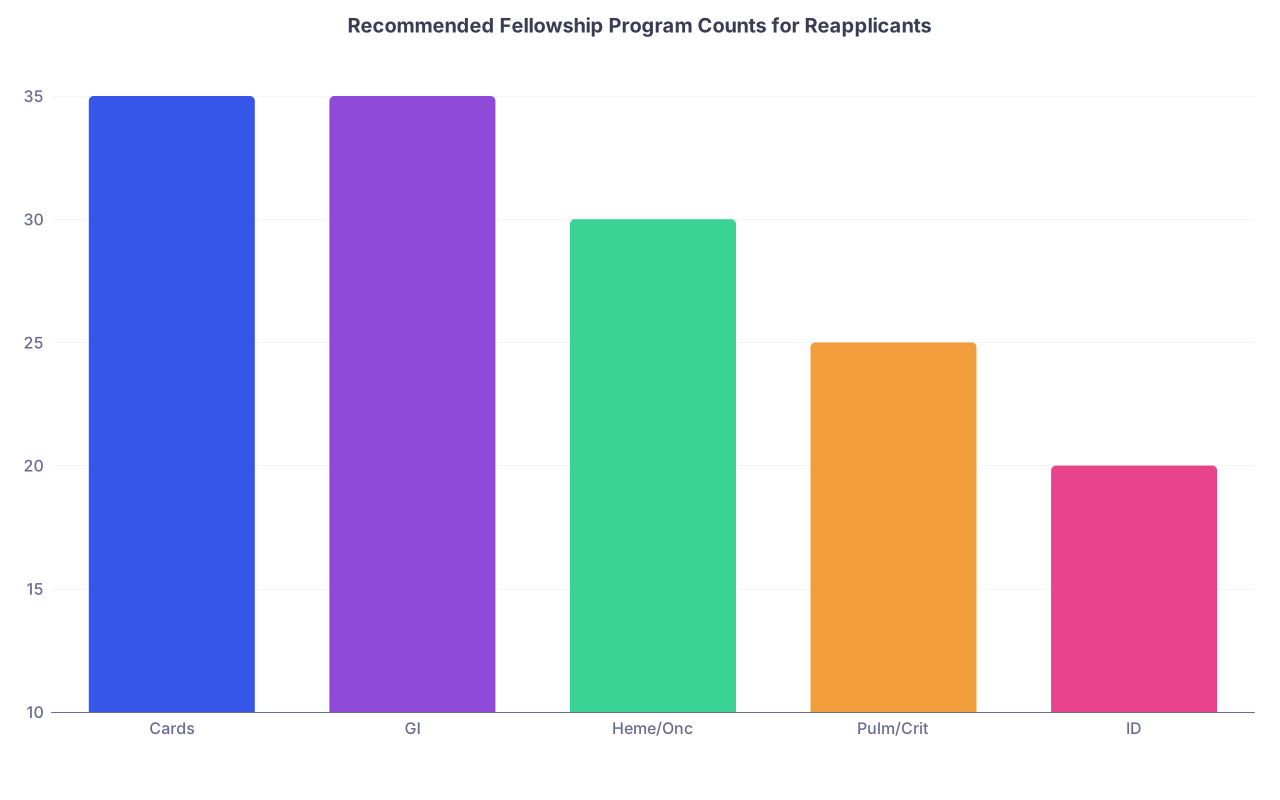
| Category | Value |
|---|---|
| Cards | 35 |
| GI | 35 |
| Heme/Onc | 30 |
| Pulm/Crit | 25 |
| ID | 20 |
If that number looks high and you feel resistance, ask yourself: do I want a fellowship, or do I want only a specific zip code and name brand?
If you’re rigid about geography or prestige, own the risk that you won’t match. That’s your choice—but don’t pretend it’s the system’s fault later.
Timing and completeness: zero excuses this time
Your second application must be early, clean, and complete. No “pending letter” nonsense.
Non-negotiables:
- ERAS submitted on day 1 or within the first 3–5 days.
- All letters uploaded before programs start downloading applications.
- Step 3 done and passed if your specialty/programs care about it.
- No missing fields, outdated CV sections, or “TBD” presentations that never materialize.
Build a simple backward timeline:
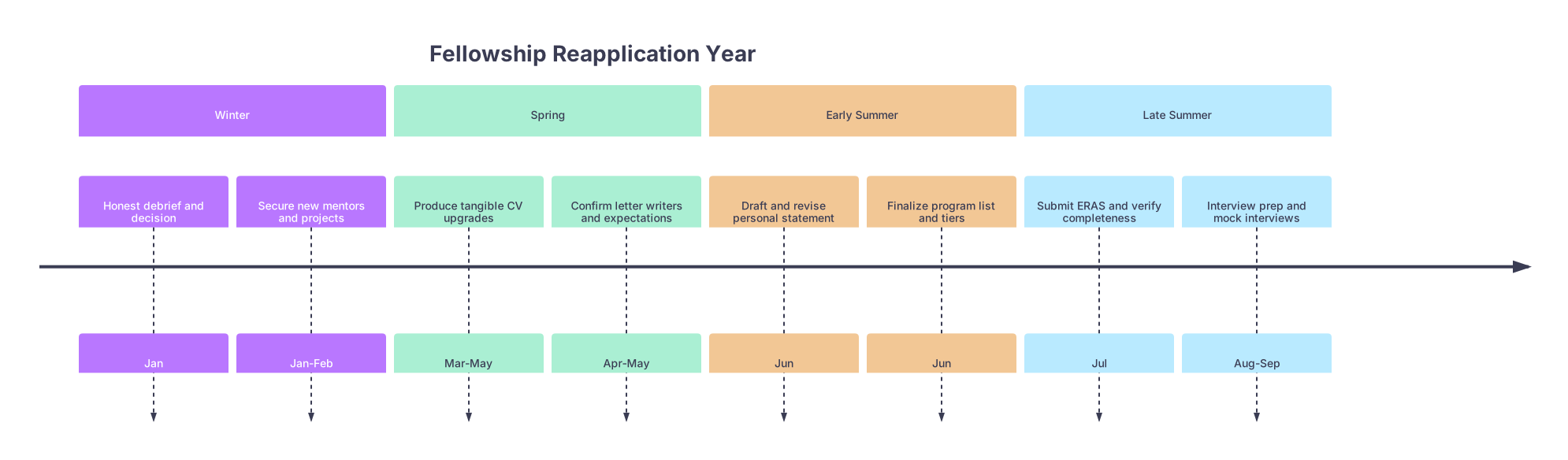
| Period | Event |
|---|---|
| Winter - Honest debrief and decision | Jan |
| Winter - Secure new mentors and projects | Jan-Feb |
| Spring - Produce tangible CV upgrades | Mar-May |
| Spring - Confirm letter writers and expectations | Apr-May |
| Early Summer - Draft and revise personal statement | Jun |
| Early Summer - Finalize program list and tiers | Jun |
| Late Summer - Submit ERAS and verify completeness | Jul |
| Late Summer - Interview prep and mock interviews | Aug-Sep |
Stick to it like it’s a procedural checklist for a central line. You don’t “probably” do steps; you do them.
Step 5: Overhaul your interview performance (if you got interviews last time)
If you had 6–10 interviews and did not match, your application is likely sufficient. Your interviewing, fit signaling, or ranking strategy was off.
Patterns I’ve seen:
- Residents who sound rehearsed, stiff, or evasive when discussing weaknesses.
- People who obsess over research in every answer when the program clearly values clinical work.
- Applicants who do not ask any program-specific questions and sound identical at every site.
Tactical changes:
Do real mock interviews with people who will push you.
Not your co-resident who tells you you’re great. Your APD. A tough attending. Someone who will say, “You sound defensive” or “You’re not answering the question.”Own your reapplication without oversharing.
When asked about not matching previously:“I applied last cycle and did not match. Feedback I received was [X and Y]. Since then, I’ve focused on [concrete changes]. I’m glad I had the extra year; I’m a stronger candidate and clinician now.”
Then pivot to what you bring to their program. Calm. Matter-of-fact.
Study each program like a board exam topic.
You should know:- Their clinical strengths.
- Any unique rotations.
- Where recent fellows went (academics vs community).
Your questions and answers should reflect that. “Why our program?” should never sound generic the second time around.
Practice the “red flag” questions until they are boring.
- “Why do you think you didn’t match last cycle?”
- “What did you do differently this year?”
- “If you don’t match again, what’s your plan?”
You need honest but contained answers. No bitterness. No blaming.
Step 6: Manage the emotional side like a professional, not a martyr
Reapplying is not just paperwork. It’s humiliation, comparison, and anxiety all over again—while trying not to screw up your day job as a resident.
This matters because burned-out, resentful residents don’t present well on the trail. PDs can smell it.
Three practical things:
Shrink the circle of people who get to comment on your process.
Your PD, 1–2 mentors, maybe a trusted co-resident. Everyone else can get, “Yeah, I’m reapplying, will see how it goes,” and nothing more.Protect your clinical performance.
The worst thing you can do is torpedo your reputation this year because you’re mentally stuck on fellowship. Programs talk. A PD who used to say “top resident” shifting to “still solid” can kill you.Set rules for comparison.
Don’t track every co-resident’s invite count like a stock ticker. Decide: I will check in on my friends, celebrate them, but not weaponize their success against myself.
You’re allowed to be upset. You’re not allowed to let that ruin your second application.
Step 7: Have a real Plan B that you can say out loud
Programs will ask: “What will you do if you don’t match this year?”
You should not freeze. And you should not lie.
A strong answer sounds like:
“My goal is still to become a [specialty] physician. If I do not match this year, I’d likely pursue a [hospitalist/chief/research] position with continued work in [specific area]. I’d use that time to further strengthen [X and Y], but I’m approaching this cycle as if this is my last application and giving it everything I can.”
Behind the scenes, you should know your real options:
- Staying on as chief resident.
- Transitioning to a hospitalist role with a strong connection to your desired specialty.
- A research year with a productive mentor.
- Seriously reconsidering specialty or path (yes, sometimes the right answer is to pivot).
Having a concrete Plan B will make you calmer in interviews. Calm people interview better.
Step 8: Know when to pivot—or stop
You’re allowed to decide fellowship isn’t worth another cycle. Or that you’re okay with a different field. Or even no fellowship at all.
Signals that it might be time to pivot:
- Your PD and specialty leadership consistently say your chances are very low, even with extra work.
- You’ve already done a true “all-in” reapplication with real upgrades and still did not match.
- The toll on your mental health, finances, or relationships is too high relative to what this fellowship will add to your life.
If you decide to stop, that’s not failure. That’s triage. You’re choosing to invest your energy somewhere with a better risk–benefit ratio.
What changes the second time actually work
Let me be blunt: cosmetic reapplications almost always fail. Tactical reapplications work more often than people think.
The things that actually move the needle:
- A clearly upgraded letter set with at least one new powerhouse letter.
- Tangible academic or clinical achievements since last cycle.
- A sharpened, honest narrative that explains your growth without begging for pity.
- A smarter program list that matches your real profile, not your ego.
- Cleaner execution—early, complete, and organized.
- Noticeably better interviewing: composed, specific, and aligned.
And underneath all of that: a mindset shift from “I hope they like me this time” to “Here’s what I offer, and here’s why I fit what you say you want.”

Pulling it together: a concrete 6-month rebuild plan
If you’re sitting at the start of a reapplication year, here’s what a real tactical plan might look like:
Month 1–2
- Get honest feedback from PD and mentors.
- Decide: reapply this cycle or delay.
- Lock in new letter writers and specific expectations.
- Attach yourself to 1–2 winnable scholarly or QI projects.
Month 3–4
- Push projects forward hard (drafts, submissions, abstract deadlines).
- Take on a visible leadership or teaching role if possible.
- Start drafting a new personal statement grounded in what’s actually changed.
Month 5–6
- Finalize program list with realistic tiers.
- Lock in all letters; remind writers with clear deadlines.
- Do at least 2 serious mock interviews.
- Submit ERAS early, double-check every section.
That’s what tactical looks like. Not magical. Just concrete, uncomfortable changes.
With those pieces in place, your second fellowship application isn’t a rerun. It’s a different show. And once you’ve survived this, you’ll be a lot more prepared for the next big gate—your attending job search, contract negotiation, and all the politics that come with it. But that’s a story for another day.