
The worst mistake residents make when switching visas during fellowship applications is treating immigration like an afterthought. It is not. It is a parallel application process that can tank your match if you treat it as paperwork you’ll “figure out later.”
You’re in residency, you’re on one visa, you want fellowship, and you probably need to change status (J→H, H→O, F→H, etc.). This is high‑stakes and time‑sensitive. Let’s walk through it like an attending would round on a complicated patient: stepwise, no fluff, and with clear “do this, not that” advice.
Step 0: Get Your Situation Exactly Defined
Before you start emailing programs or immigration lawyers, you need a one‑line, precise description of your situation. Most residents cannot give this cleanly; that’s why they get vague answers.
Write this down on paper:
Your current status (with dates)
- J‑1, sponsored by ECFMG? End date? Two‑year home requirement?
- H‑1B sponsored by your residency? Cap‑exempt or cap‑subject? End date?
- F‑1 with OPT? When does OPT end?
Your target fellowship start date
- Usually July 1, year X
Your desired future status
- H‑1B for fellowship?
- J‑1 for fellowship?
- O‑1?
- Plan to file for waiver? Green card already in process?
Then compress that into one sentence you can put in emails and interviews:
“PGY‑2 IM resident on J‑1 ECFMG sponsorship, ends 06/30/2026, subject to 2‑year home requirement, applying for 2027 Cardiology fellowship, hoping to switch to H‑1B via J‑1 waiver.”
If you cannot say your situation in one breath, you’re not ready to talk to programs yet.
Step 1: Understand the Visa Options That Actually Exist For You
Forget message‑board mythology. You have a limited menu.
| Path | Typical Use Case | Key Constraint |
|---|---|---|
| J-1 (ECFMG) | Most IM subspecialty fellows | 2-year home requirement after training |
| H-1B Cap-Exempt | University/teaching hospital fellowships | Tied to that employer only |
| H-1B Cap-Subject | Private practice or some non-academic jobs | Subject to lottery timing |
| O-1 | Strong research/academic CV | Higher bar, more documentation |
| J-1 Waiver → H-1B | Post-residency or post-fellowship jobs | Must work in underserved area |
Here’s the blunt version:
If you’re currently J‑1 in residency:
- Easiest: Stay J‑1 in fellowship, deal with waiver job later.
- Harder: Attempt J‑1 → H‑1B for fellowship (rare, requires waiver or change of circumstances).
- Very hard: Somehow dodge the 2‑year rule without a real basis. Stop looking for magic hacks; they’re basically nonexistent.
If you’re currently H‑1B in residency:
- Cleanest for fellowship: Another H‑1B, usually cap‑exempt at a university program.
- Risk: Timing of transfer and maintaining continuous status.
- Common trap: Going from cap‑exempt residency to cap‑subject fellowship or job and misunderstanding the lottery.
If you’re on F‑1/OPT:
- You’re racing the clock. Any gap between OPT ending and fellowship visa starting will destroy your plans.
- You need early, aggressive planning with both your school’s DSO and an immigration attorney.
This is where you book a consult with a real immigration attorney who does physician visas weekly, not “someone my cousin used at his tech startup.”
Step 2: Map Your Timeline Against the Match Calendar
You are not just applying for fellowship; you’re syncing three calendars:
- NRMP or specialty match calendar
- Hospital GME onboarding/credentialing
- USCIS/State Department processing times
Here’s a simplified high‑level structure.
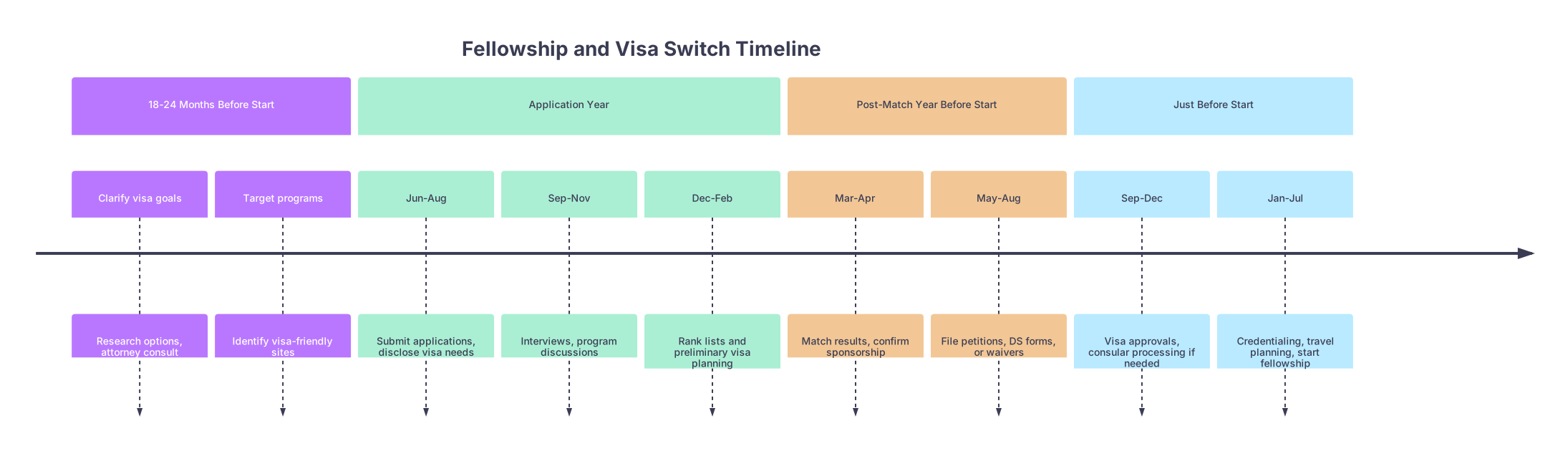
| Period | Event |
|---|---|
| 18-24 Months Before Start - Clarify visa goals | Research options, attorney consult |
| 18-24 Months Before Start - Target programs | Identify visa-friendly sites |
| Application Year - Jun-Aug | Submit applications, disclose visa needs |
| Application Year - Sep-Nov | Interviews, program discussions |
| Application Year - Dec-Feb | Rank lists and preliminary visa planning |
| Post-Match Year Before Start - Mar-Apr | Match results, confirm sponsorship |
| Post-Match Year Before Start - May-Aug | File petitions, DS forms, or waivers |
| Just Before Start - Sep-Dec | Visa approvals, consular processing if needed |
| Just Before Start - Jan-Jul | Credentialing, travel planning, start fellowship |
Practical reality: you need your broad visa plan locked down 12–18 months before fellowship start, and ideally before you hit “submit” on ERAS.
If you are switching visas, your mental model should be: “I’m applying to fellowship and running an immigration project in parallel, from day one.”
Step 3: Target the Right Programs (Visa‑Wise), Not Just Prestige‑Wise
Lots of smart residents apply broadly without checking visa patterns. Then they’re shocked when the only interviews come from programs that cannot or will not do their needed visa.
You need to triage programs early. Not all are worth your time.
Practical steps:
Build a spreadsheet with:
- Program name, location
- Fellowship type
- Past visas used for fellows (J‑1 only, J+H, H predominant, O‑1 history)
- Explicit website policy (often buried under GME pages)
- Known contacts (current or past IMGs)
Do not trust program websites entirely.
- “We accept J‑1 and H‑1B” can mean “we did one H once for the Chair’s nephew.”
- This is where you ask current fellows: “What are you all on right now?”
Prioritize:
- Tier 1: Programs that have recently sponsored the exact visa you want for the same fellowship.
- Tier 2: Programs that are flexible (e.g., large university hospitals with mixed J/H).
- Tier 3: Programs that only sponsor what you’re trying to leave. Apply only if you’re ok staying on that visa.
If you’re trying J‑1 → H‑1B during fellowship: your Tier 1 is tiny. Be realistic. You may only find a handful of programs that both sponsor H‑1B for fellows and are open to taking somebody with a J‑1 history plus home‑residency requirement complexity.
Step 4: Decide Your “Visa Story” Before You Talk to Programs
Programs hate confusion about visas. They’ll rank you lower rather than inherit a mess.
Your goal: have a clean, confident, legally realistic story you repeat consistently.
Example “visa stories”:
J‑1 resident, willing to stay J‑1 for fellowship:
- “I’m currently on J‑1 through ECFMG and plan to continue J‑1 for fellowship. After training I’ll pursue a J‑1 waiver job in a medically underserved area. I’ve already started looking into those options.”
H‑1B resident, wants H‑1B fellow:
- “I’m currently on an H‑1B through my residency, cap‑exempt. For fellowship I’m seeking continued cap‑exempt H‑1B sponsorship through a university program, then likely moving to a waiver or cap‑subject H‑1B job afterward. I’ve spoken with an immigration attorney to confirm that’s feasible.”
J‑1 resident, trying for H‑1B via waiver:
- “I understand I’m subject to the J‑1 home residency requirement. I’m exploring Conrad or other waiver options that would allow me to switch to H‑1B for fellowship, and I’ve already had an initial consultation with an attorney about the required steps and timing. I know this would require coordination with your GME office.”
Notice these are:
- Short
- Concrete
- Show prior thought and legal advice
- Do not ask the program to “figure it out for you”
Do not lead with: “Can you sponsor any visa? I’m flexible.” That signals you actually have no idea what you need.
Step 5: How and When to Disclose Your Visa Situation
You should not hide your visa situation and then spring it at rank time. That’s how bridges get burned and offers quietly disappear.
Here’s a reasonable sequence:
Application (ERAS, etc.):
- Answer all visa questions accurately.
- If there’s a dedicated “visa statement” box, put your one‑line situation summary or 2–3 sentence version.
- Do not bury this in your personal statement unless it’s central to your story (e.g., hardships, multiple moves).
Before interview day:
- If the program’s website is vague and your situation is complex (e.g., J‑1 waiver, O‑1), send a short, precise email to the coordinator:
- “I’m very interested in your [X] fellowship and wanted to briefly clarify my visa situation to ensure feasibility if I match with you.”
- If the program’s website is vague and your situation is complex (e.g., J‑1 waiver, O‑1), send a short, precise email to the coordinator:
During interview:
- Use one answer slot (often the “any questions for us?” time) to briefly confirm:
- “Given my current [visa] and plan to [target visa/waiver], would your program and GME office be able to support that, assuming all legal requirements are met?”
- Use one answer slot (often the “any questions for us?” time) to briefly confirm:
After interview, if needed:
- If a PD seemed open but unsure, a short follow‑up saying:
- “Per our discussion, I confirmed with my attorney that [summary of legal path]. If your GME is open to [visa type], I’d be very enthusiastic about ranking your program highly.”
- If a PD seemed open but unsure, a short follow‑up saying:
What you avoid:
- Long visa lectures
- Asking them to interpret immigration rules
- Surprising them after rank lists are certified
Step 6: Coordinate the Actual Switch Stepwise (Post‑Match)
Once you match somewhere, the theoretical part is over. Now we’re in execution mode.
Break it down:
6.1 Immediately After the Match
Within 1–2 weeks of Match Day:
Email the fellowship coordinator and GME:
- Restate your visa situation in 1–2 sentences.
- Ask for their standard process and their preferred immigration counsel (or if they have in‑house lawyers).
Loop in your own attorney:
- Send them your match letter.
- Confirm realistic filing dates and any hard deadlines (current status expiry, etc.).
This is where a lot of residents wait “until closer to start date.” Big mistake. You need months.
6.2 Gather Documentation Early
Every switch involves documents that people suddenly “cannot find” at the worst time. Start a folder (cloud + physical) with:
- Passport, current visa stamps
- I‑94s (all of them)
- DS‑2019s (if J‑1, every iteration)
- I‑797 approvals (if H‑1B/O‑1)
- ECFMG certificate
- Residency contract and pay stubs
- Match letters, fellowship offer letters
- CV and publications list
Your immigration attorney and GME will ask for the same subset of documents repeatedly. Better to have it organized once.
6.3 Watch the Gaps
Your single biggest enemy is a gap in status between residency and fellowship.
Common trap scenarios:
- J‑1 ending on June 30; fellowship paperwork not done; no bridging plan.
- H‑1B residency ending in June; fellowship H‑1B not filed in time; you technically fall out of status before new job starts.
- Need for consular processing (traveling home for visa stamp) with a tight or unrealistic timeline.
This is where your timeline and your attorney’s calendar matter more than your Step 3 score.
Step 7: Strategy by Common Scenario
Let’s get concrete. Here’s what I’d tell you if you were in my office with these five common setups.
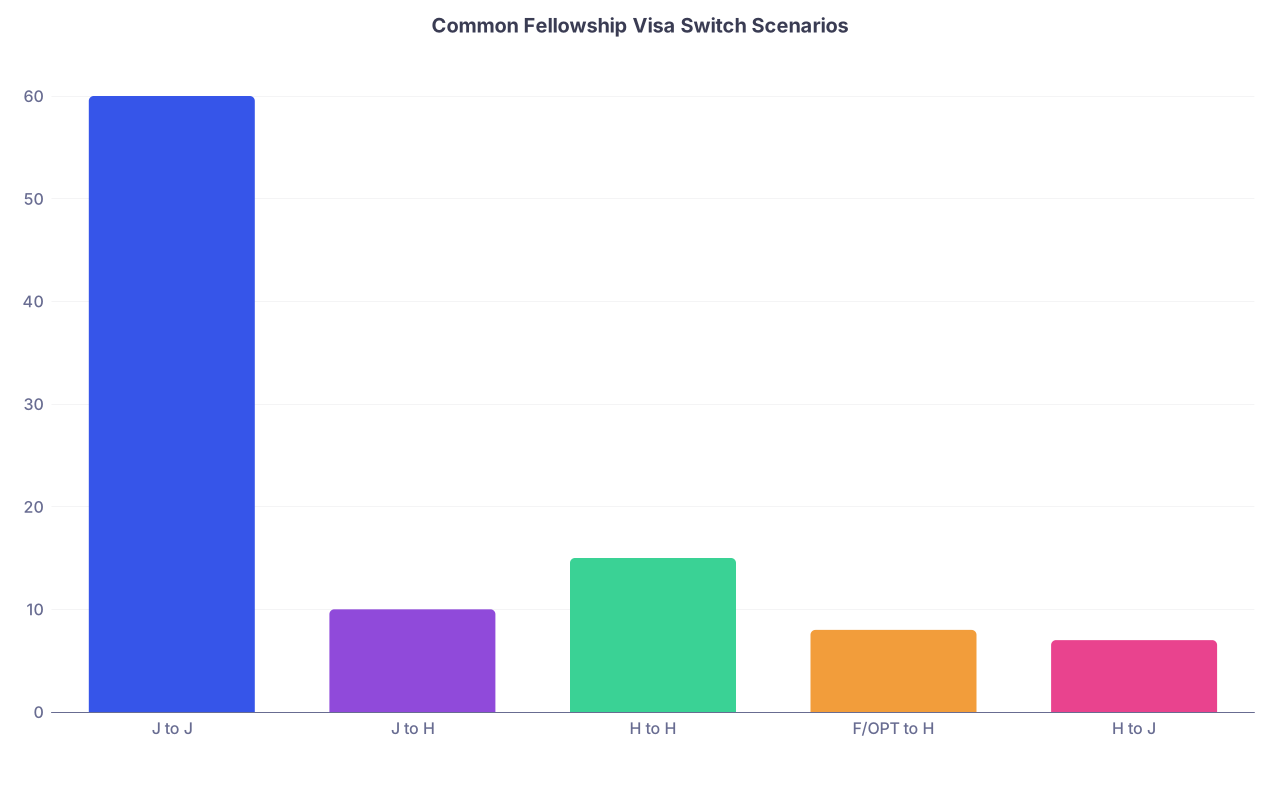
| Category | Value |
|---|---|
| J to J | 60 |
| J to H | 10 |
| H to H | 15 |
| F/OPT to H | 8 |
| H to J | 7 |
(Percentages are rough feel, not official data, but they reflect what I actually see residents dealing with.)
Scenario 1: J‑1 Residency → J‑1 Fellowship
Honestly, this is usually the least painful path.
Your strategy:
- Confirm ECFMG will continue sponsorship for your fellowship type.
- Make sure total training time rules are respected (some specialties have limits).
- Tell programs you plan to remain on J‑1 and do a waiver job after.
Main risks:
- Hitting max training limits on J‑1 if you stack too many fellowships.
- Programs misunderstanding your home residency requirement implications post‑training.
Scenario 2: J‑1 Residency → H‑1B Fellowship (with waiver)
This is the hardest one most people fantasize about. Without a legitimate waiver, you’re mostly stuck with the 2‑year rule.
If you do have or will have a J‑1 waiver:
- You need an attorney who does J‑1 waivers for physicians specifically. Not negotiable.
- You need a fellowship program that:
- Sponsors H‑1B.
- Is willing to deal with a J‑1 waiver history.
- Timeline is tight:
- State 30 waivers, federal waivers, hardship/persecution waivers all have different processing times that might not align well with fellowship start.
Blunt take: If your only reason to chase H‑1B fellowship is “I don’t want an underserved waiver job later,” you’re probably making life harder than it needs to be. Most people do J‑1 fellowship → waiver job → later career move.
Scenario 3: H‑1B Residency → H‑1B Fellowship
This is common in some competitive academic tracks.
Your strategy:
- Confirm your residency H‑1B is cap‑exempt (university or affiliated non‑profit). Most are.
- Target fellowship programs that are also cap‑exempt universities/hospitals.
- Aim for a straight H‑1B transfer, maintaining continuous status.
Watch for:
- Moving from cap‑exempt to cap‑subject: then you’re in the lottery game, and your fellowship may not align with lottery cycles.
- 6‑year H‑1B max: long residency + fellowship may hit the limit unless you have I‑140/perm process started.
Your conversations with programs:
- “I’m on cap‑exempt H‑1B. My expectation is to continue cap‑exempt H‑1B for the duration of fellowship. Is that consistent with your GME policy?”
Scenario 4: F‑1/OPT → H‑1B or J‑1 Fellowship
Tightrope walk.
Your reality:
- OPT has a hard end date.
- Any gap between OPT ending and fellowship visa start means potential status trouble.
Your strategy:
- Apply early; match into programs that have clear experience bringing F‑1/OPT grads into fellowship.
- Speak with your school’s DSO about authorized OPT durations and STEM extensions if applicable.
- Sit with an immigration attorney to map whether H‑1B or J‑1 is more realistic given timing.
I’ve seen this blow up when people assume they can just “hang around on OPT” until July. You need dates on a calendar, not vibes.
Scenario 5: H‑1B Residency → J‑1 Fellowship
Sometimes people step “backward” to J‑1 to sidestep H‑1B caps or timing issues.
Pros:
- J‑1 for fellowship can be simpler than arranging another H‑1B transfer in some institutions.
- ECFMG has a well‑oiled machine for J‑1 fellows.
Cons:
- You may newly incur or restart the 2‑year home residency requirement depending on history.
- Your long‑term path (waiver job, green card, etc.) shifts.
You absolutely need an attorney to check whether your previous H‑1B time + new J‑1 will cause complications later. Folks who wing it get rude surprises when they try to file for waivers or green cards.
Step 8: Red Flags and Avoidable Disasters
Some things I’ve seen repeatedly:
- PD says “we’ve never sponsored that type of visa, but let’s see” — translate this as: assume they cannot until proven otherwise.
- You rely entirely on program coordinators for immigration strategy — they can be excellent, but they’re not your lawyer and they work for the hospital, not you.
- You “hope” consular processing will be quick — then your visa appointment is after July and you miss your start date.
- You accept a spot at a program that “might” do your visa without confirming with GME/legal — then they reverse course in May when legal finally looks at your file.
Pattern: uncertainty + procrastination = pain.
Your job is to reduce uncertainty as early as possible by:
- Clarifying your own status and constraints
- Getting real legal advice
- Selecting only programs that match what you actually need
Step 9: Communication Templates You Can Steal
Here are quick, practical snippets you can adapt.
Email to fellowship coordinator before applying:
Dear [Coordinator],
I’m very interested in the [Year] [Fellowship] at [Institution]. Before I apply, I wanted to briefly clarify my visa situation to ensure feasibility if I were to match with you.
I’m currently a [PGY level] [specialty] resident at [current institution] on [visa type], valid through [date]. For fellowship, I’d be seeking [target visa, e.g., continued J‑1 via ECFMG / cap‑exempt H‑1B sponsorship].
Could you let me know whether your program and GME office are able to support this type of visa for fellows?
Best regards,
[Name, AAMC ID]
Short script for interview day:
“Just to confirm for planning purposes — I’m currently on [visa], and for fellowship I’d be looking to [continue J‑1 / transfer H‑1B / etc.]. Is that a visa type your GME office routinely sponsors for fellows?”
Post‑match email:
Dear [Coordinator],
I’m very excited to have matched at [Program] for [Fellowship, start year]. I wanted to touch base about next steps for visa processing.
As a reminder, I’m currently on [visa], valid through [date], and for fellowship I’d be seeking [target visa]. I’ve attached copies of my current documents [passport, I‑94, etc.] for your records.
Please let me know how best to coordinate with your GME office and any immigration counsel your institution uses.
Best,
[Name]
Use them; modify them; do not send three‑paragraph emotional epics about how stressful visas are. Programs know. They just need clean facts.
FAQ (Exactly 5 Questions)
1. Should I pay for my own immigration attorney, or just rely on the hospital’s lawyers?
Use both. The hospital’s attorney works for the institution; they’ll make sure the hospital is safe. You need your own lawyer to make sure you are safe long‑term (waivers, green card strategy, cap issues). I’d absolutely hire my own if I were switching visa types, touching J‑1 waivers, or approaching H‑1B time limits.
2. Will asking about visas hurt my chances at a program?
If you’re bluntly demanding (“you must sponsor X for me”), maybe. If you’re factual, concise, and early, most decent programs appreciate the clarity. Programs dislike surprises in May way more than a 2‑minute visa question in October. If a program penalizes you for merely clarifying feasibility, that’s probably not a place you want as your main immigration lifeline.
3. I’m on J‑1 and really want H‑1B for fellowship to avoid the waiver job. Is it realistic?
For most people, no. Not without a legitimate J‑1 waiver basis already in progress and a program willing to sponsor H‑1B. And even then, timing is tight. The far more common route is J‑1 residency → J‑1 fellowship → J‑1 waiver job (H‑1B) → later flexibility. Chasing a unicorn H‑1B fellowship often causes more anxiety than it’s worth.
4. My program website says “J‑1 only” but I heard a rumor they did an H‑1B once. Should I apply?
You can, but treat it as a reach. Ask directly (before ranking them high) if they’d consider H‑1B for you specifically. Do not rely on “a friend of a friend” stories. Institutional policy tends to be sticky; one exception years ago for a superstar or internal candidate does not mean they’ll bend rules for you.
5. When should I start planning the visa switch if fellowship starts in July 20XX?
Eighteen months out is ideal for complex switches, twelve months is the bare minimum. If you’re already inside a year and trying to change visa categories, you need to move fast: consult an attorney now, clean up your documents, and start transparent conversations with target programs. Waiting until after rank lists are certified to think about visas is how people end up unmatched or unable to start.
You’re juggling clinical work, research, fellowship apps, and a second invisible application to a different bureaucracy that does not care about match day. If you treat the visa switch as a structured project, not background noise, you’ll be fine.
Now that you have the stepwise strategy, your next job is picking the right programs and building a fellowship application competitive enough that they’ll want to work through the immigration complexity with you. But that’s a whole different battle—and one you’re finally positioned to fight properly.