

Coordinating Dual-Applying Partners for Fellowship in the Same City
What do you do when your fellowship match could put you in Boston and your partner in Phoenix—and both programs think they’re your top choice?
If you and your partner are trying to match to fellowship in the same city (or at least drivable distance), you’re in a complicated game with bad rules and high stakes. Programs are not formally “couples matching” you. Most will say they care about partner location. Some actually do. Many just… do not.
You cannot control how honest every PD is, how much they care about geography, or how many spots they have. You can control how you plan, signal, and sequence your applications.
Here’s how to handle this like adults who want careers and also want to stay together.
Step 1: Get Brutally Clear on Priorities (Before ERAS Opens)
If you skip this step, you will fight about it later. Usually during interview season when you’re both exhausted and irrational.
You need a shared framework before you even write your personal statements.
Sit down and answer these questions out loud, in writing, no hedging:
Which matters more:
- Same city at B-tier programs, or
- Separate cities if it means A+ dream programs?
What’s your minimum acceptable distance?
Same institution? Same city? 1-hour drive? 3-hour drive? Flight-only?Rank the following for each of you:
- Prestige/competitiveness of program
- Specific niche training (e.g., advanced IBD, structural heart, complex spine)
- Geography (family, kids, cost of living, lifestyle)
- Future job market in that region
You do not need identical answers. You do need a clear tie-break rule. Something like:
“If we’re both choosing between two cities and one option keeps us in the same metro area with reasonable programs for both, we pick that, unless it’s an obvious career-damaging choice for one person.”
Get this in writing. Not because it’s a contract. Because six months from now, at 1 am post-call, you’ll both misremember what you agreed on.
Now, define your city tiers.
| Tier | Cities | Notes |
|---|---|---|
| A | Boston, Chicago | Ideal for both careers and family |
| B | Philadelphia, Houston | Good programs, acceptable distance to family |
| C | Columbus, Pittsburgh | One partner good fit, one acceptable |
| D | Anywhere else | Only if one person’s career needs it |
You should each have your own program list, but share the city framework. That’s the anchor.
Step 2: Design a Coordinated Application Strategy, Not Two Parallel Ones
Most couples mess this up by behaving like two independent applicants who “hope it works out.” That’s not a strategy. That’s denial.
You need to coordinate at three levels:
- Where you apply
- How many places you apply
- How you talk about each other with programs
2A. Building your program lists together
You’re not applying as a formal couple match, but you should act like a quasi-couple match on the front end.
For each target city/region, map out:
- Programs for Partner A (e.g., GI, Cardiology, Heme/Onc)
- Programs for Partner B (e.g., ID, Rheum, Endocrine)
- Realistic match odds for each of you
Then build city “clusters.” Example:
- Boston cluster: MGH, BWH, BIDMC, Tufts
- Chicago cluster: Northwestern, UChicago, Rush, UIC
- Philly cluster: Penn, Jefferson, Temple
Your goal: in each priority area, ensure each of you has multiple reasonable targets, not just one “if we both get into the one perfect program it’ll be great” fantasy.
If one city is stacked for you but desert for your partner? Be honest. That city moves down the priority list unless your partner is ok being the “trailing partner.”
2B. Calibrate how broadly you each apply
One common problem: the more competitive partner gets 18 interviews in hot cities, the less competitive partner gets 4 scattered interviews in random places. You can’t fully prevent that, but you can optimize.
The more competitive partner should:
- Apply broadly to all the cities where the less competitive partner has a realistic shot
- Accept almost all interviews in those cities (even if some programs are “beneath” them)
The less competitive partner should:
- Apply wide in your shared priority cities (including some programs you might feel are slightly below you—this is about options, not ego)
- Still apply to some “solo” cities where the program is a strong fit, in case plans change
You’re playing odds. You want as many “paired interview cities” as possible.
Step 3: Decide When and How to Tell Programs You’re Dual-Applying
This is the part everyone stresses about. Do you tell programs you’re a couple trying to be in the same city? Will they care? Will it hurt you?
Here’s the reality:
- Some PDs will genuinely try to help coordinate.
- Some will say, “We’ll keep that in mind,” and then totally ignore it.
- A few will think, “If their partner doesn’t match here, will they rank us lower?” and subtly penalize you.
You can’t perfectly predict which is which. But there’s a reasonable way to approach it.
General rule
- Mention your partner and dual-applying in interviews and later email updates, not in your personal statement.
- Frame it as a positive stability factor, not a demand.
A simple way to bring it up in an interview:
“My partner is also applying for fellowship in [specialty] this cycle, and we’re hoping to end up in the same city if possible. They’re applying to [X, Y, Z] programs in this area. That said, I’m very genuinely interested in this program for [specific reasons].”
Notice the pieces:
- You state the fact.
- You name local programs (shows you actually researched the city).
- You explicitly reaffirm your interest in their program, not just the city.
Don’t wait until post-interview to say anything. They can’t advocate for you with their colleagues if they don’t know you exist as a dual pair.
Step 4: Tactical Communication with Programs (Without Being Annoying)
Now the nitty-gritty. How to email. Who to loop in. When to say “this is our top choice.”
You’re walking a line between advocating for yourselves and looking like manipulative rank-list gamers.
4A. Pre-interview phase
If one of you has multiple interviews in a city and the other has none, you can try a light-touch nudge.
Example email to a PD or coordinator at a program where you have not yet received an interview:
Dear Dr. [Name],
I’m writing to express my continued strong interest in the [Specialty] fellowship at [Institution]. My partner, [Name], has received interview invitations at [Programs] in [City], and we are hoping to complete our training in the same metropolitan area.
I recognize how competitive your program is and appreciate your consideration of my application. If there’s any additional information that would be helpful, I’d be happy to provide it.
Best regards,
[You]
Does this always work? No. Have I seen it tip someone from “no invite yet” to “ok, we’ll fit them in”? Yes. Especially at mid-sized programs that are a bit more human.
4B. After interviews: targeted, honest signaling
Don’t shotgun “you’re my top choice” emails to five places. Programs talk. PDs move institutions. Fellows remember names.
Choose:
- 1–2 cities where you both have viable options
- 1 program per person where you will use the phrase “rank you very highly” OR “will be ranking you as my top choice”
And make those statements true.
Example for your true #1:
Dear Dr. [Name],
Thank you again for the opportunity to interview at [Program]. After completing my interviews, [Program] remains my top choice. The combination of [research focus / clinical volume / specific mentorship] aligns perfectly with my career goals in [niche].
My partner, [Name], is also applying for fellowship in [Specialty] and has interviewed at [Programs] in [City]. We will be ranking [City] very highly as a couple, and training at [Program] would be ideal for us both personally and professionally.
Thank you again for your time and consideration.
Best regards,
[You]
Do not lie. Do not say “top choice” to anyone who is not. Programs absolutely compare notes, especially in tight subspecialties.
Step 5: Building a Coordinated Rank List Without Screwing Either Career
This is where couples spiral. The spreadsheets come out. Emotions spike.
Here’s a structured way to rank without losing your minds.
5A. Build a combined city grid
Make a table like this for your top 4–5 cities. Use your real interviewed programs.
| City | Partner A Options | Partner B Options | Joint Feasibility |
|---|---|---|---|
| Boston | MGH, BIDMC | BWH, Tufts | Excellent |
| Chicago | Northwestern, Rush | UChicago only | Moderate |
| Philly | Penn only | Penn, Jefferson | Moderate |
| Houston | Baylor, UT Houston | Baylor only | Good |
Then rate:
- Excellent = both have ≥2 options, or 1 very strong and 1 good
- Good = both have ≥1 solid option
- Moderate = one person highly constrained but possible
- Poor = one person has no real shot / only very weak fit
5B. Decide your joint priority order for cities
This is key: you’re not just ranking programs individually; you’re ranking city outcomes.
You might decide, for example:
- Boston joint outcome
- Houston joint outcome
- Philly joint outcome
- Chicago joint outcome
- Solo high-prestige outcome for one partner
- Solo fallback outcome for the other partner
Now, translate that into individual rank lists.
5C. Rank lists in practice
Example:
Partner A (Cards):
- MGH
- BIDMC
- Baylor
- Northwestern
- Penn
- UT Houston
- Solo dream (e.g., UCSF)
- Other solos
Partner B (GI):
- BWH
- Tufts
- Baylor
- UChicago
- Penn
- Jefferson
- Solo dream (e.g., UCLA)
- Other solos
You see the structure:
- Both rank Boston programs high to maximize same-city outcomes there
- Then both favor Houston over Philly/Chicago, consistent with joint priorities
- Solo dream choices only after the main shared-city clusters
Don’t rank some random solo program second “just in case I don’t get Boston.” That’s how you end up across the country while your partner matches the shared-city plan exactly as agreed.
Step 6: Handling Imbalance in Competitiveness (One Partner “Outmatches” the Other)
This is the uncomfortable part. But it’s real.
Maybe one of you is an absolute monster on paper: 2–3 first-author papers, strong letters, 260 Step 2, from a big-name IM program. The other is solid but not elite: decent research, mid-range scores, community residency.
You can’t fix that in six months. What you can do is adjust expectations and roles.
If you’re the stronger applicant
You are the “anchor.” You’ll have more pull. More options.
That means:
You should be the one more willing to:
- Take a slightly less prestigious program in a city that works for both
- Turn down solo-elite options that would strand your partner
You should lean harder on advocacy:
- Use your big-name mentors to send emails for your partner to local programs
- Ask your PD directly, “Would you be willing to reach out to [Partner’s specialty PD] at [Same institution/neighboring institution]?”
Yes, you’re giving something up. That’s the trade you’re making for not living apart.
If you’re the less competitive applicant
Your role is not to drag your partner down or insist they pass on career-defining opportunities out of pure sentiment.
Your responsibilities:
- Be honest about where you’re realistically competitive
- Apply more broadly in the overlap cities
- Be willing to consider being the trailing partner for job/fellowship after training if necessary
Sometimes the right call is: the stronger applicant picks the best-fit program in City X, you go to a still-good-but-not-elite program nearby, and you plan your job search together later.
Step 7: Using Mentors Strategically (Not Helplessly)
You’re not the first couple to do this. Programs coordinate informally all the time. You just rarely hear the details.
Here’s how to use that.
What to actually ask mentors
Do not email your PD: “Can you please help us couples match?” That’s vague and easy to ignore.
Say this instead:
“My partner and I are both applying for fellowship and are trying to end up in the same city if possible.
I will be ranking [Program A] and [Program B] in [City] highly. My partner is applying to [Programs] there.
Would you be willing to email [Specific PD names] at those programs to let them know we’re a strong dual-applicant pair with serious interest in that city?”
Give them:
- Names
- Institutions
- A one-line description of your partner’s strengths
- Clear city focus
They may not all follow through. But some absolutely will.
Step 8: Contingency Plans If You Do Not Land in the Same City
You have to look this possibility in the face. Otherwise Match Day can wreck you twice—emotionally and logistically.
If you end up apart, your options are:
- Commuter relationship during fellowship
- Re-match / re-apply later for one partner
- Post-fellowship job coordination in a shared city
8A. Commuter relationship
Works best if:
- You’re in cities within 2–4 hours travel
- One or both of you have mostly outpatient or predictable schedules
- No small kids (or very strong local support network)
If this is even remotely on the table, discuss it now:
- How often are you okay seeing each other? Weekly? Twice a month?
- Who travels more often?
- What boundaries do you want around saying yes to extra moonlighting / call for money vs time together?
8B. Re-match or re-apply
This is messy but not impossible. Common patterns I’ve seen:
- One partner does a 1-year fellowship (e.g., hospitalist-based Niche) and then re-applies to the other partner’s city
- One person applies for an advanced fellowship in their partner’s city (e.g., advanced endoscopy, transplant, EP)
You don’t plan for this as your primary route, but you should at least understand it exists as a Plan B.
Visual: Timeline of a Dual-Application Year
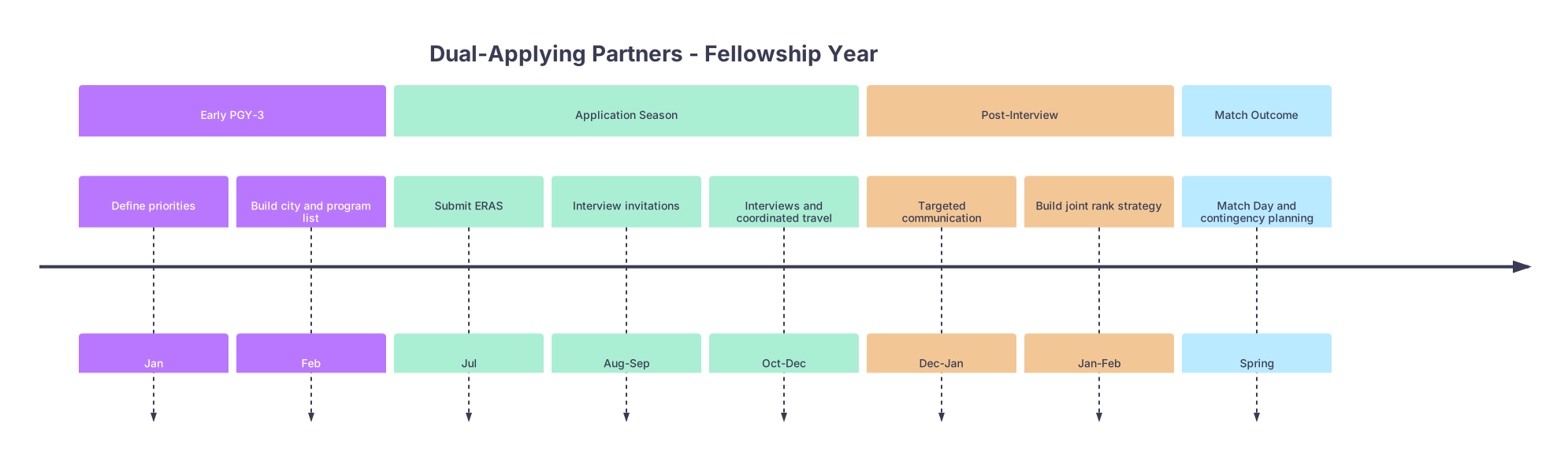
| Period | Event |
|---|---|
| Early PGY-3 - Define priorities | Jan |
| Early PGY-3 - Build city and program list | Feb |
| Application Season - Submit ERAS | Jul |
| Application Season - Interview invitations | Aug-Sep |
| Application Season - Interviews and coordinated travel | Oct-Dec |
| Post-Interview - Targeted communication | Dec-Jan |
| Post-Interview - Build joint rank strategy | Jan-Feb |
| Match Outcome - Match Day and contingency planning | Spring |
Reality Check: What Programs Actually Notice
Programs are busy. PDs are juggling their own trainees, service pressure, GME demands, and recruitment.
What cuts through:
- Clear, consistent signals (you’re not sending mixed messages to five programs in five cities)
- Specificity (you actually know who’s in the city, what the program offers, and can talk about it)
- Professional, not desperate, communication about your partner
What gets ignored or punished:
- Vague “my partner is also applying, please help us” without details
- Obvious lies (“You’re my top choice” emailed to multiple programs)
- Emotional manipulation (“If we don’t end up together this will be devastating”)
Act like a colleague, not a panicked med student.
Quick Summary: If You Remember Nothing Else
- Coordinate early and concretely: shared city priority list, realistic expectations based on competitiveness, and a joint rulebook for tie-breakers.
- Use targeted, honest communication: mention your partner in interviews, send focused emails to programs and mentors, and signal true top choices—once.
- Build rank lists around city outcomes, not just prestige, and accept that sometimes the best decision is a slightly less shiny program that lets you stay in the same life, not just the same field.


