

The worst career detours in medicine do not come from bad choices. They come from bad timing.
If you’re thinking about a gap year for research or hospitalist work before fellowship, the what matters less than the when and how long. Get the timing wrong and you delay fellowship for two cycles, lose momentum, and end up explaining a messy story on every interview. Get it right and your “gap” year becomes the strongest part of your CV.
I’ll walk you month-by-month and then week-by-week through planning a gap year during residency, with a hard focus on fellowship applications and reality inside residency programs.
Big-Picture Timeline: When a Gap Year Actually Makes Sense
First, orient yourself. Gap years for research or hospitalist work usually fall into one of three slots:
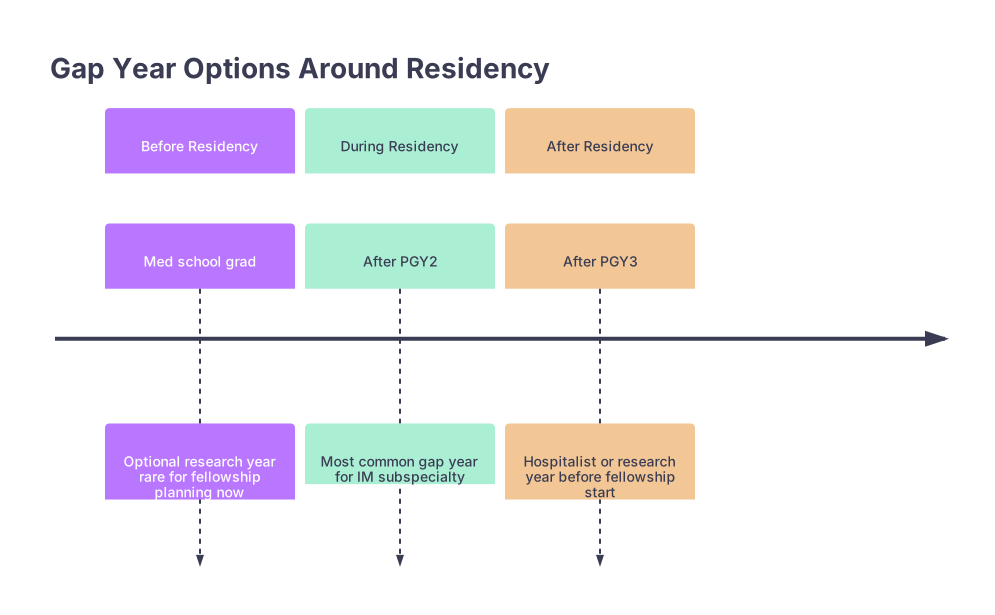
| Period | Event |
|---|---|
| Before Residency - Med school grad | Optional research year rare for fellowship planning now |
| During Residency - After PGY2 | Most common gap year for IM subspecialty |
| After Residency - After PGY3 | Hospitalist or research year before fellowship start |
You’re in residency now, aiming for fellowship. Here’s the reality by specialty:
Competitive IM subspecialties (cards, GI, heme/onc, pulm/crit):
- Common: 1 research year after PGY-2, then rejoin as PGY-3, apply that cycle.
- Or: Finish PGY-3, then 1 hospitalist or research year before fellowship.
Moderately competitive (ID, rheum, nephro, endo):
- Gap year less “required,” but strategic if you’re fixing weaker scores/letters or changing direction.
Hospital-based fellowships (critical care, neurocrit, palliative):
- Hospitalist work can be a real asset if framed correctly.
If you remember nothing else: the fellowship application year is anchored to July 1 fellowship start dates and July–September ERAS seasons. Your gap year has to bend around that, not the other way around.
12–18 Months Before: Decide If You Actually Need a Gap Year
At this point you should be:
- Late PGY-1 or early PGY-2
- Still on the “traditional” fellowship timeline
- Unsure if you can compete this upcoming cycle
Step 1: Brutal Assessment (Month 0)
Pull up your CV and answer these questions honestly:
For fellowship in a competitive field, do you have:
- At least 1–2 first- or second-author abstracts/posters?
- One strong subspecialty mentor who knows you well?
- Solid narrative letters forming (not just “hard-working resident”)?
Any red flags:
- USMLE Step 1 fail, low Step 2/3, remediation?
- Major professionalism incidents?
- Weak program reputation for your desired specialty?
If you strike out on research + mentorship and you’re aiming for cards/GI/heme-onc at solid programs, a gap year for research is often the smartest move.
If your research is fine, but you’re exhausted, uncertain about specialty, or want money/experience before committing, a hospitalist year after residency can make sense.
Step 2: Talk to People Who Know the Game (Weeks 1–2)
At this point you should:
- Schedule brief, targeted meetings with:
- Your program director (PD)
- One or two subspecialty faculty in your field of interest
- A current fellow who matched in that specialty
Ask directly:
- “If I apply this upcoming cycle, where do you realistically see my range of matches?”
- “Would a formal research year or extra experience year significantly change my trajectory?”
- “Has our program supported residents taking a year out before PGY-3 or after PGY-3?”
If the PD says, “You’re fine, apply,” and the subspecialty faculty agree, do not automatically default to a gap year. Unnecessary detours hurt more than they help.
If people say variants of, “You’re solid but not competitive for your target tier without more scholarly work,” that’s your signal.
Choosing: Research Year vs Hospitalist Year (and When)
Here’s how the two main options stack up for fellowship purposes.
| Aspect | Research Year | Hospitalist Year |
|---|---|---|
| Primary Benefit | Publications, mentorship | Clinical experience, income |
| Best Timing | After PGY-2 | After PGY-3 |
| Application Signal | Academic trajectory | Clinical maturity, real-world skills |
| Risk | Soft money funding, burnout from research grind | Can look like “giving up on academics” if framed poorly |
| Ideal For | Cards, GI, heme/onc, pulm/crit aiming higher tier | Critical care, palliative, hospital-based fellowships |
Who should choose a research year?
- You want an academic fellowship or academic career.
- Your CV is light on publications, or they’re all case reports from med school.
- You’re at a place with big-name labs/clinical investigators who actually place residents into fellowship.
Who should choose a hospitalist year?
- You’re more clinically inclined, maybe community-based long term.
- You need to pay off loans or support family.
- You finished residency without the fellowship offer you wanted, but your application is otherwise decent.
Option 1: Research Gap Year After PGY-2 – Ideal Timing
This is the most strategically powerful gap year if done correctly.
9–12 Months Before Research Year Start (Mid PGY-1 to Early PGY-2)
At this point you should:
Signal to your PD early
- Tell them you’re considering a research year between PGY-2 and PGY-3.
- Ask if your program has a standard pathway (many large IM programs do).
- Clarify: Will your PGY-3 spot be held for you? In writing.
-
- Attend divisional conferences in your target specialty.
- Pay attention to who:
- Presents multi-center trials
- Mentions NIH or major foundation grants
- Has fellows who publish and match well
Collect intel from current research residents
- Ask:
- “How much protected time is real vs theoretical?”
- “How many publications have you actually gotten in 1 year?”
- “Would you do it again?”
- Ask:
If nobody from your institution is getting good fellowship outcomes via research years, do not assume you’ll be the exception.
6–9 Months Before (Mid PGY-2)
At this point you should:
Lock in your research home
- Meet 2–3 PIs with a short, clear pitch:
- “I’m an IM PGY-2, planning a research year between PGY-2 and PGY-3 focused on X field. I’m looking for a structured year with defined projects that can realistically produce abstracts and at least one submitted manuscript by the end of the year.”
- Get concrete:
- Project types
- Expectations for authorship
- Funding or salary source (department vs grant vs you)
- Meet 2–3 PIs with a short, clear pitch:
Confirm the funding structure
- Are you:
- Paid as a research resident at your current PGY salary?
- Moving to a research position in a different department/institution?
- On soft money that might disappear halfway through the year?
- Are you:
-
- Ensure your research year:
- Starts July 1
- Allows enough time for output before ERAS opens in July the following year
- Ensure your research year:
Your goal: have at least abstracts submitted and early drafts of papers by January–March of the research year so they’re ready to list on ERAS.
0–3 Months Before Research Year Start (Late PGY-2)
At this point you should:
Get admin details nailed:
- Reappointment paperwork
- Badging/IT access to research systems
- IRB training and completion
- Any required research curriculum
Schedule your first 4–6 weeks of projects:
- Data sets you’ll be given access to
- Specific aims or hypotheses
- Standing weekly meeting with PI or mentor
If your first month looks like “we’ll figure it out as we go,” that’s how you end up with no publications and a nicely wasted year.
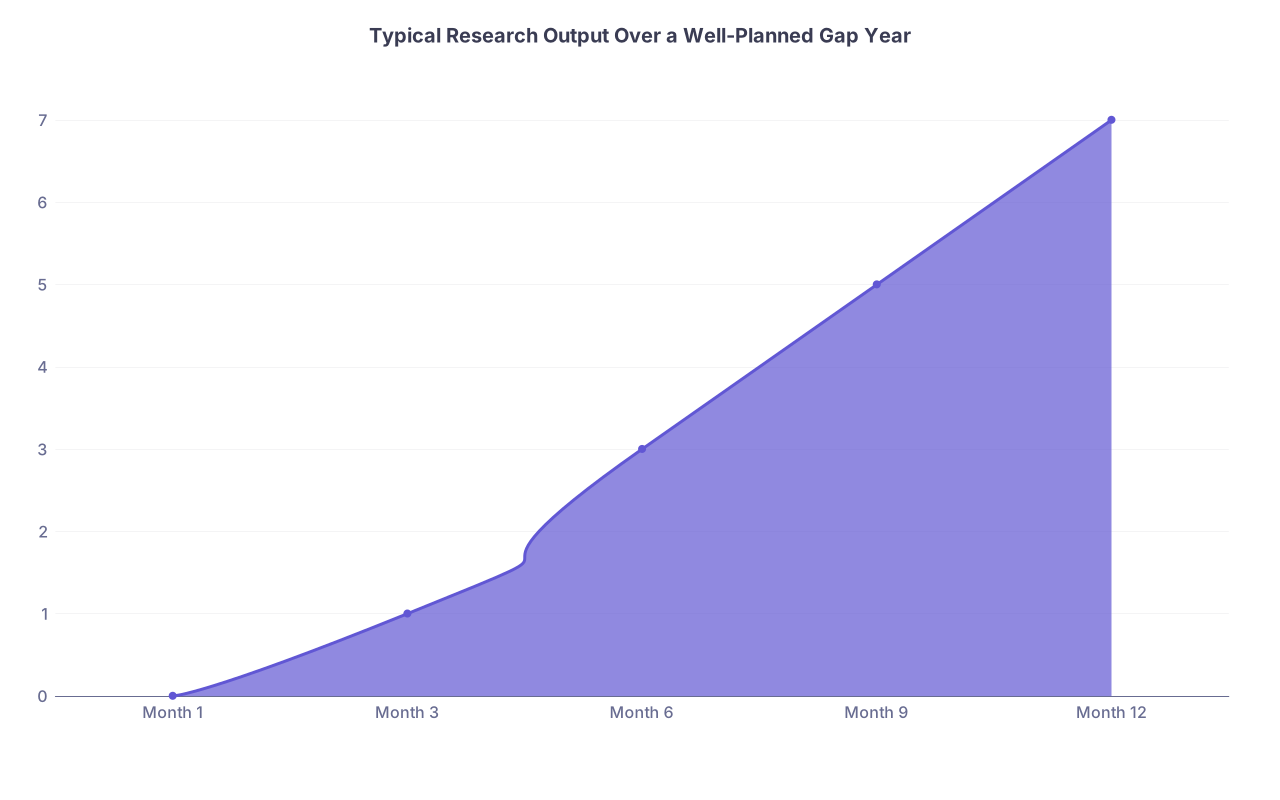
| Category | Value |
|---|---|
| Month 1 | 0 |
| Month 3 | 1 |
| Month 6 | 3 |
| Month 9 | 5 |
| Month 12 | 7 |
Interpretation: by Month 6 you should already see multiple works-in-progress, not just “thinking about a project.”
Inside the Research Year: Month-by-Month for Fellowship Positioning
Month 1–2: Setup and Data
At this point you should:
Have:
- 1–2 retrospective database projects underway
- Clear roles on any ongoing prospective trials
- A weekly or biweekly check-in with your main PI
Start a “Fellowship File”
- Cases or projects that show your clinical and academic interest
- Names of faculty who see you regularly and could write letters
Month 3–4: Abstracts and Early Products
You should:
Aim for:
- 1 abstract submitted to a major national meeting (ACC, AHA, ASCO, ATS, etc.)
- 1–2 additional projects at data-cleaning or analysis stage
Ask your PI:
- “What’s our abstract plan for the fall meetings? I need to align this with my ERAS timeline.”
Month 5–7: Manuscripts + ERAS Prep
This is the critical window.
At this point you should:
- Be drafting at least one manuscript where you’re first or second author.
- Confirm which mentors will write your fellowship letters.
- Start roughing out your personal statement, explicitly tying your research year to your fellowship goals.
By Month 7–8 (around ERAS opening):
- Have your:
- CV updated with “submitted” and “in preparation” manuscripts
- Abstract acceptances listed (if decisions are back)
- Mentors prepped to write detailed letters that:
- Describe your role on projects
- Frame the research year as intentional, not as “escape from residency”
Month 9–12: Interview Season While Still in Research
ERAS apps go in July–September. Interviews run roughly September–January.
At this point you should:
- Be able to explain your timeline cleanly:
- “I completed PGY-2, took a structured research year in heart failure under Dr X focused on outcomes in Y, then I’ll return as PGY-3 before starting fellowship.”
During interviews, program directors will look for:
- Evidence that:
- This was a planned academic move, not a remediation year.
- You can point to specific skills: database analysis, trial coordination, QI leadership.
Option 2: Hospitalist Year After Residency – Ideal Timing
Now let’s walk the other route.
This path is most common for:
- Residents who didn’t match the first fellowship cycle.
- People who weren’t originally going for fellowship and changed their mind late PGY-3.
- Residents needing financial breathing room.
6–9 Months Before PGY-3 Graduation
At this point you should:
- Decide:
- Are you applying for fellowship during PGY-3?
- Or intentionally delaying and planning a hospitalist year first?
If you’re planning a hospitalist year before fellowship apps:
- Target start date: July 1 after residency.
- Fellowship ERAS application: opens ~July during that hospitalist year, for fellowship starting the following July.
Meaning: if you graduate June 2026, work as a hospitalist July 2026–June 2027, you apply for fellowship in July–September 2026 to start fellowship July 2027.
You don’t need a full application gap; you overlap.
3–6 Months Before PGY-3 Graduation
At this point you should:
Lock in a hospitalist job that:
- Gives you schedule flexibility for interviews (7-on/7-off is helpful).
- Ideally exposes you to your future field (e.g., high ICU volume for pulm/crit).
Talk to your PD and fellowship mentors:
- Explain your plan: “I’m going to work as a hospitalist for a year, then apply to X fellowship. I’d like your support and updated letters during that time.”
Structuring the Hospitalist Year for Fellowship
Once you start:
Month 1–2:
- Learn the job, the EMR, and the culture.
- Introduce yourself to subspecialty groups you’re interested in:
- E.g., attend pulm case conferences if you’re aiming for pulm/crit.
- Volunteer for QI projects that touch their world (sepsis pathways, anticoagulation stewardship, etc.).
Month 3–6:
- Start building 1–2 specific “stories”:
- A QI project with measurable outcomes
- A teaching role (resident or student lectures)
- Leadership in committee work (M&M, code committee)
- Start building 1–2 specific “stories”:
Month 6–9:
- Prepare your application:
- Personal statement framing:
- Why you chose to work as a hospitalist
- What you learned that sharpened your fellowship goals
- How this experience will make you a better fellow
- Personal statement framing:
- Prepare your application:
Month 9–12:
- Interview while working:
- Coordinate your 7-on/7-off or vacation blocks.
- Be transparent with your employer early that you’re fellowship-bound.
- Interview while working:

Week-by-Week: 8-Week Countdown to Committing to a Gap Year
Let’s say you’re in early PGY-2 (for research) or mid PGY-3 (for hospitalist work) and on the fence. You’ve got about 2 months to make the call without chaos.
Week 1–2: Information Blitz
At this point you should:
Meet with:
- PD
- At least 2 subspecialty faculty
- A fellow who matched recently
Ask three things:
- “Would you recommend I apply this cycle?”
- “Would a gap year change my trajectory meaningfully?”
- “If I do a gap year, what should I aim to accomplish to impress fellowship PDs?”
Week 3–4: Decision and High-Level Plan
You should:
Decide clearly:
- Research gap year after PGY-2
- Or hospitalist year after PGY-3
- Or skip the gap and apply directly
Inform:
- PD formally (email + brief meeting)
- Chief residents (for scheduling and coverage planning)
- Any potential mentors/employers
Week 5–6: Lock Opportunities
For research:
- Confirm PI, funding, major projects, and start date.
For hospitalist work:
- Sign an offer, clarify:
- FTE status
- Schedule model
- Interview flexibility
Week 7–8: Narrative and Logistics
At this point you should:
- Start drafting the story you’ll eventually use in:
- Personal statements
- Interviews
- PD emails
It needs to sound intentional, not reactive:
- “I chose a research year to deepen my focus in [field], build skills in [methods], and position myself for an academic career.”
- “I chose a hospitalist year to broaden my clinical experience, lead QI efforts, and confirm my commitment to [field] with real-world practice.”
Common Pitfalls by Timeline (And How to Dodge Them)
Pitfall 1: Late Realization
Realizing you “need” a research year in April of PGY-2 with no PI, no plan, and no funding. That leads to a frantic scramble and often a low-yield, pseudo-research year.
Fix: Start evaluating by early PGY-2, not late.
Pitfall 2: Unstructured Research Year
No defined projects, no clear expectations, no regular mentorship. You’re just “around.”
Fix: Before day 1, have:
- Project list
- Meetings scheduled
- IRB plan
- Data access confirmed

Pitfall 3: Hospitalist Black Hole
You take a hospitalist job with abusive scheduling, no support for interviews, and zero connection to your future specialty. You’re too tired to apply well.
Fix: During interviews for hospitalist roles, ask:
- “How have you supported prior doctors pursuing fellowship?”
- “Is it realistic to take several days off during interview season?”
Pitfall 4: Timeline Drift
You intend a 1-year gap and somehow it becomes 2–3 years without progress, making fellowship PDs nervous about your clinical sharpness and commitment.
Fix: Lock your fellowship application season before the gap year starts. Put the ERAS opening month in your calendar and work backward.
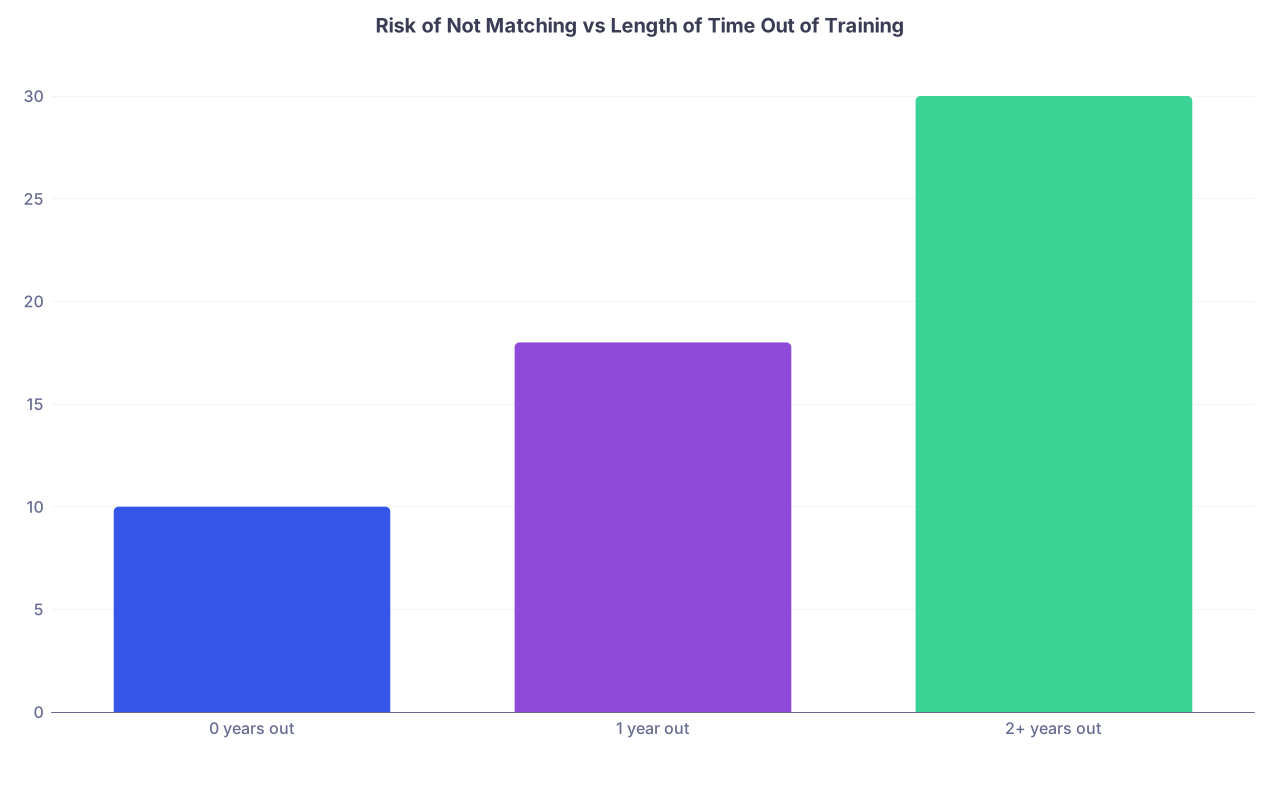
| Category | Value |
|---|---|
| 0 years out | 10 |
| 1 year out | 18 |
| 2+ years out | 30 |
(Not exact numbers, but the trend is real: prolonged gaps without clear productivity increase risk.)
FAQ (Exactly 4 Questions)
1. If I do a research year after PGY-2, do fellowship programs worry about my clinical skills?
They’ll ask, but they’re not automatically worried if you return to PGY-3 and finish strong. The key is maintaining some clinical touch—occasional call shifts, moonlighting, or clinic—so you can honestly say, “I stayed clinically active.” If you do a pure research year then jump straight into fellowship with no intervening PGY-3, that can raise sharper questions.
2. Is one year of research really enough to change my fellowship competitiveness?
If it’s structured well, yes. Residents have matched to top cards/GI/heme-onc programs off a single high-yield year: multiple abstracts, 1–2 solid papers, and strong letters from known investigators. A loose, unplanned year? That rarely moves the needle. The quality and clarity of your work matter far more than the raw duration.
3. Will a hospitalist year hurt my chances at academic fellowships?
Not automatically. Some PDs love seeing real-world hospital experience, especially for critical care and hospital-heavy specialties. It looks bad only if you drift with no QI, no teaching, no subspecialty engagement, and then suddenly decide you “always wanted” a competitive fellowship. You need at least one coherent project or leadership role to point to.
4. Do I have to decide on a gap year by a specific month of residency?
For a research year between PGY-2 and PGY-3, you should be decided and planning by roughly 6–9 months before July 1. Later than that, you’re begging for chaos and low-yield work. For a hospitalist year after PGY-3, you have a bit more flexibility, but good hospitalist jobs also fill early—aim to commit by mid-PGY-3 so you’re not scrambling at graduation.
Open your calendar right now and mark the next 2 weeks. Block three 30-minute slots to meet your PD and two subspecialty mentors. Those conversations—on those specific days—will decide whether your gap year is a strategic launchpad or a stalled year you keep explaining for the rest of your career.


