

It’s 6:03 AM. Night float just ended, your pager finally shut up, and instead of sleeping you’re doom‑scrolling forum threads about “didn’t match cards” and “no GI fellowship after IM.” Your brain’s already jumping five steps ahead:
“If I don’t match this year, I’ll never be competitive again. Programs will think I’m damaged goods. I’ll be stuck as a hospitalist forever doing night shifts until I burn out.”
Let’s sit in that exact fear for a second. Because that’s the one you’re actually asking:
Not “what are my options?”
But: “Is my career over if I don’t match fellowship right away?”
Short answer: no, it’s not over. But if you want the long answer—the honest one—you have to be willing to hear a few things that might sting and a few things that might actually let you exhale for the first time in weeks.
First: No, You’re Not Automatically Done If You Don’t Match
Let me be blunt: programs do not look at an unmatched fellowship attempt and say, “hard pass forever.” That’s Reddit brain talking.
What they actually do is ask:
- What was missing the first time?
- What did this person do about it?
- Do they clearly know what they want, or are they flailing?
I’ve seen:
- A resident who didn’t match GI, worked as a hospitalist for 2 years, cranked out 4 papers and a QI project, then matched a solid mid‑tier GI program.
- Someone who struck out in cards twice (ouch), pivoted to hospitalist with dedicated echo and stress test work, then matched an advanced imaging fellowship.
- A pulm/crit applicant who didn’t match the first time, did a chief year, fixed a mediocre letter situation, and matched a very good PCCM spot the next cycle.
You are not radioactive if you don’t match straight out of residency. You are… under review.
But. And this is the part people like to skip. What you do with the 1–3 years after not matching matters a lot.
How Fellowship Programs Actually See a Gap Year (Or Several)
Here’s the mental narrative programs create when they see a candidate who didn’t go straight through.
| Path After Residency | Common Program Reaction |
|---|---|
| Aimless hospitalist work, no growth | Red flag / lack of direction |
| Focused hospitalist job with niche (e.g., cards-heavy, ICU-heavy) | Potential asset |
| Chief year with responsibilities and projects | Leadership, maturity |
| Research year with clear output | Serious interest in academic path |
| Different specialty or random job | Confusion about goals |
They’re basically asking: “Was this time a holding pattern or did this person level up?”
So the real question isn’t “What if I don’t match?”
It’s “If I don’t match, how do I avoid making myself less competitive for later?”
Common Worst‑Case Fears (And What’s True vs. Exaggerated)
Let’s drag the intrusive thoughts into the light.
Fear 1: “If I don’t match once, no one will ever want me.”
False. But there are patterns.
Programs are actually more nervous about:
- Repeated failed attempts with no change in your application
- Vague career goals that shift every cycle (“I’m thinking maybe cards, or GI, or pulm, I just want procedures”)
- Bad or lukewarm letters that never got addressed
What they like seeing:
- A clear story: “I didn’t match, realized I needed X, spent 2 years doing X, now I’m back with more skills and better evidence I fit this field.”
- Concrete improvements: more research, stronger letters, more targeted clinical exposure.
Fear 2: “I’ll be stuck doing nights and admits forever.”
Not automatically.
There are two realities:
- Some people absolutely end up loving hospitalist or generalist life and stop chasing fellowship.
- Some people use a hospitalist job as a launchpad for fellowship and never look back.
Often what separates those two groups is intention. If you drift into whatever job shows up on email because you’re exhausted and hopeless, yeah, it’s easy to wake up 6 years later and feel trapped. If you choose a job that strategically aligns with your target fellowship, you’re not stuck—you’re in training phase 2.0.
If You Don’t Match: Immediate Steps (First 2–4 Weeks)
Here’s the part everyone avoids because it feels painful: you need a post‑mortem.
Not a vague, “I guess I’m not competitive.” A surgical dissection of what actually happened.
Step 1: Get specific feedback
Talk to:
- Your PD or APD
- Your specialty mentor (cards person if you want cards, etc.)
- A faculty member who writes a lot of fellowship letters
You want unfiltered answers on:
- Board scores / in‑training exams
- Research output compared to successful applicants
- Strength of your letters
- Perception of your professionalism and interpersonal reputation
- Whether your personal statement and application told a coherent story
And you have to say the scary sentence:
“Please be brutally honest so I can fix this.”
Step 2: Decide if your target field is still really your field
Some specialties—cards, GI, derm, heme/onc in certain regions—are bloodbaths. That doesn’t mean “don’t try,” but it does mean you should understand what uphill actually looks like.
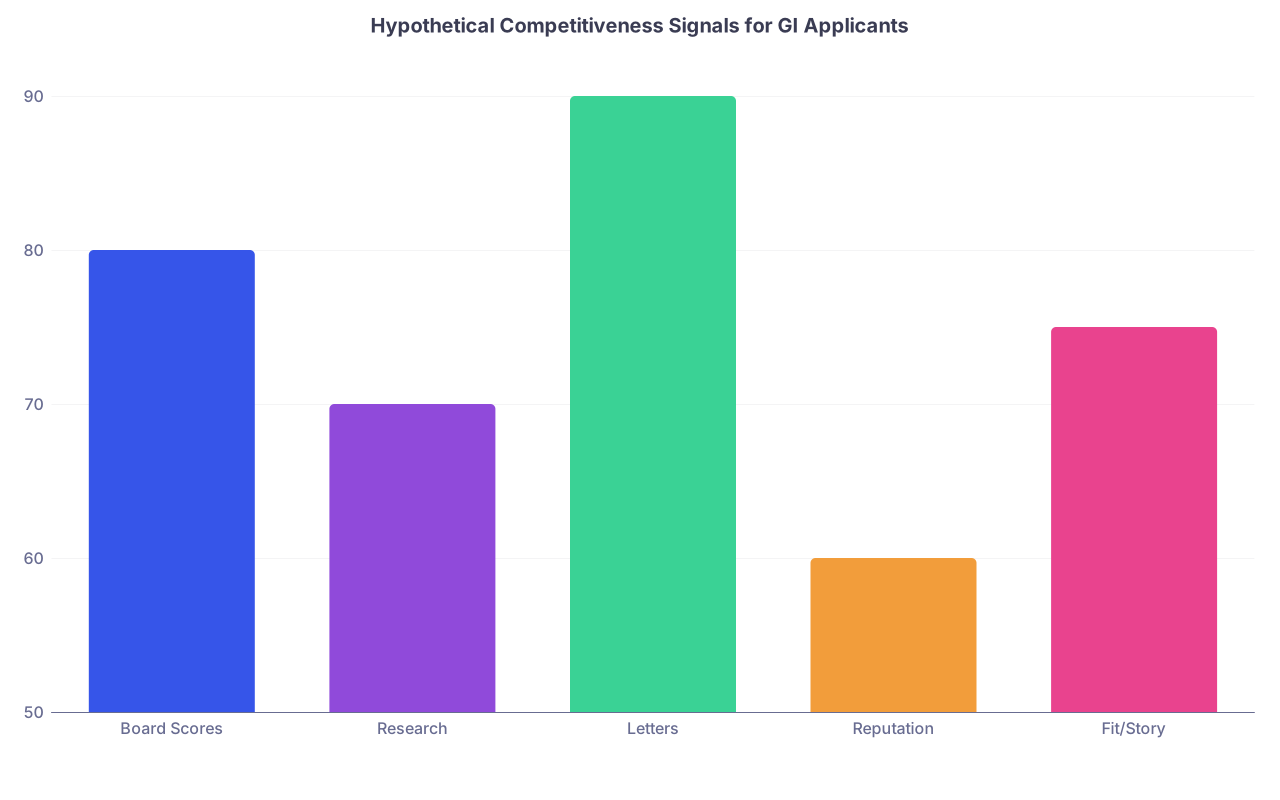
| Category | Value |
|---|---|
| Board Scores | 80 |
| Research | 70 |
| Letters | 90 |
| Reputation | 60 |
| Fit/Story | 75 |
If your mentors, plural, are saying, “Look, for GI you’re a long shot even with 3 more years,” you’re not obligated to accept that. But you’d be foolish not to at least consider adjacent options (like hepatology, hospitalist with endoscopy focus, or another field you might actually enjoy).
Step 3: Decide your primary goal for the next 1–3 years
This should usually be one of these:
- Maximize research and academic productivity
- Maximize clinical niche exposure and skills in your target field
- Fix specific weaknesses: letters, professionalism concerns, interview performance, gaps in training
If your plan is “I’ll just work as a hospitalist and see,” that’s not a plan, that’s survival mode. You’re allowed to be there emotionally for a bit. Just don’t stay.
Realistic Pathways If You Don’t Match Right Away
Here’s what people actually do that works. Not fantasy. Real.
1. Targeted Hospitalist Job (This Can Be Powerful, If You’re Intentional)
Strong option if:
- You need money.
- You’re burned out from training and need some autonomy.
- You lack research but can maybe do project‑type work.
Look for:
- A hospital where your desired specialty is strong and visible
- A division chief in that field who is willing to meet you now, not “maybe later”
- Clinical responsibilities that overlap with your future goals (ICU‑heavy for pulm/crit, telemetry/heart failure service for cards, etc.)
Then:
- Show up to the specialty conferences. Every week.
- Ask for involvement in QI, protocols, or clinical pathways.
- Make yourself known—but not annoying—to the fellows and attendings.
The mistake people make? They take a random “7 on / 7 off” job in the middle of nowhere, never see a fellow, never meet a division chief, and then wonder why their fellowship chances didn’t magically rise.
2. Chief Year
This helps when:
- Your letters are fine but not glowing.
- You need leadership, teaching, and maturity signals.
- You maybe had some professionalism rumors, friction, or “rough around the edges” reputation.
Chief year gives you:
- A PD letter with more depth
- Direct evidence you can handle responsibility
- Time to do a couple of solid projects (education, QI, scheduling redesign, etc.)
It’s not a magic stamp for hyper‑competitive fields, but I’ve seen it tip the scales for pulm/crit, heme/onc, and even cards for borderline candidates.
3. Research Year (or 2)
This can be fantastic. Or a waste of time.
Good when:
- You’re going for a research‑heavy or academic field (heme/onc, neph, PCCM, GI, cards).
- Your biggest weakness is 0–1 papers vs. your peers having 5–10.
- You have access to a real research environment (NIH, big academic center).
Bad when:
- You spend a year on “projects” that never publish or even get submitted.
- You don’t get strong mentorship or a letter from someone with name recognition.
- You’re not actually into research and are obviously miserable.
You need to interrogate any proposed research position with one blunt question:
“How many of your prior research fellows or post‑docs matched into fellowship, and where?”
If they can’t answer that with specifics, that’s a sign.
How a “Gap” Actually Looks Over Time
Think of it like this: every year you’re out from residency, you’re either:
- Becoming more of a specialist in your target direction
- Or more of a pure hospitalist/generalist with vague aspirations
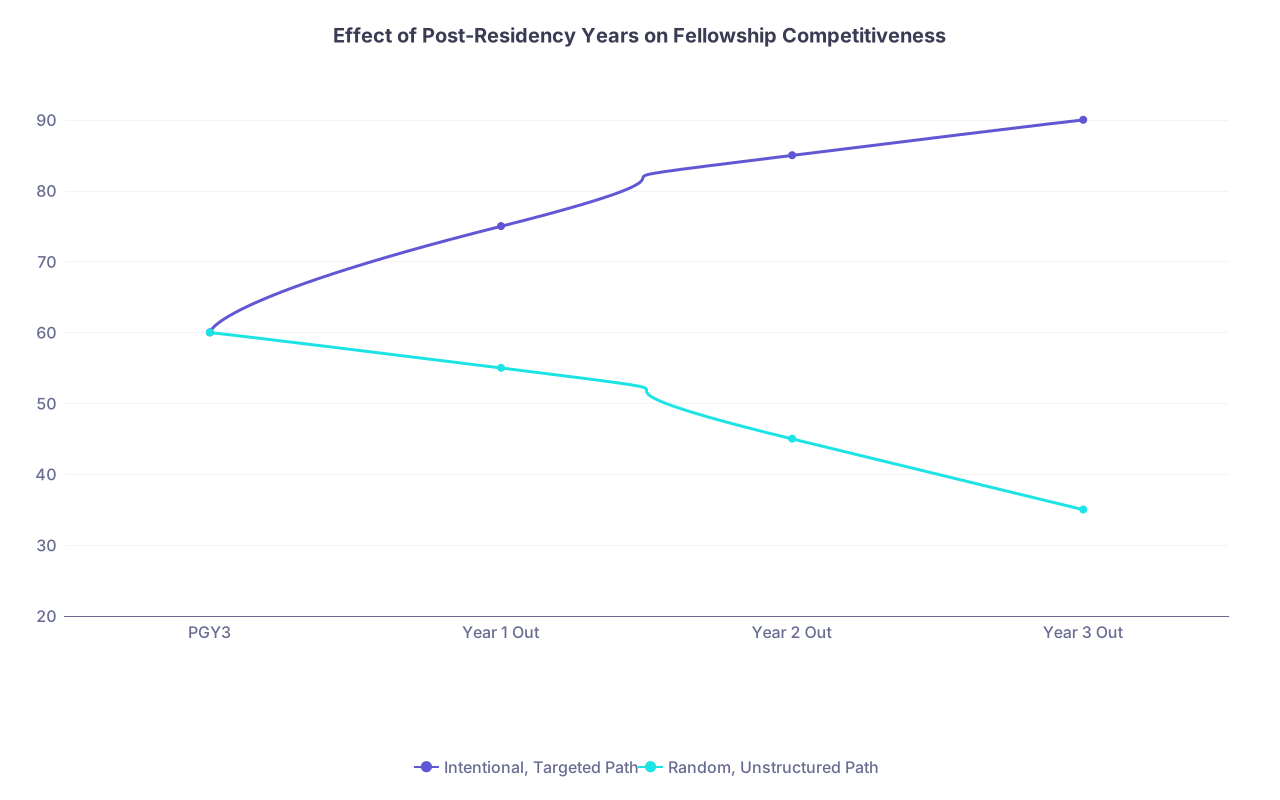
| Category | Intentional, Targeted Path | Random, Unstructured Path |
|---|---|---|
| PGY3 | 60 | 60 |
| Year 1 Out | 75 | 55 |
| Year 2 Out | 85 | 45 |
| Year 3 Out | 90 | 35 |
The first path tells a story:
“I’ve been walking toward this field the whole time.”
The second path tells a different one:
“I’ve kind of wanted this, but not enough to change anything.”
Programs know the difference. Your CV shows it in about 30 seconds.
What If You Never Match?
I’m going to say the scary thing, then the slightly kinder thing.
Scary: It is possible to chase certain fellowships for 4–5 years, not land them, and end up bitter, behind financially, and stuck in limbo.
Kinder: You’re allowed to stop without it being failure.
At some point, if:
- You’ve applied 2–3 times,
- You’ve presumably fixed the obvious weaknesses,
- And your mentors are saying, “I don’t see this happening,”
…you are not a failure for choosing stability and building a great career as a hospitalist, general internist, EM doc, gen peds, whatever.
What kills people isn’t not matching.
It’s hanging your entire self‑worth on matching.
I’ve seen “failed fellowship applicants” become:
- ICU‑level hospitalists who basically run the unit and are beloved
- Procedure‑heavy hospitalists doing lines, paras, thoras, sometimes scopes
- Education leaders, APDs, program directors, QI directors
- People who actually see their kids, go home at 5 PM, and have hobbies (!)
Fellowship is a path. Not the only path.
Strategy If You Want To Reapply (And Not Just Hope)
If you’re going to go another round, fine. But do it like someone who learned something, not like someone repeating the same test expecting a different score.

| Step | Description |
|---|---|
| Step 1 | Did not match fellowship |
| Step 2 | Get blunt feedback |
| Step 3 | Choose targeted role |
| Step 4 | Reassess specialty |
| Step 5 | 1-2 years of focused work |
| Step 6 | Update CV and letters |
| Step 7 | Reapply strategically |
| Step 8 | Consider alternative careers |
| Step 9 | Fixable issues? |
Key moves:
- Rewrite your personal statement so it actually says something beyond “I like the physiology and continuity of care.”
- Fix letters. This might mean working closely with a different attending who will actually go to bat for you.
- Trim the fat on your application—no one cares about random pre‑med clubs now. Emphasize alignment with the specialty.
- Apply smarter: mix of reach, realistic, and safety programs; don’t just shotgun every big‑name place and ignore community or less flashy programs.
Your Brain Is Telling You: “Match Now or Failure Forever.” It’s Lying.
I’m not going to gaslight you: not matching hurts. It’s embarrassing. Everyone else on your group chat seems to be posting their “so excited to announce!” graphics. You’re refreshing your email like an addict.
And yeah, your worst‑case reel is loud:
- “I wasted all this training.”
- “I’ll never be respected.”
- “I’m falling behind my classmates.”
- “My family will think I failed.”
Reality check:
- Most attendings you meet in real life do not care if you matched straight through or after a few years or never. They care if you’re competent and not unbearable to work with.
- Patients absolutely do not care what fellowship you did. They want you to listen, not miss things, and not be a jerk.
- Your income as a hospitalist / generalist is not some disastrous downgrade compared to many fellowships, especially with extra years of attending pay.
But I know none of that magically turns off the anxiety. So let’s aim for something smaller:
You don’t have to figure out your whole career tonight.
You just have to not let this one result define the rest of your moves.
FAQ (Honest Version)
1. How many times can I realistically apply for fellowship before it looks bad?
If your application isn’t changing, even two cycles can look rough. If you’re clearly improving (research, letters, roles), three isn’t crazy, but after that you have to ask what you’re sacrificing. The key question: “Is my application substantially different from two years ago?” If the answer’s no, more attempts won’t magically fix it.
2. Does being out of training for a few years hurt my fellowship chances?
It can, if those years look unfocused or disconnected from your target field. If you’ve been a random nocturnist in a small community hospital with no engagement in your specialty, it’s a harder sell. If you’ve been a hospitalist deeply embedded with the cards/ICU/GI service, going to conferences, doing projects, and getting killer letters, those years can actually help.
3. Will programs judge me for “settling” for a hospitalist job before reapplying?
No. Everyone knows you need to work and live. They’ll judge:
- Whether your job aligns with your stated interests
- Whether you did anything beyond clocking in and out
- Whether your story makes sense (“I used this time to grow in X, Y, Z ways” vs. “I just kind of survived and now I want in again”).
It’s not the hospitalist job that’s the issue. It’s what you did with it.
4. What should I do this week if I already know I didn’t match?
One concrete thing: email three people.
- Your PD or APD – ask for a specific debrief meeting.
- A faculty member in your target specialty – ask for honest feedback and future planning.
- One person outside your program who matched in your field – ask what they think actually moved their application from “pile” to “interview.”
Then open your CV and highlight everything that directly supports your target fellowship. Everything unhighlighted? That tells you what you need to build.
Do one thing today:
Open your email, pick the mentor you trust the most, and send this exact line:
“I didn’t match this cycle, and I’d really value a blunt, honest conversation about how I can make myself truly competitive—or whether I should rethink my path.”
Hit send. That’s the first real step out of panic mode and into having an actual plan.


