
What if you force yourself to apply for fellowship while you’re burned out… and end up locking yourself into three more years of a life you already kind of hate?
First: You Are Not Crazy (And You’re Not Weak)
Let me just say the part most people won’t say out loud: a shocking number of fellows started their application while absolutely fried.
Not “a little tired.”
I mean:
- Crying in the call room between consults.
- Googling “non clinical jobs for physicians” at 3 a.m.
- Snapping at nurses and then hating yourself on the walk back to the workroom.
- Feeling this low-level dread every time you put your badge on.
You’re asking: If I already feel like this, does applying for fellowship now just mean I’m signing up for more misery?
Or worse: If I don’t apply this cycle, am I permanently screwing my career?
Here’s the uncomfortable truth: both applying blindly and not applying out of panic can hurt you. The trick is figuring out whether you’re:
- Burned out from residency in general (the system, the schedule, the chaos)
- Burned out from this specific environment (toxic program, bad leadership, horrible schedule)
- Or actually in the wrong field or wrong future path (you thought you wanted cards/onc/ICU but your body is screaming no)
Those are different problems. And they need different answers.
What Burnout Looks Like When You’re Trying to Think About the Future
Burnout doesn’t just make you tired. It actually messes with decision-making.
Common burned-out-resident thoughts I hear around fellowship season:
- “If I don’t apply now, I’ll never match. Programs will think I’m broken.”
- “I already told attendings I’m going into fellowship. If I back out, I’ll look flaky.”
- “Everyone else is applying. If I don’t, I’m falling behind.”
- “If I match, at least I’ll have a job. If I don’t apply… what then?”
And my personal favorite anxiety spiral:
“I’m so tired I don’t even know what I want. But the deadline is in 3 weeks. So I’ll just throw together an application and figure it out later.”
That last one? Dangerous.
Because fellowship isn’t “just three more years.” It can lock you into:
- A certain lifestyle (night call, weekends, constant pager)
- A certain identity (once you’re “the ICU person” or “the GI person,” it sticks)
- A certain type of job market
Not inherently bad. But applying from a place of panic and exhaustion tends to push you toward one thing: survival thinking. You’ll choose what feels most “prestigious,” or what your program worships, or what your co-residents are doing… instead of choosing what actually fits you.
How Common Is Burnout Around Fellowship Time?
You’re not the outlier. You’re the norm.
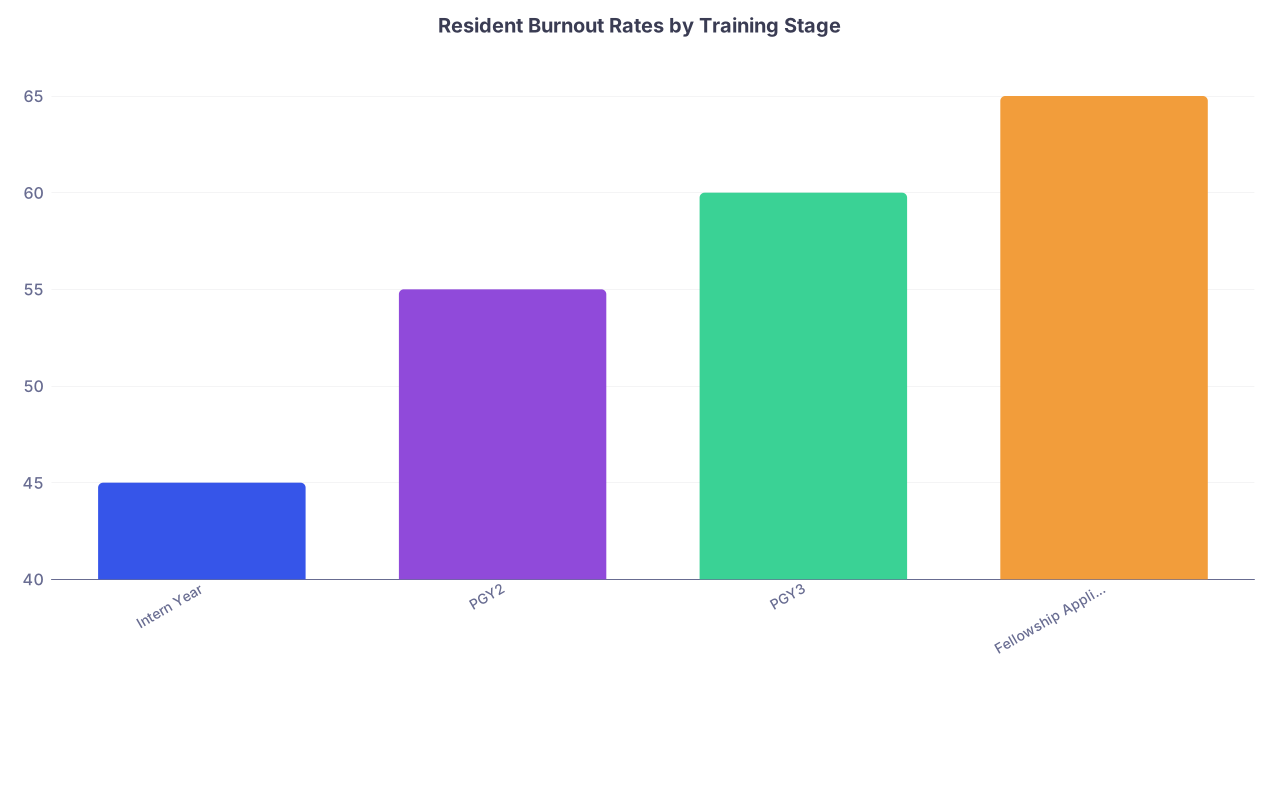
| Category | Value |
|---|---|
| Intern Year | 45 |
| PGY2 | 55 |
| PGY3 | 60 |
| Fellowship Application Period | 65 |
That “fellowship application period” spike? I’ve felt that in real time on teams:
- People volunteering for extra shifts so they look “hard-working” on letters.
- Residents studying for boards, working full time, and writing personal statements after call.
- Everyone pretending they’re “excited” about their future while half of them quietly Google “how to leave medicine.”
So no, burnout right now doesn’t automatically mean, “You’re not fellowship material.” It mostly means, “You’re a human being.”
The real question is: Do you actually want fellowship, or do you want out of residency?
Those are not the same thing.
The Three Big Questions Before You Hit “Submit”
If you’re burned out and staring at ERAS or the fellowship portal, run through these three questions honestly:
1. If residency ended tomorrow and there were no expectations, would you still want this fellowship?
Not: would your PD approve.
Not: would your parents be proud.
Not: would it sound good at dinner parties.
Would you choose this work, this lifestyle, this content, if there were no sunk costs?
Ways to test that:
- Think about the rotations you’d actually look forward to, not just tolerate.
- Pay attention to what you read/watch when no one is watching (podcasts, articles, Twitter threads).
- Remember the attendings whose jobs you’d actually maybe want one day. Are they all in that fellowship field… or are they something else?
If the only things keeping you on the fellowship path are:
- “I already told people”
- “I’m scared of general practice”
- “I don’t know what else to do”
…that’s not genuine interest. That’s fear.
2. Are you burned out from medicine itself… or from your current training environment?
These are very different:
Burned out from environment looks like:
- Toxic culture, yelling, shaming, passive-aggressive evaluations.
- Constant schedule chaos, zero backup, unsafe staffing.
- You feeling small and disposable, no matter how hard you work.
Burned out from medicine itself feels more like:
- Dreading patient care even when the day is reasonable.
- No spark of curiosity, ever, even on “interesting” cases.
- Fantasizing about careers where no one’s health depends on you.
If it’s environment burnout, fellowship might actually help. A healthier program, better structure, and more aligned field can feel very different from your current reality.
If it’s medicine burnout, fellowship is not a rescue plan. It’s just more of the same, turned up.
3. Could you defer one year… and would that actually help?
Ask yourself brutally:
If you took 1 year not in fellowship, could you realistically:
- Rest more than you do now?
- Get therapy, process what residency did to you?
- Try something different (chief year, hospitalist, research, locums, lighter clinic job)?
- Think about your long-term life instead of just trying not to drown?
Or are you in a system, country, visa situation, or financial hole where a gap year would actually make everything worse? That matters.
| Path | Pros | Cons |
|---|---|---|
| Apply now | Continuous training, momentum | Decide while burned out |
| Apply after 1 year gap | Time to recover, reflect | Harder to explain gap |
| Skip fellowship entirely | Faster to stable job/life | May limit certain specialties |
| Delay multiple years | More clarity, real-world view | Re-entry anxiety, credential lag |
None of these are automatically right or wrong. But pretending they’re all the same is how people end up trapped.
“If I Don’t Apply Now, I’ll Never Match” – Is That True?
Short answer: no. Longer answer: it’s more complicated, but still no.
Programs see people apply after:
- 1–3 years as a hospitalist
- A research year or chief year
- Time in the military or another system
- Time off for family, health, or… just stepping back
Do some old-school attendings raise an eyebrow? Sure. Some love their straight-through robots. But many program directors actually like people who’ve:
- Seen the “real world” of attending life
- Matured, stabilized, and chosen their field deliberately
- Had time to fix board failures or strengthen research
The key is: can you explain the gap coherently and without sounding like you hate medicine?
Programs like:
- “I wanted more clinical experience before specializing.”
- “I took time to focus on my own health and came back more sure this is my path.”
- “I worked as a hospitalist and realized I consistently gravitated toward [field], which confirmed my decision.”
They’re less excited about:
- “I was burned out, and I still kind of am, but I’m here anyway.”
- “I panicked, left, panicked again, and now I’m panicking my way back.”
Even then, that’s coachable. You can be honest without spilling every trauma detail.
What If You Apply While Burned Out… But Still Aren’t Sure?
Let’s say you’re leaning toward applying anyway, even though you’re exhausted. Fine. Then you need guardrails.
Here’s what I’d do:
Have one brutally honest conversation with someone who knows you clinically.
Not the “everything is great” fake talk. Ask them: “When I’m not on call, do I seem engaged in [field] or just… numb?” Watch their face.Set a maximum number of programs.
Don’t apply to 60 places “just in case” if your soul is already on fire. That’s how you end up on 18 Zoom interviews saying the same dead phrase: “I’m passionate about…”Commit to walking away if you realize during interviews you’re faking it.
If you’re mid-interview season thinking, “I do not want any of these jobs,” you’re allowed to stop. You’re not legally bound because you submitted ERAS.Stop making your personal statement a therapy note.
You can mention burnout or struggle, but don’t center it. Fellowship programs are not your processing space. Get a therapist, a mentor, a friend for that.
When Skipping This Cycle Is Actually the Healthier Move
Sometimes the bravest thing isn’t pushing through; it’s stepping back. A few signs applying this year might be a bad idea:
- You’re barely holding it together emotionally and you’re not safe to add another big stressor.
- You can’t tell if you want fellowship or you just want to not be a resident anymore.
- Your application would be basically on autopilot: no updated CV, thin letters, generic statement.
- The idea of even opening the fellowship portal makes you feel physically sick, not just anxious.
Here’s the part nobody tells you: life doesn’t freeze if you don’t apply.
You might:
- Discover you actually love being a hospitalist or generalist.
- Realize you like teaching, QI, or admin more than you like the fellowship’s day-to-day work.
- Find that after some rest, your interest in [cards, GI, heme-onc, ICU, whatever] either comes back strong… or completely evaporates. Both answers are useful.
A Very Unromantic Reality Check About Fellowship
People talk about fellowship like it’s this magical stage where you “get to focus on what you love.” Sometimes that’s true. Sometimes it’s just:
- Similar hours.
- More specialized stress.
- Higher expectations.
- Still not enough support.
You need to be honest about what you’re signing up for.

| Step | Description |
|---|---|
| Step 1 | Burned out in residency |
| Step 2 | Do not apply this cycle |
| Step 3 | Consider applying to healthier programs |
| Step 4 | Consider limited, intentional application |
| Step 5 | Do I truly want this field? |
| Step 6 | Is this environment main problem? |
| Step 7 | Burned out from medicine overall? |
Fellowship can be great. It can also be three more years of you gaslighting yourself: “Once I’m done, it’ll all get better.” Then you hit attending life, still burned out, but now with less flexibility.
Don’t use fellowship as a band-aid for a deeper wound.
How to Buy Yourself Space to Think (Without Blowing Up Your Career)
If you’re on the fence and barely hanging on, your number one job right now is not “perfect application.” It’s stabilize yourself enough to make a sane decision.
Very unsexy but helpful moves:
- Take your PTO. Actually use it. Don’t “save it for interviews” if you’re in full meltdown mode now.
- Talk to a therapist who has worked with physicians. Not your co-resident, not Reddit.
- Tell one attending or mentor the truth in a non-dramatic way: “I’m burned out, and I’m not sure if applying this cycle is smart. Can I talk this through with you?”
- Set a personal decision deadline earlier than the actual application deadline. Don’t drag this to the last possible minute if you’re already mentally done.
You’re not weak for needing space. You’re just human in a system that eats people alive and then wonders why they’re tired.
FAQ – Exactly What You’re Afraid to Ask
1. Will programs judge me if I apply later instead of straight through?
Some might. Many won’t. The ones worth training at will care what you did with that time and how you talk about it, not that you weren’t a perfectly linear robot. If you can say, “I worked as a hospitalist, got more comfortable independently managing patients, and that solidified my interest in [field],” you’re fine.
2. What if I apply now and regret it during fellowship?
Then you’ll be like a non-trivial number of fellows. It’s not game over, but it’s harder. People do switch paths, leave fellowship, or finish and pivot careers. Is it fun? No. Is it possible? Yes. But if your gut is already screaming “no” before you even apply, pay attention to that now, when your options are wider.
3. Does being burned out mean I’m not cut out for fellowship?
No. Burnout means you’ve been under sustained stress without enough control, support, or recovery. That’s not a character flaw. The real issue is whether your baseline self (when not being crushed) likes this field enough to justify more training. If you can’t even remember what your baseline self feels like, that’s a sign you need rest before big decisions.
4. What’s the worst that happens if I don’t apply this cycle?
Honestly? You feel behind while your co-residents post “excited to announce” graphics. Your anxiety tells you you’ve ruined everything. You work as a hospitalist or in a general role for a bit. Then one of three things happens:
- You miss the field a lot and apply with more clarity and better stories.
- You realize you like your current job and never look back.
- You decide you want something outside of clinical medicine.
None of those are catastrophic. They just don’t match the script you thought you had to follow.
If you remember nothing else:
- Don’t make a multi-year career decision from a place of total collapse if you can help it.
- Burnout doesn’t disqualify you from fellowship, but it does cloud your judgment—so slow down where you can.
- You’re allowed to step off the straight-through conveyor belt without destroying your future.