
It’s 8:30 pm. You’re back in your call-room-turned-Airbnb after a full day of fellowship interviews. Your voice is hoarse, your face hurts from forced smiling, and your brain is replaying every awkward silence, every answer you wish you’d phrased differently.
On paper, you’re solid. Good residency. Strong letters. Real research. You know that. But you can’t shake the sinking feeling that your interview performance was… flat. Not a train wreck. Just lukewarm. Like you never quite “clicked” with anyone and didn’t leave that “wow” impression everyone keeps talking about on Reddit.
And now your brain is going:
What if that’s it? What if I just quietly slid into the “meh” pile despite everything I’ve done for the last 10 years?
Let’s talk about that. Honestly. Not the motivational-poster version.
First: Your “Flat” Interview Probably Looks Different From the Other Side
You felt flat because you were inside your own head. They weren’t.
Here’s the thing I’ve watched happen over and over in fellowship recruitment: the candidate walks out convinced they were boring, stiff, and forgettable… and then ends up ranked very high. Why? Because selection committees are judging on a totally different channel than your anxious brain is watching.
You’re obsessing over:
- That one question where you rambled about a QI project.
- The joke that didn’t land.
- The 2-second pause before you answered “Why this program?”
They’re looking at:
- Are you safe to put in front of patients on day one?
- Will you show up, work hard, and not create chaos?
- Does your story make sense for this subspecialty?
- Will you fit with our current fellows and faculty?
Fellowship interviews are not American Idol. They’re not waiting for someone to “wow” them with a TED Talk. They want “good colleague,” not “charismatic superstar.”
I’ve seen fellowship PDs say things like, “She was a little quiet, but everything matches—great clinical letters, strong work ethic, wants exactly what we do. She’s in our top group.”
That’s the candidate who goes home thinking, “I barely showed my personality. They probably hated me.”
How Much Do Interviews Actually Matter for Fellowship?
You already know they matter. The question your brain is asking is: can a flat interview erase strong credentials?
Short answer: it can hurt you if you’re already borderline, but it usually doesn’t obliterate a solid application.
Most fellowships do something like this (even if they don’t admit it outright):
| Component | Influence Level |
|---|---|
| Letters of Rec | High |
| Residency Program/Performance | High |
| Interview Day | Moderate |
| Research/Scholarship | Moderate |
| Personal Statement/CV Story | Low–Moderate |
Then there’s the unwritten rule:
If you’re clearly problematic in the interview (rude, arrogant, sketchy ethics, wild red flags) — you’re done.
If you’re clearly outstanding — you might jump a tier.
If you’re normal and just a bit flat — you mostly sit in the range your application already put you.
What your worst-case-scenario brain is doing is assuming:
“Flat = they hated me = instant bottom of list.”
That’s just not how this works. A flat but professional interview usually means: “seems fine, not flashy, aligns with their file.” That’s a rankable outcome.
The “Flat” Feeling: What’s Actually Going On
Let’s dissect what you’re calling “flat,” because it’s usually a mix of real things and distorted perception.
1. You’re Comparing Yourself to the Imaginary Perfect Version of You
In your head, you were supposed to:
- Have one crisp, compelling story for every question.
- Be witty but humble.
- Ask brilliant questions in every room.
- Charm the PD, APD, and every random faculty who dropped in.
Reality: you were post-call last week, running on caffeine, and squeezing this interview between inpatient weeks and continuity clinic. You answered decently, maybe rambled a bit, and asked a couple of generic questions when your brain was fried.
That’s not failure. That’s… normal.
Programs know residents are tired and overextended. I’ve literally heard an APD say, “Half of them look exhausted; they’re on nights or came right off call. We’re not dinging them for low energy.”
2. Fellowship Interviews Are Awkward by Design
Multiple 20–30 minute Zoom or in-person chats with strangers, all asking similar versions of the same questions. Faculty are also tired. Some are not great interviewers. Some don’t even really want to be there. You get a monotone, “So… tell me about your research,” and then you’re supposed to sparkle?
You feel flat partly because the structure is stiff. You’re not at a dinner party. You’re in a semi-scripted professional ritual.
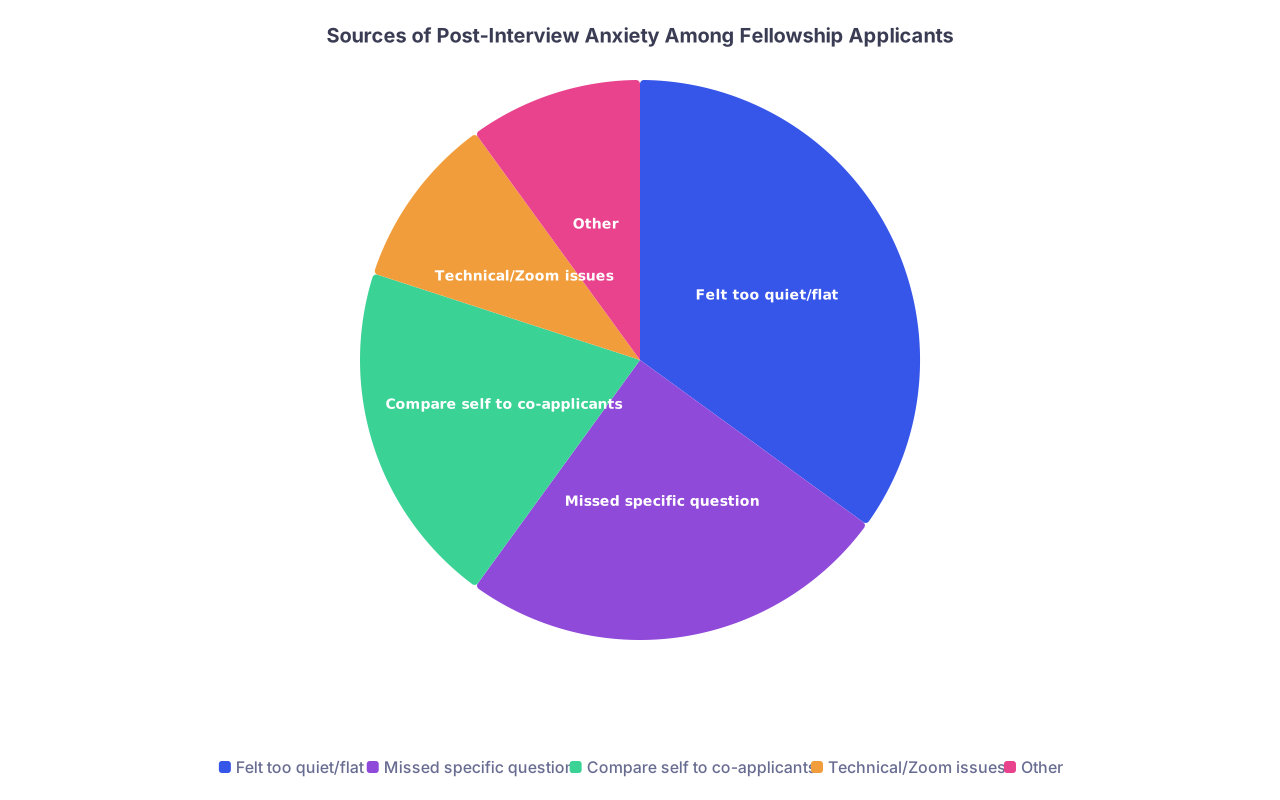
| Category | Value |
|---|---|
| Felt too quiet/flat | 35 |
| Missed specific question | 25 |
| Compare self to co-applicants | 20 |
| Technical/Zoom issues | 10 |
| Other | 10 |
Worst-Case Scenarios Your Brain Is Inventing (And What’s Real)
Your mind loves taking one lukewarm feeling and turning it into a disaster narrative. Let’s hit the big ones head-on.
“Everyone Else Probably Crushed It and I Was the Only Awkward One”
No. Just no.
I’ve sat in rank meetings. The themes are:
- “That candidate was clearly not interested in us.”
- “That one was great – definitely near the top.”
- “Most of the rest seemed fine.”
That’s it. They are not ranking 20 people along the axis of who was most charismatic. They are clustering into: clear yes, clear no, middle.
And guess what? Most people are in the middle. That means a lot of “flat to okay” interviews still end up ranked solidly.
“My Strong Application Made Them Expect More, So They Were Disappointed”
I get this one. You think: “If I’m a strong candidate on paper, they must’ve been expecting some superstar in person. I didn’t live up to it.”
Reality: strong file + normal interview = they trust the file. Period.
They’ve seen your letters. Your PD probably said things like “exceptional work ethic,” “go-to resident,” “functions at fellow level.” If you show up and you’re at least coherent and kind, that confirms the narrative. You don’t need to be dazzling. You just need to not contradict your file.
If your letters say you’re “kind, collaborative, and thoughtful,” and then in the interview you’re… kind, collaborative, and thoughtful but a bit tired? That’s consistent. Programs like consistent.
“I Didn’t Show Enough Personality, So They Won’t Remember Me”
Some truth here: charisma can help. Being memorable does help. But fellowship selection is not exclusively memory-based.
They have score sheets. Notes. Category ratings. They don’t sit there weeks later going, “Hmm, who made the funniest joke?” They look at:
- Clinical strength (from letters and program reputation)
- Fit for subspecialty and program goals
- Interview ratings (professionalism, communication, motivation)
- Any red flags noted
“Not super memorable” is not a red flag. It’s… neutral. And neutral is survivable.
Where “Flat” Can Actually Hurt You (And What You Can Still Fix)
I’m not going to pretend interview performance never matters. It does. Especially for competitive fellowships. So here’s where a flat vibe can really cost you:
- When you come across as not that interested in their program.
- When your answers don’t clearly explain why this subspecialty.
- When you seem disengaged or vaguely annoyed.
- When your story feels inconsistent with your application.
If you’re reading that and thinking, “Oh crap, that might be me,” okay. But here’s the good news: some of this is still fixable for future interviews, and some of the damage you think happened may not be as bad as you imagine.
Fixable Things Before Your Next Interview
You don’t need a full personality transplant. You just need a few levers:
Have 2–3 anchor stories locked and loaded.
One patient story. One challenge/ conflict story. One leadership/initiative story. Re-use them shamelessly across answers. Repetition is your friend when you’re tired.Pre-write a 2–3 sentence “Why this subspecialty” answer.
Short, specific, and emotionally honest without being cheesy. If you’re going into cards EP, heme/onc, GI, whatever — name the parts of the work you actually enjoy and the kind of career you see.Prepare 3 real questions that show thought.
Not “What makes your program unique?” You’re not a premed. Things like:- “How have your recent fellows shaped the direction of the program?”
- “What qualities do your most successful fellows share?”
- “How do you support fellows who are balancing research with high clinical loads?”
Use them when your brain is empty and the faculty asks, “What questions do you have for me?”
- Practice 1–2 sentences that show explicit interest.
Example: “I genuinely see myself thriving in a program with your volume and your emphasis on X; this feels like a strong fit for my goals.”
It feels forced to you. It reads as clarity to them.

| Step | Description |
|---|---|
| Step 1 | Interview Day Ends |
| Step 2 | Immediate Relief |
| Step 3 | Start Replaying Answers |
| Step 4 | Anxiety Spike - I Was Flat |
| Step 5 | Catastrophic Thinking |
| Step 6 | Talk to Co-fellows or Mentors |
| Step 7 | Realize Everyone Feels This |
| Step 8 | Return to Baseline Worry |
The Part No One Says: Programs Also Have Flat Interview Days
This isn’t a one-way performance. You felt flat? Some of them were flat too.
You might’ve interviewed with:
- Faculty who barely read your file.
- Someone double-booked with clinic, mentally half-present.
- A PD on their 14th interview day who’s running on coffee and habit.
I’ve heard candidates say, “They didn’t seem that interested in me,” and then watched that same program rank them highly. Why? Because individual faculty interviews are not the whole story. There’s:
- PD impressions
- Coordinator feedback (yes, how you treated staff matters)
- Fellow feedback from the social/dinner/Zoom chat
- Overall gestalt from the whole day
You can feel “flat” after, simply because no one lit up and said, “You’re exactly what we’re looking for, you knocked it out of the park!” They won’t say that. HR and professionalism and all that. So your brain fills silence with doom.
How to Survive the Waiting Period Without Losing Your Mind
This is the part that really eats people alive: the 2–8 weeks between interviews and rank lists/Match. You’ve replayed the day 500 times in your head. You’re imagining every program meeting ending with your name quietly sliding down their list.
Some reality-based anchors to hold onto:
- You are not a single interview performance. You are three+ years of residency, letters, reputation, and a file.
- Selection committees will forget the tiny awkward moments you obsess over. They remember patterns and outliers, not your one weird sentence.
- A neutral/flat interview is still very compatible with matching, especially with a strong underlying file.
And practically:
- Stop re-reading their website trying to “diagnose” your fit post hoc. That’s anxiety fuel.
- Don’t poll every co-applicant about how they felt they did. People lie, and comparison will wreck you.
- If feedback is culturally acceptable at your program, you can ask your PD or mentor honestly: “If my interviews feel a bit low-energy, is there anything I can tweak?” Then take their suggestions and move on. One adjustment. Not a full autopsy.

What If I Truly Bombed One Interview?
Not just flat. You know you messed one up. Blank moment. Awkward answer about a complication. Weird vibe with one interviewer.
Two things:
- Programs rarely tank your entire ranking over one awkward response unless it raised a true red flag (ethics, professionalism, patient safety).
- Even if one program did put you lower, you’re applying to multiple. Fellowship match is about your overall list interacting with theirs. You don’t need universal love. You need enough love.
If you genuinely think something came off wrong — like you answered a professionalism or safety question poorly — you can very occasionally send a brief clarification email to the PD. But only if it’s a clear, factual correction, not a long, anxious ramble.
Something like:
“After reflecting on our discussion about complication X, I realized I didn’t fully explain Y. In my current practice, I always do Z…”
Then stop. Don’t apologize fifteen times. Don’t write a novel.
Most of the time, though, you don’t need to “fix” anything. You need to let your file and the rest of the day carry the weight.
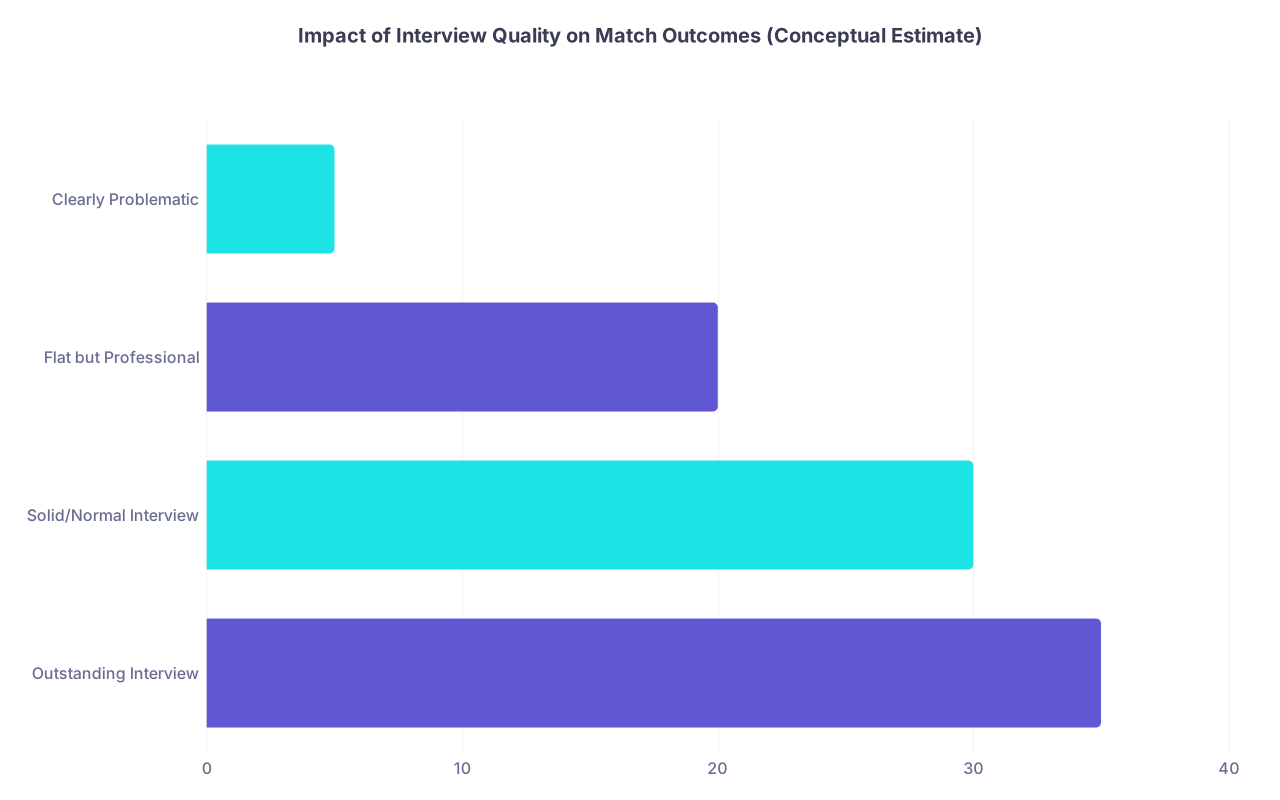
| Category | Value |
|---|---|
| Outstanding Interview | 35 |
| Solid/Normal Interview | 30 |
| Flat but Professional | 20 |
| Clearly Problematic | 5 |
(Think of these numbers as relative impact weight, not percentages. The point: being “flat but professional” is far closer to “normal” than to “disaster.”)

You’re Probably Underestimating How Strong Your File Already Is
This part is harsh but true: fellowship applications are brutally front-loaded. So much is decided before you ever open Zoom or walk into the conference room.
If you’re getting interviews at solid programs, that already means:
- Your letters didn’t quietly kill you.
- Your PD and faculty recommended you without hesitation.
- Your research or scholarly work is at least competitive for the field.
- You’re not setting off giant red flags on paper.
Interviews refine that picture. They don’t create it from scratch.
So if your interview felt flat but not catastrophic, your worst fear — “I’ve undone everything I’ve worked for” — is almost certainly wrong. You might slide a little on a given program’s list. You might not be their absolute top choice. But that is not the same as “no chance.”
You don’t need everyone to love you. You need enough programs to rank you high enough that the algorithm can do its job.

FAQs
1. Should I email programs after a flat interview to “explain myself” or restate my interest?
Usually no. A quick thank-you email is fine. A long anxious explanation (“I was tired, I’m normally more enthusiastic, please don’t judge me”) will not help and can make you look insecure. If you genuinely love a program, a short, clear sentence in a thank-you note that you’d be thrilled to train there is enough.
2. What if I’m naturally introverted and just don’t “sparkle” in interviews?
That’s not disqualifying. A lot of subspecialties are full of introverts. You don’t need to be flashy; you need to be clear, thoughtful, and kind. Practice a few concise stories and answers that show your thinking. Let your consistency and maturity be your “sparkle.” Programs value reliability more than theatrics.
3. I didn’t ask any amazing questions. Does that make me look disinterested?
Not really. As long as you weren’t blatantly disengaged, you’re fine. Program directors know applicants are juggling multiple interviews and often ask similar questions at each. Having one or two specific, non-generic questions per interview is great; anything beyond that is a bonus, not a requirement.
4. I contradicted something in my application during the interview. Am I doomed?
Usually not. Faculty often don’t remember the exact wording of your personal statement or CV. If the contradiction was minor — like slightly different phrasing of your goals — it’s forgettable. If it was major (e.g., a different story about a big event), that’s more concerning, but even then, most committees look for broad patterns, not one slip.
5. My co-residents all said their interviews went “really well” and I feel worse by comparison. What do I do?
Assume they’re giving you the polished summary, not the anxious replay. People rarely admit, “I think I was boring and awkward.” Stop comparing their external highlight reel to your internal blooper reel. Focus on what you can adjust for your next interview, not on guessing how you stack up against everyone else.
6. Is it possible to still match at a top-choice fellowship if my interview felt flat?
Yes. Happens every year. Especially if your underlying file is strong and your “flat” is actually just “calm, respectful, and a little tired.” Rank programs in your true order of preference. Don’t self-reject because your anxiety insists you were forgettable. The algorithm is built to protect you if you rank reach programs high — let it.
Key things to hold onto:
- A flat-but-professional interview almost never erases a strong file; it just makes you human.
- Programs are looking for safe, solid colleagues more than dazzling performers.
- You don’t need to be unforgettable to match — you need to be consistent, rank honestly, and then let go of the fantasy that you can control every neuron firing in a PD’s brain.


