
The obsession with first‑author papers in fellowship applications is wildly overblown—and yes, I say that as someone who spiraled over not having any.
You’re probably sitting there thinking: “Everyone else has like three first-author publications, a NEJM case report, and a Cell paper. I have…a poster and my name buried in the middle of an author list.” And your brain immediately jumps to: I’m not competitive. PDs will toss my app. I’ve basically ruined my future by not churning out manuscripts during residency.
Let’s walk through what’s real, what’s exaggerated, and where you’re actually at risk.
What Fellowship PDs Actually Look For (That Nobody Explains Clearly)
Here’s the part that people get wrong: PDs don’t care about “first-author” as a magic title. They care about signal.
Signal that you:
- Can see a project through
- Have some academic curiosity
- Fit the culture of their program (clinical? research-heavy? something in between?)
- Won’t be dead weight when they need people to help with QI, studies, abstracts, etc.
Do some PDs love first-author papers? Of course. Especially in research-heavy subspecialties. But they’re not counting positions in the author list like it’s a scorecard. They’re asking: “Does this person have enough scholarly activity for what we do here?”
And that “enough” varies a lot.
| Fellowship Type | Typical Research Expectation |
|---|---|
| Heme/Onc (top academic) | Strong research, often pub(s) |
| GI / Cards (academic) | Some publications or solid abstracts |
| Pulm/CC / Critical Care | At least some scholarly activity |
| Endocrine / Rheum / ID | Helpful but not always decisive |
| Community-focused programs | Minimal research often acceptable |
You can match into solid fellowships with zero first-author papers if the rest of your app is strong and your research “story” makes sense. I’ve seen it. You’ve probably seen it too, but your brain conveniently discounts those examples because anxiety loves selective memory.
The Ugly Truth: Where “No First-Author” Actually Hurts
Let’s not sugarcoat everything.
There are situations where not having a first‑author paper can be a real disadvantage:
- You’re aiming for very top‑tier, research‑heavy fellowships (think: Harvard heme/onc, Mayo GI, UCSF cards)
- Your fellowship field is ultra‑competitive and you have mediocre other metrics (middle‑of-the-pack letters, average Step scores, so‑so clinical comments)
- You list “a ton” of research on ERAS, but nothing ever seems to result in a finished, tangible product
That third one particularly makes PDs pause. They see 6 “ongoing” projects, all “data collection in progress,” and no final anything. That doesn’t read as “hardworking.” It reads as “starts stuff, doesn’t finish.”
PDs don’t expect every resident to have a first-author RCT or some wildly impactful paper. But if you’ve done research for years and literally nothing has made it to a poster, abstract, or paper (even as middle author), that’s a little harder to spin.
Middle-Author vs First-Author: How Bad Is It Really?
Here’s the part that your brain is blowing out of proportion.
Being a middle author is not an automatic red flag.
If anything, it can show you’re:
- A team player
- Trusted enough to be included on multiple projects
- From a busy residency where group projects are the norm
I’ve seen fellowship CVs with:
- 1–2 first‑author posters
- 2–3 middle‑author publications
- Some QI work
And those people matched into great academic programs.
The key is how it looks as a whole.
You don’t need a portfolio that screams “future NIH R01 recipient” to match. You need enough scholarly work to be credible for your chosen field and the type of programs you’re applying to.
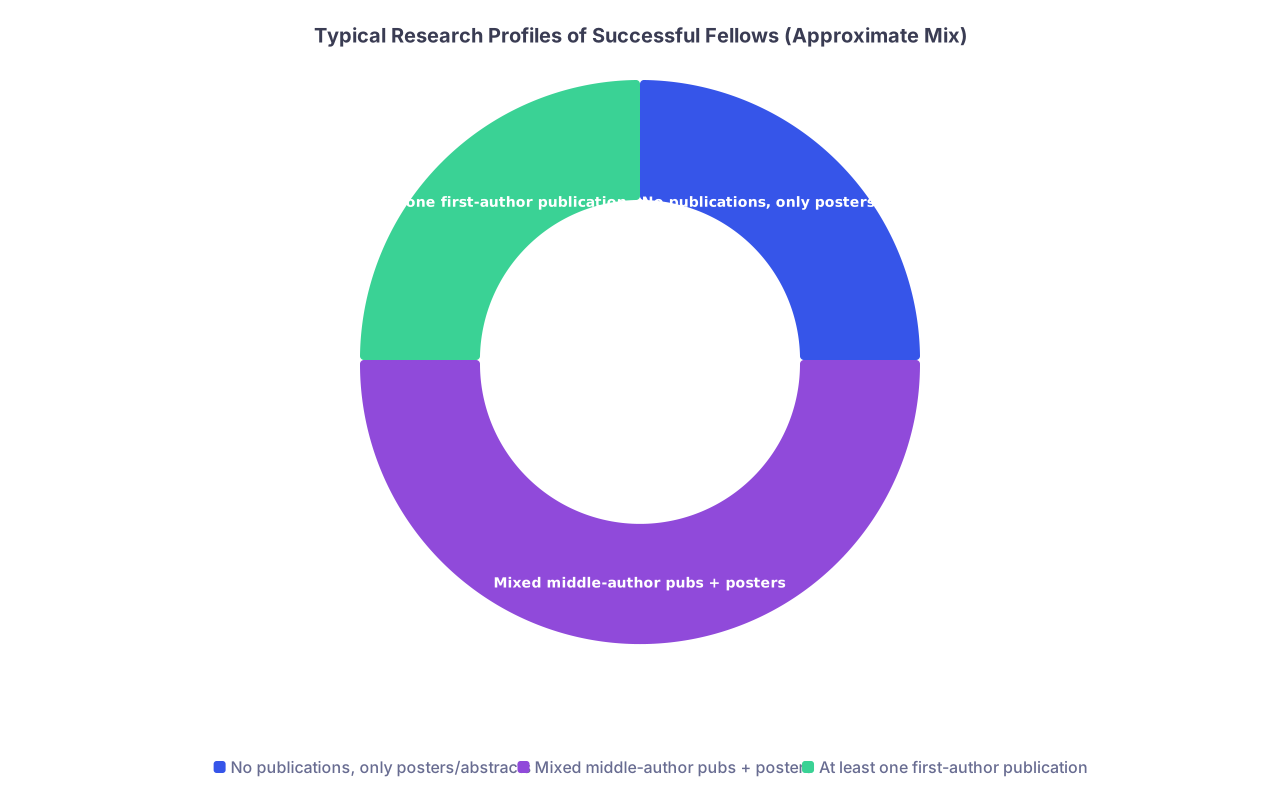
| Category | Value |
|---|---|
| No publications, only posters/abstracts | 25 |
| Mixed middle-author pubs + posters | 50 |
| At least one first-author publication | 25 |
Those numbers aren’t exact, obviously, but they reflect what I’ve seen: most successful applicants are in the middle group. A few have nothing major but still match. A smaller group has the “stacked” CV. You’re not doomed if you’re not in that last group.
What PDs Actually Read on Your CV (And What They Ignore)
This is the part you probably obsess over line‑by‑line, but PDs skim in 20 seconds.
They’re usually looking for:
- Do you have any scholarly output at all?
- Is there at least one thing where you clearly played a meaningful role (poster you presented, QI you led, case report you wrote)?
- Does your research match the field you’re applying to? (Not mandatory, but helpful.)
- Does your story feel coherent when paired with your personal statement and letters?
They are not:
- Calculating the ratio of first- to middle-author spots
- Docking you half points because you were third author instead of second
- Cross-referencing PubMed to see if that abstract made it to publication (unless something smells super off)
If you have a case report as first author, a QI poster where you presented, and maybe one or two middle-author papers, that can be totally fine even for competitive fields—especially if your clinical performance and letters are strong.
The Worst-Case Scenario You’re Imagining vs Reality
Let’s drag your nightmare thinking into the open.
Your version of events: PD opens ERAS → sees no first-author pubs → scoffs → “Next” → your whole career derails → you end up in some random non‑academic job, regretting every life choice.
Reality: PD opens ERAS. Skims education, Step scores, residency, LOR writers, personal statement, then research. Sees:
- 2 posters (you presented one at a national meeting)
- 1 middle-author paper from residency
- 1 QI project
Their thought process is something like: “Ok, some research exposure. Not a superstar, but adequate. Let me see letters… ah, PD says they’re one of the strongest residents. Good clinical comments. Interview.”
That’s it. No dramatic judgment. No blacklisting. Just weighing the whole application.
You’re imagining they care way more than they actually do.
Where You Can Get Burned: Inconsistency and Spin
PDs don’t mind if you don’t have a first-author paper. They do mind if your story doesn’t match.
If you:
- Call yourself “research-focused”
- Say you want an “R01-funded academic career” in your personal statement
- But your CV has zero first-author anything, no clear longitudinal project, and nothing substantial in-progress
…that mismatch stands out. Not because you have no first-author paper, but because your narrative doesn’t line up with your output.
On the flip side, if you say: “I enjoy research, but my main passion is clinical care and education. I’ve contributed to several projects and led a QI initiative that changed practice on our unit.”
Now your middle-author papers and QI poster fit perfectly. Coherent story. No one is sitting there saying, “Well, where’s their JAMA first-author RCT?” because you didn’t claim to be that person.
Fixing the CV You Have (Not the One You Wish You Had)
You’re not suddenly going to conjure three first-author papers in six months. So stop fantasizing about that alternate universe. Work with what’s real.
You can still strengthen things before application season in ways that PDs actually notice.
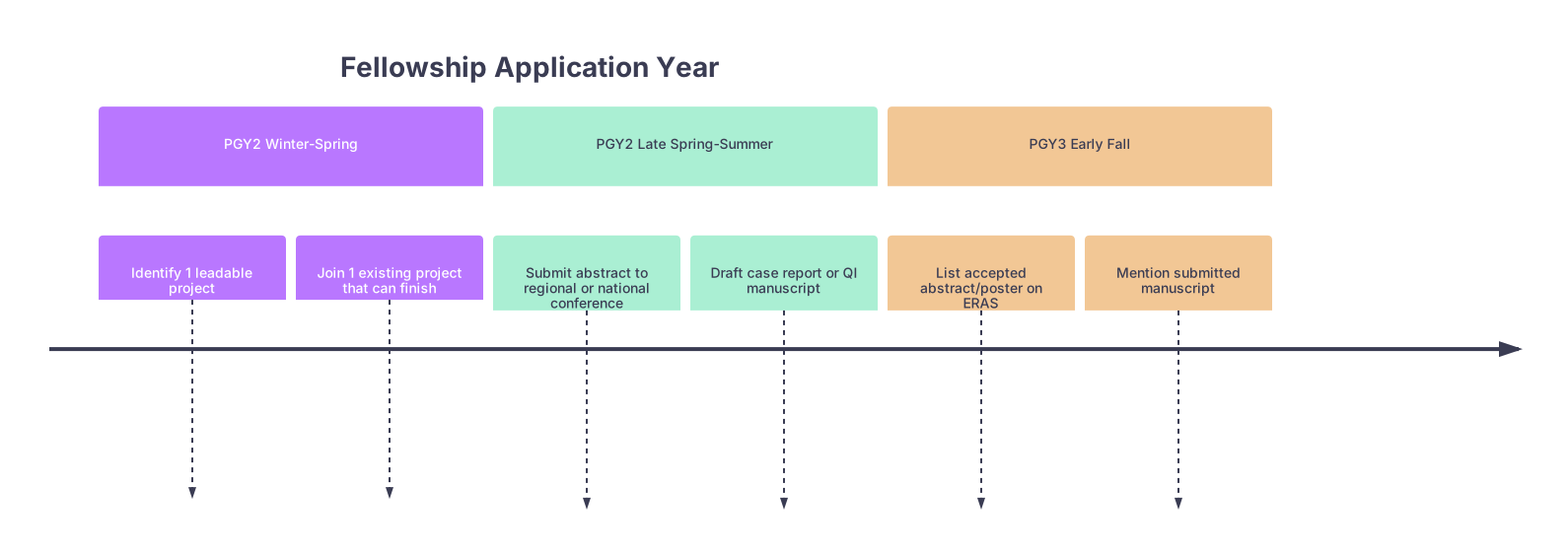
You don’t need some miracle publication. You need at least one thing that clearly looks like your baby, even if it’s “just” a QI poster that you drove from start to finish.
That is often enough to quiet the “but no first-author paper” panic.
How To Talk About Your Research Without Sounding Weak
You know how people sabotage themselves? They apologize for their CV. Out loud. During interviews.
Don’t do this: “I don’t really have any first-author things, I mostly helped with data, I know I should have done more…”
That screams insecurity and poor insight.
Do this instead: “I’ve been involved in several projects, mainly as part of a team. My most meaningful work was a QI project on reducing central line infections, where I helped design the protocol and present the findings at our regional meeting. I’d love to build on that in fellowship and get more experience leading projects from start to publication.”
You’re not lying. You’re framing.
You’re showing:
- Awareness of your current level
- Evidence of contribution
- Motivation to grow
PDs don’t expect finished products for everything. They do expect you to own your story without crumbling into apology mode.
Specialty Differences: When First-Author Really Starts to Matter
Yeah, some fellowships are brutal about research. Let’s not pretend they’re not.
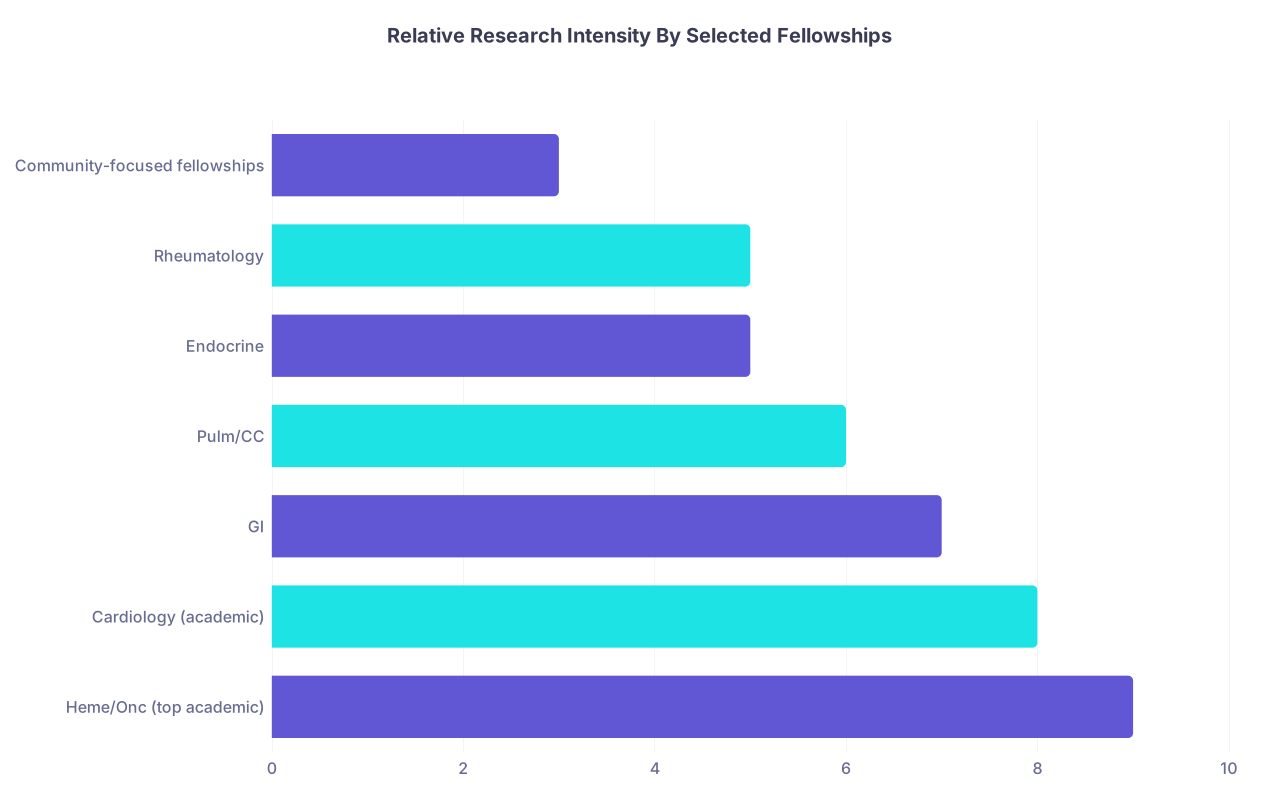
| Category | Value |
|---|---|
| Heme/Onc (top academic) | 9 |
| Cardiology (academic) | 8 |
| GI | 7 |
| Pulm/CC | 6 |
| Endocrine | 5 |
| Rheumatology | 5 |
| Community-focused fellowships | 3 |
If you’re aiming for:
- Top heme/onc
- Highly academic cards or GI
- A physician‑scientist track
Then yeah, first‑author publications start to matter more. Not because PDs worship that line on PubMed, but because they’re screening for people who have already shown they can function like junior researchers.
If that’s your dream, then you do need to ask some hard questions:
- Do I actually want a hardcore research career, or did I just think I was “supposed” to?
- If I do want it, can I extend residency, do a research year, switch to a research track, or link up with a high‑output mentor now?
- Or is it smarter to match a solid clinical fellowship first, then hustle for research in fellowship?
You’re not banned from academic careers just because you didn’t hit “first-author” before fellowship. People build research trajectories late. But the bar is higher for truly research‑intense tracks, and that’s just the reality.
Hidden Strengths PDs Care About More Than Your Author Line
This is the part everyone forgets while obsessing over PubMed:
Program directors consistently rank these as more important than research for many fellowships:
- Strong letters from people they trust
- Evidence you’re clinically solid and safe
- Being someone they can stand being around at 3 a.m. on call
- Professionalism, reliability, not being a black cloud
You know what terrifies PDs more than “no first-author publication”?
A resident with:
- Spotty professionalism
- Mediocre letters
- Rumors of being difficult or lazy
Your anxiety is zoomed in on the wrong threat.
I’ve seen residents with zero publications match great fellowships because everyone who wrote their letters basically said, “If I were sick, I’d want this person as my doctor.” That weighs heavier than “first author, Journal of Whatever, 2023.”
How To Tell If You’re Actually in Trouble vs Just Anxious
If you want a sanity check, look at your current situation through this lens.
You’re probably fine if:
- You have at least 1 or 2 tangible products (poster, abstract, QI, case report) where you did real work
- You can describe your role clearly
- Your residency is not known for cranking out piles of research
- You’re not exclusively applying to ultra‑elite research programs
You might need to hustle and be strategic if:
- You have “lots of research experience” but literally nothing completed or presented
- You keep joining projects but never follow through
- Your field is highly competitive and you’re aiming for the most academic places
You’re in deeper water if:
- You want a hardcore research career at a top‑tier academic center
- You have minimal or no scholarly output of any kind
- You’re already PGY‑3 with no realistic way to complete anything by application time
Even then, it’s not “game over.” It might just mean you need to recalibrate targets, delay application, or plan a more gradual academic path.
Quick Reality Check Before You Spiral Again
Let me boil this down, because your brain’s probably already sliding back to: “But what if I’m the exception and they secretly hate me for this.”
- Most fellowship PDs don’t care specifically about “first-author” as some sacred trophy. They care about credible, completed scholarly activity that fits your story and their program.
- You can absolutely match a good fellowship—even competitive ones—without first-author papers, as long as you have something scholarly, strong clinical performance, and coherent application materials.
- The real red flag isn’t “no first-author.” It’s “lots of research, nothing finished, no ownership” combined with weak letters or a vague, inconsistent narrative.
You’re not behind because you don’t have a first-author paper.
You’re behind only if you have nothing to show, no plan, and you’re still pretending everything is fine.
If you can fix the first two—and you still have time—you’re probably in much better shape than your anxiety is telling you.