

The myth of the “star resident” is wrecking a lot of perfectly good fellowship careers before they ever start.
You don’t have to be the golden child of your program to land a competitive fellowship. But I know exactly why it feels like you do.
You watch the obvious stars: the one everyone quotes on rounds, the chief who already has three first-author pubs in the exact subspecialty they’re applying to, the person the PD pulls aside with that “we should talk about your future” smile. And you think: cool, so fellowship is for them, not me.
Let’s pull that apart. And be brutally honest about what actually matters, what hurts you, and what you can still fix even if you’re halfway through residency and feel… painfully average.
What “Star Resident” Actually Means (And Why You Feel Like You’re Not One)
In most programs, “star resident” is code for: the people everyone already decided are going to be successful. It’s vibes plus some real things.
What makes you feel like you’re not a star:
- You’re not a chief. Or you weren’t even in the conversation.
- You don’t have your name on a big NEJM/JAMA paper (or honestly, any real publications yet).
- You’ve gotten some “areas for improvement” comments in evals that still haunt you at 2 a.m.
- You’re not the person attendings fight over to have on their service.
- You’ve had rough rotations. Maybe a complaint. Maybe a remediation plan in the past.
Here’s the awful part: nobody tells you where the real line is between “fine” and “fellowship-killing.” Everything gets lumped together in your head as “I’m not good enough, so I’m screwed.”
You’re not screwed. But you might need to be more strategic than the golden children.
What Competitive Fellowships Actually Care About
Let me be clinical about this. Most competitive fellowships (cards, GI, heme/onc, some surgical subs, certain academic-heavy tracks) are looking at a predictable cluster of things.
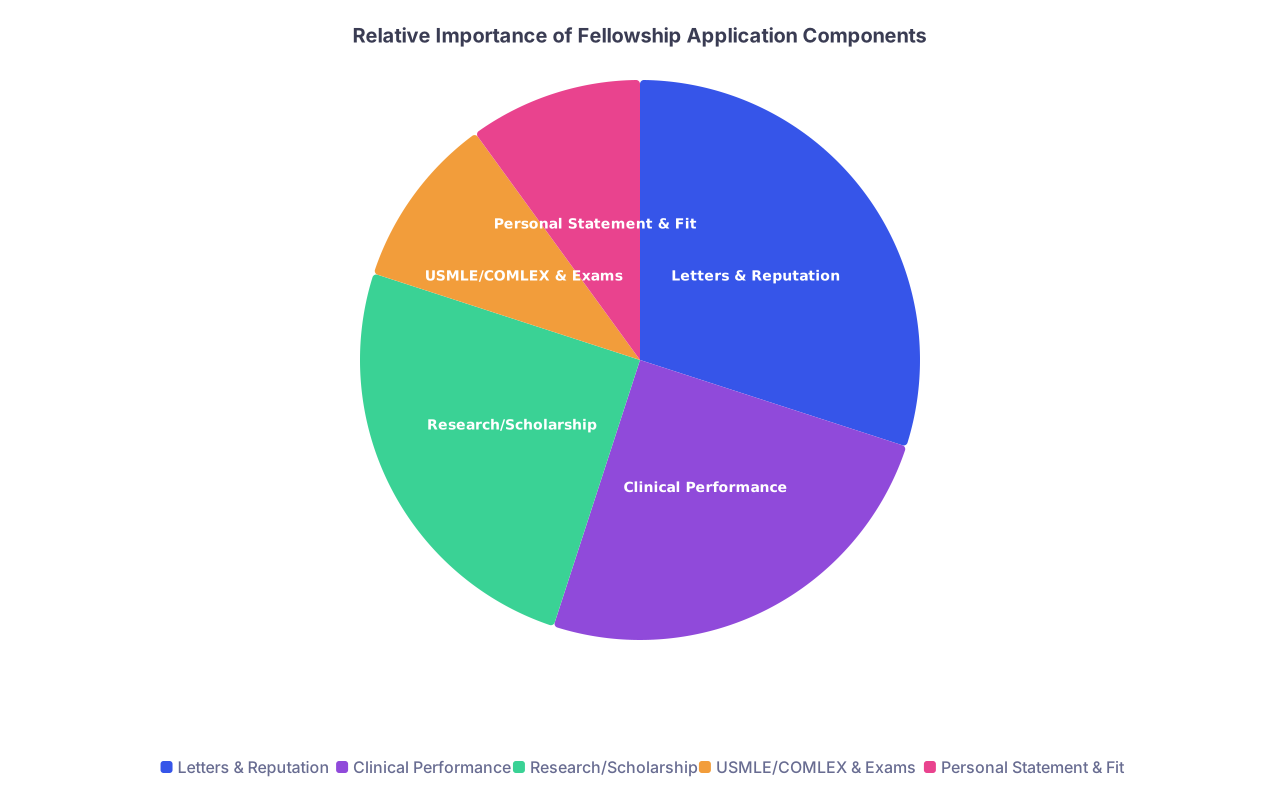
| Category | Value |
|---|---|
| Letters & Reputation | 30 |
| Clinical Performance | 25 |
| Research/Scholarship | 25 |
| USMLE/COMLEX & Exams | 10 |
| Personal Statement & Fit | 10 |
Now, where “star resident” status tends to show up:
- Letters & reputation: “Top 5% resident I’ve worked with,” “one of the best I’ve seen in 10 years”
- Clinical performance: constant “exceeds expectations,” strong chief or leadership positions
- Research: multiple pubs, posters, people know their name at conferences
You might be thinking: I’m not in the top 5% of anything. I’m not chief. My research is dust.
Here’s the non-sugar-coated truth:
You don’t need to be a star across all of these. You need to be clearly solid clinically, with something that makes your application feel purposeful, and a couple of humans willing to go to bat for you hard in their letters.
You can absolutely get a competitive fellowship as:
- A non-chief
- Someone with a few bumps in residency
- Someone with late or modest research
- Someone from a “good but not famous” residency
Is it harder than being the golden child? Yes. Is it impossible? No. I’ve seen residents with average evals and one poster match GI, and “top of the class” people not match at all.
The Damage You Can’t Ignore (And The Stuff You’re Over-Panicking About)
Not all “non-star” problems are equal. Some are career speed bumps. Some are landmines.
Let’s separate them.
| Issue | Impact on Competitive Fellowship |
|---|---|
| Not being chief resident | Mild to moderate |
| Few or no publications | Moderate |
| Middle-of-the-pack evals | Mild to moderate |
| One rough rotation / remediation | Moderate to severe (context) |
| Failed USMLE/COMLEX attempt | Moderate to severe |
You’re probably catastrophizing all of it. So:
Stuff that usually feels worse than it is:
Not being chief
There are many fellows who were never chiefs. Programs don’t have room for everyone, and politics are real. They know that.Middle evaluations, not “top third”
As long as they’re not bad, and your senior/upper-level evals are stronger than your intern ones, you’re okay. Growth matters.Limited research
Annoying for cards/GI/onc, yes. Fatal? Not if you show a realistic upward trend and some connection to the field.
Stuff that can be a real problem if you don’t address it:
- A documented professionalism issue with no narrative of growth
- A failed Step/COMLEX or major exam failure with no explanation and no later strength
- A reputation in your own program as unreliable or unsafe
Those things don’t automatically end your chances. But they require a deliberate strategy, not “I’ll just hope they don’t notice.”
You’re Not a Star. So You Need a Strategy, Not Hope.
If you’re not the PD’s obvious superstar, you don’t get to apply on autopilot. You have to be intentional.
1. Lock down your actual reputation inside your program
Here’s the nightmare: you think you’re “fine,” but at the fellowship rank meeting someone says, “Honestly, they’re okay but not someone I’d put at the top of my list.”
You need to know where you stand.
Have at least one brutally honest conversation with:
- Your program director, or
- An APD you trust, or
- A senior faculty member who’s known you on the wards
Ask painfully direct questions:
- “If I apply to [cards/GI/onc/whatever], will you be able to write me a strong letter?”
- “What are the top 2–3 negative things fellowship PDs might hear or infer about me?”
- “If you were advising your own kid with my file, would you tell them to apply this year, wait a year, or adjust specialties?”
Yes, this is terrifying. Do it anyway. Because the alternative is building your whole application on delusion.

| Step | Description |
|---|---|
| Step 1 | Decide to pursue fellowship |
| Step 2 | Schedule meeting with PD or APD |
| Step 3 | Ask about realistic competitiveness |
| Step 4 | Clarify strengths and target programs |
| Step 5 | Address weaknesses and plan timeline |
| Step 6 | Consider delay or different specialty |
| Step 7 | Feedback positive? |
2. Make your letters your superpower
If you’ll never be “best resident in 10 years,” you need to be “resident I trust completely and would rehire in a heartbeat.”
That shows up in letters.
You want:
- At least one letter that screams: “I’d take this person as my fellow tomorrow.”
- One that anchors your clinical reliability and work ethic.
- Ideally one from someone in your target subspecialty (or at least adjacent) who isn’t phoning it in.
Ask for letters early. And be specific:
“I’m hoping to apply in [field]. I know I’m not the ‘star’ of our program, but I care a lot about this and want to put my strongest foot forward. Would you feel able to write me a very strong letter, commenting on my growth and reliability as a senior resident?”
If they hesitate? That’s your answer. You need someone else.
Fix What You Still Can: Late-Stage Damage Control
You might feel like it’s too late. It probably isn’t.
Think in terms of 3 buckets: clinical, academic, and narrative.
Clinical: become boringly reliable
Programs will forgive lack of sparkle if you’re clearly safe and solid.
Between now and applications:
- Show up on time. Always. This sounds stupidly basic, but it’s the stuff that gets whispered about.
- Take clear ownership of your patients. Know every lab, every plan.
- Communicate like your life depends on it. Page earlier, ask for help sooner, close the loop with attendings and nurses.
- If you’ve had past issues (e.g., disorganization), actively show the fixes: checklists, notes, follow-up systems.
You want nursing, co-residents, and attendings to quietly stop worrying about you. That trickles into evals and letters.
Academic: build a minimal viable scholarly footprint
If you’re not already a research machine, you’re not going to become one in six months. Don’t try.
But you can usually get something on the record:
- A case report with a subspecialty attending
- A small retrospective chart review, even as middle author
- A poster at your local or regional meeting
- Quality improvement project that you actually finish and present
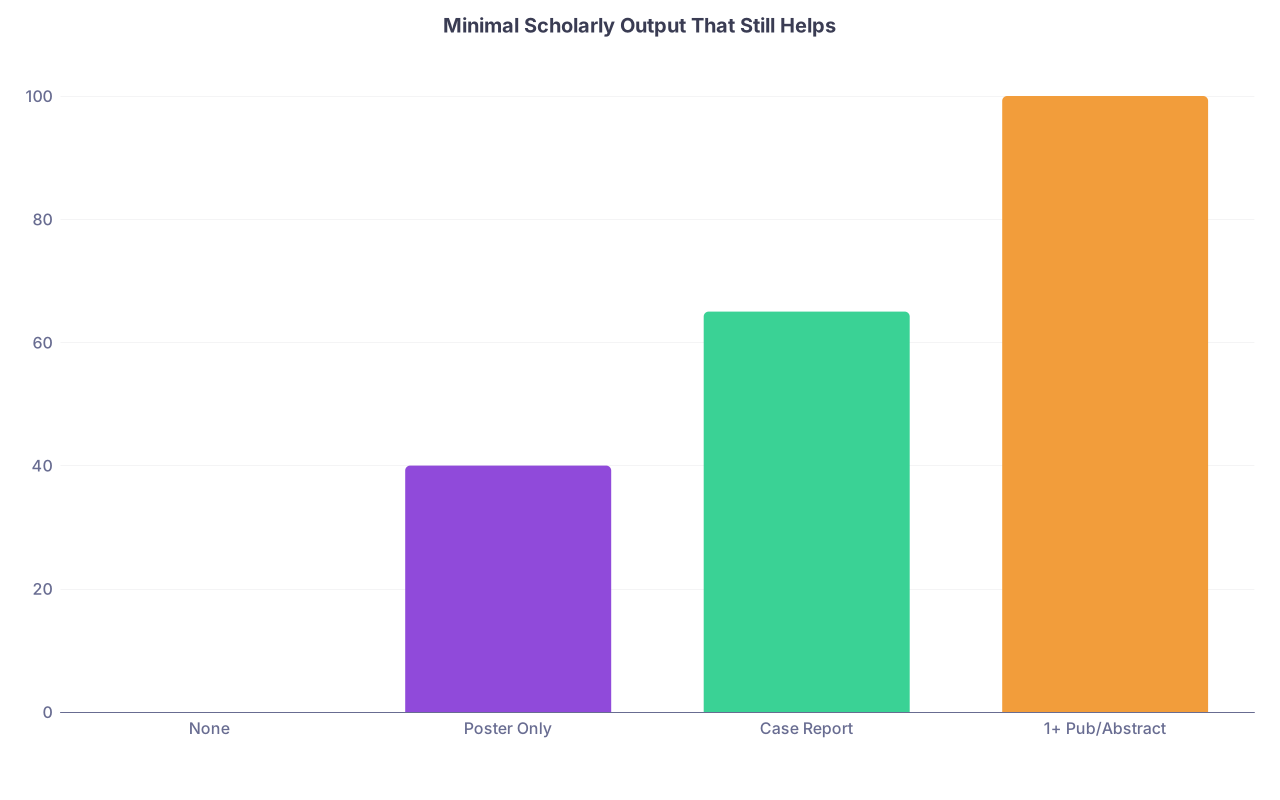
| Category | Value |
|---|---|
| None | 0 |
| Poster Only | 40 |
| Case Report | 65 |
| 1+ Pub/Abstract | 100 |
You don’t need a Nature paper. You need evidence that when you say “I’m interested in [field],” it’s not just vibes.
Narrative: stop pretending and actually own your story
Here’s where being “non-star” can secretly help you.
Fellowship PDs are tired of reading about the same curated prodigies. The “I always wanted to be a cardiologist since age 8” essays. The ones who’ve never apparently struggled or failed.
If your path has been messier, use it. Competently, not as a confession letter.
You can say things like:
- “I wasn’t the resident who showed up on day one ready for subspecialty clinic. I struggled early with time management and prioritization. What changed was…”
- “I’m not the person with a long list of publications. What I do have is a track record of seeing hard projects through, like…”
The key is: don’t sound like you’re asking for pity. Sound like someone who’s self-aware, resilient, and trending upward.
Choosing Where You Apply: Reality vs Self-Sabotage
One more ugly truth: where you apply matters as much as who you are.
Some programs want stars only. They’ll tell you, indirectly, with their match lists and gossip. Others quietly love the “solid, hungry, slightly underdog” applicant.
If you know you’re not a star:
- Apply broadly. Like, uncomfortably broadly.
- Don’t fixate only on the “name brand” programs your co-residents whisper about.
| Program Type | Relative Chance for Non-Star |
|---|---|
| Top 5 academic powerhouse | Low |
| Strong academic, mid-tier name | Moderate |
| Large community with fellowship | Moderate to high |
| Brand-new or less-known program | Higher |
| Home fellowship (same institution) | Often higher |
Home programs sometimes take their own residents who aren’t “perfect” because they know you. Don’t write that option off if you think your rep has improved over time.
The Worst-Case Scenarios You’re Spiraling About
Let’s drag the nightmares into daylight.
“What if I don’t match at all?”
It happens. Even to good residents. Especially in heavy research fields when people shoot too high or too narrow.
Does that mean you’ll never get that fellowship? No.
Common real-life paths I’ve seen:
- Do a year as a hospitalist, research fellow, or chief, then reapply with much stronger letters and maybe one decent publication.
- Pivot slightly (e.g., cards → CC, onc → palliative, GI → hospitalist with liver focus) and still end up close to your original interest.
- Find a less-known or newer fellowship the second cycle that now has a track record.
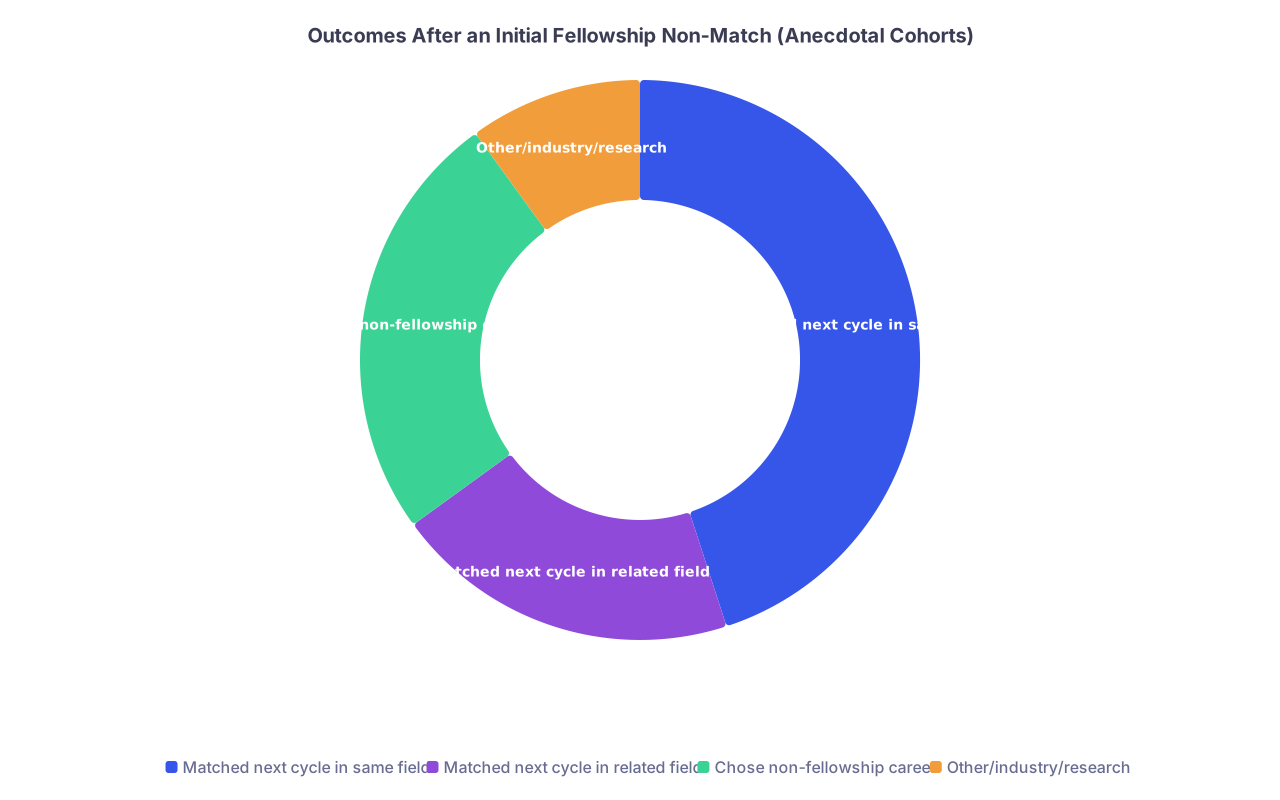
| Category | Value |
|---|---|
| Matched next cycle in same field | 45 |
| Matched next cycle in related field | 20 |
| Chose non-fellowship career | 25 |
| Other/industry/research | 10 |
“What if my PD secretly thinks I’m not good enough?”
Maybe they do. Sometimes they’re right. Sometimes they’re just conservative.
You can’t control their internal bias. But you can:
- Get multiple voices: ask another faculty member in the field for an honest take.
- Improve how you show up now so that when letters are written, the most recent version of you is the one they think of.
- If needed, accept that you might need more time (gap year, chief, research) to rebuild your image.
“What if my ‘average’ record stands out in a bad way?”
It doesn’t, honestly. It usually just blends. Which can hurt you if you don’t give them a reason to remember you.
That reason doesn’t have to be “star.” It can be:
- “That resident who took a nontraditional path and clearly grew a ton.”
- “That applicant whose letters keep saying, ‘I trust them in any situation.’”
- “The one with a very clear, grounded reason for wanting this field that matched what they said on interview day.”
What You Can Do This Week If You’re Spiraling
You don’t fix “non-star” status by grinding in the abstract. You fix it by picking one concrete lever at a time.
Here’s a simple, unglamorous next step sequence:

| Step | Description |
|---|---|
| Step 1 | Today |
| Step 2 | Email PD or APD for meeting |
| Step 3 | Ask about competitiveness and letters |
| Step 4 | Identify 1-2 key weaknesses |
| Step 5 | Choose 1 small, fast research or QI project |
| Step 6 | Ask target subspecialty faculty for mentorship |
| Step 7 | Draft honest, growth-focused personal statement outline |
Then, every week, you ask yourself: “What’s the one thing I did that makes me a slightly less risky bet to a fellowship PD?”
Not ten things. One.
FAQs
1. Do I need to be chief resident to match a competitive fellowship?
No. Being chief helps because it’s shorthand for “we trust this person,” but it’s not required. I’ve seen plenty of non-chiefs match cards, GI, and onc. What you can’t do is have nothing that shows leadership or reliability. If you’re not chief, make sure your letters and evals highlight that you step up, teach juniors, and handle responsibility well.
2. I had a documented professionalism issue. Am I done for?
Not automatically, but you can’t pretend it doesn’t exist. Programs care less about a single past issue and more about whether there’s a pattern. You need: time since the incident, clear behavior change, and ideally a letter from someone who can say, “I know about X; this is not who they are now.” If that issue is recent and serious, you might be better off delaying application a year to build a stronger new track record.
3. I have almost no research. Should I even bother applying?
If you want cards/GI/onc at top-10 academic programs with zero research, your chances are slim. But if you broaden your list, target mid-tier or community-heavy fellowships, and get some scholarly activity on the board (even one case report or poster), it can still be worth applying. Worst case, you learn how the process works and reapply stronger. Just don’t self-sabotage by only applying to hyper-competitive places.
4. My Step/COMLEX scores are average. Does that kill my chances?
For most internal medicine-based fellowships, as long as you passed and don’t have multiple failures, average scores are not a death sentence. They’re one piece of the picture. Programs will pay more attention to your in-training exams, your clinical reputation, and your letters. Use your application to emphasize growth: if your scores were weaker, show stronger performance later (ITE scores, board pass, solid senior-year evals).
5. I’m already PGY-3 and just decided on a competitive fellowship. Is it too late?
It’s late, but not necessarily too late. You probably won’t morph into a research superstar overnight, but you can still: secure strong letters, complete a small project or case report, articulate a clear, honest story for why this specialty fits you, and apply broadly (including home and less-famous programs). If your program leadership thinks you need more time to be truly competitive, you can always apply for a hospitalist year, chief year, or research position with the explicit goal of reapplying stronger.
Open your email right now and draft a message to your PD or a trusted faculty member asking for a brutally honest meeting about your fellowship chances—get real data on where you stand before you decide what to fix next.


