
Last week, a PGY-2 sat across from me in the call room, still in her scrubs, eyes red from crying. “If I take a leave now, that’s it, right?” she said. “No good fellowship will ever touch me. I’ll be that resident. The broken one.”
I’ve heard some version of that exact sentence way too many times. And I hate that residency culture makes you feel like one pause equals career death.
Let me say the scary part out loud first: a leave of absence can matter for fellowship. It raises questions. People will notice it on your application. But no, it does not automatically destroy your chances. Not even close. And the way you handle it matters more than the fact that it happened.
The Fear: “They’ll Just Throw My Application Out, Right?”
Your brain is probably running disaster scenarios on loop:
- “The second they see ‘leave of absence,’ I’m in the reject pile.”
- “They’ll assume I’m weak / unstable / unreliable.”
- “Other people didn’t need time off. Why should I get to and still match?”
- “I’ll have to lie or hide it somehow.”
Residency culture kind of trains you to believe any deviation from the “perfect, linear, no-hiccups” path is fatal. LOA during med school, red flag. LOA during residency, career-ending. Taking care of yourself = suspicious.
Reality is more annoying and less dramatic: programs are nosy, but they’re also practical.
What fellowship PDs really care about:
- Can you safely, reliably handle fellowship-level responsibility?
- Did you complete adequate training in your residency?
- Are you going to vanish mid-fellowship?
- Do your PD and attendings trust you enough to back you strongly?
A leave of absence will make them ask those questions more. It doesn’t automatically make them say “no.”
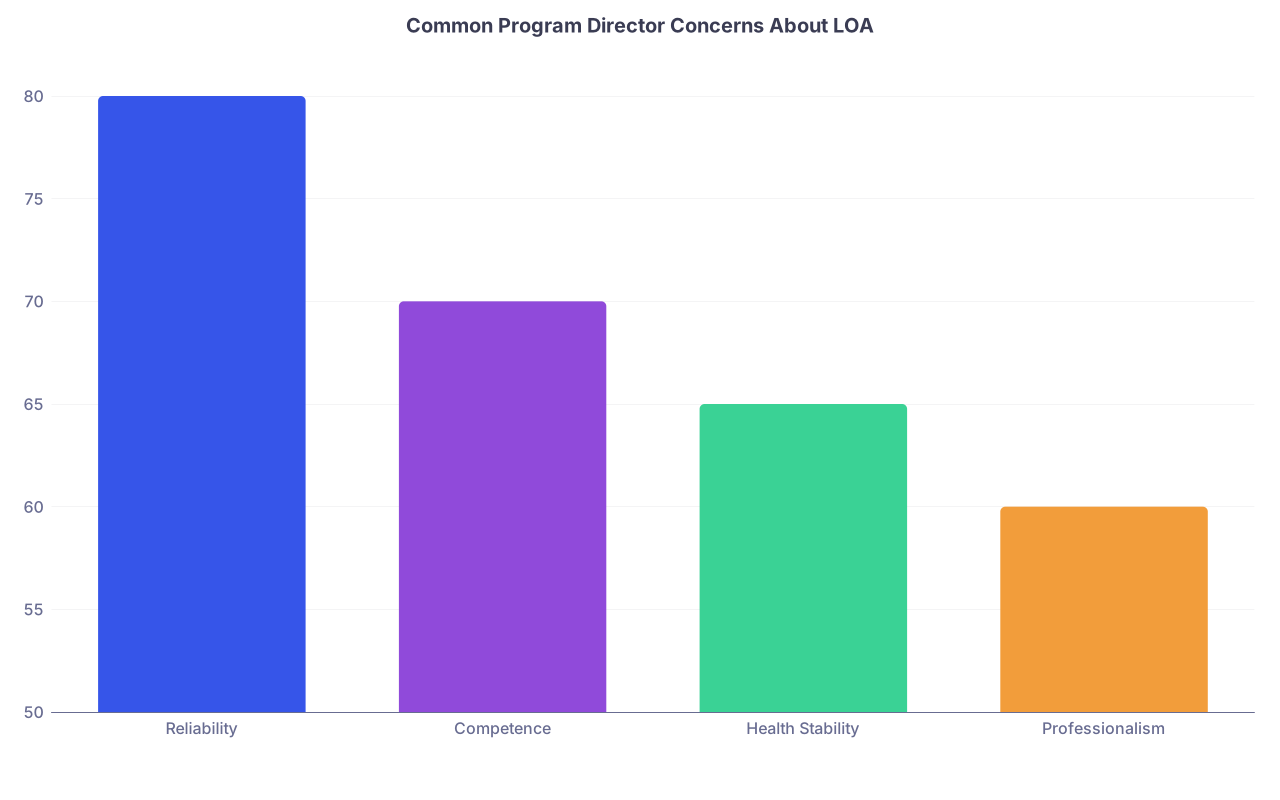
| Category | Value |
|---|---|
| Reliability | 80 |
| Competence | 70 |
| Health Stability | 65 |
| Professionalism | 60 |
(Values here are rough “how often I’ve heard PDs mention this” percentages, not actual published numbers, but you get the point: they’re focused on future risk, not punishing you for the past.)
Types of Leave: Some Are Bigger Deals Than Others
Let’s be honest: not all leaves are viewed the same way. Medicine is judgmental that way.
| Type of Leave | Initial Reaction Level | Can It Be Reframed Positively? |
|---|---|---|
| Medical (physical) | Moderate concern | Yes, usually |
| Mental health/burnout | Higher concern | Yes, if well-explained |
| Family/parental | Usually low concern | Often neutral/positive |
| Academic/performance | Higher concern | Harder, but possible |
| Visa/administrative | Low to moderate | Usually neutral |
Medical leave (physical illness, surgery, pregnancy complications)
People generally get this. If you had surgery, chemo, pregnancy complications, a hospitalization—you’re human, not a robot. Programs mostly ask:
- Are you medically stable now?
- Was performance strong before and after?
If your evaluations before and after are solid and your PD backs you up, this type of leave is rarely fatal for fellowship.
Mental health / burnout leave
This is the one that freaks people out. “If I say ‘depression’ or ‘anxiety’ they’ll never rank me.”
I’ve seen the full range of outcomes here:
- Resident with 3-month leave for severe depression → later matched into a competitive GI fellowship.
- Resident with recurrent episodes, spotty performance, vague explanations → had trouble landing any fellowship initially.
- Resident who hid it, never addressed it, PD lukewarm → application quietly sank.
Programs are not legally allowed to discriminate on disability, but they absolutely can judge “stability, reliability, performance.” Fair or not, they’ll be thinking: can you handle the intensity of fellowship now?
If you can show:
- Clear improvement and sustained functioning
- Strong PD support
- Consistent evaluations after returning
you absolutely can still match. I’ve seen it. More than once.
Family / parental leave
Honestly, this scares you more than it scares most PDs. Plenty of fellows have kids. Plenty took maternity/paternity leave as residents.
The red flags aren’t “you had a baby” or “you cared for a dying parent.” It’s:
- Multiple unexplained absences
- Poor communication or unprofessional behavior around the leave
- Needing repeated schedule adjustments with chaos every time
If your training got extended a bit, you communicated, and you still met milestones, most fellowships won’t care much—especially if it’s framed clearly in your PD letter.
Academic/performance-related leave
This is the hardest one. If you were pulled from service because of serious errors, professionalism issues, or failure to meet milestones, programs will worry this will repeat.
Does that mean you’re done? No. But you’ll need:
- Transparent, consistent story across your application, PD letter, and interview
- Clear, objective evidence of improvement (evaluations, exams, responsibilities)
- A PD explicitly saying, “This resident is now ready and I recommend them strongly”
Without that, yeah, it’s rough.
How Bad Is It Really? Competitiveness vs. LOA
You might be wondering, “Okay but what if I want cards/derm/ortho-level competitiveness in my field—am I just delusional if I take a leave?”
Here’s the uncomfortable but honest breakdown:
| Fellowship Type | LOA Impact If Well-Handled | LOA Impact If Poorly-Handled |
|---|---|---|
| Ultra competitive | Noticeable but survivable | Often fatal |
| Moderately competitive | Mild to moderate | Significant |
| Less competitive | Mild | Moderate |
“Ultra competitive” in IM world = cards, GI, heme/onc at big-name places. In other specialties, you know the equivalent.
What shifts the balance more than the LOA itself:
- Step/board scores and in-training exams
- Research, publications, letters from known people
- PD letter strength
- Interview performance and clarity about your leave
I’ve watched a resident with a 4-month mental health leave match into a very strong heme/onc program because everything else on paper screamed, “This person is an asset,” and the PD was rock-solid supportive.
And I’ve watched someone with no leave, but mediocre letters and vague stories, get nowhere.
So no, a leave doesn’t automatically drop you one competitiveness tier forever. It just narrows how sloppy the rest of your application can be. You lose your margin for error.
The Part No One Tells You: How You Handle the Leave Matters More Than the Leave
Programs care about patterns. A leave is one data point. They’re looking at:
- Did you communicate professionally?
- Did you complete your training (even if extended)?
- Are your milestones and board passes on track?
- Do your attendings trust you with responsibility?
If your LOA looked like:
- You disappeared with minimal explanation
- Your co-residents had to cover a ton of extra shifts with no clarity
- You came back and still functioned inconsistently
then yeah, that looks bad. But if it looked like:
- You were transparent with PD (to the extent you were comfortable)
- You followed institutional policies
- You returned and performed well, reliably
then programs see: crisis happened, addressed, now stable.

| Step | Description |
|---|---|
| Step 1 | Leave of absence |
| Step 2 | Clear story |
| Step 3 | Ongoing red flags |
| Step 4 | Strong PD letter |
| Step 5 | Still competitive for fellowship |
| Step 6 | Programs worried about risk |
| Step 7 | Harder match, but not impossible |
| Step 8 | Handled professionally |
How Do I Talk About It Without Torpedoing Myself?
This is where people either overshare or completely shut down. Neither works great.
You don’t owe anyone your entire trauma history. You do owe them a coherent, professional explanation.
On ERAS / application forms
If there’s a required section about LOA, be simple and factual. Think:
- “I took a 3-month medical leave during PGY-2 for a health issue, completed appropriate treatment, and returned to full clinical duties. My training end date was extended accordingly.”
You don’t need to say: “I had a panic attack so bad I thought I was dying in the call room.” That’s for your therapist, not your application.
In your personal statement
You don’t have to mention it here unless:
- It clearly shaped your career goals, and
- You can discuss it without sounding unstable or still in crisis
Sometimes one short paragraph works:
During my PGY-2 year, I required a brief medical leave, which extended my residency by three months. This time reinforced my commitment to sustainable practice and to supporting resident wellbeing. Since returning, I’ve taken on additional responsibilities including X and Y, and my performance evaluations reflect consistent growth.
Short. Controlled. Forward-looking.
In interviews
You need a 2–3 sentence, calm, repeatable answer. Something like:
- “I took a short leave during PGY-2 for a health issue that’s now fully treated. My residency end date was extended slightly, and since returning I’ve been able to function at full capacity, as reflected in my recent evaluations and my PD’s letter.”
If pushed (some will push), you can decide how much more you’re willing to share. But always bring it back to:
- Stable now
- Functioning well
- Support from PD
- Ready for next level
The PD Letter: Your Make-or-Break
Fellowships will believe your PD more than they believe you. Brutal, but true.
You want your PD letter to:
- Acknowledge the leave briefly and professionally
- Emphasize your performance after return
- Explicitly recommend you for fellowship and state confidence in your readiness
Nightmare version of a PD letter:
- Vague references to “time away”
- No clear statement of readiness
- Lukewarm language like “acceptable” or “adequate”
If you’re going to take a leave—or already did—you need a real conversation with your PD.
Things to ask directly (yes, it’s scary, do it anyway):
- “Do you feel you can strongly support my application for fellowship?”
- “How do you plan to address my leave in your letter?”
- “Is there anything specific I should be doing now to demonstrate readiness?”
If your PD can’t back you strongly, that’s actually important information. You might need:
- More time after returning to build a stronger track record
- Additional faculty advocates whose letters can help counterbalance
Will Programs See Me as a “Problem” or a Person?
Some will see you as a risk. Let’s not sugarcoat it. There are PDs who still think mental health leave = unreliable. There are places where any deviation from the “perfect” path is quietly penalized.
But there are also:
- PDs who had their own crises and remember what it felt like
- Programs that have seen residents come back stronger after a leave
- Places that very explicitly say, “We care how you’re doing now”
Your job becomes:
- Avoid programs where your story will just be a strike against you
- Focus on places that value resilience, growth, and real human beings
And sometimes that means letting go of the “shiniest” name on your list and picking the place that actually fits your reality now. That’s not failure. That’s self-preservation.
How to Protect Your Future Fellowship Chances Before and After a Leave
If you’re still deciding about a leave—or are on one now—here’s what actually moves the needle:
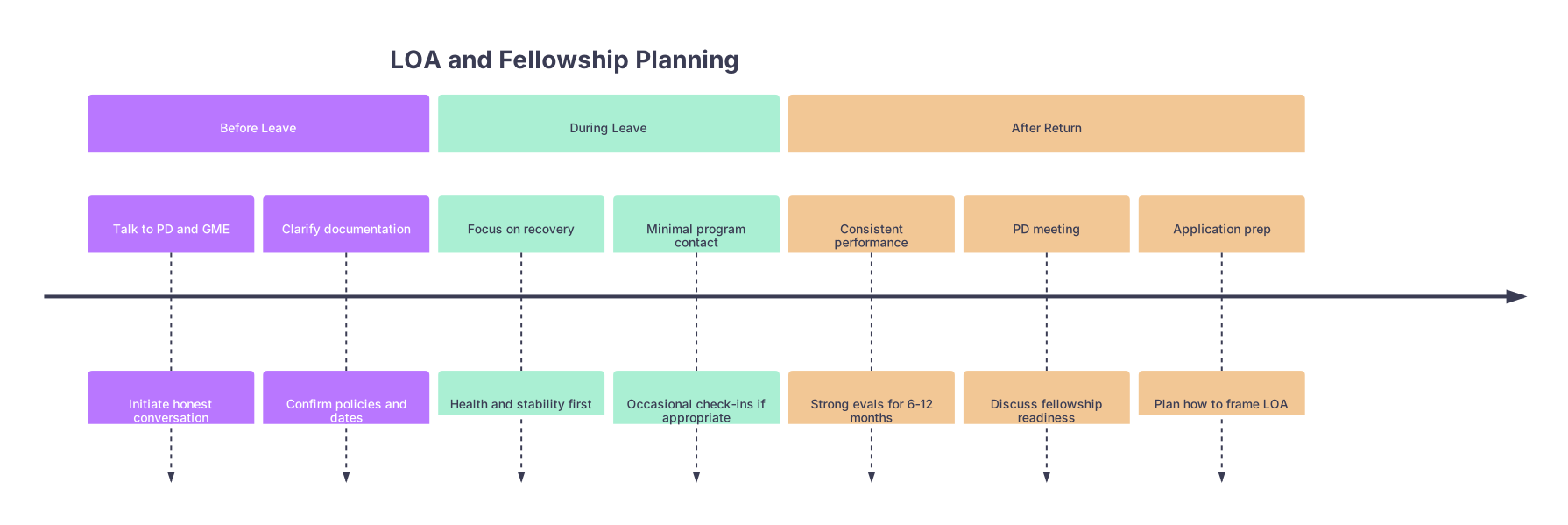
| Period | Event |
|---|---|
| Before Leave - Talk to PD and GME | Initiate honest conversation |
| Before Leave - Clarify documentation | Confirm policies and dates |
| During Leave - Focus on recovery | Health and stability first |
| During Leave - Minimal program contact | Occasional check-ins if appropriate |
| After Return - Consistent performance | Strong evals for 6-12 months |
| After Return - PD meeting | Discuss fellowship readiness |
| After Return - Application prep | Plan how to frame LOA |
Before taking leave:
- Talk (actually talk) to your PD or APD, not just email GME
- Understand how it will affect your graduation date and board eligibility
- Ask what documentation they’ll need and how it will appear in your file
During leave:
- Your only real job is to get better / stabilize
- Don’t try to secretly “keep up” with research, extra projects, etc., if it slows down recovery
- If appropriate, send a brief “I’m planning to return on X date” update closer to the end
After coming back:
- Prioritize consistency over impressiveness
- Show up. Be on time. Do your notes. Be prepared. Every day.
- Let people see you functioning well for months, not just weeks
- Ask for feedback and actually act on it
Once you’re stable, then think about buffing your fellowship app—research, QI, teaching. But don’t sprint at full speed the first week back and crash by week three. PDs see that pattern a mile away.

The Quiet Truth: Your Career Is Long. This Isn’t the Last Chapter.
Residency culture makes every decision feel irreversible. Take a leave and you’ll “never recover.” Don’t match your dream fellowship and your career is “over.”
It’s exhausting.
I’ve watched:
- Residents take leave, finish residency, do a non-ACGME year, then match fellowship later.
- People do a less competitive fellowship first, then lateral into a more competitive niche.
- Residents skip fellowship entirely, work as a hospitalist, rebuild confidence, and later reapply with a stronger story.
An LOA might change your timeline. It might change which programs you’re competitive for. But destroy everything? No. That’s your anxiety talking. Not reality.
If your choice is:
- White-knuckling through residency, deteriorating, risking patient safety and your own life
vs. - Taking a structured leave, getting actual treatment/support, and coming back functional
the second option almost always gives you a better long-term fellowship and career outcome—even if it complicates the next couple of years.
One Hard Question You Need to Ask Yourself
Are you trying to avoid a leave because:
- You truly think you can safely continue with support, or
- You’re terrified of what it “means” on paper?
If it’s mostly the second, you’re sacrificing your actual health to protect a hypothetical future that might not even exist if you crash harder.
Programs can work around dates, extensions, explanations. They can’t work around a resident who completely falls apart, harms someone, or disappears with no plan.
Your health is not a cute slogan. It’s literally the foundation on which any fellowship—even the fanciest one—has to stand.
FAQ (Exactly 4 Questions)
1. Should I delay applying for fellowship by a year after my leave?
Sometimes, yes. If your leave was recent and you only have a few months of post-leave performance to show, it can help to build a longer track record—especially for competitive specialties. A solid 12+ months of strong evaluations, responsibilities, and PD support after returning can do more for your application than rushing into the next cycle with a shaky story.
2. Do I have to disclose that my leave was for mental health specifically?
No. You’re not obligated to share diagnoses. You do need to address gaps or extensions if asked, but you can use phrasing like “health issue,” “medical leave,” or “family circumstances” while still being honest. The key is to reassure them about your current stability and functioning, not to give them every detail of what happened.
3. Will fellowship programs think I might take another leave during training?
Some will worry about this, yes. That’s why it’s critical to show a sustained period of stable performance after your return and to have your PD clearly back you up. If your recent history shows reliability, no major issues, and strong clinical work, most reasonable programs will accept that people can go through a crisis, recover, and function well.
4. What’s one concrete thing I can do this week if I’m considering a leave?
Schedule a private, honest meeting with your PD or APD—no emails, no vague messages. Lay out what you’re experiencing at a high level (you don’t have to give every detail), ask how a leave would affect your graduation and board dates, and ask what they’d need to see from you after a leave to feel comfortable supporting a future fellowship application. Write down their answers. That conversation is the first real step out of endless “what if” loops and into an actual plan.