

It’s July 1st. You’re in your new city, boxes half‑unpacked, staring at your fellowship welcome email and your stomach just drops. You went to orientation, met your co-fellows, saw the call schedule… and this awful thought keeps looping:
“Oh no. I think I made a mistake. What if I hate this? What if I already do?”
This is the nightmare scenario nobody really talks about during recruitment dinners. They talk about “fit” and “mentorship” and “research opportunities.” Not about what happens if you start the fellowship and it’s actually miserable. Or you realize you didn’t really want this field. Or you matched at your “safety” and it feels like a trap.
So now your brain is doing that thing: catastrophizing. “If I quit, my career is over. If I stay, I’ll be miserable. I’m going to disappoint everyone. There is no good option.”
Let’s walk through what’s actually real here, not the 3 a.m. panic version.
First: Are You Sure You Actually Hate It?
Before you mentally plan your escape route, you have to be brutally honest: are you sure it’s the fellowship you hate… or is it the acute transition pain?
The first 2–3 months of any new role are usually awful. You’re new, slow, constantly asking where things are, getting subtly judged by nurses and attendings, and you go home feeling useless. That’s “I hate being new” — not necessarily “I hate this whole specialty.”
Common early misreads I’ve seen:
- “Everyone here is cold and unfriendly”
Translation: they’re busy, tired, and not great at onboarding. They may soften once they trust you. - “The clinical load is insane, I can’t do this for 2–3 years”
Translation: you’re still inefficient, everything feels harder, and you haven’t built shortcuts yet. - “I picked the wrong path”
Translation: you’re grieving residency identity, co-residents, familiar system, and now feel like an impostor again.
Ask yourself a few concrete questions:
- Do I hate the day-to-day work of this field? The patients? The problems?
- Or do I mostly hate this particular program’s culture / schedule / people?
- Or do I mostly hate how new and incompetent I feel?
If you’re only 2–8 weeks in, assume at least 50% of what you’re feeling is transition shock plus sleep deprivation. That doesn’t mean your distress is fake. It just means “I hate everything” might soften with time.
But. Let’s say you’ve been in it a bit. Maybe 4–6 months. Or the dread is so strong and specific it feels different from regular adjustment. Then we’re in the territory you’re actually asking about: what if I truly hate my fellowship?
What Are Your Realistic Options If You Hate Your Fellowship?
Let me be blunt: you’re not as trapped as your brain is telling you, but you’re also not as free as, say, a software engineer who can just job-hop every six months. Medicine is sticky and political. But there are options.

| Step | Description |
|---|---|
| Step 1 | Realize you may hate fellowship |
| Step 2 | Clarify problem |
| Step 3 | Give it more time with support |
| Step 4 | Explore internal fixes or transfer |
| Step 5 | Consider exit or alternate path |
| Step 6 | Talk to PD or trusted faculty |
| Step 7 | Decide - Stay, Modify, or Leave |
| Step 8 | Field vs Program vs Transition? |
Roughly, your choices fall into a few buckets:
- Stay and modify your experience
- Transfer to a different program (rare, but not impossible)
- Switch to a different fellowship/field (complicated)
- Leave fellowship and work as an attending in your base specialty
- Pause or step out for a year of research / non-clinical work
None of these is magically clean. Every path has tradeoffs. Let’s unpack.
Option 1: Stay… But Change the Experience
This is the least dramatic and most common path. People quietly hate parts of their fellowship, make some adjustments, and get through it. Career still intact.
You ask: “But what if staying means I burn out completely?” Fair. The key is: can the experience be made tolerable or even decent with changes?
Things people actually do that help:
Have an honest (but strategic) talk with a trusted faculty member
Not a venting session with your co-fellow. I mean a semi-candid, grown-up conversation with someone who has some power or influence and doesn’t hate you.“I’m realizing I’m struggling with X and Y. I’m committed to this year, but I’m concerned about Z. Are there adjustments or focuses we can consider?”
I’ve seen people get clinic schedules tweaked, research time protected, a rotation swapped, or a toxic attending minimized.
Narrow your focus
If you dislike 80% of the general fellowship but love a small niche, lean hard into that niche. Start branding yourself in that micro-area, get projects, mentors, anything that makes your remaining time feel like it’s moving toward something you do want.Use therapy and peer support like it’s oxygen
If you’re questioning your whole path, do not white-knuckle it alone. A good therapist who knows medical culture is underrated survival gear. Same for one or two honest friends (even outside medicine) you can text when you’re spiraling.
Staying doesn’t have to mean “I surrender to misery.” It can mean “I’ll finish this, but on the most survivable terms possible, while quietly crafting my exit strategy or sub-special niche.”
Option 2: Transferring to a Different Fellowship Program
This is the option everyone whispers about: “Can I switch programs after matching?”
Short answer: possible, but rare and messy.
Real talk: programs do sometimes lose or gain fellows mid-cycle. People move for spouse jobs, health issues, visa complications, or… yes… because they hated their program. But there’s no ERAS 2.0 for this. It’s informal, political, and usually relies on networking.
Common realities if you’re thinking about transferring:
You usually need your current program director to not sabotage you.
Some PDs are surprisingly understanding when someone says, “This has been really hard; I think a different environment might be better for me.” Others. Are not.You probably won’t move after 2 weeks.
Transfers tend to happen after at least a few months when it’s clear this isn’t working, and another program has a sudden vacancy.You may need to repeat time or lose credit.
ABMS boards can be picky about continuity and program approval. You might repeat part of PGY-level or fellowship year.
This path is mostly realistic if:
- You’re in a larger specialty
- You have strong mentors elsewhere
- And you’re willing to accept some delay / repeating
If you’re in an ultra-niche fellowship with only a handful of programs nationwide, transfer is basically a unicorn.
Option 3: I Think I Chose the Wrong Field Entirely
This is the deepest pit: “I don’t just hate this program. I hate this specialty. I don’t want to be a cardiologist / GI / heme-onc / whatever anymore.”
If that’s what’s pinging in your chest, don’t ignore it, but also don’t act impulsively.
You need to sort out whether:
- You hate the culture and training environment, or
- You genuinely do not want to spend your life doing the core work of this field.
Try to imagine a good program in this field: supportive leadership, humane call, functional staff. Would you still not want to spend your career doing this specialty?
If the answer is still “nope,” then yeah — you may have outgrown or mispicked the field.
So what then?
Most people do not immediately jump to a new fellowship in a brand new field the next year. It happens, but it’s not common. More often, they:
- Finish the current fellowship (or at least the year), then
- Go work as an attending in their base residency specialty, or
- Pivot into non-clinical work (industry, admin, etc.)
Later, some apply to a different fellowship with a clearer understanding of what they actually want. Are there politics? Sure. You’ll need to explain why you left or switched without sounding flaky. But careers are long. People reinvent themselves more than you think.
Option 4: Leaving Fellowship and Working as an Attending
Your PGY brain is probably screaming: “If I quit, I’m done, no one will hire me, every future job app will say ‘this person is a problem.’”
That’s not how it plays out in real life.
You are still a board-eligible (or boarded) physician in your residency specialty. That credential didn’t vanish the moment you started fellowship. Community hospitals, private groups, telemedicine companies, urgent cares — they’re all staffed with people who got there through very non-linear paths.
Here’s the less glamorous truth: a lot of places just need a competent, licensed, board-certified/eligible doc who will show up and not be a jerk. They do not double- and triple-parse your fellowship drama.
But you’ll have to own a story you can say out loud:
Something like: “I started a cardiology fellowship and realized early on that while I liked the medicine, I didn’t want that level of sub-specialization and lifestyle long-term. I decided to go back to general internal medicine where I enjoy broader patient care and more flexibility.”
Clean. Honest enough. Not a soap opera.
If you leave:
Try to leave as gracefully as possible.
Don’t ghost. Don’t burn the hospital down on the way out. Communicate that it’s about fit and direction, not about “this program is trash and I hate you all.”Protect your letters and reputation where you can.
You don’t need them to adore you. You just want them not actively undermining you.
Is it scary? Yes. Is it career suicide? No.
Option 5: Taking a Detour – Research, Industry, or A “Gap Year”
Some people hit a wall in fellowship and don’t have the emotional bandwidth to decide their entire future while on Q4 call. So they punt. They finish the year (or leave earlier if needed) and step into a lower-intensity role while thinking.
This could be:
- A research year with a mentor from residency
- A hospitalist job with more predictable shifts
- An industry job (pharma, med device, consulting)
- A clinical educator role
This is not failure. This is “I’m not going to blow up my life while I’m exhausted and traumatized. I’ll get some distance and then decide.”
You’d be surprised how much clearer your preferences become when you’re not rounding with 14 consults before 10 a.m.
Emotional Stuff Nobody Preps You For
The logistics are one thing. The shame spiral is another.
Common internal narratives:
- “Everyone else is happy; what’s wrong with me?”
- “My mentors invested in me; I’m betraying them.”
- “I fought so hard to match here and now I want to leave? I’m ungrateful.”
- “If I quit, I’m weak. Real doctors push through.”
I’m going to cut through that: none of this means you’re weak or broken. It means you made a decision with incomplete information (like everyone does), and now you have more information. That’s it.
Residency and fellowship culture trains us to tolerate misery and call it resilience. There’s a difference between tolerating temporary pain for growth versus locking yourself into a life you actively don’t want because you’re afraid of looking flaky.
You’re allowed to change your mind. You’re just not allowed to do it irresponsibly and expect zero consequences. That’s the adult part.
How Program Directors Actually See This
I know it feels like PDs are this monolithic judging panel. They’re not. They’re humans who have:
- Seen people crumble quietly and burn out
- Seen people finally say, “I can’t do this,” and actually get better
- Seen fellows transfer, quit, reapply, pivot… all of it
Do some PDs take it personally when a fellow leaves? Yeah. Some have fragile egos or just see it as a hassle.
But many of them actually prefer:
- A fellow who comes early and says, “This doesn’t feel right; can we talk about options?”
over - A fellow who stays, becomes toxic, unsafe, or implodes mid-ICU month.
If you decide to explore leaving or transferring, your goal isn’t to convince the PD that you’re perfect. It’s to show you’re thoughtful, honest, and not going to create chaos.
Something like: “I’ve been reflecting a lot and I’m concerned that long-term, this specific path may not be the right fit for me. I want to approach this transparently and see what options might exist — whether that’s adjusting my role here, looking at research time, or, if needed, considering a different path. I’m committed to finishing my responsibilities safely and professionally.”
Not dramatic. Not accusatory. Just adult.
A Reality Check: What You’re Probably Overestimating and Underestimating
You’re probably overestimating:
- How much your career will be “ruined” by one imperfect fellowship decision
- How much everyone is paying attention to your every move
- How harshly future employers will judge a non-linear path
You’re probably underestimating:
- How many attendings secretly hated parts of their training and still built good lives
- How common it is to pivot, rebrand, and move specialties/niches over time
- Your ability to recover from one “wrong” step
Careers are 30+ years. This feels like the final exam; it’s not. It’s one chapter. Important, yes. Permanent, no.
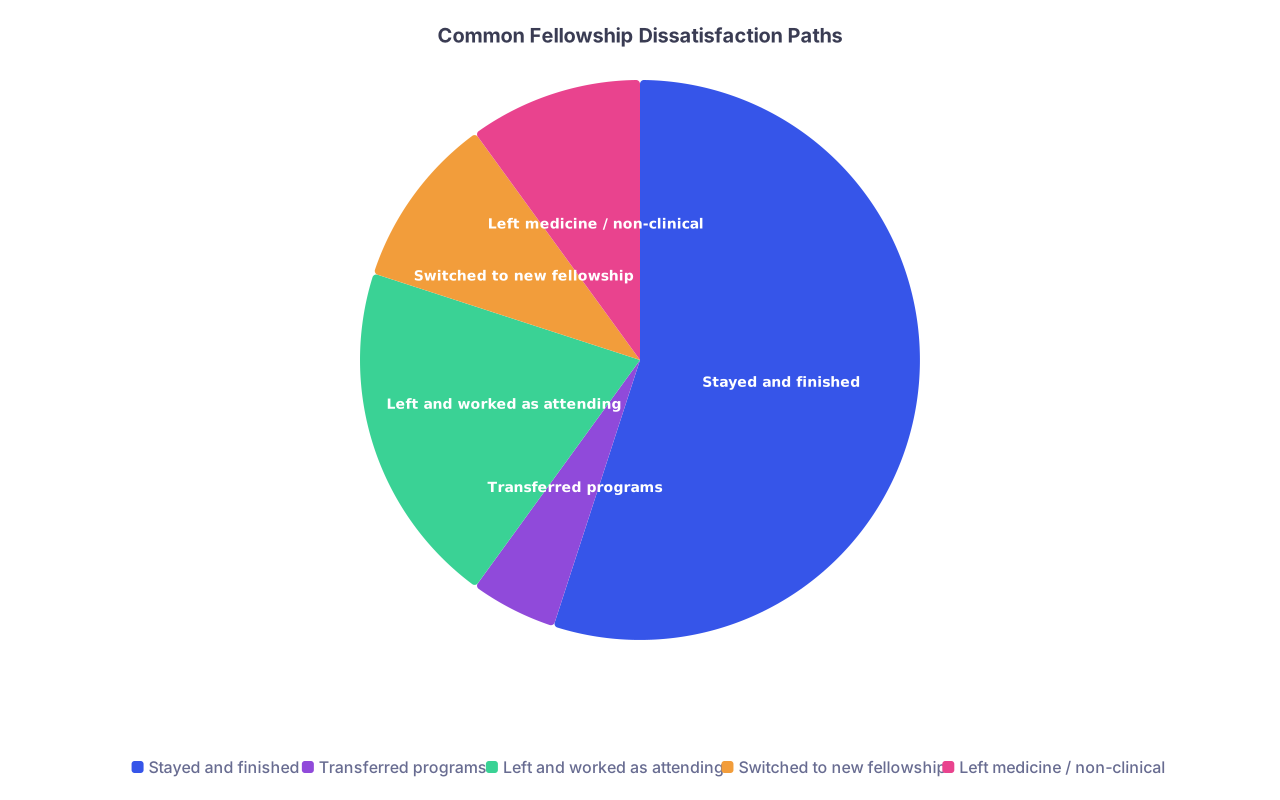
| Category | Value |
|---|---|
| Stayed and finished | 55 |
| Transferred programs | 5 |
| Left and worked as attending | 20 |
| Switched to new fellowship | 10 |
| Left medicine / non-clinical | 10 |
| Option | Upside | Main Tradeoff |
|---|---|---|
| Stay and modify experience | No disruption to CV/boards | Ongoing discomfort |
| Transfer to another program | Better fit possible | Rare, political, may repeat time |
| Switch to different fellowship | End up in better field | Reapply, explain story, delay |
| Leave and work as attending | Immediate autonomy/income | Lose subspecialty path |
| Take research/non-clinical year | Time to think and reset | Unclear next step, lower pay |

Before You Do Anything Drastic
A few things I’d strongly recommend, before making any big move:
Give it at least a defined trial period if you’re early.
“I will reassess at 3 or 6 months with real data: what I like, what I hate, what’s changeable.”Write down specifically what you dislike.
“Q3 nights, malignant attending A, zero teaching on consults” is very different from “I hate this entire specialty.”Talk to:
- One trusted mentor from med school or residency
- One person at your current program you don’t fully hate
- A therapist if at all possible
Don’t make permanent decisions on a week where you were on call 5 out of 7 days. Your brain is not a safe place then.

FAQs
1. If I quit fellowship, will I ever be able to do another fellowship later?
Not automatically blocked. People do match into a different fellowship after leaving another, but you will need a clear, mature explanation and ideally some time showing success in your base specialty or another role. The story “I left, I reflected, I worked as X, and realized I genuinely want Y” is believable. “I just bounce when I’m unhappy” is not.
2. Will future employers see me as a red flag if I don’t finish?
Some might raise an eyebrow and ask. That’s fine. Your job is to have a calm, non-defensive answer. Many community employers frankly won’t care that much as long as you’re licensed, boarded/board eligible, and come recommended by someone they trust. Academic jobs may scrutinize it more, but again — not an automatic no.
3. Can I just stay for the year so it “looks better,” even if I’m miserable?
You can, and many do, but there’s a limit. If staying means genuine risk of serious burnout, depression, or harming patients because you’re checked out, that’s not noble. There’s a difference between tolerating discomfort to complete training and sacrificing your health to protect your CV. You’re allowed to protect yourself.
4. How honest should I be with my program director about hating it?
Not 100% raw honesty. You don’t go in saying “I hate this place.” You go in saying, “I’m struggling with fit and long-term alignment, and I want to talk about options.” You’re allowed to be real, but you still have to be strategic. Assume anything you say might end up in a future letter.
5. What if I feel trapped because of visa issues or finances?
Then your option space tightens, but it’s not zero. Visa status may make leaving or changing programs much harder. In that case, the focus shifts to: how do I survive this in the least damaging way possible? Maximise support, tweak schedule where you can, plan an exit strategy at the end point, and get financial/immigration advice from actual experts, not co-fellows.
6. Does hating my fellowship mean I chose the wrong specialty forever?
No. It might mean you picked the wrong program, wrong niche, wrong timing, or that your expectations didn’t match reality. Or yes, it might mean this field isn’t for you. But one bad or misaligned fellowship year does not define the rest of your 30-year career. You’re allowed to pivot, re-scope, or practice your base specialty and still have a solid, meaningful career.
Key points:
You’re not as trapped as your anxiety is telling you. There are real, if imperfect, options: stay and modify, transfer, pivot, or leave and work as an attending.
And no, hating your fellowship doesn’t mean you’ve ruined your life. It means you have more information now — and you can use it to make your next move smarter, not more desperate.


