

The idea that one bad rotation can destroy your entire fellowship application is a myth that keeps residents up at night—but it’s not how selection actually works.
You and I both know the feeling though. That one month. The malignant attending. The night you snapped at a nurse. The consult you forgot. The eval that came back with the dreaded “Meets expectations” and a salty comment. And now your brain is screaming: “That’s it. Cards/Heme-Onc/GI is over. I’m done.”
Let’s walk through this like we’re sitting in the call room at 2 a.m. and you’re spiraling, because I’ve watched people match into insanely competitive fellowships with way worse on their record than a single rough rotation.
What Fellowship Committees Actually Look At (Not Just Your One Trainwreck Month)
Fellowship applications are not a one-rotation referendum on your soul.
Programs look at patterns over time, not isolated disasters. They’re pulling together a whole picture:
| Component | How Much It Really Matters* |
|---|---|
| Letters of Rec | Very High |
| PD/Chair Letter | Very High |
| Rotation Evaluations | Low–Moderate (as a whole) |
| Research/Scholarly | Moderate–High |
| Personal Statement | Moderate |
| Interview | Very High |
| USMLE/COMLEX | Low–Moderate (for most IM) |
*Obviously varies by specialty, but this is the rough reality for most internal medicine-based fellowships.
See “Rotation Evaluations”? Notice it doesn’t say “That One Rotation Where Everything Went to Hell.”
They’re looking for:
- Consistency: Are you generally solid, improving, not a disaster?
- Trajectory: Did you grow from PGY‑1 to PGY‑3? Or stagnate?
- Outliers: Are the bad evaluations clustered (red flag) or isolated (human)?
One bad month in a sea of otherwise decent-to-strong feedback gets mentally filed as “context needed,” not “deny interview immediately.”
Is that how it feels when you refresh your eval and see some passive-aggressive comment? No. It feels catastrophic. But functionally, on their side, it usually isn’t.
Let’s Talk About “Bad” Rotations And How Bad Is Actually Bad
You need to be honest with yourself: was the rotation just rough… or actually catastrophic?
Category 1: Normal “Bad” Rotation (Annoying but survivable)
This is most people.
Think:
- You were overworked, a bit disorganized, and got a lukewarm eval
- One attending didn’t like your style and wrote vague stuff like “needs to improve efficiency” or “could read more”
- You had a conflict with a senior or fellow that bled into your eval
- You were sick, burned out, or dealing with life (depression, breakup, family illness) and it showed
This kind of “bad” usually equals:
- “Meets Expectations” instead of “Exceeds”
- A couple of “3s” on a 1–5 scale
- Maybe one irritating comment
Programs see this literally daily. No one is tanking your entire file over it.
Category 2: Concerning But Fixable
This is more serious, but still not an automatic death sentence.
Things like:
- One rotation with “Below expectations” in professionalism or communication
- A comment about being late, disorganized, or not taking feedback well
- A low score early PGY‑1 that clearly improves later
Here, context matters a ton. If everything else is strong—good PD letter, strong subspecialty letters, research, and improvement later—this can be framed as “they had a hard rotation early and grew.”
Selection committees actually like seeing growth. Weak early evals with strong later ones tell a story they understand.
Category 3: Actual Red Flag Territory
This is where the anxiety in your head sometimes goes, even if it’s not your reality.
Stuff like:
- Documented unprofessional behavior (yelling at staff, refusing to see patients)
- Patient safety incidents from carelessness, not systems issues
- Multiple rotations with similar serious concerns
- A remediation plan, probation, or formal disciplinary action
Even here, I’ve seen people still match—if:
- It was addressed directly
- There’s clear, sustained improvement
- The PD goes to bat for you and explicitly says, “They had an issue. We fixed it. They’re ready.”
So unless you’re in this category (in which case you need a deliberate strategy, not late-night spiraling), you’re probably not “tanked.”
The PD Letter: The Real Gatekeeper (Not That One Attending)
Here’s the part they don’t tell you during intern orientation: your Program Director’s letter (and Chair letter for some specialties) matters more than almost any individual rotation evaluation.
If your PD writes:
- “One ICU rotation eval was less positive due to a mismatch in expectations, but they responded to feedback and have been consistently strong since”
that neutralizes that bad month more than you think.
Most fellowship directors trust PDs far more than one salty attending who had a bad week and took it out on evals.
Your PD sees:
- All your evals
- Your growth over years
- Your behavior over time
- Your response to feedback
- Whether nurses, staff, and co-residents trust you
That’s who fellowship programs listen to when there’s a blip.
This is why talking to your PD (instead of silently panicking) is one of the most powerful things you can do after a rough rotation.
The “What If They See That One Eval And Just Toss My File?”
Let’s be brutally honest: fellowship directors are busy, and they’re skimming.
They’re skimming for:
- Strong letters from subspecialty faculty they know/trust
- Clear commitment to the field (electives, research, QI, teaching)
- No giant professionalism bombs
They are not typically:
- Reading every line of every evaluation you got on every ward month
- Obsessing about a single ICU eval from July PGY‑2
If they see something concerning, they look for:
- Is this an isolated comment?
- Is there a pattern?
- Did the PD mention it?
- Do later evaluations contradict it?
If you’re worried, you can also preempt this in your personal statement or, better, through your PD letter. Something like:
- “During my PGY‑2 ICU month, I struggled with time management in a high-acuity environment. That month pushed me to overhaul my organizational system and seek mentorship from our ICU fellow. Since then, my ICU and ED evaluations have shown clear improvement, and I now feel confident managing complex, unstable patients.”
That shifts it from “mysterious bad eval” to “documented growth.”
Reality Check: How Much Does One Rotation Weigh Compared To Everything Else?
Let me put numbers on this since anxiety loves vague unknowns.
Say we pretend, just for your brain’s sake, that a fellowship program mentally weights your application like this:
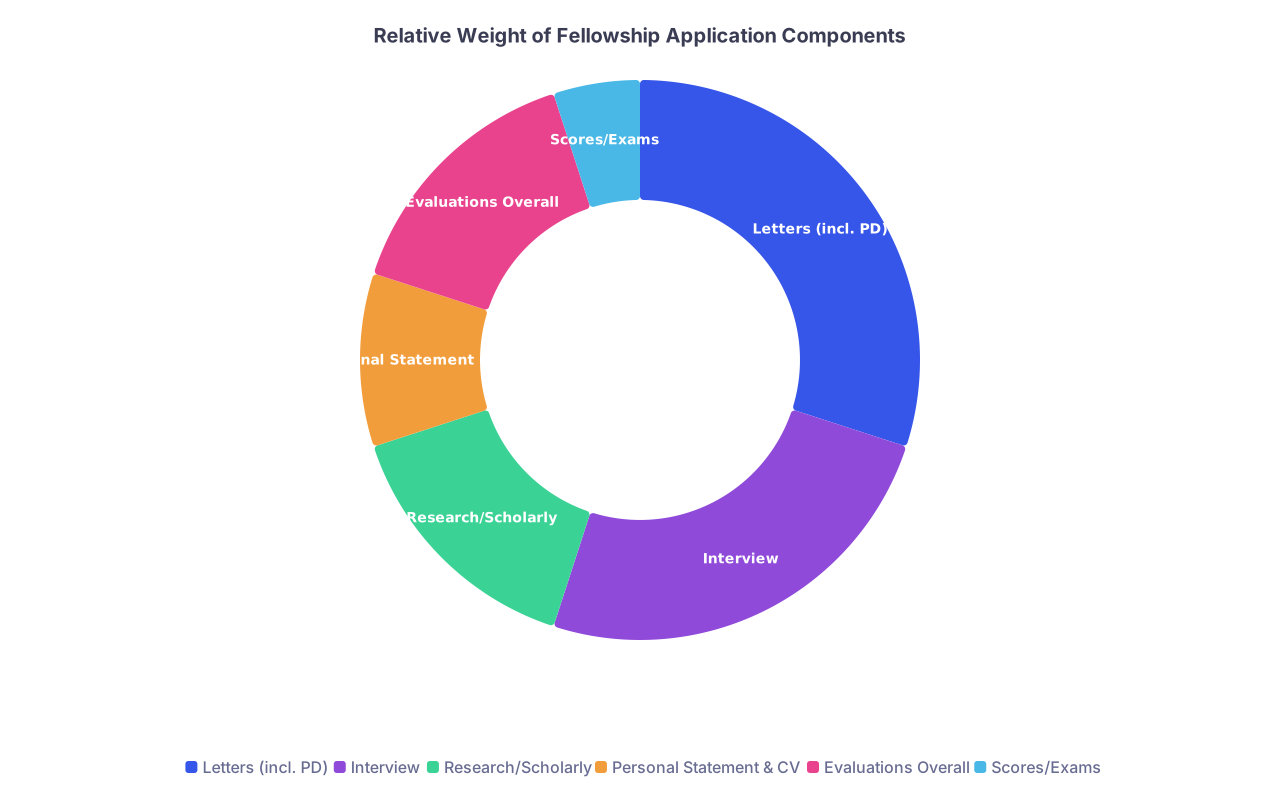
| Category | Value |
|---|---|
| Letters (incl. PD) | 30 |
| Interview | 25 |
| Research/Scholarly | 15 |
| Personal Statement & CV | 10 |
| Evaluations Overall | 15 |
| Scores/Exams | 5 |
Now zoom into that “Evaluations Overall” 15%.
Your one bad month is a fraction of that slice. It just isn’t mathematically capable of outweighing strong letters, good interviews, and a consistent upward trend.
Unless that rotation:
- Was directly in your fellowship field
- Involved someone whose letter you desperately needed
- Or contained a true professionalism disaster
…it’s background noise compared to the rest.
What If It Was In The Field I’m Applying To?
Okay, this is where the anxiety spikes, and honestly, it’s not totally irrational.
If:
- You want GI and your GI consult month was a disaster
- Or you want Cards and the CCU attending thinks you’re slow and disengaged
then yes, that hurts more. Because now the people judging you are also the ones who worked with you.
But even here, it’s not automatically fatal. I’ve seen this play out three ways:
You had one bad subspecialty attending, but another in the same field liked you
- Strategy: get letters from the people who actually like you. Avoid the one who didn’t.
- Programs won’t be like “But why don’t we have Dr. Smith’s letter?” They don’t know Dr. Smith even exists.
You were weaker early, came back stronger later
- Strategy: do another elective in that field with a different team or later in training. Crush it. Get that letter.
- Then the story becomes: “I struggled with the pace and complexity during my first exposure to X, but over time I developed the skills to excel in that environment.”
You genuinely don’t click with that subspecialty team culture
- Hard truth: sometimes that’s a sign you may fit better in a related but different fellowship.
- But it can also just mean that specific team was toxic or chaotic.
You have more control here than you think, especially if you still have time to schedule another rotation in that field.
Steps You Can Actually Take After A Rough Rotation (Instead Of Just Spiraling)
Let me be concrete. Here’s what I’d tell you to do if you were texting me from the parking lot after a soul-crushing feedback meeting.
1. Talk to your PD or APD. Directly. Soon.
Not in a “please save me” way. In a “I want to understand and improve” way.
Something like:
- “I’m concerned about how this ICU eval will look when I apply to Pulm/CC. Can we talk about how to frame this and what I can do moving forward to strengthen my application?”
They can:
- Put the eval in context
- Tell you how bad it really is (their version is usually much calmer than yours)
- Strategize future rotations and letters
- Address it proactively in their PD letter if needed
2. Get at least 2–3 rock-solid subspecialty letters
Letters can drown out a mediocre rotation.
Target:
- Faculty who have seen you handle complexity
- People who actually like teaching and mentoring
- Attendings who’ve seen your growth over time
If Dr. “I Eat Residents For Breakfast” gave you a bad eval, that sucks. But Dr. “I Actually Remember Your Patients” may write you a letter that programs care about far more.
3. Create obvious evidence of improvement
If your “bad” rotation was:
- ICU → ask to rotate again later, work deliberately on feedback
- Wards → become that senior who is organized and calm under pressure
- Communication/professionalism → ask nurses and fellows for feedback, be intentional about how you show up
Programs love the “comeback arc” more than the “perfect robot resident” anyway.
You’re Probably Overestimating How Much People Remember
This sounds harsh, but it’s actually comforting.
That attending you think hates you? They probably:
- Barely remember the details
- Are drowning in email and patient care
- Filled out your eval in 3 minutes between notes
It feels like your entire personality and competence are carved into stone forever. From their side, it’s “oh yeah, that resident who was a bit slow that month.”
And from the fellowship side? It’s “ok, one mixed eval out of dozens, PD says they’re great now, letters are strong, interview was solid.” And they move on.
Your brain does not want to believe this, because anxiety loves the story where you’re permanently marked. But reality is way more boring and forgiving.

| Step | Description |
|---|---|
| Step 1 | One Rough Rotation |
| Step 2 | Minor Concern |
| Step 3 | Real Red Flag |
| Step 4 | Context from PD letter |
| Step 5 | Strong subspecialty letters |
| Step 6 | Evidence of improvement |
| Step 7 | PD meeting and remediation |
| Step 8 | Still possible to match with clear growth |
| Step 9 | Pattern or One Off |
Quick Reality Snapshot: People Match With Way Worse
I’ve personally watched people match into competitive fellowships with:
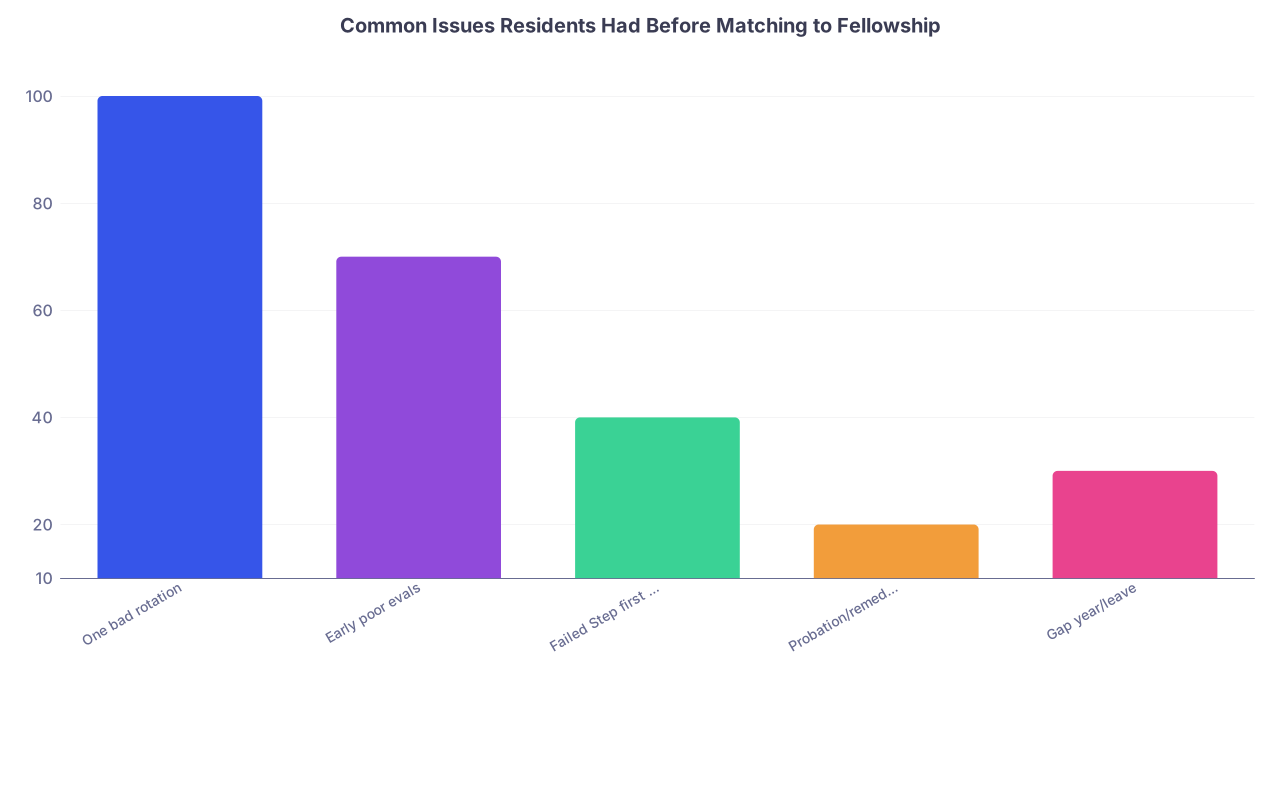
| Category | Value |
|---|---|
| One bad rotation | 100 |
| Early poor evals | 70 |
| Failed Step first attempt | 40 |
| Probation/remediation | 20 |
| Gap year/leave | 30 |
That’s not made up. Programs are full of humans with messy trajectories. Your brain keeps comparing you to an imaginary perfect applicant who doesn’t exist.
Instead of asking, “Did I ruin everything?” a better (and more accurate) question is: “What story does my application tell now, and how can I shape it going forward?”
Because you still have more control over that than your anxiety wants you to believe.
FAQ: Fellowship Panic Edition (Exactly 5 Questions)
1. Should I mention my bad rotation in my personal statement?
Only if:
- It was genuinely significant
- You clearly grew from it
- You can frame it without sounding defensive or blaming
Don’t write, “The ICU attending misunderstood me.” Do write, “My first ICU month exposed weaknesses in my time management and prioritization; addressing those gaps has been central to my growth as a senior resident.”
If it was just a slightly worse-than-average eval, don’t give it more spotlight than it deserves.
2. Will fellowship programs see every single rotation evaluation?
Not always in raw detail. They’ll certainly see your PD letter, and some programs get a summarized evaluation file. But they’re not sitting there reading every checkbox from your PGY‑1 ward month. They focus way more on letters, PD comments, and any glaring patterns. One mediocre month usually doesn’t get special attention unless someone flags it.
3. What if the attending who gave me a bad eval is well known in the field?
Then you definitely don’t want them writing a lukewarm letter. Better no letter than a weak or negative one. If you’re forced to interact with them again, use it as a chance to repair the impression. But do not assume, “They hate me, therefore their friends at every fellowship will hate me.” That’s not how it works. Faculty gossip is a thing, but it’s not the main driver of selection for most programs.
4. Is it worth doing another rotation in the same subspecialty to “overwrite” the bad one?
Yes, if you can:
- Work with different faculty
- Apply the feedback you got
- Intentionally ask for a letter if it goes well
A later, stronger subspecialty month is one of the best ways to dilute the impact of a rough earlier experience. It also gives your PD something concrete to point to: “They struggled early, then excelled later.”
5. What if I’m still early in residency and already feel like I’ve ruined fellowship chances?
You haven’t. PGY‑1 and early PGY‑2 are expected to be messy. Committees know this. What matters more is where you are by the time you’re applying: your senior-level performance, your letters, your reliability, how you show up on teams. Use the fear not to beat yourself up, but to be deliberate now—seek feedback, ask for mentorship, pick rotations strategically, and actually work on the weak spots instead of just obsessing over them.
Open your evaluation dashboard and look at the full pattern—not just that awful month. Then send one email today to your PD or a trusted faculty mentor asking to talk specifically about building a strong fellowship story despite that rotation. That single conversation will do more for your future than another week of silently replaying those bad moments in your head.


