

How many fellowship programs do you actually need to apply to so you do not end up scrambling in December—or burning out in October?
Let me give you the bottom line first, then we’ll break it down by specialty, competitiveness, and your profile.
Short Answer: Typical Ranges That Actually Make Sense
For most U.S. MD/DO residents in moderately to highly competitive subspecialties, realistic ranges look like this:
- Competitive IM subs (cards, GI, heme/onc): 25–45 programs
- Mid-range IM subs (pulm/crit, ID, rheum, endo): 20–35 programs
- Non-IM competitive fellowships (pain, sports, derm path, etc.): 20–40 programs
- Less competitive fellowships or strong in-house pipeline: 10–20 programs
Those are starting points. Not rules carved in stone. But I’ve seen those ranges work over and over again.
Where you should land in those ranges depends on three things:
- How competitive the specialty is
- How competitive you are
- How geographically picky you’re being
If you try to ignore any of those three, you either overapply and waste money—or underapply and roll the dice with your career.
Step 1: Know How Competitive Your Fellowship Is
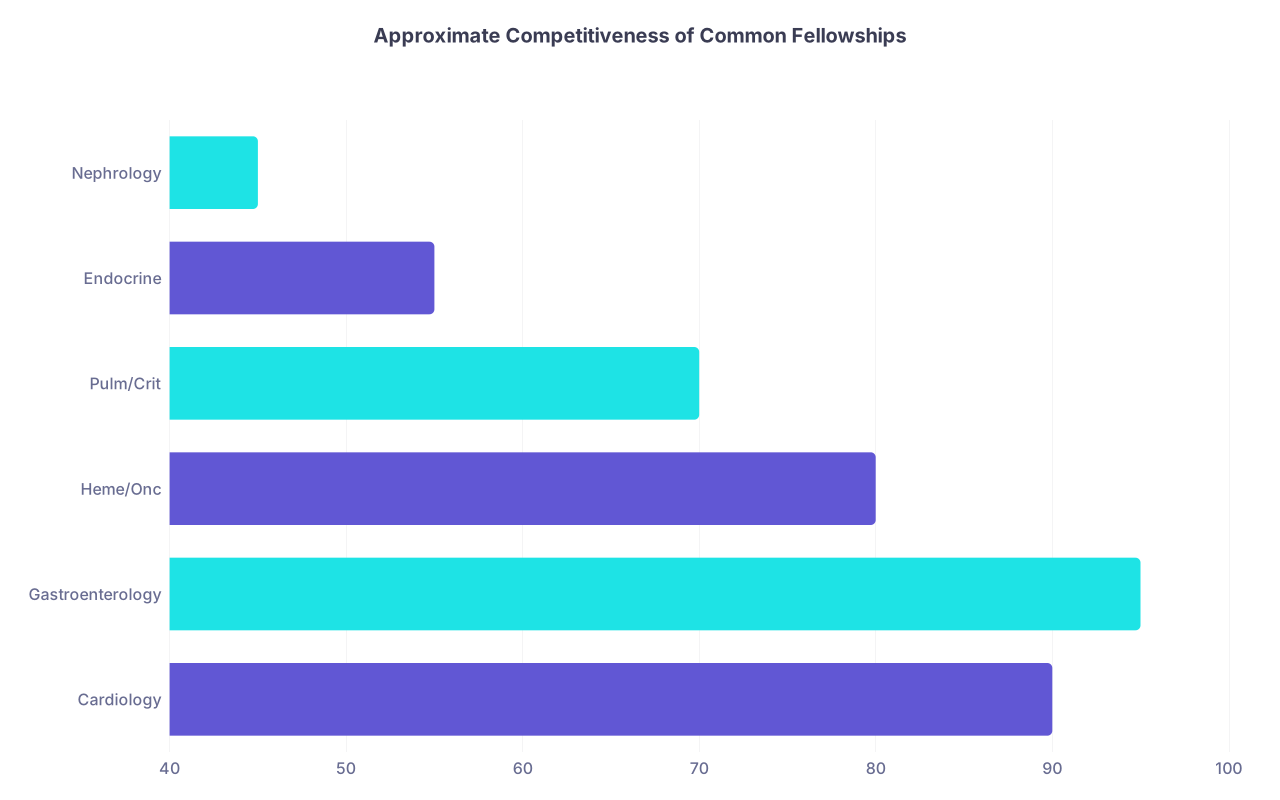
Different fellowships are not remotely equal. Applying to nephrology is not the same game as applying to GI.
| Category | Value |
|---|---|
| Cardiology | 90 |
| Gastroenterology | 95 |
| Heme/Onc | 80 |
| Pulm/Crit | 70 |
| Endocrine | 55 |
| Nephrology | 45 |
(Think of those numbers as “competition intensity,” not exact match rates.)
Rough buckets:
High-competition IM fellowships
Cardiology, GI, heme/onc
Lots of applicants with strong research and strong letters. Many community residents aiming academic.Medium-competition IM fellowships
Pulm/crit, allergy/immunology, rheumatology, ID (varies by cycle), endocrine
Still selective, but more programs and more variability.Lower-competition IM fellowships
Nephrology, geriatrics, some hospital medicine fellowships, palliative care
Often more positions than serious applicants in some regions.Other competitive non-IM fellowships
Ortho sports, pain, derm path, micrographic surgery, certain neuro fellowships, integrated vascular, plastics fellowships (for GS grads).
Small numbers of positions, intense competition.
You need to be honest about where your target fellowship sits. If you’re applying GI or cards and thinking “I’ll just apply to 10 places I really like,” you’re setting yourself up to be an attending hospitalist with regret.
Step 2: Be Brutally Honest About Your Application
Here’s how I mentally sort applicants when I advise residents:
| Applicant Tier | Typical Profile | Recommended Range |
|---|---|---|
| Strong | Top 25% of residency, strong letters, solid research, no red flags | 15–25 (medium), 25–35 (high comp) |
| Solid/Mid | Average resident, OK research, decent letters | 20–30 (medium), 30–45 (high comp) |
| At-Risk | Below-average evals, visa, significant gaps or red flags | 30–40 (medium), 40–60 (high comp) |
How to categorize yourself quickly:
Strong applicant signs
- From a reputable academic residency or strong community program with a track record of matching in your fellowship
- Top third of class / leadership roles / strong comments on evals
- 1–3 first- or second-author publications (or serious abstracts/posters) in the field
- Letters from known people in the specialty (especially at national level)
- No professionalism or major exam issues
Middle-of-the-pack applicant signs
- Solid clinical comments, but not glowing
- Some research or QI, but not heavily specialty-focused
- Letters from solid but not “name brand” faculty
- Maybe Step 1 pass on second attempt or an average Step 2 score
At-risk applicant signs
- Significant exam issues (multiple failures, major score drops)
- Program leadership concerns, professionalism issues, remediation
- Minimal or no specialty-focused work in a competitive field
- Need for visa sponsorship in a competitive region/specialty
If you’re between tiers, assume the lower tier. Overconfidence hurts more than mild overshooting on number of programs.
Step 3: Adjust for Geography
You can match into a good fellowship while being geographically flexible. You may not match if you insist on one metro area plus “nice weather.”
I usually tell residents to think of geography in tiers:
- Tier A – Must-have regions (partner’s job, kids, family needs)
- Tier B – Strong preference but survivable if not
- Tier C – Places you’d go for 2–3 years if it meant getting your fellowship
If your Tier A is tiny (e.g., “Boston or bust”) and you’re not a top-tier applicant, you need to compensate by:
- Applying to essentially every program in that region, including less desirable ones
- Strongly considering adding Tier B and C regions
- Accepting a real risk of needing to reapply or change plans
If you’re broadly open—“anywhere east of the Mississippi” or “coastal plus big midwestern academic centers”—you can lean toward the lower end of the ranges.
Concrete Ranges by Situation
Let’s translate all that into actual numbers you can use.
Internal Medicine – Cardiology, GI, Heme/Onc
Strong applicant from academic or well-known community program
Honestly, 25–30 is usually enough if you are not geographically ultra-restrictive.
If you only want 1–2 metro areas, bump to 35–40.Middle-of-the-pack applicant
Aim for 30–45.
If you have any red flags or want specific cities/regions only, push to 40–50.At-risk applicant or visa-dependent
40–60 is not outrageous here.
Apply broadly, including community and newer programs. Some people in this group match off 25 apps, some need 60+. You do not know which one you are up front.
Internal Medicine – Pulm/Crit, Rheum, Endo, Allergy, ID
Strong applicant
15–25 if geographically flexible.
20–30 if targeted to a few states/regions.Middle-of-the-pack applicant
20–30 is fine if you apply across multiple regions.
25–35 if your geography is tighter or ID cycles are competitive that year.At-risk applicant
25–40 depending on visa status and flexibility.
Lower-Competition IM Fellowships (Nephrology, Geri, Palliative)
- Strong or mid applicant from a U.S. program
10–20 is plenty if you’re flexible. I’ve seen solid residents match with 8–10 apps here. - At-risk or international grad
20–30 to be safe, especially if you need visa support.
Surgical and Other Subspecialty Fellowships
Numbers vary a lot by field size, but general ballpark:
Very small, very competitive fellowships (microvascular, complex spine, high-end sports, derm micrographic surgery, etc.):
25–40 is common. Many applicants basically apply to “every program I’d actually go to.”Moderately competitive but niche fellowships (pain, most neuro subs, some ob/gyn subs, pathology subs):
20–35 for most applicants, 30–40 if you’re weaker or location-limited.
Reality Check: Cost, Fatigue, and Diminishing Returns
You’re not applying in a vacuum. You’re applying while being a resident. On call. Post-call. Tired.
| Category | Value |
|---|---|
| 10 | 400 |
| 20 | 800 |
| 30 | 1300 |
| 40 | 1900 |
| 50 | 2600 |
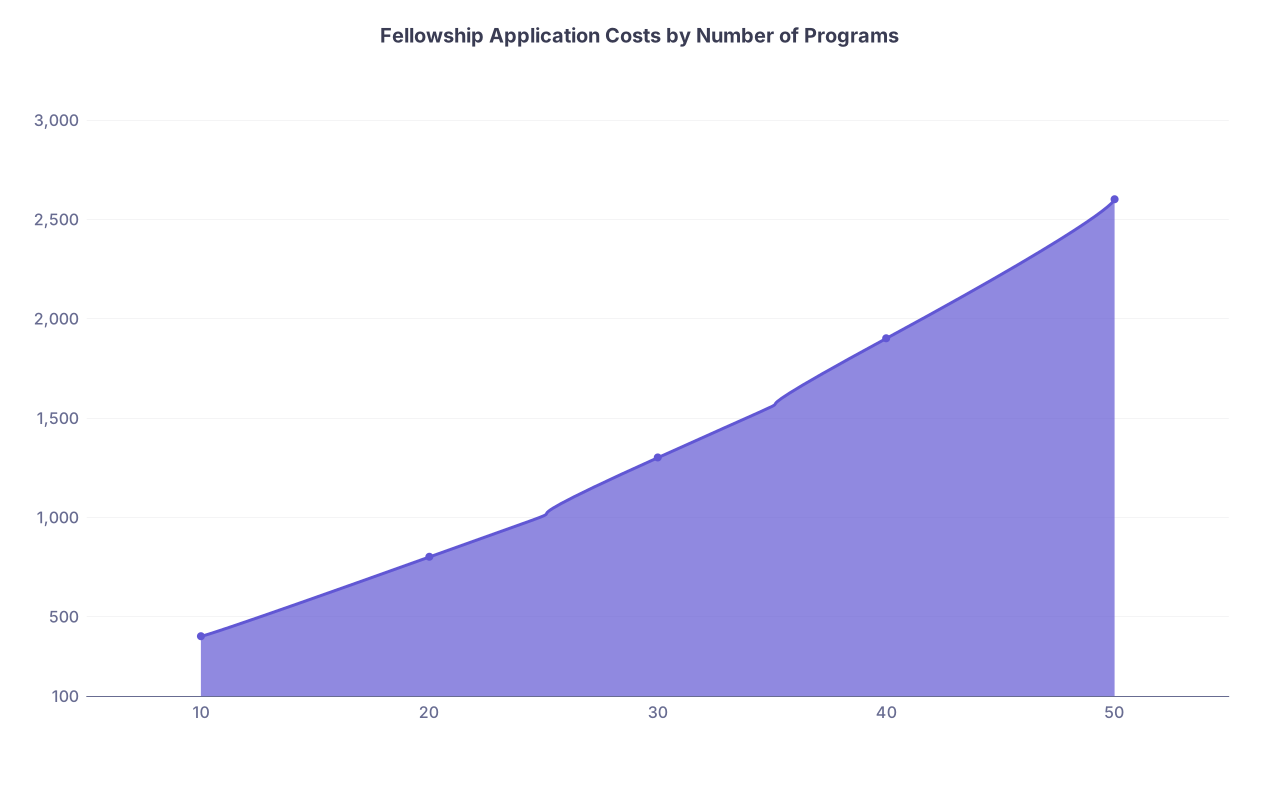
That’s not exact ERAS pricing, but it’s directionally correct: the first 10–15 programs are relatively cheap, then it ramps up.
Here’s what actually gets people:
- Writing personalized emails and statements for 50+ programs
- Interview travel or time off—even for virtual seasons, you’re using your clinic/vacation days
- Interview burnout—by program #10, you’re repeating the same answers and it shows
There is a point where another 5–10 applications don’t meaningfully change your odds, especially if they’re all in the same hyper-desired coastal cities.
For most people:
- Below 15–20 applications: you may be under-applying for competitive fields
- 20–40: reasonable zone for most serious applicants
- 40–60: only justified if you’re in a high-risk category or hyper-competitive subspecialty with broad geography
If you find yourself at 70+ applications, pause. Ask yourself:
- Am I compensating for a very weak application instead of fixing what I can?
- Am I just checking boxes without actually ranking these places realistically?
Building a Rational Program List (Step-by-Step)
If you want a clean system instead of guesswork, do this:

| Step | Description |
|---|---|
| Step 1 | Choose Specialty |
| Step 2 | Assess Competitiveness |
| Step 3 | Rate Your Application |
| Step 4 | Define Geography Tiers |
| Step 5 | Pull Full Program List |
| Step 6 | Classify Programs A B C |
| Step 7 | Set Target Application Number |
| Step 8 | Trim Or Add As Needed |
- Pull the full list of accredited programs from FREIDA, NRMP, or the specialty society.
- Mark your “A” programs – places you’d be excited to attend (prestige, fit, location).
- Mark “B” programs – reasonable fits you’d still say yes to.
- Mark “C” programs – backup options that are less ideal but acceptable for 2–3 years.
Then:
- You want most of your app list to be B programs
- Enough A programs to take your shot
- Enough C programs that if things go badly, you still match somewhere

If your count is:
- Under your target range → add more B/C programs in regions you’re willing to go
- Way over your range → cut C programs in locations you’d never realistically rank high
Special Situations
1. You Have a Strong In-House Fellowship
If your own program almost always takes its own residents and you’re well-liked:
- You can sometimes apply to fewer external places
- But don’t treat it as guaranteed unless leadership explicitly tells you you’re at the top of their list
Variation I’ve seen:
- Some residents apply only in-house and 5–10 external “dream” programs
- Others still do 15–20 external to avoid the horror story of “we thought you’d stay, but we only had one spot this year”
Be strategic, but do not put all your eggs in one basket unless your PD has spelled it out bluntly.
2. You’re Couples Matching Fellowships (or Fellow + Job)
This gets messy fast.
You’ll likely need:
- Slightly more programs than you’d otherwise apply to
- A broader geographic net (e.g., any city with 2+ hospitals or big health systems)
- Very clear communication with your partner about acceptable vs “no way” locations
Here I’d usually push:
- Competitive fields: 35–50 per person
- Less competitive fields: 20–30
3. Visa-Dependent Applicants
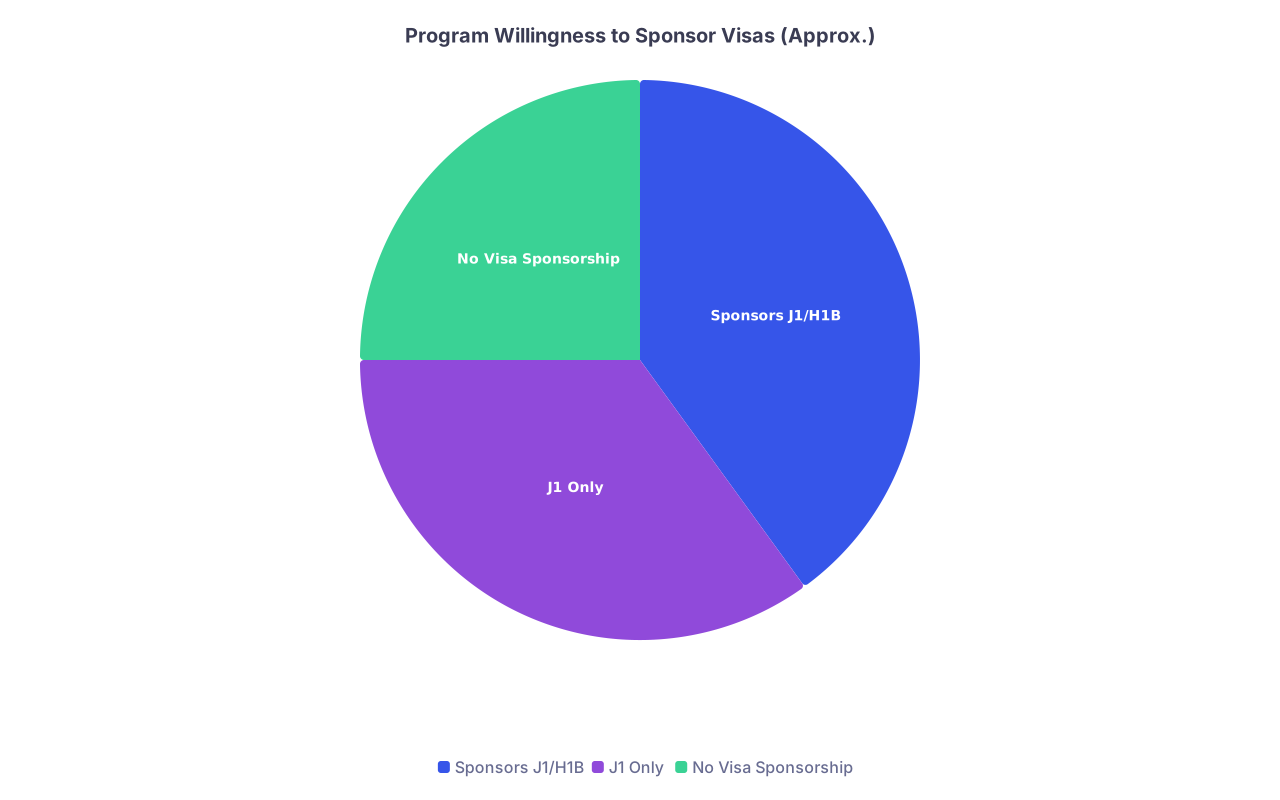
Visa needs absolutely change the math.
| Category | Value |
|---|---|
| Sponsors J1/H1B | 40 |
| J1 Only | 35 |
| No Visa Sponsorship | 25 |
Again, not exact numbers, but it matches what many applicants experience.
For visa-dependent applicants:
- Expect to apply to the upper end of every range given
- Scrutinize programs’ visa sponsorship history
- Do not waste applications on programs that have never sponsored your visa type (unless they clearly say they now do)
How To Know If You’re Under- or Over-Applying
Quick litmus tests:
You’re probably under-applying if:
- You’re applying to a high-competition specialty
- You have no in-house option
- Your list is under 20
- You’re geographically picky and middle-of-the-pack on paper
You’re probably over-applying if:
- You’re at 60+ programs
- Half your list is in cities you’d secretly never move to
- You’re strong on paper with good geographic flexibility but still going above 45

When in doubt, ask three people who actually know your performance: your PD, your associate PD, and a fellowship-trained mentor in your specialty. Give them your draft list and ask, “Too light, too heavy, or about right?”
If two out of three say you’re underdoing it—you are.
Example Scenarios
Let’s make this very concrete.
Scenario 1: Cards Applicant, Decent But Not a Superstar
- U.S. MD, mid-tier university IM program
- One cardiology abstract, one QI project, average Step 2, strong clinical feedback
- Wants East Coast but willing to do Midwest/South
Reasonable plan:
- Target 35–40 cardiology programs
- Mix of academic and hybrid/community
- Broad geography but slightly weighted to East Coast
Scenario 2: Pulm/Crit, Strong Applicant, Geographic Preference
- DO from a strong community program with academic affiliations
- Multiple pulm/crit posters, excellent letters, Step 2 > 245
- Wants to stay within 2–3 neighboring states
Reasonable plan:
- 20–25 programs mostly within the target states
- Add a few out-of-region academic programs as reach/safety
Scenario 3: Nephrology, Visa-Dependent, Average Application
- FMG on J1, community IM program, limited research
- No strong regional preference, just wants a spot
Reasonable plan:
- 25–30 nephrology programs that clearly sponsor J1
- Apply to a range of regions, including Midwest and South where visa sponsorship is more common

FAQ: Fellowship Application Numbers
1. Is there any real penalty for applying to “too many” programs?
Financially yes, logistically yes. Programs do not see how many places you applied to, but the more you apply, the more interviews you’ll need to juggle, and the more tired and generic you’ll sound by interview #15. There’s no moral penalty, but there is a time, money, and burnout cost.
2. How many interviews do I actually need to feel safe?
For most fellowships, 8–12 interviews gives a very solid chance to match if you’re ranking them sincerely. For ultra-competitive subspecialties, many feel comfortable in the 10–15 interview range. Below 5 interviews, your risk starts climbing fast.
3. Can I rely on my in-house fellowship and apply to just a few others?
Only if your PD and the fellowship PD are very explicit that you are essentially “their pick” and spots are secure. Even then, I’d still apply to at least 5–10 external programs unless your program has a truly guaranteed pipeline and history of always taking their own.
4. Should I apply to a “safety” fellowship in a different field?
Usually no. Programs can smell that you are not committed, and you risk ending up in a specialty you’re not actually interested in. Better strategy: strengthen your application, broaden geography, or be ready to take a hospitalist/job year and reapply.
5. If my specialty becomes more or less competitive the year I apply, should I adjust my number?
Yes. If mid-cycle everyone is talking about a huge surge in applicants (for example, GI or cards suddenly hot), you might lean toward the upper end of your planned range. If there’s obvious softening (like ID in some years, nephrology in many), you can feel better about the lower end.
6. Final check: how many programs should I apply to?
Use this as a sanity check:
- Competitive IM subs (cards, GI, heme/onc): 25–45 for most, 40–60 if at-risk
- Mid-competition IM subs: 20–35
- Lower-competition IM subs: 10–25
- Surgical/other highly competitive subs: 20–40
Then adjust for your own strength and how picky you’re being about location.
Key points:
You’re aiming for enough programs to realistically generate 8–12 interviews without bankrupting yourself or destroying your sanity. Competitive specialty + mid-tier application + tight geography = upper end of the range. Strong application + flexible geography = lower end.


