

The standard advice of “always leave your home program for fellowship” is lazy and often wrong.
If you’re a resident wondering whether staying at your home program for fellowship is a smart career move, here’s the real answer: staying can be excellent or a trap, depending on your goals, your program’s reputation, and how intentionally you do it. The worst mistake is treating it as the “default” just because it’s easy.
Let me walk through how people actually get burned by this decision—and how to avoid being one of them.
The Core Question: When Does Staying Make Sense?
Strip away the noise. Ask: “If this were not my home program, would I still be excited to match here for fellowship?”
If the honest answer is “yes,” then staying can be a very strong career move.
Staying is often a good choice when:
- Your home program is objectively strong in your intended niche (e.g., interventional cardiology, transplant hepatology, complex IBD, advanced GI, etc.).
- You have strong advocates there—attendings who will go to bat for you on job searches and national opportunities.
- The fellowship consistently places graduates into the jobs or academic paths you want.
- You’re not using fellowship as your chance to “reset” from a weak residency, geographic issue, or limited network.
On the flip side, staying is often a bad idea when:
- The fellowship is weakly regarded in the field or unknown outside your region.
- You want a different practice style than your home program offers (e.g., your home program is very research-heavy, but you want mostly clinical).
- You’re staying mostly because it feels safe, familiar, or because “everyone does it.”
If you feel that twinge of “I’d be embarrassed to admit I stayed if I had better options,” that’s a red flag. You need to interrogate that.
Real Pros of Staying at Your Home Program
Let’s be fair. There are real, tangible upsides to staying put.
1. Built-in trust and reputation
You’re already a known quantity. Faculty know your work ethic, your style on call, your integrity. You’ve proved you show up, do the scut, handle pressure.
That means:
- You’re more likely to get early autonomy.
- You may be trusted with higher-acuity cases or more complex patients sooner.
- People are more likely to involve you in projects, trials, QI work, or leadership roles.
I’ve seen fellows who stayed at their home program get first shot at leadership roles—chief fellow, committee memberships—because everyone already knew “this person gets stuff done.”
2. Continuity of mentors and projects
If you’ve already started:
- Research projects
- QI initiatives
- Educational curricula
- Clinical databases
Staying can turn “a couple of posters” into a real academic story. You can:
- Turn pilot data into full manuscripts.
- Move from co-author to first/second author with consistent productivity.
- Use continuity to apply for fellow-level grants or present at national meetings.
That continuity is gold if you’re aiming for an academic job or want a niche (e.g., cardio-oncology, palliative care in ICU, structural imaging).
3. Reduced transition friction
New hospital, new EMR, new politics, new culture—it all takes energy. A lot of it.
If you stay, you:
- Skip the EMR learning curve.
- Understand which attendings are supportive vs. toxic.
- Already know where to find things, who to call, how to get stuff done.
That “friction savings” can be redirected into research, building a portfolio, or simply surviving a brutal clinical fellowship.
For some high-burnout fellowships (surgical subspecialties, certain ICU tracks), starting from day one with full system familiarity is not a trivial advantage.
Real Cons and Hidden Risks of Staying
Now the part nobody romanticizing “home” likes to say out loud.
1. Perception of limited breadth
For some fellowship directors and future employers, “residency + fellowship at the same place” triggers a knee-jerk question:
Did this person ever get pushed out of their comfort zone?
That perception can hurt you if:
- Your program is mid-tier and not well known nationally.
- You’re aiming for competitive academic jobs in coastal or “name-brand” institutions.
- Your field places a high value on diverse training environments (certain surgical and academic IM specialties, for example).
Is that always fair? No. But it’s real.
2. You might be capping your brand
If your home program is:
- Strong locally, but
- Weak or invisible nationally
then doing both residency and fellowship there might box you in geographically. Great if you want to stay local. Not great if you dream about a big-name academic job three states over.
In some fields, pedigree still matters. If the top programs in your specialty are Hopkins, Mayo, MGH, UCSF, and you’re at a solid but unknown community-based fellowship, stepping out for fellowship might significantly upgrade your career ceiling.
3. Power dynamics and baggage
You already have a reputation—good or bad.
If:
- You had conflict with certain attendings.
- You struggled in intern year and that story stuck.
- You’re “the resident who had that remediation” or “the one who clashed with X attending.”
Staying means you carry all of that into fellowship. You do not get a clean slate.
Occasionally, residents think, “They know me; it’ll be fine.” Then they realize some impressions never fully reset. Leaving gives you chance to be seen at your current best, not your PGY-1 version.
How This Plays Out by Situation
Let’s break it into common scenarios. This is where people actually get stuck.
| Situation | Staying Usually | Leaving Usually |
|---|---|---|
| Strong home fellowship in your niche | Smart move | Optional |
| Weak/unknown fellowship, broad career goals | Risky | Better bet |
| You want local private practice | Often ideal | Sometimes unnecessary |
| You want top-tier academic job | Sometimes limiting | Often advantageous |
| You need a fresh start politically | Bad idea | Much better |
Scenario 1: You want local private practice
If your long-term goal is to practice clinically in the same city or region, staying is often the best move.
Local practices often:
- Know and trust your fellowship.
- Know attendings personally.
- Prefer “known commodities” who trained in their referral environment.
In many markets, a local, respected fellowship beats a better-known name three states away—because relationships drive referrals and hiring.
Scenario 2: You want national-level academic career
Now the calculus shifts.
If your home fellowship:
- Is nationally recognized.
- Has solid NIH funding, big trials, real academic infrastructure.
- Regularly sends graduates to good faculty positions.
Staying is absolutely fine, even smart. Places like MGH, UCSF, Duke, Michigan, Hopkins produce people who did both residency and fellowship there and went on to great careers.
If, instead, your home fellowship has:
- Minimal research output.
- No one going to academic jobs in major centers.
- Limited subspecialty exposure.
Then staying might quietly cap your trajectory. Leaving for a stronger, more visible academic program may be the difference between hoping for an academic job and being actively recruited.
Concrete Criteria: How to Judge Your Home Fellowship
You need hard data, not vibes. Here’s what to actually check.
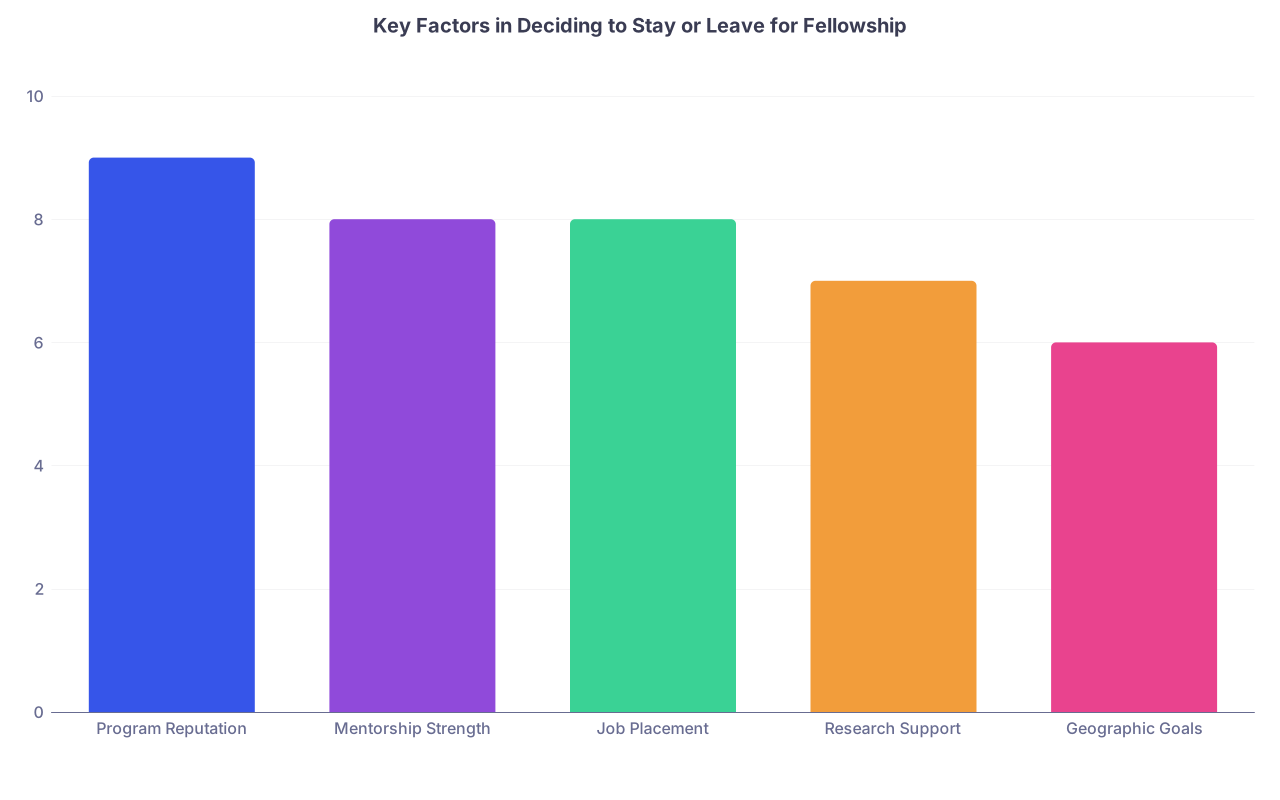
| Category | Value |
|---|---|
| Program Reputation | 9 |
| Mentorship Strength | 8 |
| Job Placement | 8 |
| Research Support | 7 |
| Geographic Goals | 6 |
Ask these questions:
Where do recent graduates end up?
- Academic vs community?
- Local vs national?
- Do these align with what you want?
Who would be your real mentors as a fellow?
- Are there 1–2 attendings doing exactly what you want to do in 10 years?
- Do they publish? Lead? Hold national roles? Get invited to speak?
What is the program known for?
- Strong in procedures? Research? Breadth of pathology? Teaching?
- Is that what you want to be known for?
Does your program open or close geographic doors?
- Do graduates easily move to other regions?
- Or do they almost all stay local because that’s where the name carries weight?
If your honest answers look good on paper, staying stops being “settling” and becomes a rational, strategic move.
How Fellowship Directors Actually View “Home Program” Candidates
You’re not guessing here. Talk to them. But in general:
They worry about two things when residents stay:
Was this person really competitive nationally?
- If you never applied out, there’s always background doubt.
- Not fatal, but it lingers.
Will they be seen as “stuck” or “comfortable”?
- Directors want fellows who actively chose their program, not residents who just drifted into it.
The antidote: act like you had options. That doesn’t mean bragging—it means being deliberate.
If you do stay, you should be able to say (truthfully):
- “I interviewed at several places, but ultimately the research and mentorship here were the best fit for what I want to do.”
- “I wanted to continue my specific project in X disease with Dr. Y, and this was the best place to do that.”
You want your decision to sound like a clear yes, not a passive default.
Should You Apply Out Even If You Think You’ll Stay?
Yes. In most cases, you should.
Here’s why:
- You calibrate how competitive you actually are.
- You gain interview practice and external feedback.
- You get perspective on how other programs are structured.
- You can compare offers instead of hoping you like the only one you see.
Worst case: you confirm your home program really is the best fit. Then when people ask, “Why did you stay?” you have a real answer, not a vague shrug.

| Step | Description |
|---|---|
| Step 1 | Want to stay at home program |
| Step 2 | Apply broadly and prioritize stronger programs |
| Step 3 | Staying likely good move |
| Step 4 | Compare home vs top programs and decide |
| Step 5 | Staying still reasonable with some external apps |
| Step 6 | Is home fellowship strong in your niche |
| Step 7 | Career goal local or regional |
| Step 8 | National academic goals |
Red Flags: When Staying Is Probably a Bad Career Move
If any of these hit too close, you should be very cautious about staying:
- You’re staying mainly because applications sound exhausting.
- You’re avoiding leaving because you fear you won’t match anywhere else and have not stress-tested that assumption.
- You’ve had serious conflict or reputation issues with key division members.
- The fellowship has chronic toxicity—high fellow attrition, widespread burnout, or recurrent program director turnover.
- Recent fellows quietly tell you, “If you can go elsewhere, you should.”
When multiple of these stack up and you still stay, you’re not “choosing your home program”; you’re choosing inertia.
How to Make Staying a Positive, Strategic Story
If you stay, you need to own the decision and spin it correctly—not in a fake way, but in a focused way.
Here’s how to frame it:
Identify your 3 key reasons for staying:
- e.g., specific mentor, ongoing project, unique clinical volume, family/geographic reason.
Connect those reasons to your future:
- “This setting lets me develop into X-type specialist.”
- “This program’s structure aligns with my goal to become Y.”
Make sure your actions match your story:
- If you claim research is the reason, you should be producing work.
- If mentorship is the reason, you should be meeting regularly with that mentor and building something real.
Directors and future employers smell the difference between “real choice” and “default” instantly.
FAQ: Staying at Your Home Program for Fellowship
1. Does staying at my home program hurt my chances for an academic job later?
It can, but not automatically. If your home fellowship is academically strong, publishes regularly, and places graduates into good faculty positions, staying will not hurt you. If your home program is weaker or unknown, and you never leave that bubble, it may limit your visibility. The key is whether your fellowship gives you real academic output, mentorship, and a track record that stands up on your CV regardless of the name on your badge.
2. Will programs outside my institution judge me for not applying out?
Some will quietly wonder whether you were competitive enough to leave, but it’s not an automatic black mark. What matters more: your CV, letters, and the story you tell. If you can demonstrate that you intentionally chose your home program for concrete reasons (mentors, niche, ongoing work) and you clearly advanced your career there, most reasonable people will accept that. It looks worst when it’s obviously a comfort move with no clear upside.
3. If my home fellowship is mid-tier, should I still consider staying?
Yes, if your goals are aligned. If you want to stay local, do predominantly clinical work, or join a nearby private practice, a mid-tier but well-respected regional program can be ideal. If you want high-end academic jobs at top centers, then you should at least apply to stronger programs and see what happens. A mid-tier program plus a strong individual CV can still get you far, but it’s harder if you never show success in a more competitive environment.
4. What if I love my home program but there’s some internal toxicity or politics?
Be honest with yourself. Mild politics exist everywhere. But if the toxicity is serious—consistent undermining of fellows, public shaming, retaliation, or chronic burnout—staying is risky. Remember, as a fellow you are even more dependent on the division for letters and career support. If you’ve already had tension with key faculty, or watched others suffer long-term there, leaving is often the safer long-game move for your career and sanity.
5. Bottom line: how do I know if staying is truly a “good career move,” not just the easy path?
Ask yourself three blunt questions:
- Does this fellowship reliably produce the type of graduates I want to become?
- Would I be excited to match here if it weren’t already my home?
- If I had offers from a couple of stronger external programs, would I still consider staying?
If you can answer “yes” to at least two of those with a straight face, staying is probably a solid career move. If not, you’re likely choosing comfort over growth—and you’ll feel that later.
Key points: Staying at your home program for fellowship can be excellent if the fellowship is strong in your niche, aligns with your goals, and you actively choose it over real alternatives. It becomes a problem when it’s the default, driven by inertia, fear, or local politics. Treat it like any other program—judge it hard, compare options, and then commit to a decision you can defend five years from now.


